
Think of financial services regulatory compliance as the rulebook for the entire financial industry. It's the framework of laws, regulations, and best practices that every financial institution has to play by to operate legally and ethically. It’s like the air traffic control system for our economy—it’s there to prevent total chaos, protect everyday consumers, and keep the market from crashing.
This system governs everything from how a bank handles your personal data to how a massive investment firm reports its earnings.
Why Regulatory Compliance Is Non-Negotiable
At its heart, financial compliance isn’t just about dodging hefty fines. It’s about building and maintaining trust. Every single transaction, whether it’s you depositing a check or a multinational corporation making a trade, relies on a complex web of rules designed to keep things fair, transparent, and secure. Without this framework, the doors would swing wide open for fraud, market manipulation, and the kind of instability that leads to financial crises.
And the consequences for getting it wrong are getting steeper. In 2024 alone, global financial penalties hit a staggering $4.6 billion. For banks, the fines skyrocketed by 522% compared to the previous year. Those numbers tell a clear story: regulators aren’t just looking for a dusty policy binder on a shelf. They expect active, living compliance systems that prove your controls are working day in and day out.
The Four Pillars of Financial Compliance
To build a compliance program that actually works, it helps to break it down into four core pillars. Each one tackles a different, but equally critical, area of risk.
Here’s a quick look at what they cover:
| Compliance Pillar | Core Objective | Common Regulations |
|---|---|---|
| Consumer Protection | Ensures customers are treated fairly and their data is kept secure. | Gramm-Leach-Bliley Act (GLBA), Consumer Financial Protection Bureau (CFPB) rules. |
| Market Integrity | Prevents market manipulation, insider trading, and other unethical behaviors. | Securities Exchange Act, rules from the SEC and FINRA. |
| Financial Stability | Prevents systemic risks that could lead to economic collapse, like capital requirements. | Dodd-Frank Act, Basel III accords. |
| Crime Prevention | Fights financial crimes like money laundering and terrorist financing. | Bank Secrecy Act (BSA), Anti-Money Laundering (AML), Know Your Customer (KYC). |
Understanding these pillars helps you see the bigger picture of what a robust compliance program is designed to achieve.
A proactive compliance program transforms from a cost center into a strategic asset. It builds institutional resilience, protects brand reputation, and creates a stable foundation for sustainable growth in a complex regulatory environment.
To really get a handle on this, it's crucial to understand the full scope of regulatory compliance risk management. This isn't just a defensive move; it's about actively identifying, assessing, and neutralizing risks tied to these complex legal frameworks. A solid compliance program isn't just about checking boxes—it's a fundamental part of your business's DNA.
You can learn more about building a modern program by checking out our complete compliance guide. It’s all about moving beyond reactive measures and embedding compliance deep into your organization to protect both your customers and your future.
Understanding Key Regulatory Frameworks and Their Impact
Jumping into the world of financial services regulatory compliance can feel a lot like learning a new language. You've got acronyms and rules galore, but they all share one common goal: building a financial system people can actually trust. To get anything done, you have to understand the core frameworks that shape just about every transaction.
Think of these regulations less like obstacles and more like the guardrails on a highway. They’re there to prevent catastrophic pile-ups, protect the drivers (your customers), and keep traffic moving smoothly. The big ones are all about stopping financial crime in its tracks and making sure the market is fair for everyone.
The Cornerstones of Crime Prevention: AML and KYC
At the very heart of financial integrity, you’ll find Anti-Money Laundering (AML) and Know Your Customer (KYC) regulations. They’re technically separate, but in practice, they work as a powerful duo. AML provides the big-picture strategy—the procedures your institution needs to detect and report suspicious activity. It's what stops criminals from washing dirty money through the legitimate financial system.
KYC is where the rubber meets the road. It’s the hands-on process of verifying who your clients are and figuring out the potential risks of doing business with them. And this isn't just a one-and-done check when they sign up; it's an ongoing effort to make sure a customer's financial activity stays consistent with what you know about them.
Get this wrong, and the consequences are very real. Picture a bank with sloppy KYC procedures letting a shell company open an account with barely any questions asked. That account could then be used to funnel millions in illegal funds, turning the bank into an unwitting accomplice and exposing it to massive fines and a ruined reputation.
Protecting the Broader Financial Ecosystem
Beyond just preventing crime, other major regulations are designed to keep the entire market stable and protect consumers from shady practices. The Dodd-Frank Wall Street Reform and Consumer Protection Act, for example, was a direct response to the 2008 financial crisis. Its entire purpose is to dial down systemic risk by forcing more transparency and accountability.
This beast of a law touches nearly every part of the financial world, from massive investment banks down to your local mortgage lender. It forces firms to hold more capital to cover potential losses and even created the Consumer Financial Protection Bureau (CFPB) to shield consumers from predatory lending.
These frameworks all work together, kind of like pillars holding up the entire compliance structure.
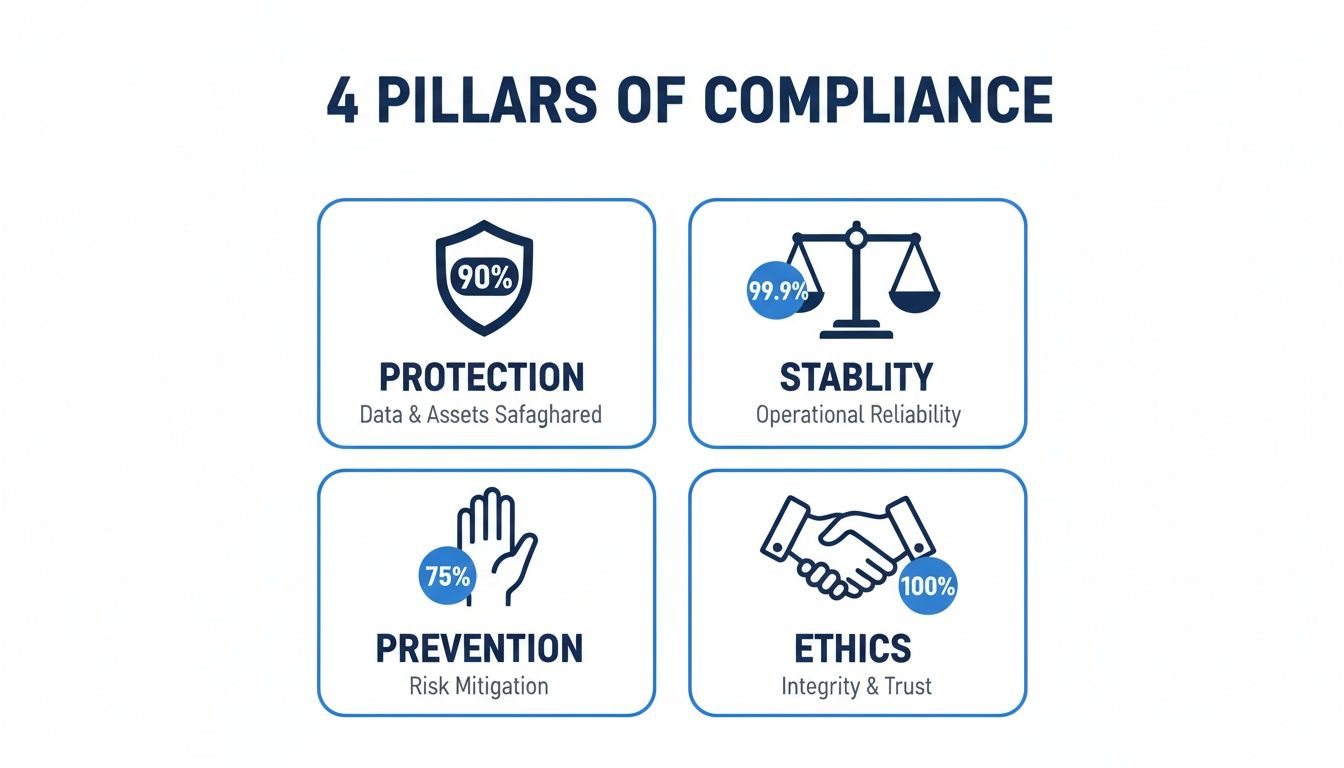
This really shows how protection, stability, prevention, and ethics are the foundation for any solid compliance program.
The Challenge of Global Operations
Things get even hairier for companies working across borders. A single international wire transfer can set off compliance requirements in the sending country, the receiving country, and any country where a correspondent bank touches the money. Each region has its own quirks and enforcement priorities.
Navigating the web of international financial regulations requires more than just awareness; it demands a standardized, yet adaptable, operational framework. A one-size-fits-all approach is doomed to fail when enforcement priorities shift dramatically between regions.
Take AML and KYC penalties, for example. Global fines recently hit a staggering $3.8 billion, but the real story is where that money is coming from. While penalties in North America actually went down, they skyrocketed in the EMEA region by 767%. This signals a major shift toward stricter enforcement outside the U.S., making it critical for global firms to get their processes in order.
This is exactly why having robust, clear, and easy-to-access audit and compliance checklists for finance and banking is non-negotiable. Without a standardized playbook, your teams are just trying to navigate a maze of conflicting rules—a surefire recipe for costly mistakes.
How to Build an Effective Financial Compliance Program

Knowing the regulations is one thing; actually putting them into practice is another beast entirely. Building an effective financial services regulatory compliance program isn't about creating a massive binder of rules that just collects dust on a shelf. It’s about building a living, breathing system that actively manages risk and weaves compliant behavior into the fabric of your daily operations.
Think of it like building a house. You need a solid foundation (that's your governance), strong support beams (risk assessment), sturdy walls (policies), proper wiring (training), and a reliable security system (monitoring). If you skimp on any one of these, the whole structure gets shaky. The goal is to get to a "compliance-by-design" approach, where following the rules is just part of how you do business, not a box you have to check.
Establish Strong Governance and Oversight
Everything starts at the top. A truly robust compliance program has to have a firm commitment from leadership. Strong governance means the board and senior management don't just know about compliance risks—they actively own them. This sets the tone for the entire organization, sending a clear signal that compliance is everyone's job.
A solid governance framework lays out exactly who does what. Who’s ultimately on the hook for compliance? How does information about risks and slip-ups make its way to the top? This structure prevents compliance from being stuck in a silo; it becomes a coordinated effort across the whole firm, with clear lines of authority and accountability.
Conduct Comprehensive Risk Assessments
You can't defend against threats you don't even see coming. A comprehensive risk assessment is like a diagnostic tool for your compliance program. It’s a systematic way to identify the specific regulatory risks your business faces based on your products, clients, and where you operate. And this isn't a one-and-done deal; it's a process that needs to be continuous.
This assessment helps you figure out where to focus your energy. Not all risks are created equal, and a proper evaluation helps you point your limited resources at the areas that pose the biggest threat. For instance, a firm that handles international payments has a much higher money laundering risk profile than a purely domestic advisory firm.
The current regulatory climate makes this more crucial than ever. The U.S. SEC kicked off 200 enforcement actions in the first quarter alone, while FinCEN saw an 18.5% jump in Suspicious Activity Report (SAR) filings. With 69% of banks prioritizing data collection rules, it’s crystal clear that regulators expect a proactive, risk-based approach. You can discover more about how these compliance standards are evolving in 2025.
Develop Clear Policies and Training Programs
Once you’ve mapped out your risks, you need to create the rules of the road. Well-defined policies translate dense, complex regulations into clear, actionable guidelines for your employees. These documents need to be straightforward, easy to find, and directly tied to specific business activities.
But policies are just words on a page if nobody knows they exist. A solid training program is what brings them to life.
- Initial Onboarding: Makes sure new hires understand their compliance responsibilities from day one.
- Ongoing Education: Keeps the whole team in the loop on new regulations and emerging risks.
- Role-Specific Training: Gives targeted guidance to employees in high-risk spots, like client-facing teams or transaction monitoring roles.
A policy tells you what to do. Training explains why it's important. And a Standard Operating Procedure (SOP) shows you exactly how to do it. You need all three for a true culture of compliance.
Implement Continuous Monitoring and Auditing
Finally, a compliance program is only as good as your ability to check that it’s actually working. Continuous monitoring involves the day-to-day checks you use to spot and stop compliance breaches before they become big problems. This could be anything from automated transaction monitoring for sketchy activity to regular reviews of marketing materials to make sure they have all the required disclosures.
Periodic audits, on the other hand, provide an independent check-up on the overall health of your program. Both internal and external audits are designed to test your controls, pinpoint weaknesses, and make sure your program is doing what you designed it to do. This feedback loop is absolutely essential for making smart adjustments and showing regulators you’re proactively managing your compliance duties. This whole cycle—assessment, policy, training, and monitoring—is the backbone of any resilient compliance framework.
Turning Compliance Policy Into Action with SOPs

A top-notch compliance program always starts with solid policies and sharp risk assessments. But let's be honest—those high-level documents don't mean much if they aren't woven into the daily, repeatable actions your team takes every single day.
This is where Standard Operating Procedures (SOPs) come in. They are the critical link that transforms your entire financial services regulatory compliance strategy from a binder on a shelf into a living, breathing part of your operations.
Think of it this way: a compliance policy is the destination on a map, but an SOP is the turn-by-turn navigation that gets you there safely and consistently. Every single time. Without clear SOPs, you’re just hoping everyone figures out their own route, which is a perfect recipe for inconsistency and human error.
In a highly regulated world, consistency isn't just a nice-to-have; it's everything. SOPs make sure every employee, from the brand-new hire to the seasoned veteran, handles critical tasks exactly the same way. This uniformity is your best defense during an audit because it creates a clear, documented trail proving your policies are actually being followed.
From Policy to Practical Workflow
So, how do you get started? The first step is to deconstruct your big, sweeping compliance policies into individual, task-oriented workflows. Take a broad policy—like your Anti-Money Laundering (AML) framework—and pinpoint the specific actions employees must take to uphold it.
For example, your AML policy states you have to verify customer identities. That one requirement branches out into several distinct operational tasks, and each one needs its own SOP:
- Customer Onboarding: A detailed procedure for how to collect and verify identity documents when opening an account.
- Customer Due Diligence (CDD): A step-by-step guide for assessing a new client's risk profile based on your firm's specific criteria.
- Transaction Monitoring: An SOP that tells an analyst exactly how to review suspicious activity alerts and when to escalate them.
When you break down policies like this, you make compliance manageable and, more importantly, actionable for your team.
Essential Components of a Compliance SOP
A well-written SOP leaves absolutely no room for guesswork. It should be so clear that an employee with just basic training can follow it and get the right, compliant result every time. While formats can differ, every compliance-focused SOP needs a few key ingredients.
An SOP is more than just a checklist; it's a tool for risk mitigation. Every step should be designed not only to complete a task but also to address a specific compliance risk identified in your program.
Here’s what to include for maximum clarity and impact:
- Purpose: Start with a simple sentence explaining why the procedure exists and what compliance goal it supports (e.g., "To ensure compliance with KYC regulations by verifying customer identity").
- Scope: Define who the SOP applies to (e.g., "All front-office staff involved in client onboarding") and the specific situations it covers.
- Step-by-Step Instructions: This is the heart of the SOP. Use clear, simple language and an active voice to walk through each action in the right order.
- Key Responsibilities: Clearly state who is responsible for each part of the process. This builds accountability.
- Version Control: Always include a version number and date. This ensures everyone is using the most current, regulator-approved procedure.
If you're looking for a deeper dive, our guide on how to write a standard operating procedure has detailed templates and best practices to get you going.
Centralizing SOPs for a Single Source of Truth
Creating great SOPs is only half the battle. If they're buried in shared drives, printed in dusty binders, or scattered across different platforms, they become useless—or even dangerous. An employee following an outdated SOP could unknowingly cause a compliance breach, making old procedures a massive liability.
This is exactly why having a centralized platform for your SOPs is non-negotiable.
A dedicated SOP management system, like Whale, becomes the single source of truth for your entire organization. It makes sure every employee has instant access to the latest version of any procedure, right when they need it. Features like version control, automatic update notifications, and built-in quizzes transform your SOPs from static documents into dynamic tools that actively support your financial services regulatory compliance efforts.
This centralized approach doesn't just make life easier for your team; it also makes audits go a whole lot smoother. When a regulator asks for your procedure on handling data privacy requests, you can pull up the exact, current SOP in seconds, complete with its revision history and training records. It shows you have a mature, organized, and proactive handle on compliance—something every regulator wants to see.
Emerging Trends Shaping the Future of Compliance

The world of financial services regulatory compliance never sits still. It's constantly being stirred up by global economic shifts, new technology, and changing political winds. If you want to build a compliance program that lasts, you can't just focus on today's rules—you have to anticipate what’s coming around the corner.
This means shifting from a reactive "firefighting" mode to a proactive, forward-looking strategy. The most durable compliance programs aren't just built for today's regulations; they're designed for tomorrow's challenges. Let’s break down the key trends that are set to define the future of compliance.
The Rise of Regulatory Fragmentation
One of the biggest headaches for global firms is the growing fragmentation of regulations. The dream of a single, coordinated set of global standards is fading. We're now in an era where national interests often come first, creating a patchwork of different rules that makes cross-border compliance a real puzzle.
For example, global outlooks show this trend isn't slowing down. Policymakers are prioritizing their own economies, causing delays in coordinated efforts like the EU's rollout of the Fundamental Review of the Trading Book (FRTB). This splintering means your SOPs have to be smart enough to handle new, region-specific risks as they pop up.
A Laser Focus on Operational Resilience
After a few years of market volatility and some very public disruptions, regulators everywhere are zeroing in on operational resilience. This isn't just your classic business continuity plan. It’s about proving your firm can absorb, adapt to, and bounce back from major operational shocks—whether that’s a cyberattack or a critical third-party vendor suddenly going offline.
Supervisors in key hubs like the EU, UK, and Singapore are turning up the heat. They expect boards to do more than just have a plan on a shelf; they want to see active monitoring and proof of resilience through tough, realistic testing. This has huge implications for your internal processes.
Operational resilience is no longer a niche IT problem. It's now a cornerstone of modern financial services regulatory compliance. Regulators see it as a direct measure of a firm’s ability to protect consumers and keep markets stable during a crisis.
The Inevitable Integration of Technology
Trying to manage all these complex, diverging demands manually is a recipe for disaster. Technology isn't just a "nice-to-have" anymore—it's essential. Automation and artificial intelligence (AI) are becoming the go-to tools for modern compliance teams, helping them cover more ground with greater accuracy and without burning out their people.
Tech is changing the compliance game in a few key ways:
- Automated Reporting: AI can handle the grunt work of generating and filing routine regulatory reports, freeing up your team for more strategic thinking.
- Enhanced Surveillance: Machine learning algorithms can sift through massive amounts of data to spot patterns of market abuse or money laundering that a human eye would almost certainly miss.
- Streamlined Audits: Centralized platforms can pull together evidence automatically, giving you a clean audit trail whenever you need it.
The growing use of Artificial Intelligence in Internal Audit is a perfect example of this shift. Firms are using AI to make their control testing sharper and to spot risks earlier. This kind of tech integration is what it takes to build a compliance framework that’s not just efficient, but ready to evolve with whatever the regulators throw at you next.
Got Questions About Financial Compliance? We’ve Got Answers.
When you're in the trenches of financial services, the same practical questions about compliance tend to pop up again and again. Whether you're building a compliance program from scratch or trying to fine-tune the one you already have, getting clear on the fundamentals is everything.
Here are some of the most common queries we hear, along with some straight-up answers.
What Are the First Steps to Build a Compliance Program for a New Financial Startup?
For any new fintech or financial startup, your first move is a thorough risk assessment. This isn't a box-ticking exercise; it's a deep dive to figure out exactly which regulations apply to your specific business model, where your customers are, and the services you offer.
Once you have a handle on the risks, your next immediate step is to appoint a dedicated compliance officer. In the early days, this person might wear a few hats, but having someone who owns compliance from day one is non-negotiable.
With a leader in place, you can get to work drafting your core policies. Hit the big ones first:
- Anti-Money Laundering (AML): These are the foundational rules for spotting and reporting suspicious financial activity.
- Know Your Customer (KYC): This is the hands-on process for actually verifying who your clients are and figuring out their risk profile.
- Data Privacy and Protection: These are the guidelines for how you manage and protect sensitive customer information.
Think of these high-level policies as your "why." The critical next step is to translate them into actionable, step-by-step Standard Operating Procedures (SOPs) that spell out the "how" for your team—like exactly how to onboard a new customer. Finally, get a training program in place so every single employee understands their role from the get-go.
How Can Technology and AI Improve Our Compliance Efforts?
Technology, and especially AI, is a total game-changer for modern compliance teams. It helps shift your program from being manual and reactive to automated and proactive. The result? Better accuracy, way more efficiency, and deeper insights.
AI-powered tools can screen thousands of transactions in real-time, flagging potentially sketchy activity with a speed and precision that a human reviewer just can's match. This frees up your team to focus their expertise on investigating high-quality alerts instead of drowning in false positives.
Technology transforms compliance from a necessary chore into a strategic advantage. By automating routine tasks and providing deeper analytical insights, it empowers compliance professionals to focus on managing risk, not just chasing paperwork.
It's not just about transaction monitoring, either. Technology automates other crucial jobs, like customer due diligence, by instantly checking identities against global watchlists and sanctions lists. When it comes to documentation, AI can help generate and update your SOPs, making sure they always reflect the latest regulatory changes. These tools can even make training more effective by creating interactive quizzes right from your procedures, reinforcing the key points and cutting down on human error.
What Is the Difference Between a Compliance Policy and a Standard Operating Procedure?
Getting the difference between a policy and an SOP is fundamental to building a solid financial services regulatory compliance program. Just think of them as two sides of the same coin: one tells you the "what and why," and the other lays out the "how."
A compliance policy is the high-level, principle-based document. It's your company's official stance, outlining the rules and your commitment to following specific laws. For instance, a policy might state, "Our firm is committed to preventing money laundering and will comply with all BSA/AML regulations." It sets the goal.
A Standard Operating Procedure (SOP), on the other hand, is the granular, how-to guide. It gives an employee the detailed, step-by-step instructions they need to follow to actually execute on that policy in their day-to-day work. So, while the AML policy sets the goal, the SOP would detail the 10 specific steps an employee must take to verify a new customer's identity to meet the KYC requirements.
Policies give you the direction; SOPs give you the roadmap to get there.
How Often Should We Review and Update Our Compliance Program?
You should be doing a comprehensive, top-to-bottom review of your entire compliance program at least once a year. This annual check-in makes sure your whole framework is still in sync with your business strategy and what's happening in the regulatory world.
But—and this is a big but—waiting for the annual review is a mistake. Your program needs to be a living, breathing thing. A review should be automatically triggered by certain events, including:
- Regulatory Changes: A new law gets passed or an old rule gets an update.
- New Products or Services: Launching something new can introduce risks you didn't have before.
- Geographic Expansion: Moving into a new state or country means a whole new set of rules to follow.
- Audit Findings: If an internal or external audit flags something, it needs attention right away.
While the whole program gets a yearly look, your most critical pieces need more frequent checks. High-risk SOPs, like the ones for sanctions screening, should be reviewed constantly to make sure they align with the latest government watchlists. Using a system with solid version control and automated notifications is the key to keeping your compliance program dynamic and effective enough to adapt on the fly.