
Think of it this way: a policy is the “why”—it sets the rules and principles for your organization. A procedure is the “how”—it gives you the step-by-step instructions for putting those rules into action. A policy is the destination on the map; a procedure is the turn-by-turn directions to get there.
Policies vs Procedures The Core Difference
Nailing down the difference between a policy and a procedure is fundamental to building an organization that runs smoothly. While they absolutely work hand-in-hand, they serve very different purposes. Policies create the big-picture, strategic boundaries for decision-making. Procedures provide the tactical, on-the-ground roadmap to get things done consistently.
This isn’t just about semantics; getting it wrong has real consequences for efficiency, compliance, and clarity. When your team understands both the rules (policies) and the specific actions they need to take (procedures), they can work with confidence. A solid policy framework prevents chaos, while clear procedures make sure critical tasks are done right, every single time. For a deeper dive into operational documents, understanding the difference between a JSA and SWMS can also shed light on how different guidelines are structured.
To really get a feel for how they relate, a side-by-side comparison helps. Each document has its own unique role, audience, and level of detail that shapes its function. If you're looking for a head start, a good policies and procedures manual template can provide a ready-to-use framework.
Policy vs Procedure at a Glance
This table breaks down the fundamental differences between strategic policies and tactical procedures, highlighting their core attributes and functions at a glance.
| Attribute | Policy (The 'Why') | Procedure (The 'How') |
|---|---|---|
| Purpose | To set direction, define rules, and manage risk. | To provide step-by-step instructions for a task. |
| Scope | Broad and applies organization-wide or department-wide. | Narrow and applies to a specific task or process. |
| Focus | Strategic principles and outcomes. | Tactical actions and repeatable steps. |
| Format | A formal statement of principles. | A detailed checklist or sequential guide. |
| Audience | All employees, management, and stakeholders. | Specific employees or teams performing a task. |
| Flexibility | Inflexible; changes are infrequent. | Flexible; updated regularly to reflect improvements. |
| Compliance | Mandatory. Non-compliance has serious consequences. | Mandatory. Non-compliance leads to errors and retraining. |
Deconstructing Policies: The Foundation of Governance
Think of policies as the constitutional documents for your organization. They are the backbone of your governance, strategy, and risk management, setting the broad, stable guidelines that steer decision-making and keep you on the right side of the law. A policy lays down the "what" and "why," establishing the rules of the road for the entire company.
A policy is a formal statement of principle. It doesn't get bogged down in the nitty-gritty details; instead, it provides a high-level framework that reflects the company’s bigger goals. This is why policies rarely change—they’re only updated in response to major shifts like new legislation or a complete pivot in business strategy.
Ownership and Scope
Responsibility for creating and signing off on policies almost always lands with senior leadership or a governing body. This top-down approach makes sure every policy aligns perfectly with the organization's mission and risk tolerance. Their scope is intentionally wide, applying to everyone in the company or, at the very least, entire departments.
For example, your Information Security Policy isn't going to list the steps for updating antivirus software. It's going to state that all company data must be protected from unauthorized access—a clear, non-negotiable standard. Similarly, a Code of Conduct policy defines expected ethical behaviors without trying to script every possible workplace interaction.
The consequences for ignoring policies are serious, ranging from disciplinary action right up to legal liability for the organization. This isn't just a list of suggestions; these are mandatory directives.
A policy is a deliberate system of principles to guide decisions and achieve rational outcomes. It is a statement of intent and is implemented as a procedure or protocol.
Stability and Strategic Alignment
Policies are built to last. In today's fast-moving business world, it's crucial to distinguish between stable policies and dynamic procedures. A 2023 Deloitte Global Risk Management Survey found that 68% of organizations reported compliance failures directly tied to poorly differentiated documentation, where high-level policies were tangled up with step-by-step procedures.
This confusion isn't just messy; it's expensive. That same year, it contributed to fines totaling over $4.2 billion globally. A company's anti-money laundering policy, for instance, should remain stable for years, only changing when major regulations shift. You can find more insights on how clear documentation prevents these failures over at ComplianceForge.com.
This stability is a key differentiator. While day-to-day operations are constantly evolving, the core principles guiding the organization shouldn't be. Policies act as an anchor, giving everyone a consistent reference point to ensure all operational documents and actions are pulling toward the same strategic goals.
Mastering Procedures: The Blueprint for Action
If policies set the "why," procedures are the "how." They are the operational workhorses that turn good intentions into concrete action. Think of them as the detailed, step-by-step blueprints that guide employees through specific tasks, making sure critical business functions get done consistently, correctly, and efficiently. Every single time.
This is where the difference between a policy and a procedure really comes alive. Procedures are the engine of your quality control and the secret to scaling up. By documenting the exact "how," you get rid of guesswork, slash errors, and build a repeatable process that anyone with the right training can nail. That consistency is gold, whether you're in customer service or manufacturing.
Defining Traits of Strong Procedures
Unlike broad, stable policies, procedures are all about specifics and they need to be dynamic. They have to be detailed enough to leave no room for misinterpretation but flexible enough to evolve as your business does. Ownership usually lands with department heads or subject matter experts—the people on the ground who know the work inside and out.
Three things define a killer procedure:
- Specific: No gray areas. A good procedure spells out every action, tool, and responsibility.
- Sequential: The steps are in a logical, chronological order for a reason. You have to follow the sequence to get the right outcome.
- Dynamic: Business changes, and so should your procedures. They need regular reviews and updates to keep up with new tech, better processes, or shifting regulations.
For instance, your company's high-level Information Security Policy mandates protecting sensitive data. The procedure that brings this to life would be something like "Responding to a Data Breach"—a super-detailed, numbered list of immediate actions.
A procedure provides detailed, mandatory steps (often a checklist) that someone must follow to complete a recurring task or comply with a policy. It explains how employees should implement a policy.
From Policy to Action: A Real-World Scenario
Let's tie this all together. Imagine your company has a "Workplace Health and Safety Policy." The policy states that all employees must have an ergonomically sound workstation. That’s the "why"—preventing injury and keeping people safe.
The procedure backing this up might be called "Ergonomic Workstation Setup." It would lay out mandatory, sequential steps for everyone:
- Complete the self-assessment ergonomics checklist within your first week.
- Adjust your chair height so your feet are flat on the floor and your knees are at a 90-degree angle.
- Position your monitor so the top of the screen is at or just below eye level.
- Submit the completed checklist to HR for review.
- If you need further adjustments, schedule a sit-down with the designated Safety Officer.
See how that works? The procedure translates the policy's goal into a concrete, repeatable, and auditable set of actions. It gives both employees and management a clear roadmap to follow, ensuring everyone is compliant and set up for success.
A Detailed Comparison of Purpose Format and Impact
Knowing the basic difference between a policy and a procedure is a good start, but the real magic happens when you dig deeper. Think of them as two distinct tools in your operational toolkit. While both aim for consistency and control, they get there in completely different ways, influencing everything from daily tasks to long-term strategy.
A policy’s job is to set the direction and manage risk from a bird's-eye view. It answers the big "what" and "why" questions, establishing broad, mandatory rules that apply across the whole company. Procedures, on the other hand, are all about tactics. They provide the literal, step-by-step instructions for getting a specific task done in a way that aligns with the policy.
Scope and Level of Detail
The most obvious difference is their scope. A policy is intentionally broad. For instance, a Data Privacy Policy will state that the company must protect customer information, but it won’t get into the weeds about which encryption software to use.
A procedure is the opposite—it's narrow and incredibly detailed. The corresponding Data Encryption Procedure would list the exact software, the required settings, and the sequential steps for encrypting a file before sending it. That granular detail is what makes a procedure something your team can actually do.
A policy sets the destination and the rules of the road, like "drive safely and obey speed limits." A procedure is the turn-by-turn GPS navigation that tells you exactly when and where to turn to arrive safely.
Audience and Frequency of Updates
Policies are written for just about everyone—all employees, management, and even external auditors. The language is formal and built to last, changing only when major regulations or business strategies shift.
Procedures are for the people in the trenches doing the work. They are living documents, usually owned by department heads or subject matter experts. These folks update them frequently to reflect new tools, better ways of working, or minor process tweaks. It's a key distinction, and you can learn more about the difference between processes vs procedures in our detailed guide.
The image below breaks down the core traits of a procedure, showing just how specific, sequential, and dynamic it is.
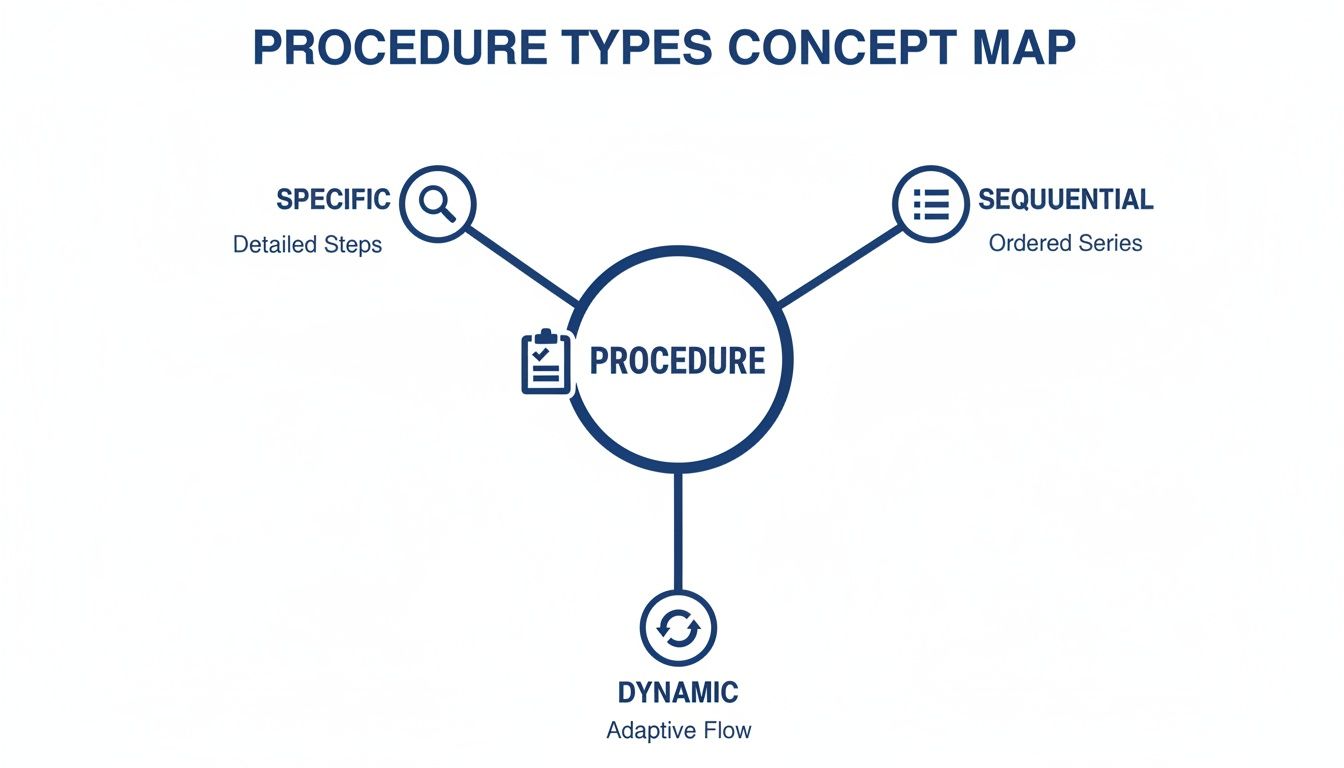
This really drives home how procedures break down complex tasks into manageable, ordered steps that can evolve as the business does.
Compliance and Consequences
The fallout from non-compliance is also worlds apart. Violating a company policy can lead to serious trouble, including legal action, hefty fines, or even termination.
Ignoring a procedure, while still a problem, usually results in operational headaches—things like rework, costly errors, or the need for retraining. It's serious, but typically a mess to clean up, not a legal disaster.
To get a clearer side-by-side view, let's break down these differences in a table.
In-Depth Analysis Policy vs Procedure
| Criteria | Policy | Procedure |
|---|---|---|
| Purpose | Sets broad guidelines and principles; answers "what" & "why." | Provides step-by-step instructions; answers "how." |
| Scope | High-level and organization-wide. | Narrow, specific to a single task or process. |
| Level of Detail | General and abstract. | Detailed, granular, and actionable. |
| Audience | All employees, management, auditors. | Team members performing the specific task. |
| Ownership | C-suite, HR, or a governing body. | Department heads or subject matter experts. |
| Update Frequency | Infrequent; changes with major strategy or regulation shifts. | Frequent; updated to reflect new tools or process improvements. |
| Format | Formal document, often outlining principles and rules. | Checklists, flowcharts, or step-by-step guides. |
| Non-Compliance | Can lead to severe consequences like legal action or termination. | Typically results in operational errors, rework, or retraining. |
Seeing it laid out like this makes the strategic separation between the two crystal clear. Policies provide the guardrails, while procedures are the actionable roadmaps that keep daily operations running smoothly within those guardrails.
How to Turn Policies into Actionable Procedures
This is where the rubber meets the road. A policy gives you the destination, but the procedure is the turn-by-turn GPS your team needs to get there. Without that connection, even the sharpest policies just collect dust, leaving your team confused and your processes a mess.
The trick is to break down a policy's big-picture goals into a clear, step-by-step guide that anyone can follow.
Think about it this way: you're bridging the gap between the "why" and the "how." Let's say your company has a “Flexible Work Policy.” It probably says something about remote work being allowed as long as employees hit their productivity targets and follow security rules. That’s a great start, but it doesn’t tell a manager how to actually get a new remote hire up and running.
That’s what a procedure is for. It turns a broad goal into a repeatable process, ensuring every new hire gets the same great experience and nothing important falls through the cracks.
Deconstructing the Policy
First things first: you need to pull apart the policy to find its core requirements. What does a "win" look like in practical, everyday terms? Slice the main policy statement into smaller, more manageable pieces.
For our “Flexible Work Policy,” the key components might be:
- Equipment Provisioning: How we get people the tech they need to do their jobs.
- Security Protocols: The rules for secure network access and data handling.
- Communication Standards: How remote team members stay in the loop.
- Performance Metrics: The specific ways we measure productivity.
Each of these becomes a section or a series of steps in your new procedure. This makes sure you cover all your bases and leave zero room for interpretation.
Building the Procedural Steps
Once you’ve got your core components, it's time to map out the actual tasks. This is the real meat of the procedure. Be specific. Who does what, and when? A step-by-step format is your best friend here.
The whole point of a procedure is to kill the guesswork. A new hire should be able to follow it and get the same result as a ten-year veteran.
Let's stick with our "Remote Work Onboarding Procedure" example. The steps could look something like this:
- HR: Sends the welcome package and employment contract 7 days before the start date.
- IT Department: Configures and ships the company laptop, monitor, and peripherals to arrive 3 days before the start date.
- Hiring Manager: Schedules a virtual team introduction for day one at 9:00 AM.
- New Hire: Completes the mandatory cybersecurity training module by the end of their first week.
See how that transforms a vague policy into a concrete action plan? If you want to go deeper on this, our detailed article on how to write a standard operating procedure has you covered.
Building a Modern Documentation System

Creating clear policies and procedures is a solid start, but the real work—and the real value—comes from how you manage them. Without a living, breathing system, your meticulously crafted documents will inevitably become outdated. They'll get lost in shared drives, buried in inboxes, and create the kind of operational chaos you were trying to avoid.
A modern documentation system solves this by creating a single source of truth.
This approach transforms your static documents into dynamic, accessible assets for your whole team. Instead of playing detective to find the latest version, everyone knows exactly where to look for the right information. A truly robust system integrates policies and procedures into one cohesive framework, not unlike a formal occupational health and safety management system.
Core Pillars of an Effective System
An integrated ecosystem for your policies and procedures isn't just a fancy folder structure. It relies on a few core pillars to keep your organization consistent, compliant, and accountable.
Here are the key components that matter:
- Version Control: No more guessing games. It automatically tracks changes and archives old versions, so everyone is working from the most current document.
- Review Cycles: Puts updates on autopilot. The system sends reminders to your subject matter experts to review and refresh procedures on a set schedule.
- Audit Trails: Creates a bulletproof history of every view, edit, and sign-off. This is your lifeline for compliance and accountability checks.
- Role-Based Access: Not everyone needs to see everything. This feature ensures people only access information relevant to their roles, cutting down on confusion and boosting security.
A single source of truth isn't just a database; it's a strategic tool that aligns the entire organization, ensuring every action taken is based on the same approved information.
Mitigating Risk and Driving Performance
The financial stakes of confusing policies with procedures are high, especially if you're in a regulated industry. A 2025 PwC survey of 5,000 companies revealed that a shocking 47% of fraud and regulatory breaches came from inconsistent process documents, costing an average of $1.7 million per incident.
It’s not all bad news, though. The survey also found that firms who clearly distinguished between policies and procedures managed to avoid 73% of penalties under new and evolving regulations.
For teams using modern SOP tools, the efficiency gains are just as compelling. A full 78% of users reported faster compliance audits thanks to their centralized, version-controlled documentation. These systems also help eliminate the 29% error rate that plagues manual updates in older, legacy setups.
Frequently Asked Questions
Even with the clearest definitions, a few common questions always pop up when you start putting policies and procedures into practice. Let's tackle them head-on to clear up any lingering confusion.
Can a Document Be Both a Policy and a Procedure?
Nope. It’s a common mistake, but a single document really shouldn't try to be both. This just muddies the waters. A policy is your high-level rulebook, while a procedure is the detailed, step-by-step game plan for following those rules. Smashing them together makes the document a nightmare to read, manage, and update.
Good practice is to create a formal policy document and then link out to one or more separate procedural documents. This keeps your high-level strategy clean while giving people a direct path to the tactical instructions.
Which One Should We Create First?
Always, always start with the policy. The policy sets the "why" — it establishes the strategic direction and the rules of the game. It’s pretty much impossible to write a clear, effective procedure if you haven't first defined the principles and goals it needs to support.
Think of it this way: the policy provides the necessary framework and authority for the procedure. Once leadership has signed off on the policy, you can then dive into developing the specific "how-to" steps in your procedure.
How Often Should Policies and Procedures Be Reviewed?
Their review cycles are definitely different, and for good reason.
- Policies are built to be stable. They should be reviewed annually or when something big happens, like new legislation dropping or a major shift in business strategy.
- Procedures are much more dynamic. They need to be looked at far more frequently. Best practice is a semi-annual review, or even sooner if a process, tool, or team responsibility changes. This makes sure they stay accurate, relevant, and genuinely useful.