
The real difference between a process and a procedure boils down to scope and detail. Think of a process as your high-level roadmap—it's the what and the why that guides you toward a major business goal. A procedure, on the other hand, is the turn-by-turn GPS navigation—the specific, step-by-step how for getting a single task done right.
Unpacking the Core Difference Between Process and Procedure
To get a real grip on your operations, you have to stop using "process" and "procedure" like they're the same thing. They aren't. They represent two totally different layers of how work gets done. A process gives you that big-picture, strategic view of how your business creates value, while procedures provide the tactical, on-the-ground instructions for consistent work.
Let’s say you want to onboard a new client. The client onboarding process is the whole journey, covering the major milestones:
- Kicking things off with a consultation and needs analysis.
- Getting the contract signed and the first payment sorted.
- Holding the project kickoff and assigning the team.
- Delivering the final work and following up.
This process lays out the entire path from a prospect to a happy, paying client. It answers, "What are the major things we need to do to successfully onboard someone?" But it deliberately leaves out the nitty-gritty details of how to do each of those things.
That's where procedures jump in. Tucked inside that broader onboarding process, you’d have a specific procedure titled "How to generate and send a new client contract" or "How to set up a new client in the project management software." These are the documents that leave zero room for error, giving your team the exact sequence of steps to make sure everyone does the task the exact same way, every single time.
Key Takeaway: A process is a collection of related activities focused on a broad outcome. A procedure is a detailed guide for performing a single one of those activities correctly and consistently.
Quick Look Key Differences Between Process and Procedure
To really nail down the distinction, let's break it down side-by-side. This table gives you a quick, at-a-glance view of how processes and procedures differ, helping you see where each one fits into your operational puzzle.
| Characteristic | Process | Procedure |
|---|---|---|
| Purpose | To achieve a strategic business objective or outcome. | To execute a specific task consistently and correctly. |
| Scope | Broad and often cross-functional (end-to-end). | Narrow and focused on a single, specific task. |
| Focus | The "what" and "why" of a series of actions. | The "how" to perform one specific action. |
| Detail Level | High-level, often shown in flowcharts or maps. | Granular, with detailed, step-by-step instructions. |
| Example | "Managing inventory" | "How to conduct a weekly stock count" |
Seeing them laid out like this makes it crystal clear: you can't have effective procedures without a clear process to guide them, and a process is just a nice idea without solid procedures to make it happen.
Defining a Business Process: The Strategic View
To really get the difference between a process and a procedure, you first have to look at a business process from 10,000 feet up. A business process is the high-level roadmap of related activities that all point toward a specific company goal. It's the "what" that creates value, focusing on the big picture instead of the tiny details of how to get there.
Think of it like the architectural blueprint for a massive operation. It answers the big questions, like, "What are the major phases needed to take a product from a rough idea to a market launch?" or "How do we get a customer's order from the moment they click 'buy' to the package landing on their doorstep?" This strategic map almost always cuts across different departments, requiring multiple teams to work together.
For any business serious about improving how it operates, getting a firm grip on defining business processes is the first crucial step. It sets the stage for meaningful business process optimization.
The Core Components of a Process
A well-defined process isn't just a to-do list; it's a living system with clear parts that work together to turn raw inputs into something valuable.
- Inputs: These are the resources, information, or materials that kick the whole thing off. For a "new hire onboarding" process, the inputs would be a signed offer letter and the new hire's personal details.
- Activities: These are the major actions or stages in the workflow. Think broad strokes here, like 'Conducting Orientation' or 'Setting Up IT Equipment.' Not the nitty-gritty.
- Outputs: This is the final, tangible result. In our onboarding example, the output is a fully integrated, productive new employee ready to contribute.
Seeing this flow visually is a game-changer. That's why so many companies rely on process maps or flowcharts to lay out how these pieces connect, showing exactly where handoffs happen between teams and where critical decisions are made.
A business process is the strategic 'what' and 'why' of an operation. It's the end-to-end journey that delivers value to the customer or the business, not the specific turn-by-turn directions for each step.
Processes Driving Real-World Results
The strategic power of defining a process really clicks when you see the impact it has on the ground. Take the manufacturing world, where the distinction between processes and procedures has led to some incredible improvements.
One mid-sized production firm started by mapping its entire production process—a high-level flow from raw material delivery to shipping out finished goods. This process was built around one major goal: increasing throughput by 20% without letting quality slip. Once they rolled it out, their total process completion time fell by 18%, and even better, error rates plummeted by an amazing 71%.
This is a perfect example of why a process is all about strategic alignment. It creates the framework that lets all the detailed procedures underneath it work effectively. Without that clear, overarching process, individual procedures just become disconnected tasks. They don't add up to anything meaningful, which only creates confusion and kills efficiency.
Defining a Procedure: The Tactical Details
If a process is the strategic, high-level map of where you're going, a procedure is the tactical, turn-by-turn set of directions. Think of it as the granular, step-by-step instruction manual designed to get a single task done perfectly—every single time. The whole point is to stamp out ambiguity, ensuring everything is done with consistency, safety, and compliance in mind.
Simply put, if the process covers the “what” and “why,” the procedure is all about the “how.” It gives a crystal-clear answer to the question, “What are the exact steps I need to follow to nail this specific task?” This obsession with detail leaves no room for guesswork, making procedures the bedrock of solid quality control and effective training.
Breaking Down the Anatomy of a Procedure
Procedures are all about a narrow scope and a high level of detail. They couldn't care less about the big-picture goal; their only job is to make sure one small part of that picture is executed flawlessly. They are the essential building blocks that give a larger process its structure and reliability.
So, what does a good procedure look like?
- Sequential Steps: The instructions are almost always laid out in a logical, numbered list.
- Specific Actions: Every step spells out a clear, distinct action to take. No vague language allowed.
- Clear Responsibilities: It nails down exactly who is responsible for doing the work.
- Required Tools or Materials: It lists out any software, equipment, or resources needed to get the job done.
This prescriptive approach is what makes procedures so powerful for scaling a business. When everyone on the team follows the same detailed instructions, the output becomes wonderfully predictable and reliable.
A procedure is a formal set of instructions for a single, recurring task. It’s deliberately rigid to ensure that every person performing the task achieves the exact same result, adhering to all quality and safety standards.
Procedures in Action: The Order Fulfillment Example
Let's circle back to our "order fulfillment" process. That’s the high-level strategy for getting a purchase into a customer's hands. But within that framework, a bunch of tactical procedures are working behind the scenes to make it happen.
For instance, the process stage "Prepare Order for Shipment" would break down into specific, documented procedures like:
- How to Generate a Shipping Label: This would detail the exact clicks inside the shipping software, which fields to fill out, and how to pick the right carrier based on the order's weight and destination.
- How to Conduct a Final Quality Check: This procedure would be a checklist of items to verify, like confirming item SKUs match the packing slip and checking for product damage before sealing the box.
These nitty-gritty guides are what we call Standard Operating Procedures (SOPs). Learning how to build a solid SOP is a non-negotiable skill for any operations manager. To really get this down, check out our in-depth guide on how to write a standard operating procedure.
One manufacturing firm we know saw incredible results by getting rigid with its production procedures. They created a 12-step assembly sequence, complete with torque specifications and barcode-verified checklists, which took all the guesswork out of the equation. This simple change slashed their new employee training time from four weeks down to just 10 days. Without these precise instructions, their bigger process would have been a mess of inconsistent work, errors, and delays.
A Detailed Look at Processes vs. Procedures
To really get a handle on operational efficiency, you have to go beyond the basic definitions and look at how processes and procedures actually function. They're a team, sure, but they play different positions and are judged by completely different rules. Getting these distinctions right is what separates businesses with messy, chaotic workflows from those that run like a well-oiled machine.
This is where the true difference comes alive—in their purpose, scope, flexibility, and the metrics you use to track them. Let's dig into each of these to see how they play out in the real world.
Process vs Procedure: A Feature-by-Feature Breakdown
Before we dive into the nitty-gritty of each attribute, this table gives you a quick, at-a-glance comparison. Think of it as your cheat sheet for understanding the fundamental differences between the strategic "what" and the tactical "how."
| Attribute | Process (The 'What' and 'Why') | Procedure (The 'How') |
|---|---|---|
| Purpose | Achieve a broad, strategic business objective (e.g., improve customer satisfaction). | Complete a specific, individual task within a process (e.g., issue a customer refund correctly). |
| Scope | Broad, often cross-functional, and end-to-end. The 10,000-foot view. | Narrow, focused on a single activity performed by one person or a small team. The ground-level view. |
| Granularity | High-level. Outlines major stages, inputs, and outputs. | Highly detailed. Provides specific, step-by-step instructions for a task. |
| Flexibility | Designed to be adaptable to meet changing goals or market conditions. | Built for rigidity and compliance to ensure consistency and quality. |
| Ownership | Typically owned by a department head or process owner who oversees the entire workflow. | Owned by the team or individual responsible for executing the task. |
| KPIs | Measured with high-level business metrics (e.g., Customer Lifetime Value, Net Promoter Score). | Measured with task-level metrics (e.g., Average Handle Time, First-Contact Resolution). |
While the table gives a great overview, the real magic happens when you understand the why behind each of these differences. Let's explore that nuance.
Strategic Purpose: The Goal vs. The Task
The most crucial difference comes down to strategic intent. A process is all about achieving a big-picture business goal. It answers the question, "What major outcome are we trying to drive?" Its purpose is always tied back to delivering value, whether to a customer or to the business itself.
A procedure, in contrast, exists to get a specific task done within that larger process. It answers a much tighter question: "How do I do this one thing correctly?" Its purpose is purely tactical—to guarantee consistency, quality, and compliance on a micro-level.
- Process Purpose: Successfully onboard a new client to ensure long-term retention. This is a strategic business objective.
- Procedure Purpose: Correctly set up the new client's account in the CRM. This is a specific, repeatable task.
A process is your strategic compass pointing toward a business outcome. A procedure is the detailed instruction manual for taking a single step on that journey. One provides direction; the other ensures correct execution.
This distinction is everything. Without a process to guide them, procedures become random, disconnected tasks. They turn into "busy work" instead of valuable steps in a coordinated effort.
Scope and Granularity: The Big Picture vs. The Zoom Lens
A process inherently has a broad scope. It maps out an end-to-end workflow that might kick off in sales, move through operations, and finish in finance, involving multiple people and decision points. It’s the panoramic view of the entire operation.
A procedure, on the other hand, is deliberately narrow. It zooms in on a single activity, usually performed by one person or a small team. The focus is on the nitty-gritty, sequential steps for that one task, leaving nothing to interpretation.
This is where you can visualize the detailed, consistent nature of a procedure.
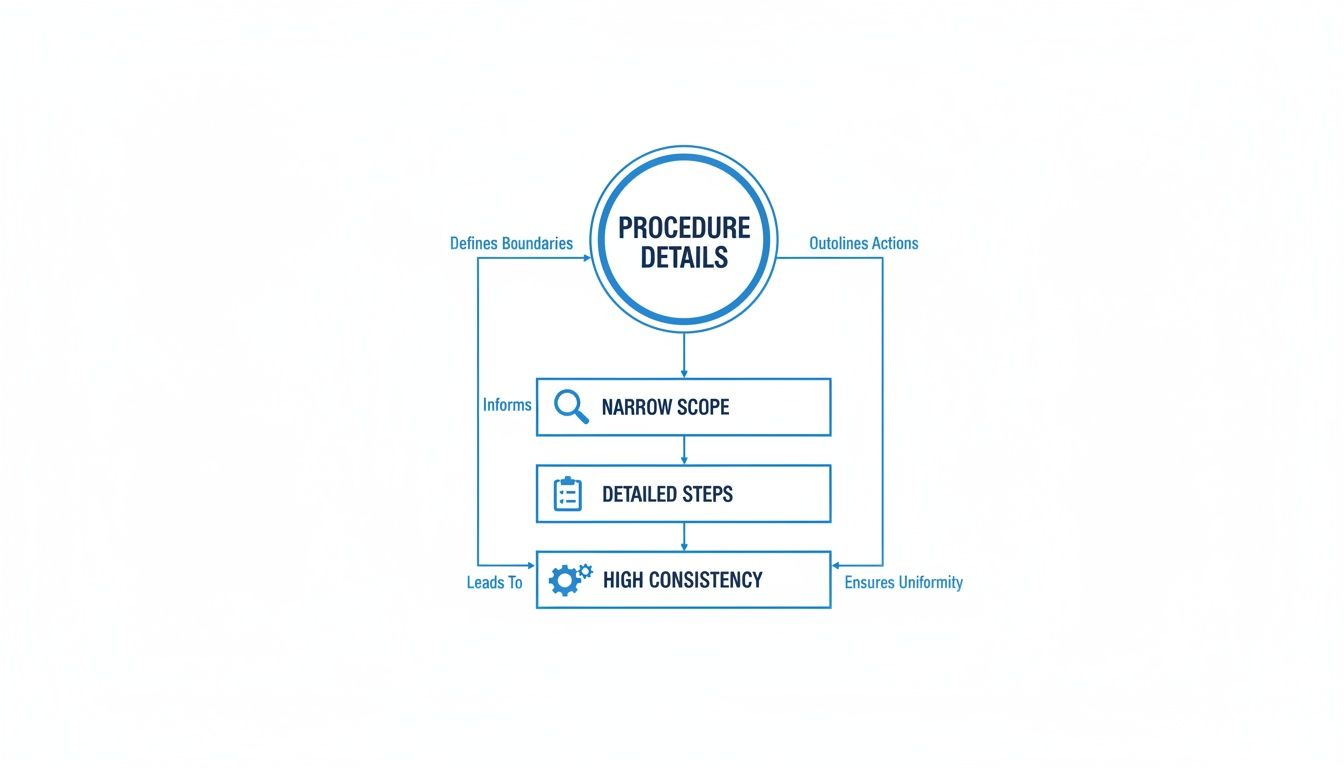
As the flowchart shows, procedures are all about drilling down to ensure every action is performed the same way, every time.
For instance, the "Content Creation" process is a huge workflow covering research, writing, editing, and promotion. Buried within it, you'll find a procedure for "How to Upload a Blog Post to WordPress," which details every single click. If you want to dive even deeper into tactical documentation, our guide on the difference between an SOP and a work instruction offers more clarity.
Flexibility and Adaptability: Outcome vs. Compliance
Processes are built to be flexible. Since the focus is on achieving a strategic outcome, the path to get there can—and should—evolve. Markets shift, customers change, and a healthy process allows for tweaks and improvements to hit the target more effectively.
Procedures are the polar opposite. They are designed for rigidity and compliance. Their entire value is in being prescriptive, ensuring a task is performed the exact same way every single time. This is non-negotiable for quality control, safety, and maintaining standards.
- Process Flexibility: A marketing process might be adapted to include a new social media channel if it proves to generate better leads.
- Procedure Rigidity: The procedure for processing payroll must be followed to the letter, with zero deviation, to ensure legal and financial compliance.
This is a critical distinction for managers. You want your team to innovate on the process, but you need them to stick to the procedure. Getting this wrong either stifles improvement or creates chaos.
Measurement and KPIs: Value vs. Execution
Finally, how you measure success for a process versus a procedure is completely different. A process is measured with high-level Key Performance Indicators (KPIs) that are directly tied to business value.
A procedure's success, however, is measured with task-level metrics focused on completion, accuracy, and speed. These are operational metrics that simply confirm the task was done right.
Think of it like this: trying to measure the success of your entire "customer support" process just by looking at how fast tickets are closed is a classic mistake. It completely misses the bigger picture of customer satisfaction, which is the actual goal.
How to Document Your Operations for Success
Knowing the difference between a process and a procedure is a great first step, but the real magic happens when you actually document them. Good documentation is what turns abstract ideas into concrete playbooks that drive consistency, make training a breeze, and unlock continuous improvement across your whole company.
Without it, even your best workflows are just tribal knowledge trapped in a few key people's heads—a risky game you don't want to play.
Visualizing the Process Workflow
Documenting a process is all about capturing the big picture. You're not trying to detail every single click or keystroke. The goal is to create a visual map that shows how work flows from A to Z. This is where process maps and flowcharts are your best friends.
A solid process map gives you that 10,000-foot view, making it easy to spot how different departments and tasks connect. It should clearly lay out the major stages, critical decision points, and where handoffs happen between people or teams.
A great process document nails these four things:
- A Clear Start and End Point: What kicks the whole thing off? What does "done" actually look like?
- Key Stages: The major phases of the workflow, identified without getting bogged down in the weeds.
- Inputs and Outputs: What's needed to start each stage, and what does it hand off to the next?
- Roles and Responsibilities: Who owns each part of the workflow? This kills confusion around accountability.
This high-level map is your strategic playbook. It’s what you'll pull up when you need to hunt down bottlenecks, find ways to be more efficient, or pivot to meet new business goals.
Creating Actionable Procedures with SOPs
If a process map is the "what," your procedures are the "how." The single best way to document a procedure is by creating a Standard Operating Procedure (SOP). Think of an SOP as a super-detailed, step-by-step guide that leaves zero room for guesswork. It's designed to make sure a task is done the exact same way, every single time.
A well-crafted SOP is the bedrock of operational consistency. It transforms tribal knowledge into a shared, reliable asset that empowers employees to perform tasks correctly and confidently without constant supervision.
For anyone serious about running a tight ship, learning how to properly handle documenting business processes is a non-negotiable skill. A truly useful SOP template should always cover a few key areas to give your team the clarity they need.
Here’s a simple but powerful structure for any SOP:
- Title and SOP ID: Give it a clear name (e.g., "How to Process a Customer Refund") and a unique ID for version control.
- Purpose: One quick sentence explaining why this procedure exists.
- Scope: Who is this for? When does it apply?
- Responsibilities: Pinpoint exactly which role is responsible for doing the work.
- Step-by-Step Instructions: This is the heart of the SOP. Use numbered steps, clear action verbs, and toss in screenshots or quick videos where they can help.
- Required Resources: A checklist of all the tools, software, or info needed to get the job done.
Connecting Processes to Procedures
Here’s where it all comes together. The final, most crucial step is linking your detailed procedures back to their parent process. This is exactly what modern knowledge management platforms like Whale are built for. They let you create a dynamic operational playbook where you can build a high-level process map and then link each stage directly to its specific SOPs.
This creates a seamless flow. An employee can look at the overall process, understand the context, and then click into any stage to get the granular, step-by-step instructions they need right at that moment.
This tight connection ensures your team doesn't just know what to do and why, but also has instant access to the guide on how to do it perfectly. That synergy is what makes the relationship between a process and a procedure so powerful.
Common Pitfalls When Defining Processes and Procedures
Knowing the textbook difference between a process and a procedure is one thing. Actually applying it correctly? That’s where a lot of companies trip up. When the documentation gets messy, it creates operational gaps that lead to confusion, inefficiency, and a whole lot of wasted effort.
Spotting these common pitfalls is the first step to building an operational framework that actually works.
Creating Procedures in a Vacuum
One of the biggest mistakes I see is teams creating procedures in total isolation. Someone documents a specific task but fails to connect it to the larger, guiding process it belongs to. What you end up with is a library of disconnected instructions that lack any strategic context. No one can see how their individual actions contribute to the bigger picture.
For instance, a marketing team might write a super-detailed procedure on "How to Post on Instagram." It's useful, sure, but it’s a heck of a lot less effective when it’s not nested inside a broader "Content Marketing Process." That process is what defines the strategy, the audience, the content pillars, and the metrics for success—it's the "why" behind every single post.
Making Processes Too Rigid
Here's another classic mistake: designing processes that are way too restrictive. While procedures absolutely need to be rigid to guarantee consistency, processes have to be flexible. Think of a process as a strategic map; it has to be able to adapt to shifting business goals, market changes, or new customer feedback.
When a process is locked down too tightly, it kills agility and innovation. Teams get so fixated on following a prescribed workflow that they completely miss chances to improve things. The whole point of a process is to achieve an outcome, and the path to get there should always be open for optimization.
Writing Procedures Without Enough Detail
On the flip side, procedures often suffer from the opposite problem. The entire value of a procedure is in its nitty-gritty detail. A vague or incomplete procedure is almost worse than having none at all—it gives a false sense of clarity while leaving mission-critical steps wide open to interpretation.
This almost always leads to inconsistent work, quality control nightmares, and the same errors popping up over and over again. If a procedure for "Processing a Customer Refund" just says "Issue refund in the payment system," it’s a failure. A proper procedure would detail every single click, required authorization, and confirmation step to ensure it’s done right every time, no exceptions.
The core mistake is a failure to align the level of detail with the document's purpose. Processes should be flexible roadmaps focused on outcomes, while procedures must be rigid, detailed instruction manuals focused on flawless execution.
Getting this right has a massive impact. For example, financial services firms that drew a clear line between high-level processes (like an end-to-end expense approval workflow) and granular procedures (like an 8-step verification protocol) saw their error rates plummet by 62%. By building automation into specific procedures, they slashed policy violations by 89%. And because their processes were flexible, they could adapt to market shifts without having to rewrite every single procedure from scratch. You can dig into more of these findings on process management on Kissflow.com.
Ultimately, avoiding these pitfalls comes down to discipline. Always start with the process to nail down the "what" and the "why." Only then should you drill down to create the detailed, step-by-step procedures that define the "how," making sure every action is purposeful and perfectly aligned with your strategic goals.
Frequently Asked Questions
Even after you've nailed down the definitions, the real questions pop up when you try to put it all into practice. Getting the difference between a process and a procedure isn't just academic—it's what stops documentation from becoming a mess and helps you build a company that can actually scale.
Let's tackle some of the most common questions we hear from teams on the ground.
Can a Process Exist Without a Procedure?
Absolutely. A process can totally exist as a high-level game plan without every single step being formally written down. This is classic startup territory, where workflows are changing on the fly. A sales team knows the general "sales process," but they might not have a step-by-step guide for every little task.
But that's not a long-term strategy. If you want consistency, quality control, and a training system that doesn't rely on word-of-mouth, a process eventually needs to be backed by solid procedures. The process gives you the roadmap, but procedures make sure everyone drives on the right side of the road, every single time.
A process without procedures is a huge operational risk. You’re completely dependent on a few key people, and getting consistent results as you grow becomes nearly impossible.
When Should I Create a Formal Procedure?
It's time to create a formal procedure the moment a task hits one of these triggers: it's done over and over, it needs to be exact, it's tied to compliance or safety, or inconsistency could blow up in your face.
If a task is critical to its parent process and you need different people to do it the exact same way, it's a non-negotiable. It needs a documented procedure. Think about things like processing payroll, running safety checks, or deploying code to a live server—these aren't areas where you can afford to just "wing it."
How Do Policies Relate to Processes and Procedures?
The easiest way to think about it is a three-level hierarchy. It flows from the big, broad rules all the way down to the specific, actionable steps. This keeps everything aligned, from your company's core values to the clicks an employee makes.
- Policy (The "Why"): This is the top-level stuff—the rules of the game. A policy is a formal statement that guides decisions, like a "Data Security Policy."
- Process (The "What"): This is the high-level workflow that puts the policy into action. It shows the main stages for getting something done, like a "Breach Response Process."
- Procedure (The "How"): These are the nitty-gritty, step-by-step instructions for a single task within that process, like a "System Shutdown Procedure."
Each layer just gets more detailed, making sure the big-picture governance from your policies actually translates into real-world, consistent actions. Getting this framework right is fundamental to running a tight ship.