
Creating a Standard Operating Procedure, or SOP, is all about taking a repeatable task, breaking it down into clear steps, getting an expert to double-check it, and then handing it over to your team. The end goal? A simple guide that anyone can pick up and use to get a consistent, top-notch result. Every single time.
Why Effective SOPs Are Your Greatest Competitive Edge
Let’s be honest. For a lot of teams, creating SOPs feels like a chore—just more paperwork to pile onto an already packed schedule. But looking at it that way completely misses the point. Unclear processes are silent killers of growth. They lead to expensive mistakes, inconsistent customer experiences, and messy onboarding for new hires.
They create friction. They stall progress. They turn what should be simple tasks into frustrating bottlenecks.
Viewing SOPs as a strategic asset, not just an administrative burden, is the first real step toward operational excellence. When done right, they aren't just instruction manuals; they're your playbook for efficiency, quality, and scaling your business.
The Real-World Cost of Ambiguity
Imagine your new marketing hire launching their first paid ad campaign. Without a clear SOP, they might target the wrong audience or blow the budget, wasting thousands of dollars before anyone even notices. It happens.
Or think about a customer support agent handling a tricky refund request. An inconsistent process means one customer gets a full refund while another gets denied, chipping away at your brand's reputation and customer loyalty. These aren't just hypothetical scenarios; they’re the daily fallout from having procedural gaps.
Without a standardized process, you're essentially allowing every employee to reinvent the wheel for every task. This isn't just inefficient; it's a direct route to inconsistent outcomes and preventable mistakes.
This kind of operational drag has a very real price tag. It’s why the global market for SOP management software is projected to more than double, hitting USD 2.5 billion by 2033. This explosive growth isn’t random; it reflects a hard business reality. Companies are aggressively looking for tools to simplify SOP creation and cut down on the errors that drag down productivity.
Transforming Chores into Advantages
With the right tools and a focused mindset, you can flip this task from a dreaded project into a source of genuine competitive advantage. Well-crafted SOPs deliver massive value:
- Accelerating Onboarding: New hires get up to speed and become productive way faster when they have clear, step-by-step guidance for their main jobs.
- Ensuring Consistency: Your customers get the same high-quality service and product experience every single time, no matter who on your team is helping them.
- Capturing Knowledge: Critical process knowledge gets documented and stays with the company, so it doesn't walk out the door when an experienced employee leaves.
- Empowering Teams: Clear instructions cut down on employee stress and build confidence, letting them do their jobs accurately and with more autonomy.
When you invest time in solid documentation, you’re not just writing things down. You are building a scalable, resilient, and efficient foundation for your entire operation. You can explore a deeper dive into the benefits of standard operating procedures in our related article.
Laying the Groundwork for Process Documentation That Actually Works
Before you write a single word of your next SOP, stop and think. The best process documentation isn't churned out in a frantic rush; it’s the result of a smart, upfront strategy. This initial planning phase is where you separate the SOPs that will actually make a difference from the ones that just create more administrative noise.
Jumping straight into writing without a clear plan is a classic mistake. It's how you end up with detailed guides for low-impact tasks while your most critical, high-risk processes are left to guesswork. The goal here is to focus your energy where it truly counts, making sure every document you create adds real, tangible value.
How to Decide Which Processes to Document First
Look, not every single task in your business needs a formal SOP. Over-documenting can be just as bad as under-documenting, burying your team in paperwork they'll never read. The key is to be strategic.
Start by zeroing in on processes that are complex, happen all the time, or carry a high risk of failure if someone messes up. A simple way to think about this is weighing the impact of a mistake against the frequency of the task.
Here’s what to look for when you're deciding where to start:
- High-Risk Tasks: Anything where an error could lead to a safety issue, a big financial loss, or an unhappy customer. These should be at the very top of your list.
- Frequently Performed Tasks: Think daily or weekly routines. Documenting these ensures consistency and efficiency, turning small time-savings into massive productivity gains over time.
- Multi-Person Processes: When a task gets handed off between different people or departments, an SOP is your best defense against miscommunication. It keeps everyone on the same page.
- Tasks with High Variability: If five people on your team are all doing the same job in five completely different ways, an SOP establishes a single, best-practice standard for everyone.
To make this even clearer, we use a prioritization matrix. It’s a simple but powerful tool to help you score and rank your processes, taking the guesswork out of the equation.
SOP Prioritization Matrix
| Process Name | Frequency (Daily/Weekly/Monthly) | Impact of Failure (Low/Medium/High) | Team Dependency | Priority Score |
|---|---|---|---|---|
| Customer Refund Processing | Daily | High | Medium | 10 |
| New Hire Onboarding | Monthly | High | High | 9 |
| Weekly Social Media Posting | Weekly | Medium | Low | 7 |
| Monthly Expense Reporting | Monthly | Medium | Low | 6 |
| Ordering Office Supplies | Monthly | Low | Low | 3 |
By mapping out your processes like this, you get a clear, data-informed view of what to tackle first. Focus on the high scores, and you can be sure you're working on what matters most.
Assembling Your Documentation Dream Team
Creating an SOP should never be a solo mission. The most effective documentation is a team sport, requiring input from the people who actually live and breathe the process every day. Assigning clear roles isn't just helpful; it's essential.
Here are the key players you'll need on your team:
- Process Owner: This is the person ultimately responsible for the SOP. They give the final approval and make sure it’s kept up-to-date. Usually, this is a manager or team lead.
- Subject Matter Expert (SME): Your SME is your go-to expert on the ground—the person who does the task day in and day out. Their practical knowledge is what makes an SOP accurate and realistic.
- End-Users: Pull in a few team members who will actually use the SOP. They offer a fresh pair of eyes and can instantly flag steps that are confusing or just plain wrong.
An SOP written without the input of a Subject Matter Expert is just a work of fiction. It might look good on paper, but it won't survive first contact with reality.
Choosing the Right SOP Format
The format of your SOP should fit the task. A simple checklist is perfect for a routine, step-by-step job. But for a process with a bunch of "if-then" decision points, a flowchart might be a much better fit. The days of boring, text-heavy Word docs are over.
In the past, drafting SOPs was a slow, painful process that often led to 20-30% productivity dips from inconsistent work. Modern digital platforms have completely changed the game. They allow for interactive guides, embedded videos, and instant updates that can slash training costs by up to 40%. You can discover more insights about SOP management improvements to see the full impact.
A huge piece of this puzzle is figuring out where these SOPs will live. That's why it's so important to understand how to build a knowledge base that can serve as the central, single source of truth for your team. This ensures everyone can find the most current version of a procedure the moment they need it, killing the risk of someone using an outdated document. If you think about storage and access from the start, you set your entire SOP initiative up for success.
Building Clear and Actionable SOPs From Scratch
Alright, let's get to the good stuff—turning all that strategic planning into a document someone can actually use. This is where the rubber meets the road, moving from high-level ideas to a practical, step-by-step guide.
A truly great SOP is built on a solid foundation: it needs accurate information, a crystal-clear structure, and to be written with the end-user front and center. The goal? Create a guide so straightforward that a brand-new hire could pick it up and get the same quality result as a seasoned pro. This takes a bit of method, but it's totally achievable.
Gathering the Right Information
The best SOPs are based in reality, not assumptions made in a conference room. To get the raw material you need, you have to go straight to the source. That means watching the process happen and talking to the people who live and breathe it every day.
- Observe the Process: Seriously, go watch a Subject Matter Expert (SME) do the task from start to finish. Take notes. Record a video (with their permission, of course). Take a bunch of screenshots. You need to pay attention to the tiny details and quick decisions an expert makes without even thinking.
- Interview Your Experts: After you've watched them work, sit down with your SME for a chat. Ask clarifying questions. Dig into why they do things a certain way. This is your golden opportunity to uncover all that "tribal knowledge" that usually only exists in the heads of your most experienced people.
"If you write an SOP from a conference room without ever watching the work get done, you’re just documenting a fantasy. The real process lives on the factory floor, in the support queue, or on the sales call—go there first."
Don't just ask "what's next?" Go deeper with open-ended questions like, "What are the common problems you run into here?" or "Is there a shortcut you use that isn't in the old guide?" This is how you unearth the practical, real-world nuances that make an SOP genuinely useful.
The diagram below really nails the key planning stages that set you up for success before you even start writing.
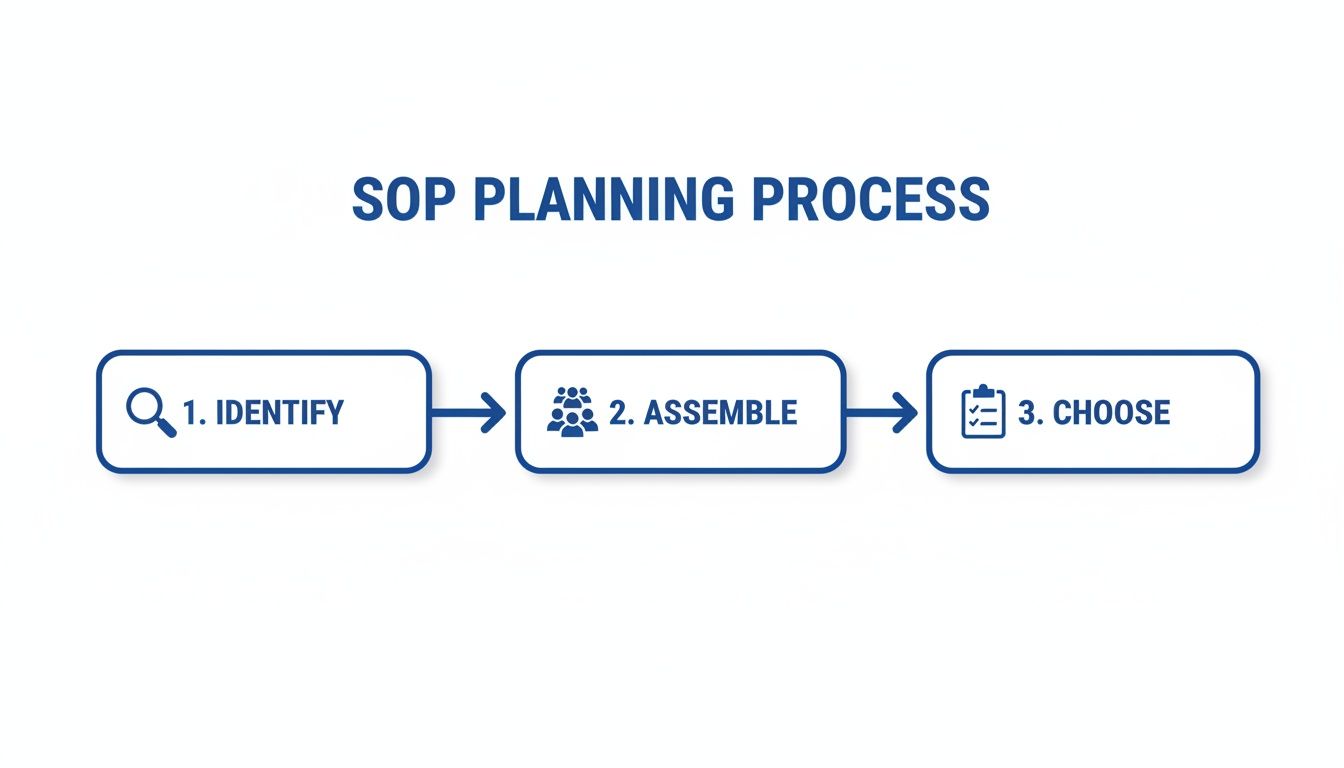
As you can see, a solid SOP starts way before the first word is written. It begins with identifying the need, getting the right people involved, and picking the right format for the job.
Structuring Your SOP for Maximum Clarity
Once you've got your notes, screenshots, and interview transcripts, it's time to bring order to the chaos. A confusing layout can render even the most accurate information useless. The structure should feel like a GPS, guiding the user from point A to point B without any wrong turns.
A solid SOP structure usually includes these key pieces:
- A Clear Title: Be specific. Not "Marketing SOP," but "How to Schedule a Weekly Social Media Post on Platform X."
- Purpose Statement: A quick sentence or two on why this SOP exists and what the end goal is. Context is everything.
- Scope and Responsibilities: Spell out who this SOP is for and which roles are responsible for what. No more guessing games.
- Required Resources: List every tool, software login, or material someone needs to get the job done. This prevents frustrating delays.
- Step-by-Step Instructions: The heart of the document. Use a numbered list with clear, concise, action-oriented steps.
- Visual Aids: Don't just tell, show. Use screenshots, diagrams, or even short video clips to make complex steps easier to understand.
Always remember you're writing for someone who might be stressed, brand new, or just plain distracted. Simplicity is your best friend. Use short sentences, active voice ("Click the button" not "The button should be clicked"), and plain English. Ditch the jargon and acronyms, or if you can't, include a glossary.
From Confusing Text to Clear Instructions
Let's look at a quick before-and-after. We’ve all seen SOPs that are dense, text-heavy walls of pain.
Before (The Confusing SOP):
"The monthly client report generation procedure requires the user to first log into the analytics platform. Once logged in, the appropriate date range must be selected from the dropdown menu, after which the user should navigate to the 'Export' function. The file should be downloaded in CSV format and then opened in the spreadsheet software, where it must be formatted according to the client template V2.3 before being saved as a PDF and emailed to the account manager for final review."
This is a classic "wall of text." It might be technically correct, but it's a nightmare to scan and super easy to mess up.
After (The Clear SOP):
- Log in to the analytics platform.
- Select the correct date range for the report.
- Navigate to Reports > Export.
- Choose Export as CSV.
- Open the downloaded CSV file in your spreadsheet software.
- Apply the "Client Report Template V2.3" formatting.
- Save the final report as a PDF.
- Email the PDF to the account manager for review.
See the difference? The second version is instantly scannable and actionable. Each step is a clear command, making it much harder to get lost. When you're managing dozens of these, modern process documentation software can be a game-changer, automating a lot of this formatting and structure for you.
Using AI to Accelerate the Writing Process
Building out SOPs doesn't have to be a soul-crushing manual task. AI tools can be an amazing co-pilot here, seriously speeding up the creation of that first draft.
You can feed your raw interview notes, a video transcript, or even a simple bulleted list into an AI model and have it generate a structured, well-written first draft in seconds. It can transform messy notes into clean, sequential steps and ensure your tone is consistent. This frees up your subject matter experts to do what they do best: review the draft for accuracy and add their critical insights, instead of getting bogged down in grammar and formatting.
Launching Your SOPs for Maximum Team Adoption

Let's be honest: a technically perfect SOP is only half the battle. A brilliant document that just gathers digital dust is completely useless. The real success of any process documentation comes down to adoption—whether your team actually uses it to make their work better, faster, and more consistent.
This is exactly where many organizations stumble. They pour tons of effort into writing and structuring, only to "launch" the SOP with a quick email before wondering why nothing changes. A strategic launch isn't about just announcing something new; it's a deliberate campaign to build trust, show people what's in it for them, and bake the SOP into your team's daily muscle memory.
The Critical Review and Validation Loop
Before any SOP sees the light of day, it has to survive contact with reality. That’s why a two-pronged review process is absolutely non-negotiable. You need feedback from both the experts who know the process inside and out and the end-users who will be following the instructions every day.
First up, your Subject Matter Experts (SMEs) have to validate for accuracy. They’re the ones who need to meticulously check every step, every technical detail, and every "what if" scenario to ensure the procedure is correct and safe. Their job is to protect the integrity of the process.
Next, a group of end-users must validate for clarity. Give them the draft and ask them to follow it, no hand-holding allowed. Where do they get stuck? Which steps are confusing? This real-world test drive is invaluable for spotting confusing jargon, finding missing steps, or uncovering assumptions the writer made.
This feedback is gold. Use it to refine the language, add clarifying screenshots, and simplify complex sections until someone with fresh eyes can get the job done flawlessly.
Crafting Your Strategic Launch Plan
Once it's been validated, your SOP is ready for its debut. But a haphazard rollout will kill adoption before it even starts. You need to approach it with a clear, multi-step plan that treats your internal team like your most important audience.
- Communicate the "Why" First: Don't just announce a "new procedure." Explain the benefit. Frame it as a tool to reduce stress, eliminate guesswork, and help everyone do their best work. For example, "We've created a clear guide for processing rush orders to ensure we never miss a deadline and can confidently give customers accurate delivery times."
- Provide Hands-On Training: For complex or high-stakes SOPs, a training session is a must. Walk the team through the process, demonstrate the key steps, and let them ask questions. This interactive approach builds confidence and nips concerns in the bud.
- Make It Impossible to Ignore: Your SOPs have to live where your team works. Burying them in a nested folder on a shared drive is a recipe for failure. Use a centralized knowledge base or a platform like Whale to make procedures instantly searchable and accessible.
An SOP's value is directly proportional to its accessibility. If a team member can't find the correct procedure in under 30 seconds, they'll likely just guess—and that's precisely what you're trying to prevent.
Overcoming Resistance and Building Momentum
Change, even when it's for the better, can be met with skepticism. Some team members might see a new SOP as bureaucratic red tape or a sign they aren't trusted. It’s your job to get ahead of this by highlighting how standardization actually empowers them.
Show them that clear processes reduce the mental load of remembering every little detail, protect them from making mistakes, and create a fairer standard for everyone. When an SOP is seen as a supportive tool rather than a restrictive rule, adoption tends to follow naturally.
The rigor of this entire process is essential, especially in regulated fields. For instance, a survey of Health Information Organizations revealed that effective SOPs are known to reduce operational errors by 30-50%. This isn't just a best practice; it's often a mandatory requirement. You can learn more about standards adoption in healthcare to understand its impact. When you show your team that creating SOPs is about achieving this level of excellence, you start to build a culture that values clarity and continuous improvement.
Keeping Your SOPs Relevant and Up-to-Date
The absolute worst thing you can do after creating a brilliant SOP is to stick it on a virtual shelf and forget about it. Think of SOPs as living documents, not museum relics. The moment you hit publish, the clock starts ticking toward their expiration date. They have to evolve right alongside your tools, your team, and your business goals.
Letting your documentation get stale isn't just lazy—it's dangerous. An outdated SOP can be even worse than no SOP at all because it actively guides your team to follow an incorrect, inefficient, or even unsafe process.
Establish a Regular Review Cadence
The best way to stop your processes from becoming irrelevant is to get proactive with a review schedule. Don't wait for something to break before you fix it. Instead, assign a specific review frequency to every single SOP in your library.
What’s the right cadence? It really depends on the process itself:
- Quarterly Reviews: This is perfect for dynamic processes that change often, like anything involving fast-moving software, marketing tactics, or sales strategies.
- Annual Reviews: These work well for stable, core business functions that don't change much. Think financial closing procedures or standard HR onboarding checklists.
- Immediate Reviews: Some events should trigger an instant review. A major software update, a change in safety regulations, or the introduction of new equipment all fall into this category.
You absolutely need to assign a Process Owner for each SOP. This is non-negotiable. This person is responsible for making sure the scheduled review actually happens, gathering feedback, and seeing any updates through to approval.
Create a Powerful Feedback Loop
Your team on the front lines? They're your best source of intel for process improvement. They're the first ones to notice when a step feels clunky, a screenshot is out of date, or a better tool is available. Your job is to make it incredibly easy for them to share that feedback.
Something as simple as a "Suggest an Edit" button inside your SOP platform can be a game-changer. This lets any user flag an issue or propose a better way of doing things directly on the document they're using. You'll create a continuous, collaborative improvement cycle where the people doing the work help keep the documentation sharp. To really build this culture, you can explore proven methods for continuous improvement that will strengthen this feedback loop.
A static SOP library is a sign of a stagnant business. A library with a constant stream of suggested edits and updates is the sign of a healthy, engaged organization that is always getting better.
Master Your Version Control
One of the biggest headaches of managing SOPs the old-fashioned way is the absolute chaos of multiple versions. When your procedures live as Word docs or PDFs scattered across shared drives and email inboxes, it’s a nightmare trying to make sure everyone is using the latest version.
This is where a modern platform makes all the difference. A centralized system gets rid of this risk completely by creating a single source of truth.
Traditional vs. Modern SOP Management
Take a look at how the old way of doing things stacks up against a modern approach. The difference in efficiency and reliability is massive.
| Feature | Traditional Method (Word/Drive) | Modern Platform (e.g., Whale) |
|---|---|---|
| Version Control | Manual file naming (e.g., "SOP_v3_FINAL_Final_2.docx"), high risk of error. | Automatic version history, with clear audit trails of every change. |
| Accessibility | Users must search through folders, often finding outdated copies. | One central location where only the current, approved version is visible. |
| Update Rollout | Relies on email announcements and manual distribution. | Instantaneous updates pushed to all users simultaneously. |
By moving to a modern platform, you never have to wonder if a team member is referencing an old, incorrect procedure. Everyone always has the right instructions, period.
Measure the Effectiveness of Your SOPs
So, how do you know if your SOPs are actually working? You have to move beyond just tracking completion rates and look at the real-world impact on your business.
Start by tracking key performance indicators (KPIs) directly tied to your documented processes. If you want to dive deeper into this topic, check out our full guide on how to review your SOPs.
Here are a few metrics worth watching:
- Reduction in Error Rates: Are quality control failures or customer complaints related to a specific process going down?
- Decrease in Training Time: How quickly are new hires getting up to speed on tasks that have clear SOPs?
- Improved Consistency: Are the outcomes of a process becoming more predictable and reliable, no matter who's doing the task?
- Fewer "How-To" Questions: Are your managers and subject matter experts spending less time answering the same repetitive questions?
When you track these metrics, you can draw a direct line between your documentation efforts and tangible business improvements. This data not only proves the value of your work but also points you toward which SOPs need the most attention, closing the loop on your continuous improvement cycle.
Common Questions About Creating SOPs
Even with the best playbook in hand, you're bound to run into a few questions once you start building out your SOPs. It happens to everyone. Let's tackle some of the most common ones I hear, so you can sidestep these hurdles and get your documentation right from the start.
How Detailed Should My SOPs Be?
This is the classic Goldilocks question. You want them detailed enough for a brand-new hire to follow the steps and nail the task without needing to tap someone on the shoulder for help. But you don't want them so granular that they read like a phone book.
The goal is clarity and repeatability, not encyclopedic length.
A good rule of thumb is to document every critical action and decision point. For anything that gets a bit complicated, don't just write more words. Lean on visuals. A few well-placed screenshots, a simple diagram, or even a quick video clip can explain a complex step far better than a wall of text ever could.
What's the Best Way to Get Team Members to Actually Use the SOPs?
Ah, the million-dollar question. Adoption is everything. You can write the most beautiful SOPs in the world, but if they just collect dust, what's the point? It really boils down to three things: making them easy to find, getting your team involved, and keeping them relevant.
- Make it accessible: Your SOPs have to live where your team works. If someone has to spend more than 30 seconds hunting for a procedure, they're just going to give up and ask a coworker.
- Get people involved: Don't create SOPs in a vacuum. Pull the end-users—the people actually doing the work—into the creation and review process. When they help build the guide, they feel a sense of ownership. It becomes their tool, not just another rule from management.
- Keep it relevant: This is non-negotiable. The SOP has to be up-to-date and genuinely solve a problem. If following the procedure makes your team's job easier, faster, or less stressful, they'll turn to it every time.
An SOP that isn’t used is just wasted effort. The ultimate measure of success is whether your team sees your documentation as a reliable ally in getting their work done right.
How Often Should We Review and Update Our SOPs?
There’s no magic number here; a one-size-fits-all schedule just doesn't work. The right frequency depends entirely on the process itself.
For fast-moving processes, like anything tied to marketing software or sales workflows that change constantly, a quarterly review is probably a good idea. Things just evolve too quickly to wait any longer.
On the flip side, you have your stable, core operational procedures—think of things like month-end financial closing. Those are probably fine with a simple annual review. The key isn't the specific timeline, but having a scheduled review cycle and a clear owner for every single SOP. Good software can even automate these reminders so nothing ever slips through the cracks.
Can I Use AI to Write My SOPs?
Absolutely. In fact, you should be. AI is an incredible accelerator for getting SOPs off the ground, but—and this is a big "but"—it shouldn't be the final author.
Use AI tools to generate a solid first draft from a prompt, transcribe a video of you doing the task into written steps, or even just clean up grammar and formatting. It’s a massive time-saver.
Think of AI as your co-pilot, not the pilot. It gives you a fantastic starting point, but a human subject matter expert always needs to be in the driver's seat to review, edit, and validate the final document. They add the real-world context and nuance that AI just can't replicate.