
To slash employee turnover, you first have to get brutally honest about what it's really costing you, and then you need to dig into the why. It’s not just about a better health plan or Friday pizza; it’s about building solid systems for hiring, onboarding, and creating feedback loops that actually work.
Thinking about your employee experience isn't just a "nice-to-have"—it's a core business function that hits the bottom line. Hard.
Why High Turnover Is Quietly Costing You More Than You Think

Before you can fix the leak, you have to grasp the size of the flood. Too many leaders only see the obvious costs staring them in the face—recruiter fees, job board postings. The reality is, those direct expenses are just the tip of a very expensive iceberg.
The real financial drain is the quiet, creeping costs that slowly eat away at your company’s foundation. Every single time a seasoned employee walks out the door, a massive amount of institutional knowledge goes with them. This is that gut-feel expertise, the unwritten rules about your clients, and the hard-won lessons that take years to build. You can't just write a check for that.
The Ripple Effect of a Single Departure
It’s never just one person leaving. Their departure creates a vacuum, and the rest of the team gets sucked in to pick up the slack. This inevitably leads to burnout, sinking morale, and a nosedive in productivity. That strain is contagious. It's often the push that makes other great people start polishing their resumes.
Think about it. A top sales rep quits. Suddenly, their colleagues are drowning, trying to manage their own pipelines while also putting out fires on the departed rep’s key accounts. Service levels drop, client relationships get rocky, and the team’s momentum grinds to a halt.
Here’s a number that should make you sit up straight: a single salaried employee's departure can cost a company anywhere from 50% to 200% of their annual salary. That calculation includes everything from recruitment and training to the brutal hit from lost productivity. What looks like a small problem is actually a massive financial liability.
Calculating Your Real Turnover Cost
If you want to get buy-in to invest in retention, you have to speak in a language everyone understands: dollars and cents. You need to translate these "soft" costs into hard numbers. A simple framework can shine a light on the true financial impact and make it painfully clear why learning how to reduce employee turnover is a critical business priority.
First, tally up the tangible costs:
- Separation Costs: Think exit interviews, severance pay, and all the administrative legwork.
- Vacancy Costs: Did you hire a temp? Pay overtime to existing staff? It all adds up.
- Recruitment Costs: This is the obvious one—ad fees, recruiter commissions, and the hours your team sinks into screening and interviewing.
- Onboarding and Training Costs: Don't forget the time and resources poured into getting a new hire up to speed.
Now for the intangible costs, which are often the real killers:
- Productivity Loss: This includes the lost output while the role is empty plus the new hire’s ramp-up time (which is never as fast as you hope).
- Team Disruption: How much less efficient is the rest of the team as they adjust to new dynamics and fill in the gaps?
- Loss of Knowledge: This one is tough to quantify but represents a massive long-term blow to your company's competitive edge.
Once you have these numbers, the conversation shifts. Turnover is no longer just an "HR problem"—it's a critical operational and financial crisis. This is the bedrock understanding you need before you can build a retention strategy that actually works.
Uncovering the Real Reasons Your Best People Leave

Guesswork won't solve your retention problem. Honest data will. To really get a handle on turnover, you have to stop assuming you know why people are walking out the door and start digging for the truth.
This isn't about sending out another generic survey. It's a commitment to creating multiple ways for your team—both departing and current—to give you candid, actionable feedback.
Go Beyond the Exit Interview
The first tool everyone reaches for is the exit interview. And yes, it’s valuable, but it’s also a reactive measure. The person is already gone. The secret is making these conversations feel genuinely safe and confidential, so you get honesty, not just polite platitudes.
But relying only on exit interviews is like trying to drive by looking in the rearview mirror. You need forward-looking tools, too. That's where anonymous pulse surveys and proactive "stay" interviews come in.
- Pulse Surveys: These are short, frequent, anonymous check-ins that give you a real-time snapshot of how the team is feeling.
- Stay Interviews: These are structured, one-on-one chats with your current top performers. The goal? To find out what keeps them there and what might tempt them to leave.
By weaving these methods together, you build a complete listening strategy. You start spotting troubling trends before they turn into another resignation letter.
Ask Questions That Actually Get Answers
The quality of your data lives and dies by the quality of your questions. Closed-ended "yes/no" questions are a dead end. You need open-ended prompts that encourage people to tell a story.
Think about an exit interview. Instead of asking, "Were you satisfied with your manager?" try this:
"Can you describe your relationship with your manager and how it impacted your day-to-day work?"
That small tweak changes everything. It shifts the focus from a simple rating to a rich, detailed narrative. Now you have specifics you can actually do something with.
Connect the Dots in Your Data
Once the feedback starts rolling in, you need a system to make sense of it all. Don't let valuable insights rot in a spreadsheet. Your goal is to pinpoint recurring themes and patterns that point to bigger, systemic issues.
Look for trends across departments, roles, and even how long someone's been with the company. Are new hires always complaining about a confusing onboarding? Are people in one specific department all mentioning a lack of growth opportunities? These patterns are your roadmap for change.
Disengaged teams suffer a whopping 43% higher turnover rate than engaged ones, often because employees feel disconnected or unsupported. Given that only 21% of employees worldwide feel engaged at work, it’s a massive—and costly—problem. Tackling engagement head-on by improving processes and manager support is a proven way to slash turnover.
A lack of support for diverse needs can also be a huge, often unspoken, driver of turnover. To create a truly inclusive environment where your best people feel they belong, consider implementing practical reasonable adjustments for neurodivergent employees at work.
When you move from assumption to a data-backed understanding of what’s really going on, you can finally stop guessing and start building a retention strategy that works.
Designing an Onboarding Experience People Won't Want to Leave

An employee's first 90 days are a make-or-break period. It’s where they decide if they made the right choice. A great experience validates their decision to join you, but a chaotic, confusing one plants seeds of doubt that quickly bloom into regret.
Honestly, too many companies lose fantastic people before they even get a chance to make a real impact.
This isn't just about handing over a laptop and a stack of HR forms. A truly retention-focused onboarding experience is a carefully planned journey. It’s designed to make new hires feel supported, competent, and genuinely connected to their team and the company mission from the moment they walk in the door.
The secret ingredient here is consistency. Every new hire, no matter their role or manager, deserves the same high-quality introduction. This is where creating a single source of truth for all your training materials becomes an absolute game-changer.
From Chaos to Clarity with Centralized SOPs
Picture a new marketing hire’s first week. On Monday, their manager shows them one way to pull a campaign report. On Tuesday, a well-meaning colleague shows them a different, “faster” way. By Friday, they’re stuck, totally unsure of the right process and too embarrassed to ask for help again.
This happens all the time, and it's a direct result of undocumented, tribal knowledge. The solution? Centralize everything into clear, step-by-step Standard Operating Procedures (SOPs). Documenting your core processes kills ambiguity and gives new hires the confidence to find answers on their own.
When every critical task is documented with checklists, screenshots, and simple instructions, you dramatically shrink the time it takes for a new person to feel confident and start contributing.
Impact of Structured vs Unstructured Onboarding
The difference between a documented, structured onboarding and an informal, "figure it out as you go" approach is stark. It directly impacts key metrics that determine whether your new hire stays and thrives or quickly heads for the exit.
| Metric | Structured Onboarding with Centralized SOPs | Unstructured Onboarding |
|---|---|---|
| Time to Productivity | 30-50% faster ramp-up to full productivity. | Slower, inconsistent ramp-up; often double the time. |
| First-Year Retention | Retention rates increase by up to 82%. | Significantly higher turnover, often losing 1 in 5 new hires. |
| Role Clarity & Confidence | High. Clear SOPs provide a roadmap for success. | Low. Leads to confusion, anxiety, and frequent errors. |
| Manager Time Investment | Reduced. Managers coach, not just repeat basic instructions. | High. Managers spend excessive time on repetitive training. |
| Team Integration | Seamless. New hires feel connected and part of the team. | Isolated. New hires feel like outsiders trying to catch up. |
As you can see, investing in a robust, SOP-driven system isn't just a "nice-to-have." It’s one of the most effective moves you can make to stop bleeding talent and build a more stable, productive team.
Building a Structured 90-Day Roadmap
A great onboarding program doesn't stop after the first week. You need a structured plan that maps out the entire first three months, complete with clear goals and milestones.
Here’s what that looks like in action:
- Week 1: Focus on Connection. The goal is cultural immersion, not drowning them in tasks. Schedule intros with key team members, set up their tools, and assign an onboarding buddy who isn't their manager.
- Weeks 2-4: Focus on Core Training. This is where your SOPs become their best friend. Assign specific training modules built around your documented processes. Using a tool like Whale, you can create interactive guides and quizzes to check for understanding and build confidence.
- Weeks 5-8: Focus on Application. Time to put that training to work. Start assigning small, low-risk projects where they can apply what they've learned. This builds momentum and gives them some early wins.
- Weeks 9-12: Focus on Integration. By now, your new hire should be operating more independently. The focus shifts to long-term goal setting and weaving them fully into your team’s regular workflows.
Throughout this entire journey, regular check-ins are non-negotiable. A manager should meet with the new hire weekly for the first month, then bi-weekly for the next two. These aren't just status updates; they are dedicated conversations to answer questions, offer support, and make sure they feel on track. To see how these pieces come together, check out our guide on creating a comprehensive employee onboarding process.
The Power of Mentorship and Connection
Finally, never underestimate the human element. An SOP can teach someone how to use your CRM, but it can’t explain the unwritten rules of the office or offer a friendly ear when things get overwhelming.
Assigning an onboarding buddy or mentor from a different department can make all the difference. This person becomes a safe, informal resource for all the "silly" questions a new hire might be nervous to ask their boss. This relationship fosters a deep sense of belonging that ties them to the company on a personal level, making them far less likely to start looking elsewhere.
Turning Your Managers into Retention Champions
You’ve heard the old saying: people don't leave companies, they leave managers. It’s a cliché for a reason. Your frontline leaders have a more direct, day-to-day impact on an employee’s experience than any C-suite executive or company-wide policy ever will.
If you want to pull one of the most powerful levers for reducing turnover, you need to transform your managers from simple supervisors into true retention champions.
This isn’t just about soft skills training. It's about equipping them with the right systems. A manager's most important job is to coach, develop, and motivate their team. But too often, they’re stuck in the administrative weeds, answering the same process questions day after day.
Empowering Managers with Documented Processes
When you standardize your critical processes and centralize them with Standard Operating Procedures (SOPs), you give your managers back their most valuable resource: time.
Instead of explaining a workflow for the tenth time, they can point an employee to a clear, well-documented guide in a tool like Whale. This simple shift is a game-changer. It frees up managers to focus on the high-impact activities that actually drive people to stay.
- Impactful One-on-Ones: These meetings can finally move beyond status updates. They become genuine coaching sessions focused on an employee’s real-world challenges and future aspirations.
- Constructive Feedback: With a foundation of documented expectations, feedback becomes objective and developmental, not personal or arbitrary.
- Meaningful Career Pathing: Managers can have proactive conversations about an employee’s future because they aren’t constantly putting out fires in the present.
Documented SOPs also build a crucial foundation of fairness and consistency. When every team member is trained and evaluated against the same clear standard, it vaporizes perceptions of favoritism and builds trust—a massive driver of loyalty. Identifying and addressing the 7 traits of ineffective leaders is a crucial first step, but giving them strong procedural tools is what sets them up for success.
The link between leadership and retention is undeniable. Gallup research shows that a staggering 50% of employees have left a job just to get away from a bad boss. More than salary, it's trust in leadership that predicts long-term commitment.
With turnover a top concern for 66% of HR executives in 2025, and 68% of companies facing unexpected spikes, this isn't a luxury. Empowering managers with structured SOPs is a core retention strategy. You can dig into more insights in the Gallagher turnover report to see the full scope of the challenge.
From Supervisor to Coach
Training your managers to use these systems is where the magic happens. It’s not just about showing them where the documents are; it’s about coaching them on how to leverage this framework to lead better.
Let's look at a real-world example. Sarah, a manager on an operations team, used to spend hours each week onboarding new warehouse staff, repeating the same safety protocols and inventory procedures over and over again. After her company implemented a centralized SOP platform, everything changed.
Now, new hires complete a self-paced training module with interactive guides and quizzes before their first day on the floor. Sarah’s role has completely shifted. Her "onboarding" time is now spent discussing their career goals, introducing them to key team members, and checking in on their progress. She’s become a mentor, not just a trainer.
This shift has a ripple effect. Her new hires feel more confident and competent from day one. Her existing team sees a manager who is invested in their development, not just their output. The result? Her team’s turnover rate dropped by 30% in just six months. She wasn't just managing tasks anymore; she was building a team people were loyal to.
This is the practical, powerful outcome of turning managers into true retention champions.
How to Measure and Refine Your Retention Strategy
Slashing employee turnover isn't a "one and done" project you can cross off a list. It’s a living, breathing part of your business—a constant cycle of measuring, learning, and tweaking your approach.
If you just launch a new initiative and hope for the best, you’re flying blind. The real magic happens when you build a system to track your efforts and make smart, data-driven adjustments over time.
This turns retention from a reactive fire drill into a proactive strategy, ensuring it evolves right alongside your team and the needs of your business.
Pinpointing Your Key Retention Metrics
First things first: you have to know if what you're doing is actually working. A single, company-wide turnover number is a start, but it barely scratches the surface. The real insights are found when you dig a layer deeper.
You need to track a focused set of KPIs that give you a complete picture of the employee experience.
Your dashboard should have a healthy mix of leading and lagging indicators:
- Employee Net Promoter Score (eNPS): It’s a simple but powerful question: "On a scale of 0-10, how likely are you to recommend our company as a place to work?" Think of it as an early warning system for employee sentiment.
- Engagement Levels: Don't wait for the annual survey. Use regular pulse surveys to get a real-time feel for morale, motivation, and connection to the company. A dip in engagement is often a red flag for future turnover.
- Promotion and Growth Rates: Are people moving up, or are they stuck? Tracking internal promotions tells you if you're providing clear career paths. If not, you risk losing your most ambitious people.
- Turnover by Segment: This is where you find the hotspots. Break down your turnover rate by department, manager, tenure, and even performance level. Is one manager’s team a revolving door? Are new hires leaving within their first six months?
These metrics give you the context to start asking the right questions and focus your resources where they’ll have the biggest impact. For more ideas, you can always explore other top retention strategies.
The Power of Pilot Programs
Before you roll out a massive, company-wide retention initiative, test it on a smaller scale. Running a pilot program is your secret weapon for validating ideas, working out the kinks, and gathering hard data without disrupting the entire organization.
Let's say your data shows that new hires in the customer support department have an alarmingly high turnover rate in their first year. Instead of overhauling everyone's onboarding, you could run a targeted pilot just for that team.
You might introduce a new mentorship program, beef up the training with better SOPs, and add bi-weekly check-ins for all new support reps for one quarter. During that time, you monitor their engagement scores, how quickly they get up to speed, and—of course—their retention rate compared to a control group.
A pilot-and-iterate approach minimizes risk and maximizes learning. You get to prove an initiative's value with real numbers, which makes getting buy-in for a wider rollout a whole lot easier. It's all about making small, calculated bets that lead to big, validated wins.
Creating a Continuous Feedback Loop
Your data tells you what is happening, but you still need to understand why. This is where the magic of combining your quantitative metrics with qualitative feedback comes into play.
A truly great measurement strategy includes a system for continuous listening. It’s about more than just numbers on a dashboard; it’s about the human experience behind them.
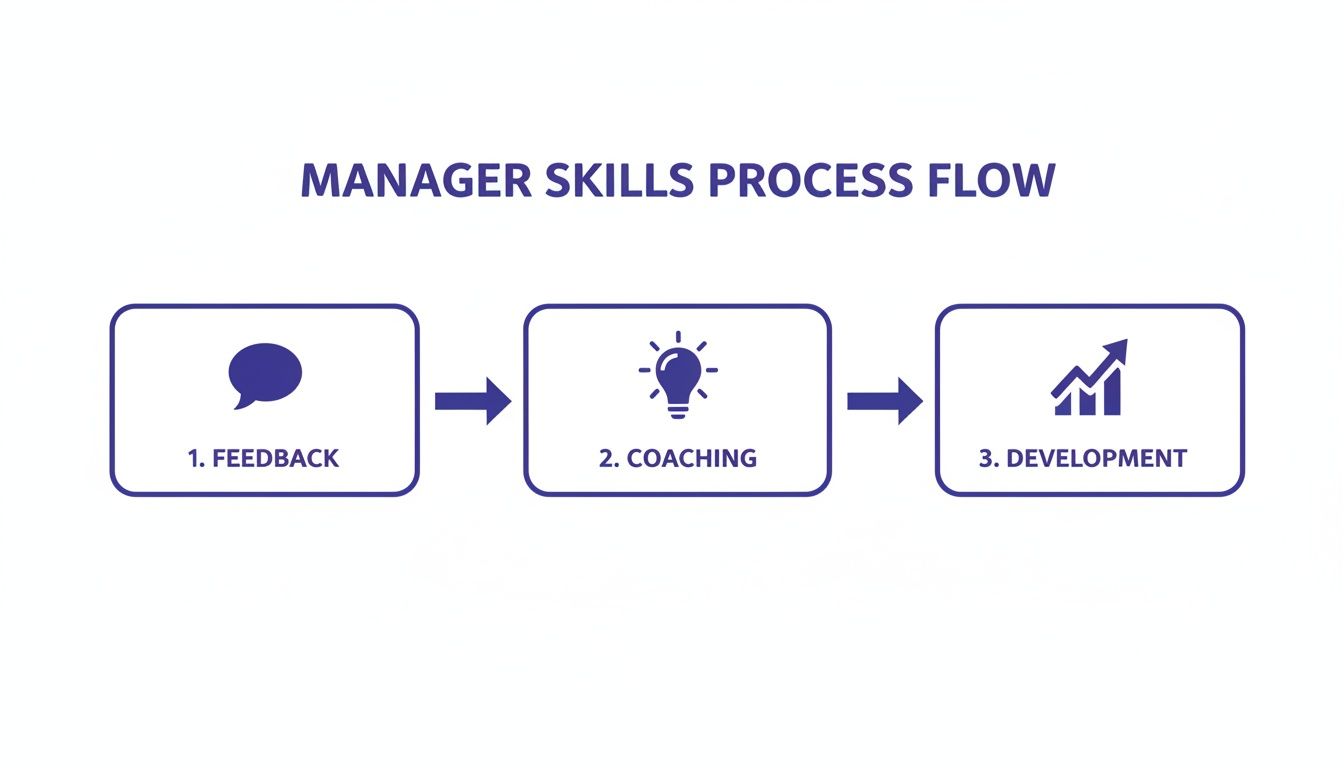
This shows how manager skills in feedback, coaching, and development aren't just one-time actions but a continuous loop that keeps employees supported and growing.
Make sure you’re integrating these qualitative inputs into your reviews:
- Dig into Exit Interview Themes: Don't just file them away. Look for patterns. Are multiple people from the same department citing the same reasons for leaving? Compare those themes to your data.
- Conduct "Stay" Interviews: This is a game-changer. Proactively talk to your top performers and ask them what keeps them here. Just as importantly, ask what might tempt them to look for a job elsewhere.
- Mine Pulse Survey Comments: Anonymous comments are often a goldmine of candid feedback. This is where you find out what's really happening on the ground level.
This combination of hard data and human stories gives you the full picture. Your KPIs might show a team’s eNPS is dropping, but the comments from stay interviews could reveal it’s because their software tools are outdated and making their jobs harder.
Now you can make a precise, targeted fix—like investing in a software upgrade for that specific team—and measure the impact on your KPIs next quarter. This continuous loop is the key to building a retention strategy that actually works. You can even dive deeper into how to measure the success of your employee onboarding process in our related guide.
Got Questions About Reducing Employee Turnover? We've Got Answers
Putting a full-blown retention strategy into play can feel like a massive undertaking. If you're an ops manager or HR leader, you're in the trenches, and it's totally normal to have questions about how to make these changes actually work.
Let's tackle some of the most common hurdles you might be up against. Think of this as your practical guide to moving past the planning stage and starting to see a real difference.
Our Employee Turnover Is Sky-High. Where Do I Even Begin?
When turnover feels like a five-alarm fire, your first job is triage. Forget the long-term strategic vision for a minute. You need to stop the bleeding, and that means a laser focus on immediate intervention.
Start talking to people—now. Conduct detailed, confidential exit interviews with every single person heading out the door. You need their raw, unfiltered honesty. At the same time, get a quick, anonymous pulse survey out to your current team to pinpoint their biggest frustrations right now.
Once you have that data, look for the most painful, recurring patterns. Is everyone complaining about the same manager? The chaotic scheduling? The lack of clear direction? Your goal is to find one or two "quick wins" that can bring some immediate stability. Don't try to boil the ocean. Pick the top issue and throw all your energy at it.
How Can I Get Leadership to Actually Invest in Retention?
To get the C-suite on board, you have to talk their language: data and return on investment (ROI). Stories about low morale are nice, but a solid financial case is what really gets their attention.
Use the framework from the first part of this guide to calculate the real cost of your turnover problem. Don't just estimate—factor in recruitment costs, training hours, lost productivity, and the impact on team morale. Present this number as a direct hit to the company's bottom line.
For example, frame it like this: "Our 25% turnover in the operations department cost us an estimated $450,000 last year. That's pure loss."
Then, flip the script. Your proposed solutions aren't expenses; they're investments with a clear payoff. For instance, "If we invest $60,000 in a structured onboarding program and better manager training, we project we can cut turnover by 5%. That's a $90,000 annual savings and a 150% ROI in the first year alone."
What's the Big Deal with SOPs and Retention Anyway?
Standard Operating Procedures (SOPs) have a massive—and seriously underrated—role in keeping your people around. They’re the foundation of a stable, predictable workplace, which is a powerful antidote to many of the reasons people quit.
Put yourself in an employee's shoes for a second:
- For the New Hire: Clear SOPs are a lifeline. They kill the anxiety and confusion that cause so many new folks to bail early. It gives them a roadmap to find answers and feel like they're contributing from day one.
- For the Veteran Employee: Documented processes mean fairness. It ensures work gets done consistently and performance is evaluated the same way for everyone. This gets rid of the "who's the favorite today?" frustration.
- For the Manager: Good SOPs free them up from answering the same questions over and over. They can stop being trainers-on-demand and start being actual coaches and mentors.
When you use a tool like Whale to centralize all your SOPs, everyone knows where to find the right information, instantly. That builds a deep sense of trust and stability—and people don't want to leave environments like that.
Is It Even Possible to Reduce Turnover in High-Churn Industries?
Absolutely. It’s a huge mistake to assume that crazy-high turnover is just "the cost of doing business" in industries like retail, hospitality, or call centers. While you'll always have a higher baseline, you can always make it better.
The trick is to be relentless about the things you can control. You might not be able to change the fundamental nature of the job, but you can dramatically improve the day-to-day experience of doing it.
Think about it: a world-class onboarding process, crystal-clear SOPs for every single task, managers who are genuinely supportive, and scheduling that people can count on. These things make an enormous difference. In a high-churn field, simply being the best place to work is your ultimate weapon for attracting—and keeping—the best people.