
Let's be real—the first few weeks on the job are when a new hire decides if they've found a long-term home or if they should start quietly updating their LinkedIn profile. A truly effective onboarding employee process isn't a one-day info dump; it's a strategic journey that weaves a new person into the fabric of your company from the get-go.
Why Your Onboarding Process Needs More Than a Welcome Packet

Handing someone a generic welcome packet and a mountain of paperwork just doesn't cut it anymore. That initial experience sets the tone for their entire future with you. A weak start almost guarantees a quick finish, creating a revolving door of talent that’s not just disruptive but incredibly expensive.
The financial hit is staggering. Between high recruitment costs and a shaky global economy, the price of employee turnover keeps climbing. Losing and replacing just one employee can cost anywhere from half to twice their annual salary, making new hire retention a critical business goal.
That first month is the make-or-break period. Studies show 70% of new hires decide if a job is a good fit within that initial window. And for those who feel undertrained because of a shoddy onboarding process? A shocking 80% are already planning to quit.
The Real Cost of a Poor First Impression
When a new hire feels lost, disconnected, or completely overwhelmed, the fallout echoes across the entire organization. A haphazard "sink or swim" approach doesn't just risk losing that employee. It drags down team morale and tanks productivity while managers are forced to spend their valuable time re-hiring and re-training instead of focusing on strategic goals.
This is where a structured, thoughtful onboarding process becomes your competitive advantage. It’s about so much more than logistics. A great onboarding experience is built on three core pillars:
- Clarity: Making sure new hires know exactly what their role is, what’s expected of them, and how their work plugs into the company's bigger picture.
- Connection: Intentionally building relationships with their manager, teammates, and the wider company culture through planned introductions and real support systems.
- Confidence: Giving them the tools, knowledge, and early wins they need to feel capable and ready to make a meaningful contribution.
A great onboarding experience is your first—and best—opportunity to prove to a new hire that they made the right choice. It transforms them from a nervous newbie into a committed, long-term team member. Effective new employee training strategies should be engaging and tailored to fit the needs of each individual. By implementing interactive workshops and mentorship programs, organizations can foster a supportive environment that encourages growth and development. This approach not only enhances skill acquisition but also strengthens the connection between new hires and the company culture.
To give you a clearer picture of how this journey unfolds, here’s a breakdown of what a modern, multi-stage onboarding process looks like.
Key Phases of a Modern Onboarding Journey
| Phase | Objective | Typical Duration |
|---|---|---|
| Pre-boarding | Build excitement and handle logistics before day one. | 1-2 weeks pre-start |
| Orientation (Week 1) | Immerse in company culture, values, and essential tools. | First 5 days |
| Role-Specific Training | Develop job-specific skills and process knowledge. | First 30 days |
| Integration & Performance | Foster connections and enable meaningful contributions. | 30-90 days |
| Ongoing Development | Set long-term goals and a path for continued growth. | 90+ days |
Each phase is designed to build on the last, ensuring new hires feel supported and prepared every step of the way, turning initial enthusiasm into lasting engagement.
Moving Beyond the Welcome Packet
Ultimately, a modern onboarding process isn't a single event—it's an ongoing journey. It needs to be a documented, repeatable system that ensures every new hire gets a consistent, high-quality experience that still feels personal. As you build out your strategy, it's worth checking out the latest employee onboarding trends to stay ahead of the curve.
The end goal is simple: create an experience that makes every new team member feel confident, connected, and genuinely excited to start their career with your company.
Building Your Repeatable Onboarding Blueprint
Alright, let's move from theory to action. A truly great onboarding employee process isn't something you can just wing; it’s built on a documented, repeatable system—what we call Standard Operating Procedures, or SOPs. This isn't about creating stuffy, impersonal rules. It's about building a reliable framework so every new hire gets the same high-quality, supportive introduction to your company.
Think of it as a playbook for success. It ensures consistency and prevents managers from accidentally skipping critical steps.
Mapping the New Hire Journey
The first step is to break the entire onboarding experience down into clear stages. For each one, you’ll want a detailed checklist of actions. This clarity is a game-changer for both the hiring manager and the new employee.
Here's how I typically see it broken down:
- Pre-boarding: This is the crucial time between the offer acceptance and day one. The goal here is to build excitement and get the boring stuff out of the way early. Think about tasks like setting up IT accounts, shipping a welcome kit with some cool company swag, and sending out some light reading about the team.
- First Day: The first day should be all about connection, not drowning in paperwork. A solid plan might include a warm welcome from the team, a quick tour of the office (or virtual workspace), and introductions to a few key people they'll be working with.
- First Week: Now, it’s about setting small, achievable goals. This could be completing a simple, low-risk task, finishing a couple of essential training modules, or just scheduling one-on-one chats with everyone on their immediate team.
When you document these steps, you create a predictable and much less stressful experience. New hires who know what to expect feel more secure and can focus on what really matters: learning their role. This is where you can master documenting business processes effectively, turning high-level goals into concrete, actionable steps.
A well-documented process empowers managers to execute a flawless onboarding experience every single time. It eliminates guesswork and ensures that every new hire, whether remote or in-office, feels equally valued and prepared from day one.
From Checklists to a Central Knowledge Base
Individual checklists are a fantastic start, but their real power is unlocked when they live in a central, accessible place. When you house your onboarding SOPs in a knowledge base platform like Whale, you turn static documents into a living, breathing resource.
Instead of reinventing the wheel for every new hire, managers can simply pull up the onboarding playbook, assign tasks, and track progress. This frees them up from administrative headaches so they can focus on the human side of onboarding—mentorship, feedback, and actually integrating the new person into the company culture.
For the new hire, seeing this all laid out provides a clear roadmap. This infographic gives a simple example of how a visual flow can guide someone through their orientation.
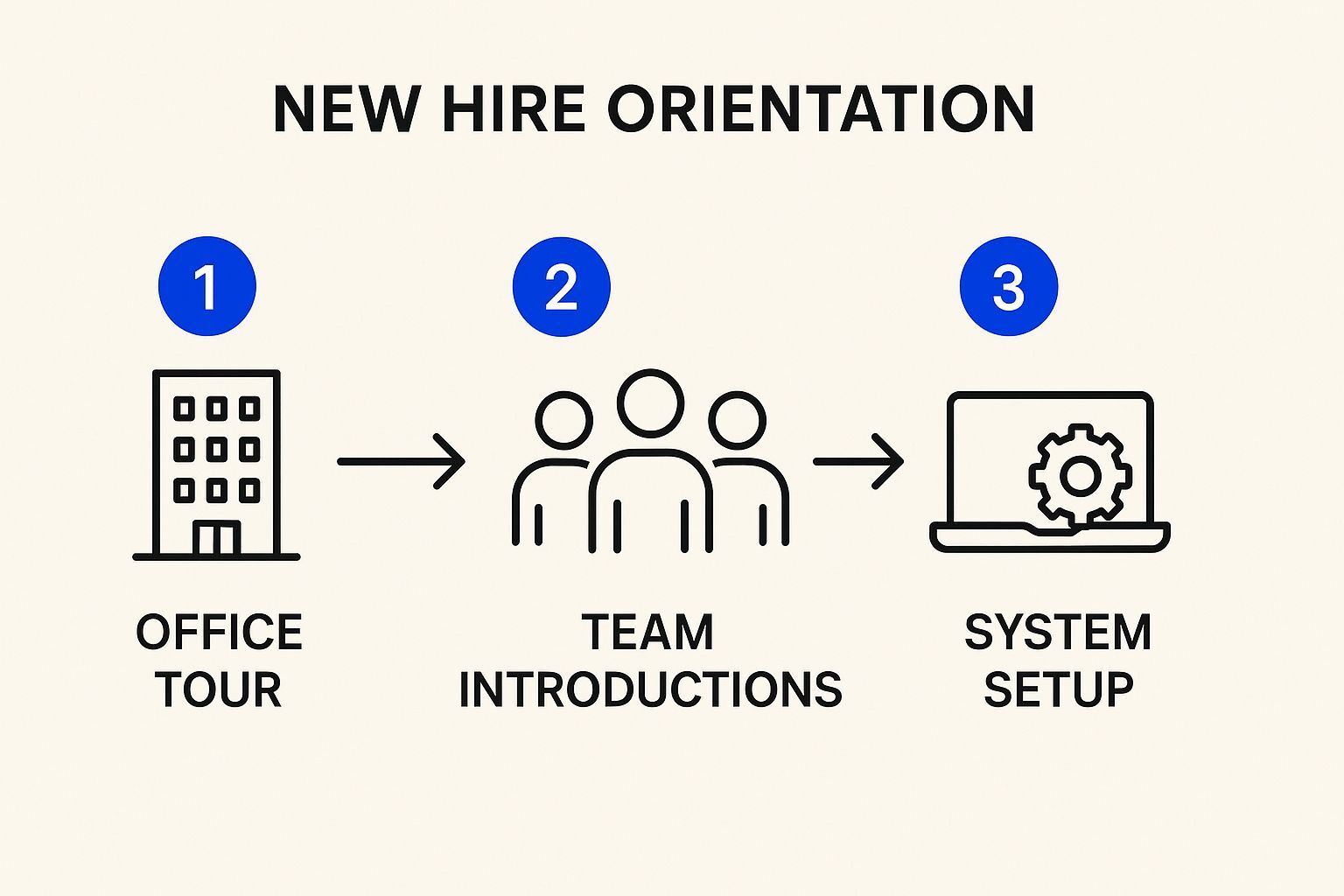
This kind of visual map helps new hires see the key milestones, making the whole process feel structured and manageable. It transforms a long list of tasks into a clear journey.
Creating this blueprint is an investment, but it's one that pays off. Organizations with a standard onboarding process see 50% greater new hire productivity. By documenting each step, you're not just creating paperwork; you're building an asset that directly leads to faster ramp-up times and stronger employee commitment in the long run.
Crafting a Memorable and Effective First Week

The first week is when all your careful planning for the onboarding employee process finally comes to life. This is your moment to make a lasting impression, turning a new hire's nervous energy into genuine excitement. The real art here is balancing the necessary paperwork with genuine human connection.
A schedule packed with back-to-back meetings and mountains of forms is a recipe for burnout. Trust me, I've seen it happen. Instead, you want to structure the week to build momentum gradually. Day one should be light on tasks and heavy on welcomes, setting a friendly and supportive tone right from the start.
The data doesn't lie. A recent study found that only 52% of employees are actually satisfied with their onboarding experience. This isn't just a feel-good metric; it has real consequences. In fact, a staggering 64% of employees are likely to leave within their first year if their onboarding is a mess. You can explore more detailed employee onboarding statistics to see the full picture.
The Power of an Onboarding Buddy
One of the best things you can do to make someone feel at home immediately is to assign them an onboarding buddy. This isn't their manager or a direct supervisor. It's a peer—a friendly face who can offer informal guidance and show them the ropes.
Your onboarding buddy becomes the go-to person for all the "unwritten rules" of the office, like:
- Knowing when to use Slack versus sending an email.
- Decoding the team's inside jokes and project codenames.
- Answering those small questions a new hire might feel too shy to ask their manager.
This simple relationship is incredibly powerful. It helps new team members feel socially connected and psychologically safe, which massively accelerates how quickly they feel like they belong. It transforms what could be an isolating week into a genuinely welcoming one.
Structuring Meaningful Interactions
While a buddy provides that crucial informal support, you can't leave interactions with the manager and team to chance. These meetings need to be just as intentional.
I've found that short, focused one-on-ones work best. A quick 15-minute daily check-in with the manager can provide a world of clarity and reassurance. Beyond that, schedule 30-minute intro chats with key team members. These aren't interviews; they're casual conversations to understand who does what and how they'll all work together.
The goal of these initial meetings isn't to talk about projects; it's to build rapport. Personal connection is the foundation upon which professional trust is built.
Assigning a Confidence-Building First Project
By the end of the week, you want your new hire to feel a sense of accomplishment. The quickest way to get there? Assign them a small, low-risk, and totally achievable first project. This "early win" does wonders for their confidence and shows them they can add value right away.
This task shouldn't require a deep dive into company history. It could be as simple as:
- Reviewing a piece of documentation and offering fresh-eyed feedback.
- Fixing a minor, well-documented bug in the code.
- Doing some introductory research on a new topic or competitor.
Completing that first task proves to the new hire—and to the rest of the team—that they are capable and ready for bigger challenges. It's a small victory, but it's a powerful step in their journey from newbie to a fully integrated team member.
Using Technology to Enhance the Human Experience
Let's be honest: a manual onboarding employee process is a gamble. It hinges on managers remembering every single detail, every time. That's a recipe for inconsistency, missed steps, and a disjointed experience for your new hire.
The right technology, however, can provide a solid framework without stripping away the personal touch that truly makes someone feel welcome.
Instead of greeting a new team member with a mountain of paperwork, what if you could offer a guided digital journey? Using a modern knowledge management platform, you can build a single, centralized hub for every piece of onboarding material. This gives new hires one place to find answers, anytime they need them.
This isn’t just a nice-to-have; it's a serious business move. The global market for employee onboarding software is on track to hit $1.34 billion by 2025, and for a good reason. Most new hires decide within their first month if they see a future with a company. The stakes are high. You can discover more insights about employee onboarding statistics from deel.com to see just how critical this initial period is.
Creating Guided Learning Paths
With the right tech, you can stop treating onboarding like a one-off event and start designing it as a self-paced learning path. This allows you to drip-feed content exactly when it's needed, preventing that dreaded feeling of information overload.
For instance, a new hire’s first day could unlock modules covering company culture and setting up essential tools. By the end of their first week, they might get access to key project workflows and team communication standards. It's all about delivering information that's immediately relevant and actionable.
- Day 1-3: Focus on the fundamentals—company values, team introductions, and communication tools.
- Week 1: Introduce role-specific processes and assign a small, low-stakes introductory task to build confidence.
- First 30 Days: Unlock deeper training on more complex systems and long-term project goals.
This structured approach not only empowers new hires to take charge of their own learning but also gives managers a clear line of sight into their progress through simple checklists and completion tracking.
The real magic of technology in onboarding isn't about replacing human interaction. It's about automating the tedious admin work so your team has more time for what actually matters: mentorship, meaningful feedback, and making a new person feel like part of the culture.
Streamlining Technical Training
This tech-centric approach is a game-changer for technical roles where following a process to the letter is non-negotiable. When you document every step in a system like Whale, you ensure new developers or IT specialists are following best practices from the moment they start. It cuts out the guesswork and drastically reduces the risk of costly mistakes.
Beyond just documenting your internal practices, specific tools can make the technical side of onboarding even smoother. It's worth exploring how merge queues can ease newcomers' onboarding to see how you can automatically enforce best practices in a development environment.
By combining a centralized knowledge base with smart, automated workflows, you're not just creating an onboarding process—you're building a scalable and repeatable system. This is how you guarantee that every new hire, no matter their team or location, gets a consistent, high-quality experience that sets them up for success from day one.
Measuring and Improving Your Onboarding Process

Let’s be real: creating a great onboarding employee process isn't a "set it and forget it" task. The best programs are living, breathing systems that evolve and get better with time. But how do you make that happen? You have to stop guessing what works and start gathering actual data and feedback to guide your improvements. One key to enhancing this process is identifying efficient onboarding strategies for businesses that have proven successful across various industries. Implementing proven frameworks can streamline training and increase employee engagement from day one. By continually assessing and adjusting these strategies based on employee experiences, you can create a more effective onboarding journey that sets the stage for long-term success.
This data-driven approach does more than just fine-tune your process; it turns onboarding from a simple administrative chore into a strategic powerhouse. When you can walk up to leadership and show them exactly how your process impacts retention and productivity, getting buy-in for future resources becomes a whole lot easier. This is how you build a true culture of continuous improvement.
Key Metrics to Track
You can't fix what you can't see. Vague feelings about how onboarding is "going" just don't cut it. To get a real pulse on your program's health, you need to focus on a handful of key performance indicators (KPIs) that tell a clear story.
Here are the essentials I always recommend starting with:
- New Hire Satisfaction Scores: Are your new people feeling supported, engaged, and set up for success? A simple survey is the most direct way to get into their heads and understand their experience.
- Time-to-Productivity: How long does it actually take for a new hire to start contributing meaningfully to their team? A shorter ramp-up time is one of the clearest signs of an effective onboarding process.
- 90-Day Retention Rate: This one is the ultimate test. If you're consistently losing new hires within their first three months, it's a massive red flag that something in your onboarding is broken.
Tracking these numbers gives you a solid baseline. It lets you spot trends, pinpoint bottlenecks, and celebrate the areas where your efforts are truly paying off. For a deeper look at this, check out our full guide on how to measure your employee onboarding process.
Building an Effective Feedback Loop
Metrics tell you what is happening, but honest feedback from your new hires tells you why. Setting up a structured feedback loop is your secret weapon for gathering those crucial, actionable insights. In my experience, short, anonymous surveys are the most effective way to do this.
Don't wait until the 90-day mark to ask for feedback. By then, it's often too late. Regular check-ins show new hires you care about their experience and give you a chance to fix small issues before they become big problems.
Consider sending out brief surveys at key milestones in their journey. A simple, consistent schedule makes all the difference.
A Simple Survey Schedule
| Milestone | Purpose of Feedback |
|---|---|
| Day 7 | Check first impressions. Was the initial setup smooth? Did they feel welcomed? |
| Day 30 | Gauge role clarity and training progress. How are they integrating with the team? |
| Day 90 | Assess overall satisfaction, confidence in their role, and their sense of belonging. |
This regular cadence of feedback provides invaluable qualitative data. It helps you pinpoint exactly which parts of your process are hitting the mark and which ones need a rethink. When you combine this with your hard metrics, you get the complete picture—empowering you to make smart, targeted improvements that strengthen your entire onboarding system from the ground up.
Got Questions About Onboarding? We've Got Answers
Even the most buttoned-up onboarding plan will have a few wrinkles to iron out. It's just part of the process. I've seen managers wrestle with everything from engaging remote hires to proving the program's ROI. Let's dig into a few of the most common questions that pop up.
How Do You Make Onboarding Engaging for Remote Employees?
This is a huge one, especially since nearly 80% of employees are looking for hybrid or fully remote jobs. When you can't rely on the natural buzz of an office, you have to be much more intentional about creating connection.
It starts with the small things. Don't just ship a laptop and call it a day. Send a thoughtful welcome kit—think company swag, a nice notebook, and maybe a gift card to their favorite local coffee shop. It’s a small gesture that makes a massive first impression.
You also need to engineer social time. Schedule a virtual team lunch where everyone gets a food delivery gift card, or run a quick online trivia game.
For remote hires, structured social time isn't just a "nice-to-have." It’s absolutely critical for building the trust and easy rapport that in-office teams often develop by just being around each other.
What’s the Best Way to Keep the Process from Being Boring?
Let's be honest: a lot of onboarding programs are a total snooze-fest. In fact, a whopping 58% of organizations admit their process is mostly just paperwork and administrative tasks. That's a guaranteed way to make your new hire's eyes glaze over.
The trick is to break up the monotony. Mix the necessary evils (like I-9s and benefits forms) with genuinely interactive and human elements. Here’s a simple way to think about it:
- Get the paperwork out of the way early. Use employee self-onboarding software so they can tackle forms before their first day even starts.
- Give them an onboarding buddy. This is their go-to person for all the "silly" questions they're afraid to ask their manager.
- Schedule casual 1-on-1s. Book short, informal video calls with key people on the team throughout the first week. No agenda, just a chat.
When you spread out the boring stuff and prioritize human connection, the entire experience becomes more memorable and, frankly, more effective. For a ton more ideas, our employee onboarding checklist is packed with actionable steps.
How Long Should an Onboarding Process Really Last?
One of the biggest mistakes I see companies make is thinking of onboarding as a one-day or one-week thing. All the data points to the same conclusion: longer, more structured onboarding gets better results. A great process should really cover the new hire’s first 90 days.
Now, that doesn't mean you're holding their hand for three straight months. It’s more about structured phases.
- The First Week: This is all about connection, culture, and getting them set up with the basic tools.
- The First 30 Days: Now you can start diving into role-specific training and giving them their first real tasks.
- Days 30-90: This phase is about fostering independence. They should be making real contributions, getting regular feedback, and working toward their first set of performance goals.
This extended timeline gives people the breathing room they need to actually absorb information, build real confidence, and settle into their role and the company culture. It’s an investment that pays off big time in retention and performance down the road.