
Unlocking Peak Performance: Streamlining Your Business Processes
Want to boost efficiency, reduce costs, and improve quality? This listicle presents seven key process optimization strategies to achieve precisely that. Learn how methodologies like Lean Manufacturing, Six Sigma, and Kaizen can transform your operations. We'll cover the core principles, benefits, and potential drawbacks of each approach, offering actionable insights for immediate application. Understanding and implementing effective process optimization strategies is crucial for any business seeking to improve its bottom line and maintain a competitive edge in 2025.
1. Lean Manufacturing
Lean manufacturing is a powerful process optimization strategy that systematically minimizes waste while maximizing productivity within a manufacturing system. Its core focus lies in delivering maximum value to the customer by identifying and eliminating non-value-added activities (waste) and streamlining workflow through continuous improvement. This approach deserves a prominent place in any discussion of process optimization due to its proven ability to significantly enhance efficiency, quality, and customer satisfaction.
At the heart of lean manufacturing are five core principles:
- Define Value: Understand precisely what the customer values and tailor all processes to deliver that value efficiently.
- Map the Value Stream: Visually represent every step in the production process, from raw materials to finished goods, to identify areas of waste.
- Create Flow: Ensure a smooth and uninterrupted flow of materials and information throughout the entire value stream.
- Establish Pull: Produce goods only when they are needed by the customer, minimizing inventory and maximizing responsiveness.
- Pursue Perfection: Strive for continuous improvement by constantly seeking ways to eliminate waste and enhance value.
Lean manufacturing emphasizes just-in-time production, a system that minimizes inventory by producing goods only when they are needed. This, combined with a continuous improvement culture known as Kaizen, allows organizations to adapt to changing customer demands and market conditions quickly. Waste elimination is targeted across seven key categories: transportation, inventory, motion, waiting, over-production, over-processing, and defects.
Implementing lean manufacturing offers numerous benefits:
- Reduced operational costs: Streamlining processes and minimizing waste typically leads to cost reductions of 15-25%.
- Improved quality and customer satisfaction: By focusing on value and eliminating defects, lean manufacturing delivers higher quality products and increases customer satisfaction.
- Increased employee engagement: Lean empowers employees to identify and solve problems, leading to greater engagement and ownership.
- Faster delivery times and improved cash flow: Reduced lead times and optimized inventory contribute to faster delivery and improved cash flow.
However, adopting lean manufacturing also presents some challenges:
- Cultural change: Lean requires a significant shift in organizational culture, demanding buy-in and commitment from all employees.
- Initial disruption: Implementation can be disruptive initially, requiring adjustments to existing processes and workflows.
- Suitability: Lean may not be suitable for all industries or processes, particularly those with highly variable demand or long lead times.
- Ongoing commitment: Lean is not a one-time fix; it requires ongoing commitment, resources, and continuous improvement efforts.
The success of lean manufacturing is well documented. The Toyota Production System, pioneered by Taiichi Ohno, famously reduced inventory levels by 75%. Boeing leveraged lean principles on its 737 production line to increase the production rate by 42%. Even outside of manufacturing, organizations like the Virginia Mason Medical Center have utilized lean principles to reduce patient wait times by a remarkable 85%.
To successfully implement lean manufacturing, consider these tips:
- Start with value stream mapping: This exercise helps visualize the entire process and identify key areas of waste.
- Begin with pilot projects: Focus on specific areas to demonstrate the benefits of lean before scaling across the entire organization.
- Train employees: Ensure all employees understand lean principles and their roles in the process.
- Use visual management tools: Tools like Kanban boards provide real-time visibility into workflow and inventory levels.
- Measure and track: Consistently monitor key performance indicators (KPIs) to track progress and identify areas for improvement.
The following infographic illustrates the first three crucial steps in initiating a lean transformation.
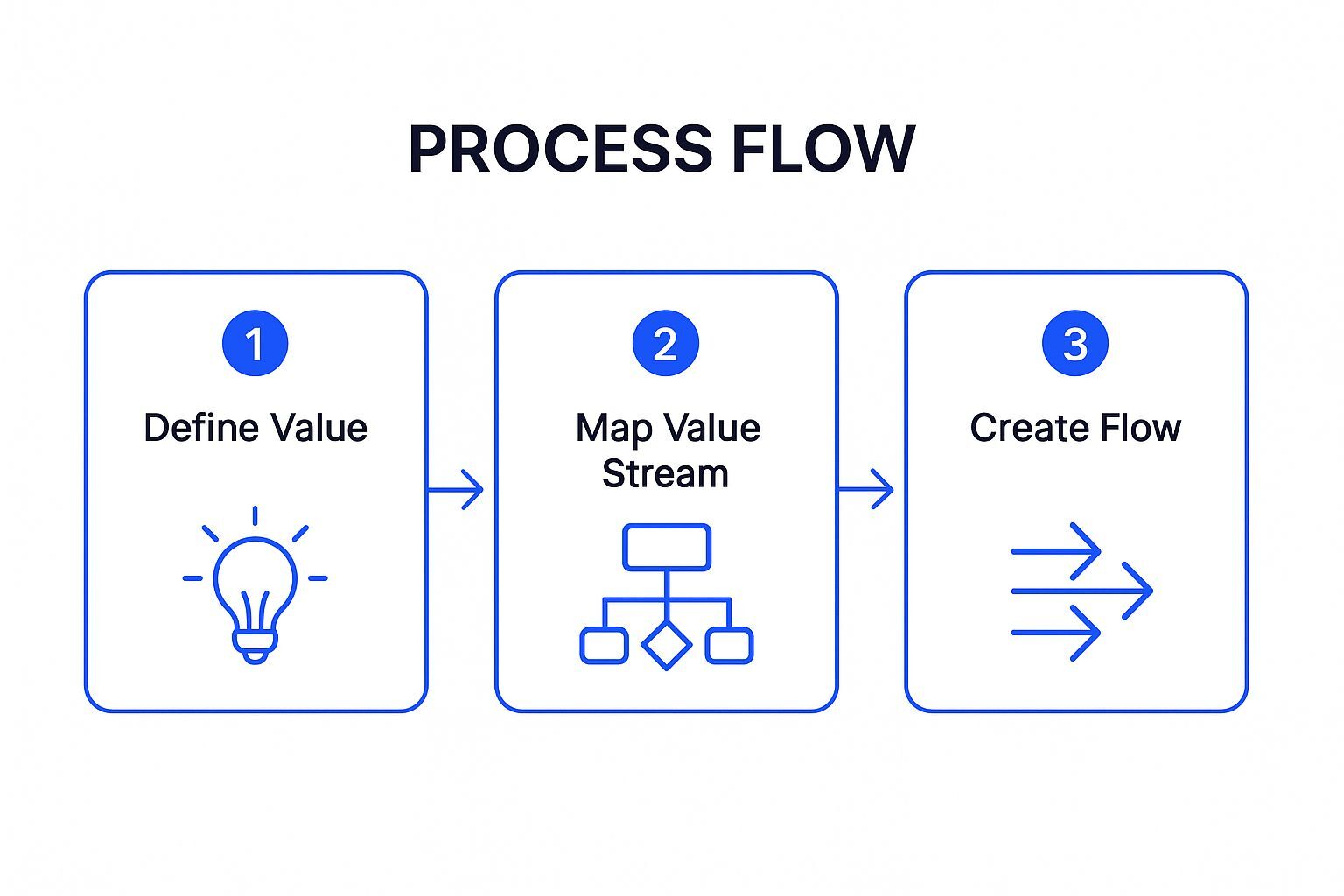
These initial steps establish the foundation for a successful lean implementation, ensuring a clear understanding of customer value and paving the way for streamlined processes.
Lean manufacturing, popularized by figures like Taiichi Ohno, James Womack, Daniel Jones, and Shigeo Shingo, is a proven strategy for achieving operational excellence. While it requires commitment and ongoing effort, the potential rewards in terms of cost reduction, quality improvement, and customer satisfaction make it a compelling option for organizations seeking to optimize their processes.
2. Six Sigma
Six Sigma is a powerful, data-driven methodology for process optimization that focuses on eliminating defects and achieving near-perfect quality. Its core principle revolves around minimizing variability in processes to deliver consistent, high-quality outputs. By employing statistical analysis and a structured approach, Six Sigma aims to achieve a defect rate of no more than 3.4 defects per million opportunities (DPMO). This translates to a 99.99966% success rate, setting a high bar for process performance. Six Sigma is particularly well-suited for organizations looking to significantly improve quality, reduce costs, and boost customer satisfaction. It’s a rigorous approach to process optimization that goes beyond simply identifying problems; it provides a framework for understanding the root causes of defects and implementing sustainable solutions.

At the heart of Six Sigma is the DMAIC cycle – Define, Measure, Analyze, Improve, and Control. This five-phase framework provides a structured roadmap for process improvement projects. In the Define phase, the project scope, goals, and customer requirements are clearly defined. The Measure phase involves collecting data to understand the current state of the process and establish baseline performance metrics. During the Analyze phase, the collected data is analyzed to identify the root causes of defects and variations. The Improve phase focuses on developing and implementing solutions to address the identified root causes. Finally, the Control phase involves establishing monitoring mechanisms and control plans to ensure that the improvements are sustained over time and prevent regression.
Six Sigma also utilizes a "Belt" system to denote different levels of expertise and certification, including Green Belt, Black Belt, and Master Black Belt. This structured approach to training and certification ensures that practitioners possess the necessary skills and knowledge to effectively apply the Six Sigma methodology.
Why Use Six Sigma for Process Optimization?
Six Sigma deserves its place on any list of process optimization strategies due to its proven ability to deliver substantial improvements in quality and efficiency. It offers a structured, data-driven approach that minimizes guesswork and promotes objective decision-making. This method is particularly beneficial for organizations operating in highly regulated industries or those with complex processes where even small errors can have significant consequences.
Benefits of Six Sigma:
- Significant Quality Improvements and Defect Reduction: By focusing on reducing variation, Six Sigma helps organizations achieve dramatic reductions in defects and improve overall product/service quality.
- Data-Driven Decision Making: The reliance on data and statistical analysis ensures that decisions are based on facts rather than intuition, leading to more effective solutions.
- Strong ROI: Six Sigma projects often deliver substantial returns on investment, typically ranging from $150,000 to $300,000 per project.
- Develops Analytical Thinking Across the Organization: The implementation of Six Sigma promotes a culture of data-driven decision-making and analytical thinking across all levels of the organization.
Drawbacks of Six Sigma:
- Can be Complex and Resource-Intensive: Implementing Six Sigma can require significant investment in training, software, and personnel.
- May Lead to Over-Analysis and Slower Decision Making: In some cases, the emphasis on data analysis can lead to delays in decision-making.
- Requires Extensive Training and Certification: The "Belt" system, while beneficial, can be time-consuming and expensive.
- Less Effective for Creative or Innovation Processes: The structured nature of Six Sigma may not be well-suited for highly dynamic or creative processes.
Examples of Successful Six Sigma Implementation:
- General Electric: Under Jack Welch's leadership, GE implemented Six Sigma across the company, resulting in over $12 billion in savings over five years.
- Motorola: Motorola, one of the pioneers of Six Sigma, significantly reduced defect rates by 99.7%, resulting in substantial cost savings and improved product reliability.
- Bank of America: By applying Six Sigma principles, Bank of America streamlined its mortgage processing time from 60 days to just 15 days.
Tips for Successful Six Sigma Implementation:
- Select projects with clear, measurable outcomes: Focus on processes where improvements can be easily quantified and tracked.
- Ensure strong leadership support and sponsorship: Executive buy-in is crucial for securing resources and driving adoption.
- Use statistical software tools for data analysis: Leverage specialized software to simplify data analysis and reporting.
- Focus on customer-critical processes first: Prioritize processes that directly impact customer satisfaction.
- Combine with Lean methodologies for maximum impact: Integrating Six Sigma with Lean principles can create a powerful synergy for optimizing processes and eliminating waste.
By understanding the principles, benefits, and potential drawbacks of Six Sigma, organizations can effectively leverage this methodology to achieve significant improvements in process performance, quality, and customer satisfaction.
3. Business Process Reengineering (BPR)
Business Process Reengineering (BPR) is a radical process optimization strategy that involves fundamentally rethinking and redesigning core business processes to achieve dramatic improvements in performance metrics such as cost, quality, service, and speed. Unlike incremental process improvement methodologies, BPR aims for a complete overhaul, discarding outdated practices and embracing innovative solutions. It challenges the status quo and conventional wisdom, asking “Why do we do it this way?” instead of simply “How can we do it better?” This makes BPR a powerful tool for organizations seeking significant leaps in efficiency and effectiveness, rightfully earning it a place amongst essential process optimization strategies.
BPR is fundamentally process-oriented rather than function-oriented. Traditional organizations often structure themselves around departments like marketing, sales, and manufacturing. BPR, however, analyzes processes that cut across these departmental boundaries, such as order fulfillment or product development. By focusing on the flow of work, BPR identifies bottlenecks, redundancies, and non-value-added activities that hinder overall performance.
Technology enablement plays a crucial role in BPR initiatives. It's not just about automating existing processes; it's about leveraging technology to completely transform how work is done. For example, implementing enterprise resource planning (ERP) systems can integrate information and automate workflows across different departments, streamlining operations and improving decision-making. Similarly, advancements in areas like artificial intelligence and machine learning can be leveraged to automate complex tasks and provide valuable insights.
Customer-focused outcomes are central to BPR. The redesigned processes should aim to deliver greater value to customers, whether that means faster service, higher quality products, or more personalized experiences. By understanding customer needs and expectations, BPR initiatives can ensure that the organization is aligned with its market demands.
Benefits and Drawbacks of BPR
BPR offers the potential for substantial improvements, sometimes exceeding 100% in key performance indicators. It can eliminate redundant and non-value-added activities, significantly reducing operational costs. Furthermore, BPR enables organizations to leverage technology for a competitive advantage, optimizing processes for speed, efficiency, and innovation. By aligning processes with strategic objectives, BPR helps organizations stay ahead of the curve in a rapidly changing business environment.
However, BPR is not without its risks. It has a high failure rate, often cited as between 60-70%. This is often attributed to poor planning, inadequate communication, and resistance to change within the organization. BPR can be highly disruptive to the organization and its employees, requiring significant investment in resources, training, and change management. Implementing BPR can also encounter strong resistance from employees accustomed to existing ways of working.
Real-World Successes
Despite the risks, successful BPR implementations can yield remarkable results. Ford Motor Company famously reduced its accounts payable staff by 75% through a BPR initiative that streamlined invoice processing. IBM Credit Corporation dramatically reduced loan approval time from seven days to four hours by redesigning its credit application process. And Taco Bell redesigned its kitchen operations, shifting food preparation to centralized commissaries, which increased efficiency by 30%.
Actionable Tips for BPR Implementation
For organizations considering BPR, these tips can increase the likelihood of success:
- Secure leadership buy-in: Strong CEO and senior management commitment is crucial for driving the necessary changes and overcoming resistance.
- Focus on strategic processes: Start with processes that are broken or critical to the organization's strategic objectives.
- Build cross-functional teams: Involve employees from different departments to ensure diverse perspectives and buy-in.
- Leverage technology strategically: Use technology as an enabler of change, not just for automating existing processes.
- Communicate effectively: Clearly communicate the vision and benefits of BPR to all stakeholders throughout the process.
When to Consider BPR
BPR is most appropriate when an organization faces significant performance challenges, disruptive market forces, or opportunities for radical innovation. It's not a quick fix or a band-aid solution; it's a transformational undertaking that requires commitment, resources, and a willingness to embrace change.
Learn more about Business Process Reengineering (BPR) This resource can provide further insights into BPR and related process optimization strategies. As businesses navigate an increasingly competitive landscape, understanding and applying these strategies effectively can be the key to sustainable success. BPR, when implemented thoughtfully and strategically, can unlock significant value and drive transformative change. This approach, popularized by thinkers like Michael Hammer, James Champy (authors of 'Reengineering the Corporation'), and Thomas Davenport (process innovation expert), has proven its potential to revolutionize operations across diverse industries, making it a critical consideration for any organization seeking substantial process optimization.
4. Total Quality Management (TQM)
Total Quality Management (TQM) is a comprehensive, organization-wide approach to process optimization strategies that seeks to improve quality in every facet of a business. It’s not merely a set of tools or a short-term project, but a fundamental shift in management philosophy that emphasizes continuous improvement, customer satisfaction, and employee involvement. TQM recognizes that quality is everyone's responsibility, from the CEO to the frontline worker, and integrates quality principles into every business process. By prioritizing continuous improvement and customer focus, TQM helps organizations enhance efficiency, reduce costs, and achieve a sustainable competitive advantage. This makes it an invaluable process optimization strategy for businesses of all sizes, particularly those in competitive or regulated industries.
At the heart of TQM lies the belief that consistent quality improvements require a systemic approach. It involves meticulously examining every process, identifying areas for improvement, implementing changes, and continuously monitoring the results. This iterative cycle of planning, doing, checking, and acting (PDCA cycle), also known as the Deming cycle, is crucial for sustained success. TQM also emphasizes proactive measures to prevent defects rather than reactive measures to correct them, leading to significant cost savings and enhanced customer satisfaction.
How TQM Works in Practice:
TQM functions by embedding a culture of quality throughout the organization. This is achieved through several key features:
- Organization-wide commitment to quality: Leadership must champion TQM and demonstrate a visible commitment to quality. This includes establishing clear quality objectives, providing resources for quality initiatives, and fostering a culture that values continuous improvement.
- Customer focus as the primary driver: TQM prioritizes understanding and meeting customer needs. Organizations gather customer feedback, analyze customer data, and use this information to drive process improvements that enhance customer satisfaction.
- Continuous improvement mindset: TQM promotes a culture of constant improvement. Employees are encouraged to identify areas for improvement, propose solutions, and implement changes.
- Employee empowerment and involvement: TQM recognizes that employees are the key to quality improvement. Organizations empower employees to take ownership of quality, providing them with the training, tools, and authority to make improvements in their work areas.
- Fact-based decision making: TQM relies on data and analysis to drive decision-making. Organizations collect data on key performance indicators (KPIs) and use this data to identify trends, track progress, and make informed decisions about process improvements.
Examples of Successful TQM Implementation:
Several prominent organizations have successfully implemented TQM principles, achieving significant improvements in quality, efficiency, and customer satisfaction.
- McDonald's: Their standardized processes for food preparation and service ensure consistent quality and customer experience worldwide, a cornerstone of their global success.
- 3M: Their strong focus on innovation and a deep-rooted quality culture have led to thousands of patents and a diverse range of high-quality products.
- Ritz-Carlton: Their commitment to service quality excellence has earned them numerous quality awards and established them as a leader in the hospitality industry.
Actionable Tips for Implementing TQM:
- Start with leadership commitment and vision setting: Secure buy-in from top management and clearly articulate the organization's quality vision.
- Implement comprehensive training programs for all employees: Equip employees with the knowledge and skills necessary to understand and implement TQM principles.
- Use quality circles and cross-functional teams: Encourage collaboration and problem-solving by forming teams focused on specific quality improvement projects.
- Establish clear quality metrics and regular monitoring: Define key performance indicators (KPIs) and track progress towards quality objectives.
- Recognize and reward quality achievements: Celebrate successes and acknowledge employee contributions to reinforce the importance of quality.
Pros and Cons of TQM:
Pros:
- Improves customer satisfaction and loyalty
- Enhances employee morale and engagement
- Reduces costs through prevention rather than correction
- Creates a sustainable competitive advantage
Cons:
- Requires long-term commitment and patience
- Can be difficult to measure immediate ROI
- May become bureaucratic if not properly managed
- Requires a cultural transformation, which can be time-consuming
When and Why to Use TQM:
TQM is particularly beneficial for organizations operating in competitive industries or those facing increasing customer demands for quality. It's a suitable process optimization strategy when:
- Customer satisfaction is a top priority.
- There's a need to reduce costs and improve efficiency.
- The organization is committed to continuous improvement.
- There's a desire to build a strong quality culture.
TQM, though requiring a significant investment of time and resources, offers substantial returns in terms of improved quality, increased efficiency, enhanced customer satisfaction, and a strengthened competitive position. It's a proven approach to process optimization that can transform an organization's performance and drive sustainable success. Its focus on continuous improvement, customer-centricity, and employee empowerment sets the foundation for long-term growth and profitability.
5. Agile Process Optimization
Agile process optimization stands out as a dynamic and iterative approach to process improvement, placing a premium on flexibility, collaboration, and rapid adaptation to change. While initially conceived for software development, the core principles of Agile have proven remarkably versatile, extending their reach to diverse business processes across various industries. This methodology empowers organizations to accelerate delivery cycles and cultivate a culture of continuous optimization. Unlike traditional, linear approaches, Agile embraces change as an opportunity rather than an obstacle. It acknowledges the evolving nature of business environments and provides a framework to respond effectively. This responsiveness contributes significantly to faster time-to-market, a crucial advantage in today’s competitive landscape.

At the heart of Agile lies the concept of iterative and incremental improvement. Processes are broken down into smaller, manageable cycles (often called “sprints”), allowing teams to focus on delivering working solutions in shorter intervals. This iterative nature fosters continuous learning and improvement, as teams regularly review their performance, gather feedback, and adapt their approach for the next cycle. This is complemented by the formation of cross-functional, self-organizing teams. These teams are empowered to make decisions and take ownership of the process, promoting a sense of shared responsibility and boosting overall morale. Regular retrospectives, a key component of Agile, encourage teams to reflect on what went well, what could be improved, and how to implement those improvements in subsequent sprints.
The benefits of adopting an Agile approach are substantial. Faster time-to-market and delivery allows businesses to respond quickly to market demands and gain a competitive edge. The inherent adaptability of Agile methodologies equips teams to handle changing requirements with ease, minimizing disruption and maximizing efficiency. Moreover, Agile fosters improved team collaboration and communication, creating a more cohesive and productive working environment. A culture of continuous learning and improvement becomes ingrained within the organization, driving innovation and pushing the boundaries of what’s possible. Learn more about Agile Process Optimization and explore the range of workflow management software available to support your Agile implementation.
However, Agile isn't a one-size-fits-all solution. It requires a high level of team maturity and discipline to function effectively. Predictability in timelines and outcomes can be challenging, especially in the initial stages of implementation. While Agile thrives on flexibility, this can sometimes lead to scope creep if not managed carefully. Furthermore, Agile might not be suitable for all types of processes or industries, particularly those with highly rigid regulatory requirements or where precise predictability is paramount. Scaling Agile across large organizations can also present complexities, requiring significant organizational change and buy-in from all levels.
Several real-world examples demonstrate the power of Agile. Spotify, renowned for its innovative organizational structure, utilizes an Agile model with "squads" and "tribes" to foster autonomy and collaboration. ING Bank underwent a large-scale Agile transformation, resulting in significant improvements in speed and efficiency. Even in manufacturing, companies like Haier have successfully adopted self-managed teams inspired by Agile principles to streamline appliance production.
For organizations considering implementing Agile process optimization, several key tips can pave the way for success:
- Start small: Begin with a pilot project involving a small, cross-functional team. This allows you to test the waters, gather feedback, and refine your approach before scaling across the organization.
- Regular reviews and retrospectives: Implement regular sprint reviews to assess progress and gather customer feedback. Conduct retrospectives to identify areas for improvement within the team’s process.
- Customer-centric approach: Maintain a laser focus on customer value and feedback. Ensure that customer needs are prioritized throughout the development process.
- Visual management tools: Utilize visual management tools like Scrum boards to track progress, identify bottlenecks, and promote transparency within the team.
- Embrace experimentation: Foster a culture of experimentation and learn from failures. Agile thrives on continuous improvement, and embracing experimentation is crucial to this process.
Agile process optimization offers a powerful framework for businesses seeking to enhance efficiency, adaptability, and collaboration. By understanding its principles, benefits, and limitations, organizations can make informed decisions about whether Agile is the right fit for their specific needs and context. When implemented effectively, Agile can be a game-changer, driving significant improvements in process performance and fostering a culture of continuous innovation.
6. Theory of Constraints (TOC)
The Theory of Constraints (TOC) is a powerful process optimization strategy that deserves a prominent place on any improvement team’s toolkit. It offers a focused approach to identifying and systematically eliminating bottlenecks that hinder overall system performance. Unlike other process improvement methodologies that may spread efforts across multiple areas, TOC concentrates on the single most critical constraint, offering a targeted approach for maximizing impact. This makes it particularly valuable for organizations seeking significant gains with focused effort, from scaling startups to large enterprises in regulated industries. Whether you’re an operations manager, a process improvement specialist, or part of a human resources team seeking to streamline training, understanding and applying TOC can unlock substantial performance improvements.
At its core, TOC operates on the principle that any system’s output is limited by its weakest link – the constraint. This could be a physical bottleneck like a slow machine in a manufacturing plant, a policy bottleneck such as a lengthy approval process, or even a knowledge bottleneck where a lack of specific expertise slows down a team. TOC provides a clear framework for identifying this constraint and systematically improving its performance, thereby improving the performance of the entire system. This system thinking approach distinguishes TOC from other methodologies that might focus on local optimizations which may not contribute to overall system improvement. Instead of striving for local efficiency, TOC emphasizes improving throughput, which is the rate at which the system generates money through sales.
TOC utilizes a five-step focusing process often referred as the “Five Focusing Steps”:
-
Identify the Constraint: The first step involves pinpointing the system's bottleneck. This requires a thorough understanding of the entire process flow and careful analysis of each step to determine the one that restricts overall output. Process mapping and data analysis are crucial tools in this stage.
-
Exploit the Constraint: Once identified, the constraint's capacity should be maximized without significant investment. This might involve optimizing its operating schedule, reducing downtime, or improving the quality of its input. The goal is to squeeze every bit of performance out of the existing constraint.
-
Subordinate Everything Else to the Constraint: All other processes in the system should be subordinated to the constraint’s pace. This prevents non-constraints from overproducing and creating unnecessary inventory, ensuring that the entire system works in sync with the constraint's capacity. This step highlights TOC’s focus on system-level optimization rather than individual process efficiency.
-
Elevate the Constraint: If exploiting and subordinating haven't achieved the desired throughput, this step involves investing in improvements to the constraint. This could mean purchasing new equipment, adding staff, or redesigning the process around the constraint.
-
Repeat the Process: Once the original constraint is resolved, another constraint will inevitably emerge. The Five Focusing Steps then restart, ensuring continuous improvement and preventing complacency. This cyclical nature makes TOC a dynamic and adaptable approach to process optimization.
The benefits of TOC are significant. It provides a clear focus for improvement efforts, avoiding scattered initiatives that deliver minimal impact. Its relative simplicity makes it easy to understand and apply across various departments and industries, from IT and logistics to finance and manufacturing. Furthermore, TOC can deliver quick wins and measurable results, demonstrating the value of the methodology and encouraging further adoption. Real-world examples abound, demonstrating the power of TOC. Ford Motor Company improved plant throughput by 20%, the Israeli Air Force reduced aircraft maintenance time by 50%, and Lucent Technologies increased production capacity without significant capital investment, all by applying the principles of TOC.
However, TOC isn’t without its potential drawbacks. It can sometimes oversimplify complex systems, and if not properly applied, it carries the risk of sub-optimization. Because constraints can shift over time, ongoing monitoring is crucial. Additionally, TOC primarily addresses process bottlenecks and may not fully address underlying cultural or organizational issues that can impact performance.
For teams looking to implement TOC, several practical tips can enhance success. Begin by mapping the entire process flow to visually identify potential constraints. Once identified, concentrate all improvement efforts on that constraint. Measure throughput, inventory, and operating expense to track progress and identify shifts in the constraint. Ensure non-constraint processes don't work faster than the constraint, as this can lead to inventory buildup and waste. Finally, anticipate future constraints and prepare solutions before the current constraint is fully resolved, maintaining momentum and ensuring continuous improvement. By understanding the principles of TOC and applying these practical tips, organizations can achieve substantial and sustainable performance gains.
7. Kaizen (Continuous Improvement)
Kaizen, a Japanese term meaning "change for the better," represents a powerful process optimization strategy focused on continuous, incremental improvements. Unlike radical, disruptive changes, Kaizen emphasizes small, ongoing positive adjustments involving everyone from the CEO to frontline employees. This collaborative approach creates a culture of constant enhancement, leading to significant improvements over time. For operations managers, process improvement teams, HR professionals, and businesses across diverse industries—from scaling startups to regulated manufacturing giants—Kaizen provides a sustainable path to enhanced efficiency and effectiveness.
Kaizen operates on the principle that small changes, consistently applied, can yield substantial results. It focuses on eliminating waste (Muda) in all its forms – defects, overproduction, waiting, unnecessary transportation, inventory excess, unnecessary motion, and extra processing. By empowering employees at every level to identify and address these areas of waste, Kaizen fosters a sense of ownership and continuous learning within the organization. This is especially valuable for scaling startups and small to mid-size businesses looking to build agile and adaptable processes.
Several key features distinguish the Kaizen approach:
- Small, Incremental Improvements: Kaizen avoids large-scale overhauls in favor of manageable, bite-sized improvements implemented regularly. This minimizes disruption and facilitates rapid implementation.
- Employee Involvement at All Levels: Kaizen recognizes the value of every employee's perspective. From the shop floor to the executive suite, everyone contributes to identifying opportunities for improvement. This participative approach fosters buy-in and ownership.
- Focus on Eliminating Waste (Muda): Kaizen systematically targets and eliminates all forms of waste, streamlining processes and maximizing resource utilization. This lean thinking is crucial for industries with stringent compliance requirements like manufacturing, finance, and insurance.
- Standardization of Improved Processes: Once improvements are implemented, they are standardized to ensure consistency and prevent backsliding. This is essential for maintaining gains and building a foundation for future improvements.
- Regular Kaizen Events and Workshops: Dedicated events and workshops provide focused opportunities for teams to analyze processes, identify waste, and develop improvement solutions. This focused approach helps teams achieve rapid progress in specific areas.
The benefits of implementing Kaizen are numerous:
- Low Cost and Low Risk Approach: Incremental changes are less expensive and risky than large-scale projects.
- Builds Employee Engagement and Ownership: Kaizen fosters a sense of shared responsibility for process improvement, boosting morale and motivation. This is particularly beneficial for HR and training professionals seeking to build a culture of continuous learning.
- Creates a Sustainable Improvement Culture: Kaizen embeds continuous improvement into the organizational DNA, creating a dynamic and adaptable environment.
- Cumulative Impact Can Be Substantial Over Time: While individual improvements may appear small, their cumulative effect can be transformative, significantly impacting key performance indicators.
However, Kaizen also presents some challenges:
- Results May Be Slow to Materialize: The incremental nature of Kaizen means that significant improvements may take time to emerge.
- Can Be Difficult to Maintain Momentum: Sustaining enthusiasm and engagement over the long term requires ongoing leadership support and reinforcement.
- May Not Address Fundamental Process Flaws: Kaizen is less effective in situations requiring radical process redesign.
- Requires Ongoing Management Support and Resources: Implementing Kaizen successfully requires dedicated resources and sustained commitment from leadership.
The success of Kaizen is well documented. Toyota's adoption of Kaizen principles propelled them to industry leadership, demonstrating the power of continuous improvement. Nestlé reduced energy consumption by 12% through employee suggestions generated by a Kaizen program. Lockheed Martin achieved a 25% improvement in aircraft production efficiency through Kaizen initiatives. These examples highlight the broad applicability and significant impact of Kaizen across diverse industries.
To implement Kaizen effectively, consider the following tips:
- Create suggestion systems for employee ideas: Encourage active participation by providing accessible channels for submitting improvement ideas.
- Hold regular Kaizen events focusing on specific areas: Focus efforts and resources on targeted improvements through dedicated events.
- Celebrate small wins and recognize contributors: Acknowledge and reward contributions to reinforce positive behaviors and maintain momentum.
- Use the Plan-Do-Check-Act (PDCA) cycle: This iterative approach provides a structured framework for implementing and evaluating improvements.
- Make improvements visible through displays and metrics: Showcase progress and demonstrate the tangible benefits of Kaizen to maintain engagement.
Learn more about Kaizen (Continuous Improvement)
Pioneered by individuals like Masaaki Imai (who popularized Kaizen in the West), Taiichi Ohno (architect of the Toyota Production System), and Shigeo Shingo (Toyota efficiency expert), Kaizen provides a proven pathway for organizations seeking to optimize their processes and achieve sustainable competitive advantage. By embracing the philosophy of continuous improvement, businesses can create a culture of innovation, enhance efficiency, and drive long-term success. For IT, warehouse, and logistics operations teams dealing with complex processes and ever-evolving demands, Kaizen offers a particularly powerful approach to process optimization.
Process Optimization Strategies Comparison
| Strategy | Implementation Complexity 🔄 | Resource Requirements ⚡ | Expected Outcomes 📊 | Ideal Use Cases 💡 | Key Advantages ⭐ |
|---|---|---|---|---|---|
| Lean Manufacturing | Medium – requires cultural change 🔄 | Moderate – ongoing training & tools ⚡ | Reduced costs (15-25%), improved quality & flow 📊 | Manufacturing, production lines, process optimization | Waste elimination, faster delivery, employee empowerment ⭐ |
| Six Sigma | High – statistical training & DMAIC 🔄 | High – certified personnel & software ⚡ | Near-perfect quality, significant defect reduction 📊 | Quality-critical, data-driven process improvements | Data-driven decisions, strong ROI, quality focus ⭐ |
| Business Process Reengineering (BPR) | Very High – radical redesign, disruptive 🔄 | Very High – investment & senior support ⚡ | Breakthrough improvements (50-100%+), cost & speed 📊 | Large-scale restructuring, technology-driven change | Drastic performance gains, strategic alignment ⭐ |
| Total Quality Management (TQM) | Medium to High – organization-wide culture change 🔄 | Moderate – training & ongoing commitment ⚡ | Improved customer satisfaction, morale, cost reduction 📊 | Comprehensive quality focus across all processes | Sustainable quality culture, employee involvement ⭐ |
| Agile Process Optimization | Medium – iterative, requires team discipline 🔄 | Moderate – empowered teams & tools ⚡ | Faster delivery, adaptability, continuous improvement 📊 | Dynamic environments, software, innovation processes | Flexibility, continuous learning, collaboration ⭐ |
| Theory of Constraints (TOC) | Low to Medium – focus on bottleneck management 🔄 | Low – monitoring tools & management focus ⚡ | Quick wins, improved throughput 📊 | Bottleneck-driven process optimization | Clear focus, quick impact, simple concept ⭐ |
| Kaizen (Continuous Improvement) | Low to Medium – incremental & cultural 🔄 | Low – employee involvement & events ⚡ | Sustainable improvement culture, gradual impact 📊 | Continuous small improvements, employee empowerment | Low cost, employee engagement, lasting culture ⭐ |
Optimizing for Success: Choosing the Right Strategies and Tools
Process optimization isn't a one-size-fits-all endeavor. From Lean Manufacturing's focus on waste reduction to the iterative improvements championed by Kaizen, the strategies discussed in this article offer diverse approaches to enhancing efficiency and effectiveness. Key takeaways include understanding the core principles of each methodology, recognizing the specific challenges they address, and aligning them with your organization's unique context. Whether you're striving for improved quality (TQM), radical change (BPR), or constraint management (TOC), selecting the right process optimization strategies is the first step towards achieving operational excellence.
Mastering these concepts and approaches empowers your organization to achieve significant improvements across various areas, including reduced costs, improved quality, faster turnaround times, and increased employee engagement. The impact of streamlined processes extends beyond operational efficiency; it contributes directly to enhanced customer satisfaction, increased profitability, and a more competitive market position. For example, implementing Six Sigma can significantly reduce defects and improve product quality, leading to increased customer satisfaction and loyalty. Meanwhile, Agile methodologies can help teams adapt quickly to changing market demands and deliver projects faster.
To further streamline your process optimization efforts and maximize the use of your existing resources, consider developing a comprehensive content repurposing strategy. This approach, as outlined by revid.ai's Effective Content Repurposing Strategy to Boost Engagement, allows you to adapt and reuse your valuable content across various platforms and formats, reaching a wider audience and reinforcing your message without starting from scratch each time. This can be especially helpful when training employees on new processes or communicating changes to stakeholders.
Implementing the right process optimization strategies is crucial for achieving your business objectives. Consider your specific needs, industry, and resources when selecting a methodology. For efficient implementation and management of these strategies, explore Whale. Its AI-powered SOP platform helps centralize documentation, streamline training, and ensure consistent execution, driving sustainable improvements across your organization. Request a demo today and discover how Whale can help you optimize for success.
Embarking on the journey of process optimization might seem daunting, but the potential rewards are substantial. By embracing a culture of continuous improvement and selecting the right tools and strategies, your organization can unlock new levels of efficiency, productivity, and ultimately, success.