
A well-crafted SOP for project management is so much more than just a document—it's the playbook that separates predictable success from constant chaos. Think of it as the standardized framework that guides your teams, making sure everyone is on the same page, reducing silly mistakes, and making project outcomes far more reliable. This kind of structured approach can genuinely transform how your company handles everything from tiny tasks to massive, complex initiatives.
Why a Solid SOP Is Your Project Management Advantage

Let's get past the generic benefits and talk about how standardizing your workflows solves real, everyday pain points. How much time is wasted reinventing the wheel for every new project? Or think about the critical knowledge that just walks out the door when a key team member leaves. A practical SOP is your best defense against this kind of institutional memory loss.
You’re not just writing things down; you're building a reusable, scalable system for success. When everyone follows the same process for initiating projects, flagging risks, or communicating with stakeholders, you completely eliminate ambiguity. That clarity gives your team the confidence to execute flawlessly because they know they’re aligned with best practices.
Before we dive deep into the how-to, let's get a high-level view of what a great project management SOP should contain.
Key Components of a Project Management SOP
Here is a quick overview of the essential elements that every effective project management SOP should include. This provides a roadmap for the rest of the guide.
| Component | What It Achieves |
|---|---|
| Project Initiation | Defines how a project officially starts, from idea to approval. |
| Planning & Scoping | Outlines how to define goals, deliverables, timelines, and resources. |
| Execution & Monitoring | Guides the day-to-day work, progress tracking, and quality control. |
| Risk Management | Establishes a process for identifying, assessing, and mitigating risks. |
| Communication Plan | Sets expectations for stakeholder updates, meetings, and reporting. |
| Project Closure | Details the steps for finalizing deliverables, archiving, and post-mortems. |
Each of these components plays a crucial role in creating a comprehensive and actionable playbook for your team.
Driving Consistency and Reducing Errors
Without a defined process, every project manager brings their own habits and methods to the table, which almost always leads to inconsistent outcomes. An SOP establishes that single source of truth, guaranteeing a baseline level of quality and performance across every single project.
This consistency pays off in a few direct ways:
- Faster Onboarding: New hires can get up to speed in a fraction of the time by following a documented playbook.
- Improved Collaboration: Teams just work better together when they share a common language and understanding of the process.
- Reduced Rework: Clear instructions and predefined quality checks minimize mistakes and the expensive revisions that follow.
The data backs this up. It's a bit shocking, but despite all the fancy tools out there, only 23% of organizations actually use dedicated project management software. This tells us that tons of teams are still trying to coordinate complex work through emails and spreadsheets, which makes a documented SOP absolutely vital.
Now, consider that 59% of project managers are juggling up to five projects at once. Without standardized procedures, they're forced to constantly reinvent processes, which dramatically increases the risk of errors and burnout.
A great SOP doesn’t just tell people what to do; it shows them the best way to do it. It captures the collective wisdom of your most successful projects and makes it available to everyone, turning individual expertise into an organizational asset.
Building a Foundation for Scalable Growth
As your organization grows, those informal, ad-hoc processes start to crack under the pressure. What worked for a team of five becomes pure chaos for a team of fifty. An SOP provides the structural foundation you need to scale your operations without sacrificing quality or efficiency along the way.
You can learn more about the powerful benefits of standard operating procedures in our detailed guide. Ultimately, it’s the mechanism that ensures your tenth project runs just as smoothly as your first, creating a predictable and professional experience for your team and your clients.
Preparing to Build Your Project Management SOP
A great project management SOP isn’t created in a vacuum. It’s built on a rock-solid understanding of what's actually happening on the ground in your organization. Before you can standardize anything, you have to get brutally honest about your current processes.
This upfront prep work is what separates a genuinely useful SOP from just another document collecting dust in a shared drive.
First things first, you need to define your scope. It’s tempting to try and boil the entire ocean—to create one master document that covers every single project phase from kickoff to closeout. But trust me, a more focused approach almost always wins.
Ask yourself: Are we tackling the entire project lifecycle, or is there a specific, high-friction area that needs immediate attention? Maybe it's your change request process or how you handle stakeholder reporting. Nailing a narrow scope can deliver a quick win and build the momentum you need for bigger process improvements down the line.
Mapping Your Current Workflows
Next up, you have to map out how your team works right now. The key here is to capture reality, not the ideal version you have in your head. This is a fact-finding mission, plain and simple.
Your goal is to create an honest snapshot of how projects get done, warts and all. That includes all the unofficial workarounds, communication gaps, and frustrating bottlenecks.
To get the full picture, you can:
- Shadow a Project Manager: Spend a day with them. Watch their tasks, sit in on their meetings, and observe how they make decisions.
- Interview the Team: Talk to people in different roles. A developer's perspective on the workflow will be vastly different from a designer's, and you need both.
- Dig into Past Projects: Look at project retrospectives and post-mortems. What are the recurring complaints and challenges? The patterns will tell you a lot.
This mapping exercise will shine a bright light on the pain points. You might discover that project kickoffs are consistently chaotic or that getting budget approval is a complete black box. These are the golden opportunities where a well-designed SOP can make a massive impact.
If you want to go deeper on the nuts and bolts, this guide on how to write a standard operating procedure is a great resource.
Gathering Input and Setting Objectives
An SOP written by one person in a dark room is doomed from the start. For this thing to actually get used, you must get input from the people who will be living it every day: your project managers and their teams.
Their insights are pure gold. They know what works, what doesn't, and what's realistic. Involving them turns a top-down mandate into a shared tool that everyone is invested in.
The most successful SOPs are co-created, not dictated. They reflect the collective wisdom of the team and solve problems that people genuinely care about.
Finally, you need to set crystal-clear objectives. Vague goals like "improve efficiency" are useless because you can't measure them. Get specific.
Are you trying to reduce project planning time by 15%? Or maybe the goal is to decrease the number of missed deadlines caused by poor communication.
Defining these measurable outcomes does two crucial things. It gives you a clear target to aim for as you write the SOP, and it provides a benchmark to prove its value after it’s been rolled out.
Structuring a Clear and Actionable SOP
Okay, you've done the prep work. Now it's time to build the actual SOP. The most powerful way I've found to structure any project management SOP is to mirror the natural lifecycle of a project.
By organizing your procedures around these distinct phases, you create an intuitive guide that team members can actually follow from a project's first spark to its final deliverable.
This approach is all about breaking a huge, complex process down into manageable, logical chunks. Instead of one massive document, you’ll have clear sections for Initiation, Planning, Execution, Monitoring, and Closure. This makes the SOP scannable and ensures people can find the exact guidance they need, right when they need it.
This flowchart lays out the core prep steps, making sure you cover all your bases before you start writing the SOP itself.
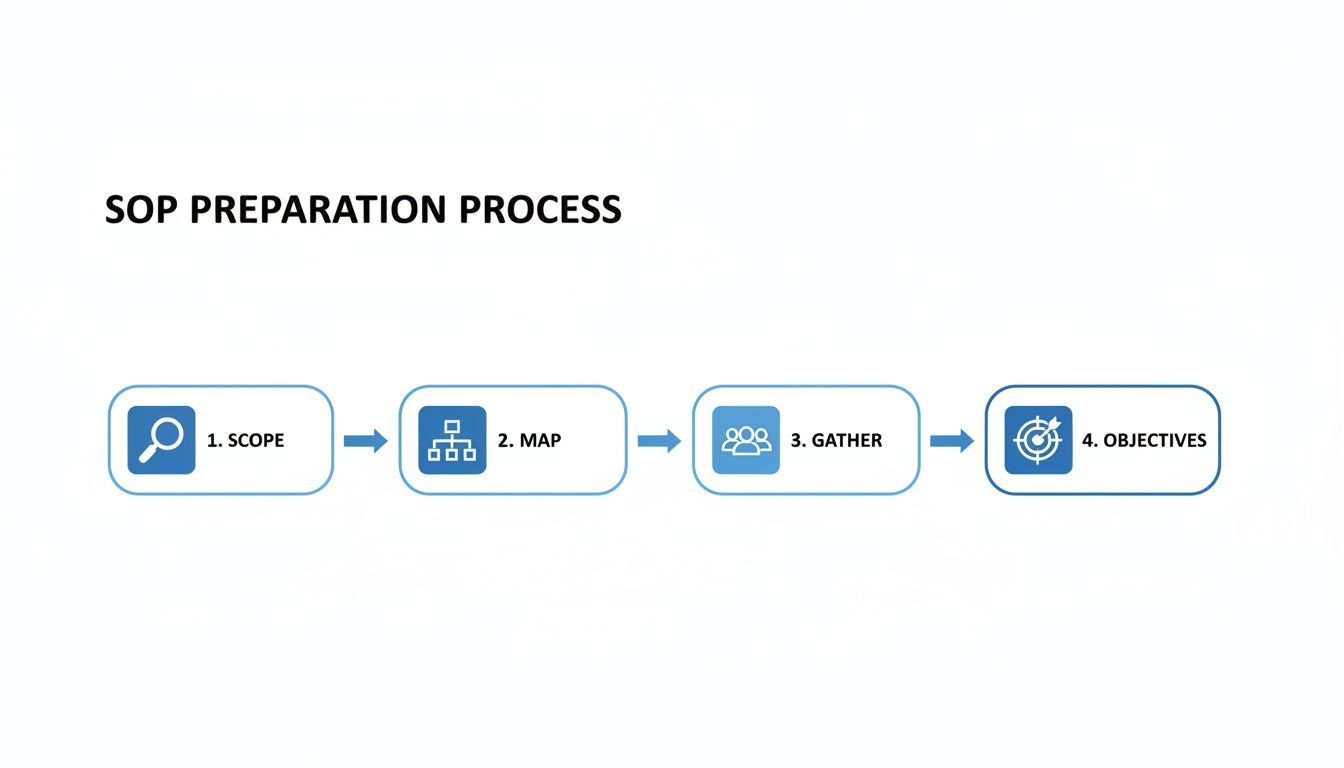
This process really highlights the importance of grounding your SOP in how your team actually works before you write a single instruction.
From Project Initiation to Closure
Each phase of your SOP needs specific, actionable guidance. The goal here isn't to create more red tape but to stamp out ambiguity.
For example:
- Initiation: This section could include a simple project charter template. It should define how a project is formally proposed, who needs to sign off on it, and what key info (like the problem statement and success metrics) is required right from the start.
- Planning: This is where you can standardize risk assessment. A solid SOP should include clear guidelines for the 5 stages of risk management. This keeps teams from either ignoring risks entirely or getting bogged down in analysis paralysis.
- Execution & Monitoring: Here, you standardize communication. A simple checklist can outline expectations for weekly status updates, define the format for progress reports, and clarify how to use your project management tools for task updates.
- Closure: Standardize the project hand-off and retrospective process. Include a checklist for archiving documents, notifying stakeholders of completion, and scheduling a lessons-learned session.
Formalizing these steps is becoming critical as companies pour money into project management tools. Between 2024 and 2033, the project management software market is forecast to jump from USD 8.72 billion to USD 40.12 billion. That growth is being driven by organizations that are codifying repeatable playbooks for everything from planning to reporting, making sure they squeeze every drop of value from their software.
Keeping It Clear and Usable
The best SOP is one that people actually use. That means clarity and usability are non-negotiable.
Use straightforward language and ditch the corporate jargon wherever you can. Think about how your team communicates naturally and write in that voice. Visual aids are your best friend for breaking up text and simplifying complex processes. A simple flowchart for the change request process, for instance, is far more effective than a dense paragraph of text.
Real-World SOP Excerpt: Communication Protocol
- Weekly Status Updates: A one-page summary is due every Friday by 3 PM in the designated project channel. The update must include: (1) Key accomplishments this week, (2) Goals for next week, and (3) Any new risks or blockers.
- Stakeholder Meetings: Bi-weekly check-ins will be scheduled. The project manager is responsible for circulating an agenda 24 hours in advance and sharing meeting notes within 4 hours of conclusion.
- Urgent Issues: All urgent blockers must be flagged immediately in the project management tool and a direct message sent to the project lead.
This example is clear, specific, and actionable. It leaves no room for guessing and sets a consistent standard that anyone on the project can follow without a second thought.
Bringing Your SOP to Life with Technology and AI
Let's be honest. A static SOP for project management buried in a shared drive is where good intentions go to die. For your procedures to actually work, they need to be a living, breathing part of your team's daily grind. That means getting them out of dusty documents and plugging them directly into the tools your team already lives in.
Imagine your procedures being right there inside Asana, Jira, or Slack. Instead of having to hunt for a document, a team member sees the exact SOP checklist pop up within their project task. This kind of seamless integration turns your SOP from a passive reference guide into an active, in-the-moment assistant that guides work as it's happening.
Integrating SOPs Into Your Project Management Tools
The whole point is to make following the correct procedure the path of least resistance. When your SOPs are embedded in your daily software, you get rid of the friction. Compliance becomes second nature, not a chore.
Think about these practical ways to make it happen:
- Task Templates: Build your SOPs directly into task templates in your project management software. When someone kicks off a new "Client Onboarding" project, it automatically populates with tasks that link straight to the relevant SOP steps.
- Workflow Automations: Use tools like Zapier or your platform's built-in automations to trigger SOP-related actions. For example, when a task gets moved to the "In Review" stage, an automated message could hit the project channel with a link to the quality assurance checklist.
- Contextual Pop-Ups: Some dedicated process documentation software options are smart enough to surface SOPs based on the screen a user is on, providing instant guidance without them even having to ask.
An SOP is only as good as its accessibility. If a team member has to switch contexts and dig through a messy drive to find a procedure, they just won't do it. Embedding your SOPs puts the right information in the right place at the right time.
The Emerging Role of Artificial Intelligence
Artificial intelligence is completely changing how SOPs are created, maintained, and used. The AI in project management market is expected to jump from USD 3.08 billion in 2024 to USD 7.4 billion by 2029. For SOPs, this is a massive shift.
Instead of manually writing out long, tedious documents, teams can now use AI-powered platforms like Whale to auto-draft step-by-step procedures from screen recordings or existing workflows.
But this tech goes way beyond just creation. AI can also analyze project data to flag parts of your SOP that consistently cause delays or confusion, giving you data-backed insights for making improvements. It can even generate quick training videos or quizzes from your documented procedures, making onboarding way more engaging and effective. As companies invest in new tech, reliability and ease of use are huge priorities, and AI is delivering on both.
Launching and Improving Your SOP for Long-Term Success
Creating a solid SOP for project management is a huge win, but let's be real—the document itself is just the beginning. The real magic happens when you bring it to life and get your team to actually understand, adopt, and own the processes you've worked so hard to build.
Simply dropping a new SOP into a shared drive with a top-down announcement is a recipe for disaster. I've seen it happen time and time again. What separates a useful SOP from one that just collects dust is a thoughtful rollout strategy.
Your launch isn't about enforcing a new set of rules from on high. It's about selling the "why" behind the changes. You need to frame the SOP as the solution to the exact pain points your team is already feeling—things like messy project handoffs, scope creep, or unclear expectations. That’s how you get genuine buy-in from the get-go.
Driving Adoption Through Communication and Training
Your rollout communication needs to be sharp, focused, and targeted. Please, don't just blast out a mass email with the SOP attached and call it a day. Instead, schedule a quick kickoff session to walk everyone through it. More importantly, use that time to highlight how it solves their daily frustrations and makes their jobs easier.
And when it comes to training, make it helpful, not a chore. Nobody wants to sit through a dry reading of a document.
- Hands-On Workshops: Run a few short, interactive sessions. Give your teams a mock project and let them apply the new SOP in a low-stakes environment.
- Quick Reference Guides: Nobody can memorize a 50-page document overnight. Create one-page cheat sheets or visual workflows for key processes, like how to submit a change request.
- Leadership Champions: Make sure your project leads and managers are consistently using and referencing the SOP. When they treat it as important, the rest of the team will follow suit.
This kind of focused effort ensures the SOP is seen as a valuable tool from day one, not just another piece of administrative baggage. A smooth rollout also keeps current projects on track, letting teams get comfortable with the new procedures without grinding everything to a halt.
An SOP is a guideline, not a straitjacket. It should help people do things faster, remove uncertainty, and free them up for high-impact work—not force them into something that will never fit comfortably.
Creating a System for Continuous Improvement
Here's a hard truth: the best SOPs are never "done." They're living guides that have to evolve with your team, your tools, and your goals. A process that works perfectly today might be a bottleneck in six months. That’s why building a feedback and update mechanism isn't just nice to have—it's non-negotiable.
First, establish a dead-simple feedback loop. This could be a dedicated Slack channel, a simple form, or even just a standing agenda item in your project retrospectives. The key is to make it ridiculously easy for anyone on the team to flag a process that's causing friction or suggest an improvement.
Next, schedule regular, systematic reviews of your SOP. Quarterly check-ins are a great place to start. During these reviews, dig into the feedback you've collected and look at the performance data from recent projects. Did a specific procedure create a bottleneck? Are teams constantly skipping a particular step? Use those insights to refine and update your documentation.
This iterative approach turns the SOP from a static document into a shared resource that everyone has a stake in improving.
Got Questions About Project Management SOPs?
Whenever you start formalizing a process, especially for something as fluid as project management, a few questions always pop up. Getting these sorted out is the key to making sure your SOPs are actually practical, get used by the team, and don't just end up collecting dust.
How Detailed Should We Make Our PM SOPs?
This is a classic "it depends" situation, but it really boils down to two things: your team's experience level and how complex your projects are. The real goal is to provide just enough detail to keep everyone consistent without boxing them in. A good SOP is a guardrail, not a cage.
For the really critical, high-stakes stuff, you need to get granular. Think about any process that has serious financial or legal consequences if it goes wrong:
- Budget Approvals: Spell out the exact steps, what forms to use, and who needs to sign off for different spending amounts.
- Change Control: This needs a formal, defined process for how a change to scope, timeline, or budget gets submitted, reviewed, and approved. No wiggle room here.
- Client Handoffs: A detailed checklist is your best friend. List every single deliverable, sign-off needed, and system access that has to be transferred for a clean handoff.
On the flip side, for tasks that are more creative or collaborative, a simple framework works much better than a rigid script. A brainstorming session SOP, for instance, might just outline the goals, set a timebox, and specify how ideas will be captured. The how of the creative part is left up to the team.
My advice? Start with the essential, high-risk areas first. You can always add more detail later as you see where your team is consistently hitting roadblocks.
What are the Biggest Mistakes to Avoid When Creating SOPs?
Oh, I've seen a few. The single biggest mistake is writing an SOP in a vacuum. When a manager locks themselves in a room and emerges with a "perfect" process without talking to the people who actually do the work, it's dead on arrival. The document is almost always impractical and gets ignored immediately. Your team is on the front lines—their input is non-negotiable.
Another classic pitfall is making the SOP a novel. A 100-page manual isn't a daily guide; it's a doorstop. If someone on your team can't find what they need in under a minute, you've failed. Keep it short, use visuals, and break everything down into scannable chunks.
Finally, and this one is critical, people forget to plan for updates. Your SOP is a living document, not a stone tablet. An outdated process is worse than no process at all because it kills trust and teaches people to ignore the system. You have to build a simple review cycle into your plan from day one and give someone clear ownership of keeping it current.
How Can We Get the Team to Actually Use the SOPs?
This is the million-dollar question. Adoption is everything, and it comes down to three things: accessibility, integration, and leadership.
First, make your SOPs ridiculously easy to find. If people have to dig through nested folders in a shared drive, they won't bother. Put them in a centralized tool like Whale, where information pops up right where your team is working.
An SOP is only effective if it's easier to use it than to ignore it. The path of least resistance must lead to the correct procedure.
Second, weave the procedures directly into your existing tools. Don't just tell people there's a checklist; link to the specific SOP checklist right from the task in your project management software. This kind of in-context guidance makes following the process feel like a natural part of the workflow, not an extra step.
And third, leadership has to walk the walk. When managers consistently reference the SOP in meetings, use it to answer questions, and hold people accountable to it, they send a powerful message: "This is how we do things here, and it matters." That's how you make it stick.