
Let's be real: a random pile of Word docs and checklists you can't quite trust isn't a training strategy. It's a growth killer, plain and simple. Switching to a standardized training plan template for staff creates a single source of truth, making sure every single person on your team gets the same high-quality guidance from day one. This isn't just about being organized; it's a direct lever you can pull to boost performance across the board.
Why Generic Training Checklists Don't Cut It Anymore
Honestly, patching together your employee training with a bunch of disconnected documents is just asking for trouble. In any business moving at a decent clip, that kind of inconsistency is a massive risk.
Think about it. A new finance hire misses a critical compliance step because their checklist was two versions old. A member of your manufacturing team causes a major delay because the safety protocols they were given were vague. These aren't just "what ifs"—they're the kind of real-world problems that spring from a broken training system.
This haphazard approach actively works against you. When every manager is left to invent their own "training," valuable knowledge gets stuck in silos, best practices evaporate, and new hires end up with wildly different experiences. You're left with a team running on guesswork instead of proven processes, and that hits your quality and customer satisfaction right where it hurts.
The Real Price of Inconsistent Training
The damage from sloppy training isn't just about a little confusion here and there. It sends ripples through your entire business, leading to very real losses in productivity and morale. This is especially true when it comes to remembering what was taught. Inconsistent methods do a terrible job of fighting the natural human tendency to forget things over time. If you want to get ahead of that, our guide on the forgetting curve is a great place to start.
When training feels like an afterthought, you pay the price in employee turnover, repeated mistakes, and missed growth opportunities. A centralized plan isn't about bureaucracy; it's about building a team that's competent, confident, and pulling in the same direction.
The data tells the same story. Companies that invest in solid employee training programs pull in 218% higher income per employee than those winging it. What's more, these teams are often 17% more productive and 21% more profitable. Why? Because their people have the clarity and skills they need to do their jobs well. You can see more stats on the impact of structured training from eLearning Industry.
Moving to a standardized staff training plan isn't just a small tweak. It’s the foundational step you need to take to scale your business without losing the quality that got you here in the first place.
Before we dive into building your template from the ground up, let's break down the core pieces that absolutely have to be there. Getting these right is the difference between a plan that collects dust and one that actually builds a high-performing team.
Essential Components of a Winning Training Plan
This table breaks down the non-negotiable elements every staff training plan template needs to drive real results and create a competent workforce.
| Component | What It Looks Like in Practice | The Impact on Your Team |
|---|---|---|
| Clear Objectives | "By day 30, new sales reps will be able to demo our core product feature set without assistance." | Provides a clear "finish line" for learning, motivating employees and focusing their efforts. |
| Defined Audience | Segmenting training for "New Hires," "Frontline Managers," or "Senior Leadership." | Ensures content is relevant and avoids overwhelming employees with information not meant for them. |
| Structured Curriculum | A logical flow from foundational knowledge (company values) to role-specific skills (using the CRM). | Prevents confusion and builds skills progressively, leading to better long-term retention. |
| Realistic Timelines | Allocating 4 hours for compliance training in week one, with 1-hour follow-ups for the next 3 weeks. | Sets clear expectations for both the employee and their manager, making the workload manageable. |
| Assessment & Certification | A short quiz after the security module or a practical skills test for operating new machinery. | Confirms that knowledge has been understood, not just consumed, and identifies any learning gaps. |
| Clear Ownership | "The Head of Sales owns the sales training module, with reviews scheduled quarterly." | Prevents content from becoming outdated and ensures there's a point person for feedback and updates. |
Each of these components plays a crucial role. Without them, even the best-intentioned training program can fall flat, leaving your team confused and your business at a standstill.
How to Build Your Master Training Template
Let's be honest, creating a master training plan template for staff isn't about just filling in a document. It’s about building a real strategic framework. This is your blueprint for turning fresh hires into confident, capable team members and giving your current staff the tools they need to grow. It’s how you finally move from scattered checklists and inconsistent training to a clear, repeatable process that actually works.
The very first move? Define sharp, measurable training objectives. Get rid of vague goals like "learn the software." That helps no one. Instead, you need to aim for concrete outcomes that leave no room for guesswork.
For example, a solid objective for a new customer service rep would be: "By the end of week two, the employee can independently resolve the top five most common customer support tickets." That kind of clarity gives both the employee and their manager an actual finish line to cross.
Getting this right feels like moving from chaos to clarity, and ultimately, to real business growth.
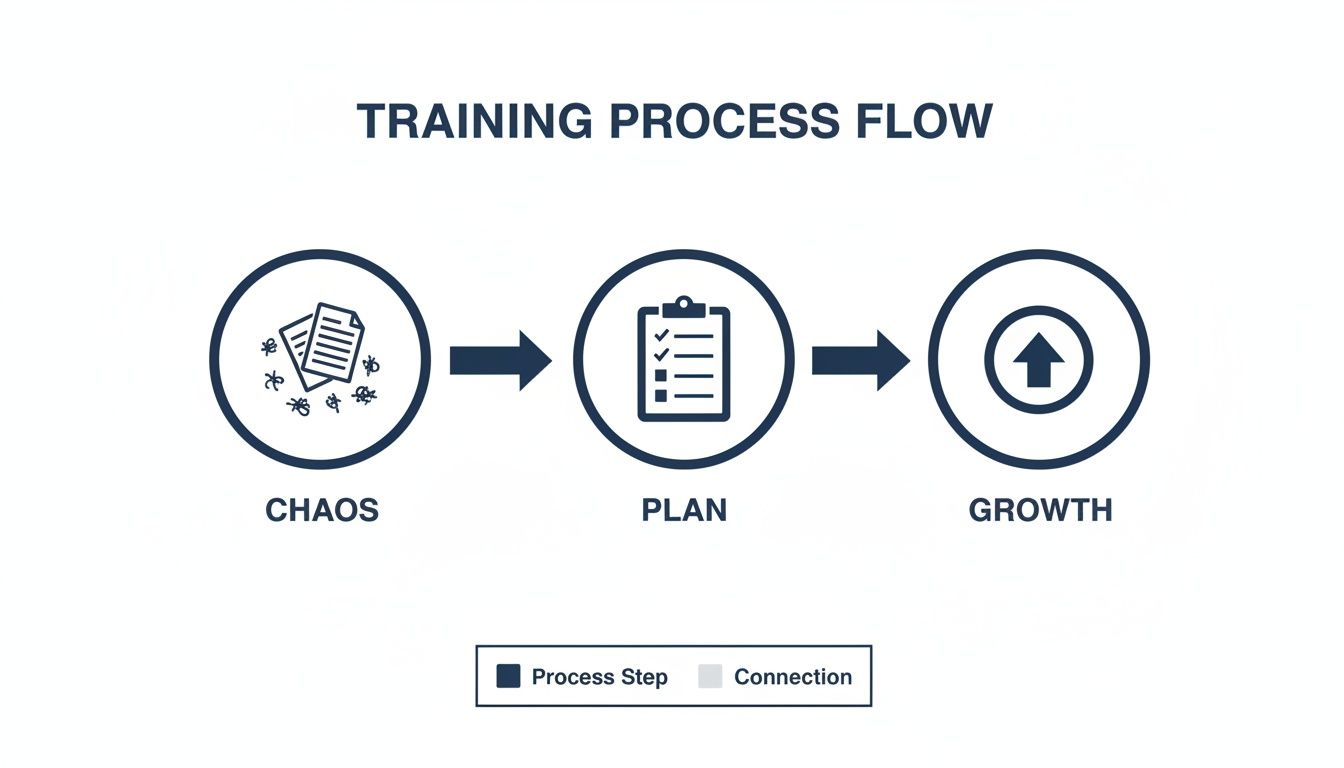
This process is all about transforming scattered, unreliable docs into a clear path that fuels both employee development and your company’s success.
Map Out Role-Specific Learning Paths
Not all training is created equal—because not all roles are the same. A warehouse operator needs rigorous training on safety SOPs and heavy machinery, while a marketing coordinator needs to live and breathe your brand guidelines and social media policies. That’s why mapping out distinct learning paths is absolutely essential.
Start by breaking down your workforce into key roles or departments. For each group, ask the big question: what knowledge is mission-critical for them to succeed?
- For Sales Teams: This will probably look like product knowledge modules, CRM best practices, and maybe even some mock-call scenarios.
- For IT Staff: You'll want to focus on cybersecurity protocols, internal ticketing systems, and hardware setup procedures.
- For New Managers: Their training should cover performance review processes, conflict resolution, and solid team motivation techniques.
This targeted approach makes sure every single employee gets relevant information that directly helps them in their day-to-day work. It prevents them from drowning in content that wasn’t even meant for them. The best way to nail this is by doing a detailed analysis. To help you get started, we've put together a guide on how to create a training needs analysis template.
Structure Your Curriculum Logically
Once you know your objectives and your audience, it's time to structure the curriculum. A logical flow is your best friend here—it prevents cognitive overload and helps people actually remember what they learned. Think of it like building a house: you’ve got to pour a solid foundation before you can even think about putting up the walls.
A proven structure that we've seen work time and again follows this kind of progression:
- Company-Wide Essentials: This is the foundation. It covers the company mission, values, and core policies (like security and HR), plus a quick overview of the org structure. This part should be consistent for absolutely everyone.
- Role-Specific Fundamentals: Next up, introduce the tools, software, and key processes that are specific to that person's job. This is where those role-specific learning paths you mapped out earlier come directly into play.
- Practical Application & Hands-On Tasks: Now, you move from theory to practice. This could mean shadowing a senior team member, completing a sample project, or handling supervised tasks to build real-world confidence.
- Advanced Skills & Career Growth: This final layer is all about long-term development. We're talking leadership training, specialized certifications, or upskilling for future roles within the company.
A well-structured curriculum doesn't just teach someone their job for today. It provides a clear roadmap for how they can grow with the company tomorrow, which is a powerful driver of employee retention. Research shows a lack of growth opportunities is the top reason people quit their jobs, cited by 63% of employees. Building this into your template addresses that problem head-on.
Creating Training Content That People Actually Use
A perfectly structured training plan template for staff is only half the battle. Let's be honest—if the content itself is dry, dense, and feels completely disconnected from the day-to-day grind, your team is going to tune out before they even start.
The real goal isn't just to throw information at them; it's to craft a learning experience that grabs their attention and actually sticks.

This means we have to move beyond static documents and passive reading. The training programs that truly work are the ones that blend different learning styles to keep things interesting. Think about pairing self-paced online modules for the foundational knowledge with invaluable, hands-on training led by a seasoned mentor.
From Passive Reading To Active Learning
To get a real boost in knowledge retention, your content has to be interactive. People forget static documents, but they remember what they do.
So instead of just describing a process, build a practical scenario around it. For instance, rather than a long wall of text about handling customer complaints, why not create a short, interactive quiz? Present a realistic customer issue and ask the trainee to choose the best response. This forces them to apply the knowledge, not just skim it.
Here are a few ways you can build active learning into your content:
- Scenario-Based Quizzes: Test their decision-making skills with problems they'll actually face on the job.
- Role-Playing Exercises: Let employees practice those tricky conversations or complex procedures in a safe space.
- Interactive Demos: Use screen recordings or guided walkthroughs that require them to click through the steps themselves.
Making this shift from passive to active learning is a game-changer. It directly impacts how well your team performs and how connected they feel to their work. Globally, only 23% of employees are engaged, but solid training is a huge motivator. And with self-paced learning proven to increase retention by up to 67%, it’s crystal clear that the quality of your training content matters.
The Power Of Feedback Loops
Here’s a pro tip: creating great content is a continuous process, not a one-and-done task. The final, and maybe most crucial, piece of the puzzle is setting up a solid feedback loop. Your team on the ground knows what’s working, what’s confusing, and what’s missing entirely.
Give your employees a dead-simple way to provide feedback right on the training materials. This could be a comment section in your knowledge base or a quick survey after a module. This feedback is absolute gold—it tells you exactly how to refine and improve your content over time.
Peer-to-peer coaching plays a massive role here, too. Encourage your experienced team members to mentor new hires, giving them real-time feedback that reinforces the formal training. This is what bridges the gap between knowing something in theory and being able to apply it in practice. It ensures your training content isn't just consumed, but truly understood and put to use.
For more detailed guidance, check out our guide on how to write a training manual that people will actually want to read.
Choosing the Right Home for Your Training Program
A brilliant staff training plan can fall flat if it’s buried somewhere no one can find or, even worse, trusts. The right technology is what turns a static document into a living, breathing training ecosystem that your team actually uses. It’s time to move beyond the chaos of shared drives and the endless "final_v2_final" document names we've all seen.
Deciding where your plan will live is a strategic move that directly impacts its success. Your goal should be a central hub that's instantly accessible, a breeze to update, and smoothly integrated into your team's daily grind. This isn’t just about storage; it’s about creating a single source of truth that empowers your people.
From Shared Drives to Smart Platforms
Let's be real: shared drives are where good training plans go to die. They have zero version control, making it impossible to know if you're looking at the most current procedure. Searching for specific information is a slow, frustrating crawl, and there’s no way to track who has completed what. It's just not a scalable solution for a growing business.
A dedicated knowledge platform, on the other hand, is built to solve these exact headaches. It comes packed with features that are non-negotiable for a modern team:
- Robust Version Control: Everyone is always working from the latest approved process. This is absolutely critical for compliance and safety.
- Instant Access for All Staff: Crucial information is at your team's fingertips, whether they're in the office or out in the field.
- Smart Integrations: Learning gets embedded directly into daily tools like Slack or project management software, making training a natural part of the workday instead of a chore.
As you're designing the program and picking a home for it, it’s worth weighing the pros and cons of different formats, like exploring the differences between online vs. classroom learning. This will help you land on a platform that truly supports the delivery methods you need.
A great platform doesn’t just store your content; it brings it to life. It transforms your training from a passive checklist into an active, engaging resource that drives performance and reduces costly mistakes.
Comparing Training Management Tools
Let's break down the options. The best choice really hinges on what your team needs to get the job done, but a quick comparison shows why moving beyond basic file storage is a game-changer for your training plan.
| Key Feature | Shared Drives (e.g., Google Drive) | Generic LMS | AI-Powered Knowledge Platform |
|---|---|---|---|
| Version Control | Manual and error-prone; leads to confusion. | Usually present, but can be complex to manage. | Automated and foolproof; always the single source of truth. |
| Accessibility | Dependent on folder structure; search is often weak. | Better, but can feel separate from daily workflow. | Seamlessly integrated into the tools your team already uses. |
| Analytics | Non-existent; no way to track comprehension. | Tracks completion rates but often lacks deeper insights. | Provides clear analytics on effectiveness and engagement. |
| Content Creation | Requires separate tools; difficult to standardize. | Often has clunky, outdated content builders. | Streamlines creation with templates and AI assistance. |
At the end of the day, putting your resources into a modern knowledge platform is an investment in consistency, efficiency, and your team's long-term success. It ensures your training program can grow and adapt right alongside your business, providing a solid foundation for every employee from day one.
How to Roll Out and Measure Your Training's Impact
So you've built the perfect training plan. Awesome. But your job isn't done—in fact, the hardest part is often getting people to actually use it. A successful launch is way more than just firing off a mass email and hoping for the best.
How you introduce this new training sets the tone for everything that follows. The goal is to build genuine excitement and show your team this isn't just another mandatory task to check off their to-do list.
First things first, get your leadership team on board. They need to be the program's biggest champions. When a leader explains the "why"—how this training helps everyone succeed, makes their jobs easier, and opens up new opportunities—it completely changes the conversation. That first announcement is your single best chance to build real momentum.
Nailing the Communication
Instead of a "big bang" launch that hits everyone at once, think about a phased rollout. Why? Because it’s smarter. Start with a small, engaged team for a pilot program.
This lets you gather honest feedback, iron out any wrinkles, and—most importantly—collect some killer testimonials. Nothing sells a training program better than a colleague saying, "This was actually really helpful."
Once you’re ready for the wider launch, map out a simple communication plan. It should include:
- The Big Announcement: Get a leader to send the kick-off email or Slack message. It needs to be upbeat and focused on the benefits.
- The "What's In It for Me?" (WIIFM) Guide: A quick, scannable doc that clearly outlines how this training helps employees build skills, solve annoying problems, or advance their careers.
- Crystal-Clear Instructions: Don't make people hunt for it. Provide dead-simple, step-by-step instructions on how to access the training.
This isn’t just about making sure people retain information; it’s about building a more capable and motivated team. In a tight talent market, good training is a secret weapon. While only 15% of full-time workers are 'highly engaged', that number skyrockets for employees who receive quality training—a staggering 92% report higher engagement.
Measuring What Truly Matters
Okay, the program is live. Now you need to prove it’s working. And I don’t mean just tracking completion rates. Knowing who finished a module is step one, but it tells you nothing about real impact.
The real goal is to connect your training efforts to tangible business outcomes.
The most powerful metrics are the ones that show a clear return on investment. You're not just training people for the sake of it; you're solving business problems, reducing friction, and boosting performance.
This is where you shift from "did they do it?" to "did it make a difference?" Focus on the key performance indicators (KPIs) that your leadership team actually cares about. This is how your training plan template for staff goes from being a document to a driver of real change.
Look for improvements in areas like:
- Productivity Gains: Are teams finishing tasks faster? Is their output higher?
- Error Reduction: Have you seen a drop in costly mistakes or customer complaints?
- Faster Onboarding: Are new hires hitting their stride and becoming fully productive in less time?
- Improved Compliance: Is your team better prepared for quality checks and audits?
Speaking of compliance, think about how your program strengthens your position against external standards. For example, well-trained staff are absolutely essential for navigating complex ISO 9001 audit requirements and keeping those valuable certifications.
To get the full picture, mix hard data with human feedback. Use simple pulse surveys or schedule quick check-ins with managers. This qualitative info is gold—it tells you what’s resonating and what needs a rethink. This continuous feedback loop is what turns a good training program into a great one that delivers bottom-line results, year after year.
Common Questions About Staff Training Plans
Even with a killer plan in hand, you’re going to get questions. It’s just part of the process. Let's dig into some of the most common ones that managers and HR leaders run into when they're building and maintaining their training plan template for staff.
How Often Should We Update Our Staff Training Plan Template?
Your training plan needs to be a living document, not some static file that gets lost in a shared drive. It’s got to evolve with your business.
As a general rule, a quick review every quarter is a good idea to catch minor updates. For the big stuff, a full, deep-dive review should be on the calendar annually.
But let's be real—some things can't wait for a quarterly check-in. You'll need to jump on revisions immediately whenever you have major changes to:
- Company processes (like rolling out a new customer intake system)
- Technology (switching to new software, for example)
- Compliance or safety regulations (when new industry standards drop)
This is where using a centralized knowledge platform with built-in version control becomes a game-changer. It guarantees everyone is working from the latest info, which is absolutely critical for preventing costly mistakes and keeping the team safe.
What Is the Best Format for a Training Plan Template?
The best format is one that's flexible, super accessible for everyone, and dead simple for the owners to update. A spreadsheet might feel like enough for a tiny team, but trust me, it doesn't scale. It quickly turns into a messy source of confusion and outdated information.
For most teams, a dynamic format inside a central knowledge base is way more effective. You'll want a solution that handles all sorts of media—not just text, but images, videos, and screen recordings too. The real power move? Adding interactive elements like quizzes to actually confirm your team understood the material. This setup ensures your template can adapt to different learning styles and the specific needs of each role.
How Do We Measure the ROI of Our Training Program?
Measuring the ROI of your training program goes way beyond just checking completion rates. Ticking a box doesn't mean the knowledge stuck or that it's being used correctly on the job. To prove its worth, you have to connect your training directly to real business metrics.
To demonstrate real value, track key business metrics from before and after the training rolls out. This transforms training from a "cost center" into a clear driver of business growth and efficiency.
Focus on the numbers that directly impact your bottom line and how well the business runs. Think about tracking things like:
- A drop in the time it takes new hires to get fully up to speed.
- Fewer support tickets or customer complaints tied to specific processes.
- An uptick in production output or sales figures.
- Better employee retention rates, which slashes your recruitment costs.
When you tie your training goals directly to these kinds of business outcomes, you're building a powerful case for your program and showing a clear, tangible return on your investment.