
In a competitive supply chain, warehouse efficiency is not just an advantage; it's the foundation of your business's success. A disorganized or mismanaged warehouse directly impacts every part of the operation, leading to costly inventory errors, slow order fulfillment, increased operational expenses, and ultimately, dissatisfied customers. Achieving operational excellence requires moving beyond reactive problem-solving and implementing a proactive, structured framework. This is where a commitment to proven warehouse management best practices becomes essential.
This guide provides a detailed roadmap to building a high-performing warehouse. We will move beyond theory and provide actionable steps for implementation. You will learn how to refine your facility's physical layout for better flow, adopt systems for precise inventory control, and establish robust safety programs that protect your team. We will also cover the importance of data-driven decision-making through key performance indicators (KPIs), the creation of effective employee training programs, and the strategic integration of technology.
Each practice outlined below is a critical component of a larger system designed to create a more productive, accurate, and scalable operation. Whether you are looking to fix specific bottlenecks or overhaul your entire process, these ten strategies will provide the clarity and direction needed to transform your warehouse from a cost center into a powerful competitive asset. Let's dive into the foundational tactics that define industry-leading logistics.
1. Implement Standardized Operating Procedures (SOPs) Documentation
Creating and maintaining comprehensive, written standard operating procedures is a foundational warehouse management best practice. SOPs document every critical process, from receiving and putaway to picking, packing, and shipping. This practice establishes a single source of truth for all warehouse operations, ensuring consistency and reducing errors.

With clear SOPs, teams can execute processes identically regardless of shift or personnel changes. For example, global logistics giant DHL implements detailed SOPs for every handling procedure to maintain consistent quality standards across its network. This documentation is not just a manual; it’s a tool for quality control, safety compliance, and efficient employee training.
How to Implement Effective SOPs
Implementing SOPs goes beyond just writing down instructions. To make them an active part of your operations, consider a structured approach:
- Document with Clarity: Use a mix of text, images, and videos to explain procedures. A video showing the correct way to operate a forklift is far more effective than a text-only description.
- Make Them Accessible: Store SOPs in a centralized, easy-to-access digital platform. Modern knowledge management tools like Whale allow you to quickly convert existing processes into structured, searchable SOPs that staff can view on tablets or mobile devices.
- Assign Ownership and Review: Designate process owners for each SOP and schedule quarterly or semi-annual reviews. This keeps documentation current with any process improvements or new equipment.
- Integrate into Training: Embed SOPs directly into your onboarding and continuous training programs. This reinforces correct procedures from day one.
Key Takeaway: SOPs are not static documents meant for a binder on a shelf. They are dynamic guides that drive consistent, safe, and efficient performance across your entire warehouse operation.
By treating documentation as a core operational function, you build a resilient system that supports scalability and continuous improvement. The principles for creating effective standard operating procedures for manufacturing are highly applicable to the warehouse environment, emphasizing clarity, accessibility, and regular updates.
2. Adopt Inventory Management Systems (WMS)
A Warehouse Management System (WMS) is a foundational technology for modern warehouse management best practices. This software provides real-time visibility into your entire inventory, automating and optimizing everything from receiving and storage to order fulfillment. A WMS acts as the central brain for your warehouse, reducing manual errors, improving inventory accuracy, and enabling data-driven decisions that boost efficiency.
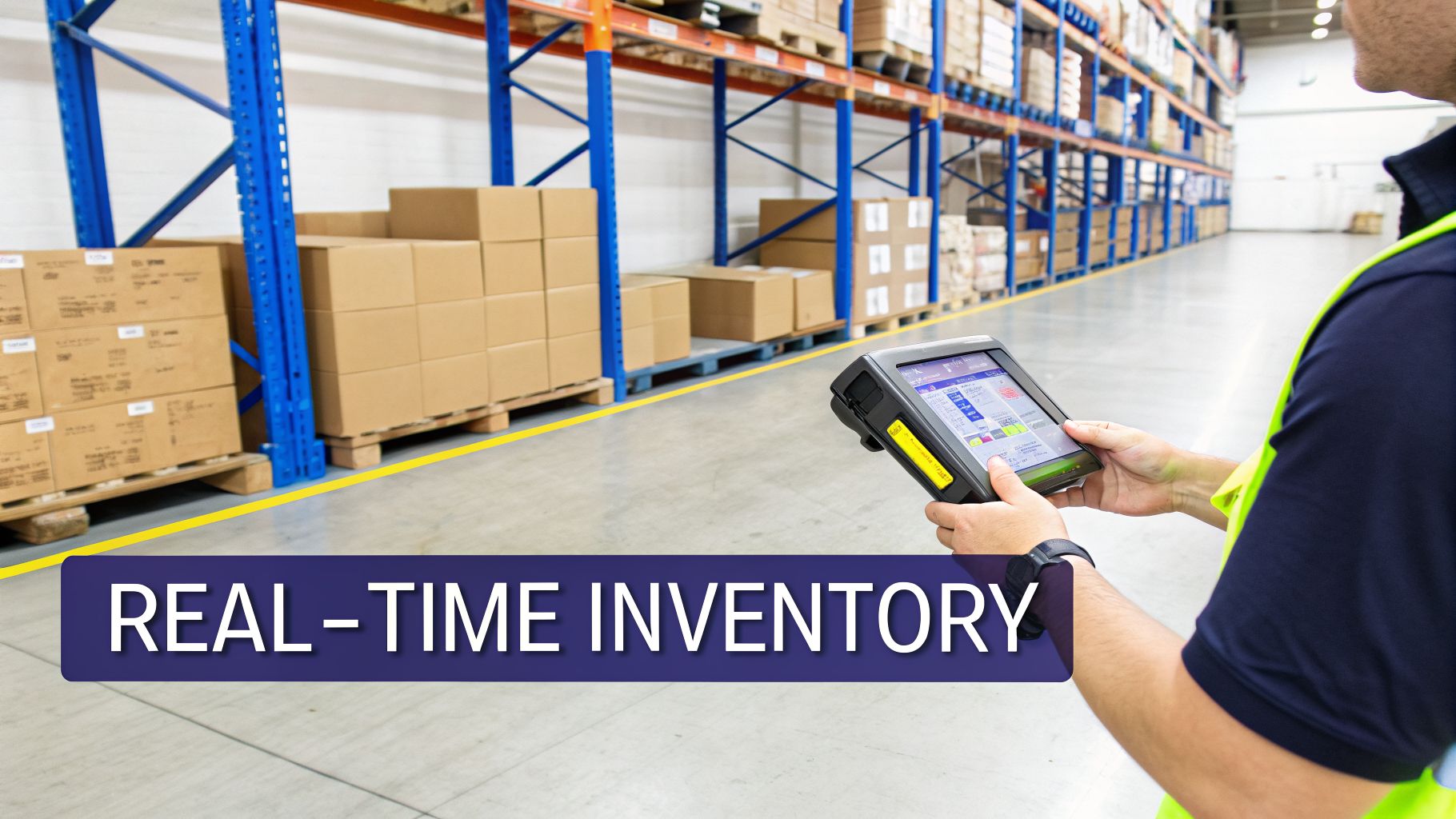
Leading companies depend on robust WMS solutions to manage complex logistics. For instance, Wayfair coordinates its massive network of over 18 fulfillment centers using a sophisticated WMS, while FedEx relies on its system to track millions of packages daily with precision. These systems aren't just for large enterprises; they provide scalable control that is critical for growing businesses.
How to Implement a WMS Effectively
Choosing and implementing a WMS requires a strategic approach to maximize its benefits and ensure a smooth transition for your team.
- Document Processes First: Before implementation, thoroughly map your current warehouse workflows. This documentation helps you configure the WMS to match your operational needs, not the other way around.
- Prioritize Integration Capabilities: Select a system with strong API capabilities. This ensures it can connect seamlessly with your existing tools, like accounting software, ERP systems, and e-commerce platforms.
- Invest in Comprehensive Training: A WMS is only as good as the people who use it. Conduct thorough, role-specific training for all staff before the system goes live to ensure high adoption and correct usage.
- Pilot Test Before Full Rollout: Start by deploying the WMS in a single, controlled area of your warehouse. This pilot phase allows you to identify and resolve any issues on a small scale before a full, company-wide deployment.
Key Takeaway: A WMS moves your warehouse from reactive guesswork to proactive, data-informed control. It is the core technology that enables inventory accuracy, fulfillment speed, and operational scalability.
By carefully planning the implementation, you can make sure your WMS becomes a central asset for achieving new levels of productivity and accuracy in your warehouse operations.
3. Implement Lean Warehouse Practices
Adopting lean methodology is a powerful warehouse management best practice focused on maximizing value by eliminating waste. This approach, pioneered by Toyota, targets non-value-added activities, optimizes workflow, and fosters a culture of continuous improvement. In a warehouse setting, this means reducing excess motion, minimizing wait times, and creating a more organized, efficient, and safer environment.
This philosophy drives operational excellence. For example, third-party logistics (3PL) giant XPO Logistics has transformed operations across numerous sites by applying lean principles to reduce processing times and improve service quality. The goal is to create a flow where every step adds value from the customer's perspective, from receiving goods to shipping them out.
How to Implement Lean Warehouse Practices
Rolling out lean principles requires a systematic approach that engages the entire team. To successfully integrate this methodology into your warehouse, consider these steps:
- Start with 5S: Begin with a pilot in one section of your warehouse. Implement 5S (Sort, Set in order, Shine, Standardize, Sustain) to create a clean, organized, and visual workspace. This builds momentum and demonstrates immediate benefits.
- Hold Daily Huddles: Conduct brief daily stand-up meetings to discuss problems, review metrics, and brainstorm solutions. This empowers employees and promotes quick, collaborative problem-solving.
- Conduct Gemba Walks: Regularly walk the warehouse floor (the "gemba") to observe processes firsthand. This is the best way to identify inefficiencies and opportunities for improvement that aren't visible from a desk.
- Document and Standardize: As you refine processes, document them in your SOP management platform. This ensures that new, leaner methods are standardized and consistently followed by all team members.
Key Takeaway: Lean isn't a one-time project; it's a continuous pursuit of perfection. By empowering your team to identify and eliminate waste, you create a resilient, efficient, and constantly improving warehouse operation.
By implementing lean practices, you shift from simply managing tasks to optimizing entire value streams. This approach builds a strong foundation for sustainable growth and operational excellence.
4. Establish Comprehensive Safety Protocols and Training
A safe warehouse is an efficient and productive one. Establishing comprehensive safety programs is a non-negotiable warehouse management best practice, serving as both a moral imperative and an operational necessity. These programs go beyond basic compliance to create a culture of safety that includes hazard identification, rigorous equipment training, ergonomic best practices, and clear emergency procedures.

A well-trained workforce actively reduces accidents, which in turn lowers workers' compensation claims and prevents costly operational disruptions. For example, OSHA-compliant warehouses often report 25-50% fewer accidents than non-compliant facilities. This focus on safety improves employee morale and retention, showing your team that their well-being is a top priority. Amazon, for instance, invests heavily in its safety programs and publishes annual reports to demonstrate its commitment to a secure work environment.
How to Implement Effective Safety Protocols
Building a robust safety culture requires more than just a rulebook; it demands active participation and clear, accessible guidelines. A structured approach ensures safety remains a top priority.
- Document and Distribute: Use a tool like Whale to document all safety SOPs, from forklift operation to emergency evacuation routes. Digital distribution ensures every team member can access the latest procedures on a tablet or mobile device.
- Conduct Regular Briefings: Hold monthly safety meetings to discuss recent incidents or near-misses. Use these sessions to reinforce protocols and introduce new safety measures.
- Implement a Near-Miss System: Create a no-blame system for reporting near-misses. This encourages employees to report potential hazards without fear of reprisal, allowing you to address risks before they cause an accident.
- Require Equipment Certification: Mandate formal certification and regular recertification for all employees operating heavy machinery like forklifts, pallet jacks, and order pickers.
Key Takeaway: Proactive safety management is an investment, not an expense. It protects your most valuable asset, your people, while directly contributing to operational stability and efficiency.
By embedding safety into your daily operations and training, you build a resilient and responsible workplace. A detailed warehouse safety checklist can provide a strong foundation for your auditing and compliance efforts.
5. Optimize Warehouse Layout and Organization
A strategic warehouse layout is one of the most impactful warehouse management best practices, directly influencing travel distance, picking efficiency, and space utilization. A well-designed floor plan reduces wasted motion, improves safety, and accelerates order fulfillment. It transforms your physical space from a simple storage area into a highly efficient operational hub.
Major e-commerce and retail players demonstrate the power of an optimized layout. Amazon's fulfillment centers use sophisticated slotting strategies to meet their demanding two-day delivery promises, while Zara organizes its warehouses by product velocity to support its fast-fashion model, ensuring quick turnaround times from production to store shelves. These examples show that layout is not a one-time decision but a continuous strategic advantage.
How to Implement an Optimized Warehouse Layout
Optimizing your layout requires a data-driven approach rather than guesswork. A systematic process ensures your design meets current and future operational needs.
- Conduct an ABC Analysis: Classify your inventory based on turnover rate. Place 'A' items (fastest-moving) in the most accessible locations, 'B' items (moderate movers) next, and 'C' items (slow movers) in less prime spots.
- Utilize a 'Golden Zone': Position your highest-velocity 'A' items within the ergonomic "golden zone," between the picker's waist and shoulders. This reduces physical strain and speeds up picking.
- Implement Clear Signage: Use large, clear labels with barcodes for aisles, racks, and bins. This system minimizes search time and reduces putaway or picking errors.
- Design for Traffic Flow: Create wide, one-way aisles where possible to prevent congestion and improve safety. Ensure there is enough space for workers and equipment like forklifts to move freely. When undertaking significant changes or relocating, managing inventory during the transition is critical. In such cases, professional services for your Perth removals and storage can provide the temporary off-site capacity you need to execute a smooth redesign.
Key Takeaway: Your warehouse layout is a dynamic tool that should evolve with your business. Regularly review sales data and operational metrics to make informed adjustments that continuously improve efficiency and throughput.
6. Implement Performance Metrics and KPI Tracking
Data-driven warehouse management relies on clearly defined Key Performance Indicators (KPIs) to measure efficiency and effectiveness. This practice involves selecting, monitoring, and analyzing metrics that align with your business objectives. Tracking KPIs like order accuracy, inventory turnover, and cycle time allows you to pinpoint operational weaknesses, make informed decisions, and drive continuous improvement.
This level of performance measurement is a hallmark of industry leaders. For example, global parcel service DPD uses rigorous KPI tracking to maintain its impressive 98%+ on-time performance rate. Similarly, Amazon tracks hundreds of metrics to ensure its fulfillment centers operate at peak efficiency. These companies prove that what gets measured truly gets managed.
How to Implement Effective KPI Tracking
Successfully using KPIs requires a systematic approach that turns raw data into actionable insights. To build a performance-driven culture, consider these steps:
- Start with Critical Metrics: Avoid tracking everything. Begin with 5-7 core KPIs that have the biggest impact on your goals, such as order accuracy rate, on-time shipping, and receiving cycle time.
- Establish a Baseline: Before implementing changes, measure your current performance for at least 30 days to establish a solid baseline. This allows you to accurately track the impact of new initiatives.
- Promote Transparency: Share KPI dashboards and visual boards in common areas of the warehouse. When the entire team sees the daily metrics and goals, it fosters a sense of shared ownership and accountability.
- Investigate Root Causes: When a metric slips, focus on understanding the underlying process issue rather than blaming individuals. A drop in picking accuracy could signal a slotting problem, not just employee error.
- Link Performance to Recognition: Connect consistent KPI achievement to employee recognition programs or incentives. This reinforces the importance of the metrics and motivates the team to meet targets.
Key Takeaway: KPIs are more than just numbers on a dashboard; they are the vital signs of your warehouse operation. Use them to diagnose problems, guide strategy, and celebrate successes.
By embedding performance measurement into your daily routine, you create a feedback loop that fuels one of the most crucial warehouse management best practices: continuous improvement. This data-first mindset enables you to adapt quickly and maintain a competitive edge.
7. Develop Structured Employee Training and Onboarding Programs
Investing in structured training is a critical warehouse management best practice that directly impacts safety, productivity, and employee retention. A formal program ensures every team member understands their role, equipment operation, safety protocols, and company quality standards from day one. This consistency minimizes costly errors, reduces workplace accidents, and accelerates the time it takes for new hires to become fully productive.
Companies known for operational excellence, like Costco, demonstrate the value of this approach. Their deep investment in employee training contributes to a turnover rate that is roughly 50% lower than the retail industry average. Similarly, Amazon's extensive onboarding and upskilling initiatives for its warehouse associates are designed to build a competent and adaptable workforce capable of meeting high-volume demands.
How to Implement Effective Training Programs
A successful training program is more than a single orientation session; it's a continuous process that supports employees throughout their tenure. To build a program that delivers measurable results, focus on a systematic approach:
- Centralize Training Materials: Use a single platform to house all training content, from SOPs and safety guides to video demonstrations. Centralization ensures everyone learns from the most current and approved materials.
- Use Mixed-Media Formats: Combine written documents with visual aids. A short video showing the correct procedure for packing fragile items is more engaging and easier to remember than text alone.
- Establish a Mentorship System: Pair new employees with experienced team members for their first one to two weeks. This provides on-the-job guidance, reinforces formal training, and helps new hires integrate into the team culture.
- Verify Competency: Implement practical tests or certifications at the end of key training modules. This verifies that employees have not only completed the training but can also apply the skills safely and correctly before working independently.
- Schedule Refresher Training: Conduct regular refresher sessions, especially for safety procedures or when new technology is introduced. This keeps skills sharp and ensures compliance with evolving standards.
Key Takeaway: Structured training is a direct investment in your operational efficiency and workforce stability. By treating onboarding and continuous education as a core function, you create a safer, more productive, and more reliable warehouse team.
Documenting every training session and its completion is essential for both performance management and regulatory compliance. It builds a foundation of accountability and a culture of continuous learning that is fundamental to modern warehouse management best practices.
8. Establish Quality Control and Accuracy Verification Systems
A robust quality control program is a critical warehouse management best practice for protecting brand reputation and minimizing costly returns. This involves creating systematic checks to verify order accuracy, inspect for damages, and ensure inventory data is correct. Implementing multiple verification points at key stages, such as picking, packing, and pre-shipment, drastically reduces the number of errors that reach the customer.
This multi-layered approach is how major retailers like Amazon maintain exceptionally high order accuracy rates. Each package may pass through several digital and manual checkpoints to confirm its contents match the customer's order. Similarly, Zappos builds immense customer loyalty through rigorous quality inspections that ensure every item shipped meets their high standards. Quality control is not just about catching mistakes; it's about building a system that prevents them.
How to Implement Effective Quality Control
Building a quality-focused culture requires clear processes and the right tools. To integrate effective verification systems into your workflow, consider these steps:
- Implement Multi-Point Verification: Establish a minimum of a three-point check system: once during picking, again during packing, and a final random audit before shipment. Use barcode scanners at each stage to automate accuracy verification.
- Create Visual Quality Standards: Document what qualifies as acceptable or unacceptable product condition using clear images and descriptions. Tools like Whale are ideal for creating these visual SOPs and making them instantly accessible to staff on tablets at their workstations.
- Establish a Feedback Loop: Create a process for quality issues to be traced back to the source. This isn't for punitive measures, but to identify specific individuals or shifts that may need additional training on certain procedures.
- Track Key Quality Metrics: Monitor metrics like Order Accuracy Rate, Damage Rate, and Picking Accuracy per employee. Analyzing this data helps pinpoint systemic issues and highlights opportunities for process improvement or targeted training.
Key Takeaway: Quality control is an active, ongoing process, not a final inspection. By embedding verification checks throughout the fulfillment workflow, you create a system that catches errors early and fosters a culture of accuracy and accountability.
9. Implement Technology Integration and Automation
Integrating technology and automation is a core component of modern warehouse management best practices. Strategic automation, ranging from barcode scanning to advanced robotics, directly boosts efficiency, accuracy, and safety. The key is to thoughtfully implement technology in areas with high repetition, low variability, and a clear return on investment, such as picking, sortation, and data management.
This practice moves operations beyond manual limitations. For instance, Amazon Robotics uses over 500,000 robotic drive units in its fulfillment centers to bring shelves to workers, dramatically cutting down travel time. Similarly, Ocado’s automated warehouses deploy sophisticated picking robots to fulfill grocery orders with remarkable speed and precision, demonstrating the power of purpose-built automation.
How to Implement Effective Automation
Successfully integrating automation requires a strategic plan, not just a technology purchase. To ensure a smooth transition and maximize benefits, approach implementation methodically:
- Start with High-ROI Basics: Before committing to major capital expenditures, master foundational technologies. Implementing barcode scanners and automated label printers can deliver significant accuracy gains with minimal investment.
- Identify Ideal Processes: Analyze your operations to pinpoint tasks that are repetitive, physically demanding, and prone to human error. These are prime candidates for automation.
- Prioritize System Integration: Choose automation solutions that integrate smoothly with your existing Warehouse Management System (WMS). Seamless data flow between systems is critical for operational visibility.
- Plan for Change Management: Prepare your team for the shift. Focus on upskilling employees to manage, maintain, and work alongside new automated systems, turning potential job displacement into career development.
Key Takeaway: Automation is not about replacing people; it's about augmenting their capabilities. The most effective technology integrations free up your workforce from mundane tasks to focus on problem-solving, quality control, and continuous improvement.
By adopting a phased and people-centric approach, you can introduce automation that strengthens your operation, improves working conditions, and builds a foundation for future growth. Documenting these new, automated workflows within your SOP platform is crucial for training and consistency.
10. Create a Preventive Maintenance Schedule and Equipment Management Program
Proactive equipment care is a critical warehouse management best practice that directly impacts safety, uptime, and profitability. A preventive maintenance program moves beyond fixing equipment when it breaks; it involves scheduled inspections, regular servicing, and repair tracking for all assets, from forklifts and conveyor systems to pallet wrappers and racking. This strategy prevents costly unplanned downtime and extends the operational life of your most valuable equipment.
Logistics leaders like FedEx depend on rigorous maintenance programs to ensure the reliability of their massive equipment fleets, from delivery vehicles to sorting machinery. By scheduling service based on usage hours or calendar dates, they avoid peak-season failures that could cripple operations. This approach transforms maintenance from a reactive expense into a strategic investment in operational continuity.
How to Implement Effective Preventive Maintenance
Building a successful equipment management program requires structure, documentation, and consistency. Follow these steps to establish a proactive maintenance culture:
- Document and Standardize: Create detailed, equipment-specific maintenance checklists. Store these procedures in a centralized SOP platform like Whale, where technicians can access them on mobile devices right next to the equipment.
- Establish a Clear Schedule: Develop a monthly and quarterly maintenance calendar. Post it in a highly visible area and assign clear responsibilities to your maintenance team or certified operators.
- Empower Operators: Train equipment operators to perform daily pre-operation checks. A simple checklist can catch minor issues like low fluid levels or worn tires before they escalate into major repairs.
- Track and Analyze: Use a maintenance log or a simple tracking system to record every inspection, service, and repair. Regularly review this data to identify recurring problems, track costs, and inform decisions about equipment replacement.
Key Takeaway: A preventive maintenance program is your warehouse's insurance policy against unexpected downtime. It shifts your focus from expensive, reactive repairs to low-cost, proactive care, ensuring equipment is always safe and ready for operation.
By integrating maintenance into your operational rhythm, you safeguard your assets and protect your bottom line. A well-documented process is the first step, and creating a formal SOP for equipment maintenance ensures every check is performed correctly and consistently.
Top 10 Warehouse Management Best Practices Comparison
| Item | 🔄 Implementation complexity | ⚡ Resource requirements | 📊 Expected outcomes | 💡 Ideal use cases | ⭐ Key advantages |
|---|---|---|---|---|---|
| Implement Standardized Operating Procedures (SOPs) Documentation | 🔄 Medium — 2–4 weeks initial, ongoing updates | ⚡ Low — documentation tools, time, some training | 📊 Consistency ↑; errors −30–50%; faster onboarding | 💡 Multi-shift operations, onboarding, regulatory compliance | ⭐ Ensures consistent execution, compliance, knowledge transfer |
| Adopt Inventory Management Systems (WMS) | 🔄 High — 3–6 months deployment | ⚡ High — software license, IT integration, training | 📊 Inventory accuracy ~99%+; picking errors −90%; faster fulfillment | 💡 High-volume, multi-site, multi-channel fulfillment | ⭐ Real-time visibility, automation, actionable analytics |
| Implement Lean Warehouse Practices | 🔄 Medium — 1–3 months to start, cultural change | ⚡ Low–Medium — training, time, facilitator support | 📊 Waste −25–40%; efficiency & safety improve over time | 💡 Operations seeking low-cost efficiency and continuous improvement | ⭐ Reduces waste, raises morale, continuous incremental gains |
| Establish Comprehensive Safety Protocols and Training | 🔄 Medium — 4–8 weeks initial program | ⚡ Medium — training, audits, PPE, administrative effort | 📊 Injuries −40–60%; fewer disruptions and lower insurance costs | 💡 High-risk environments, regulated sites, retention-focused orgs | ⭐ Reduces accidents, ensures compliance, improves morale |
| Optimize Warehouse Layout and Organization | 🔄 Medium — 2–4 weeks (may need downtime) | ⚡ Medium — planning, racking/shelving investment | 📊 Picking time −20–40%; space utilization +15–25% | 💡 Space-constrained facilities, many SKUs, fast movers | ⭐ Faster picks, better space usage, reduced handling damage |
| Implement Performance Metrics and KPI Tracking | 🔄 Low–Medium — 3–6 weeks to baseline & dashboards | ⚡ Medium — dashboards, data sources, BI tools | 📊 Faster issue ID; data-driven improvements; accountability | 💡 Teams aiming for measurable improvements and scalability | ⭐ Visibility into performance, supports continuous improvement |
| Develop Structured Employee Training and Onboarding Programs | 🔄 Medium — 3–6 weeks to build initial program | ⚡ Medium — trainers, LMS, materials, time | 📊 Productivity ramp +50–75% faster; errors −40–60% | 💡 High turnover, rapid hiring, certification-required roles | ⭐ Faster onboarding, consistent competency, higher retention |
| Establish Quality Control and Accuracy Verification Systems | 🔄 Low–Medium — 2–3 weeks to implement procedures | ⚡ Medium — verification stations, scanners, staff | 📊 Order errors −90%+; fewer returns; improved customer satisfaction | 💡 Customer-facing fulfillment, high-value or error-sensitive items | ⭐ Protects brand, reduces reverse logistics, high accuracy |
| Implement Technology Integration and Automation | 🔄 High — 6–18 months depending on scope | ⚡ Very High — capital, technical expertise, integration | 📊 Picking efficiency +30–50%; labor costs −20–40%; accuracy ~99%+ | 💡 Very high-volume, repetitive processes with clear ROI | ⭐ Scalable throughput, 24/7 operation, reduced physical strain |
| Create a Preventive Maintenance Schedule and Equipment Management Program | 🔄 Low–Medium — 2–4 weeks to establish | ⚡ Medium — maintenance staff, spare parts, tracking tools | 📊 Failures −70–80%; equipment life +20–30%; fewer emergency repairs | 💡 Equipment-heavy operations, uptime-critical facilities | ⭐ Reduces downtime, extends asset life, improves safety |
Building Your Foundation for Warehouse Excellence
The journey to an optimized warehouse is not a destination but a continuous process of refinement. Throughout this guide, we've explored ten foundational warehouse management best practices, from the meticulous organization of your physical space to the strategic implementation of technology and the critical development of your workforce. Each practice, whether it's establishing robust SOPs, adopting a WMS, or tracking performance through KPIs, represents a powerful lever for improving efficiency, safety, and profitability. Viewing these strategies not as a simple checklist but as interconnected components of a larger operational ecosystem is the key to unlocking their full potential.
From Theory to Action: Your Next Steps
The sheer volume of potential improvements can feel overwhelming. Instead of attempting a complete overhaul at once, focus on a strategic, phased approach. Identify the areas within your operation that present the most significant challenges or offer the greatest opportunity for a quick, impactful win.
Here’s a practical way to begin:
- Conduct a Gap Analysis: Start by assessing your current operations against the best practices discussed. Where are the most noticeable gaps? Is it a lack of documented procedures, inconsistent inventory counts, or an inefficient picking process?
- Prioritize for Impact: Rank these gaps based on their potential impact on cost, safety, and customer satisfaction. Optimizing your warehouse layout might yield substantial long-term benefits, but formalizing your safety protocols could prevent a costly accident tomorrow.
- Focus on Documentation First: Central to nearly every best practice is the need for clear, consistent, and accessible documentation. Standardized Operating Procedures are the bedrock of repeatable success. Before you invest heavily in new technology or layout changes, ensure your core processes are defined. Tools like Whale are specifically designed for this, providing a central hub to create, update, and distribute the essential knowledge that guides your team. This creates a solid foundation upon which all other improvements can be built.
The True Value of Operational Discipline
Mastering these warehouse management best practices does more than just reduce operational costs or speed up fulfillment times. It fundamentally changes the role of your warehouse within your organization. A well-run warehouse ceases to be a simple cost center and becomes a strategic asset, a competitive differentiator that directly contributes to business growth and enhances customer loyalty.
Key Takeaway: A commitment to process excellence transforms your warehouse into a reliable engine for customer satisfaction. Consistency, accuracy, and speed are no longer aspirational goals; they become the standard, predictable output of a finely tuned system.
This transformation is built on a culture of continuous improvement, where every team member is empowered with the knowledge and tools to perform their role effectively and safely. It's about creating an environment where data, not guesswork, drives decisions and where processes are designed for both efficiency and human well-being. By embracing this holistic view and taking deliberate, incremental steps toward improvement, you are not just organizing shelves and managing inventory. You are building a resilient, scalable, and high-performing operation prepared for the challenges and opportunities of tomorrow.