
Think of process management as a blueprint for making your business run smoother, faster, and smarter. It's the practice of mapping out, fine-tuning, and continuously improving the series of steps that deliver value to your customers. At its core, it’s about turning messy, unpredictable tasks into a well-oiled machine that pumps out consistent, high-quality results every single time.
Unlocking Consistent Results with Process Management
Imagine a high-end restaurant kitchen during a chaotic dinner rush. Every single action, from how an onion is diced to the final swirl of sauce on a plate, follows a precise, repeatable process. This system is what guarantees that every customer gets the same fantastic meal, cooked to perfection, no matter who's working the line that night. Process management brings that exact level of consistency and excellence into your business operations.
It’s so much more than a corporate buzzword. It's a real-world solution to common business headaches like inconsistent quality, wasted resources, and the general chaos that comes with growth. By methodically mapping, analyzing, and improving your workflows, you build a rock-solid foundation for reliable, predictable success.
The Shift From Reactive to Proactive Operations
Without clear processes, most teams are stuck in a reactive loop, constantly putting out the same fires day after day. It's a frustrating cycle of inefficiency where all your time and energy go into crisis management instead of innovation. Process management shatters that cycle by creating standardized, proven ways of handling your core business functions.
Once a workflow is documented and everyone understands it, things start to click. It becomes much easier to:
- Identify Bottlenecks: You can finally see exactly where tasks are slowing down or getting stuck in the mud.
- Reduce Errors: When the steps are clear, there’s less guesswork and human error, which naturally leads to higher-quality work.
- Onboard New Hires Faster: Great documentation acts as a roadmap, helping new team members get up to speed quickly and start contributing meaningfully.
- Scale with Confidence: As your business grows, established processes ensure you can handle a higher volume of work without things falling apart.
At its heart, process management is the discipline of treating your internal operations with the same care and attention you give your products or services. It transforms hidden knowledge into a shared, actionable asset that drives continuous improvement.
This move toward structured operations isn't just a trend; it's a fundamental business shift. The global Business Process Management (BPM) market, valued at $11.84 billion in 2021, is on track to hit $26.18 billion by 2028. This incredible growth shows just how seriously organizations are taking process management—not as a background task, but as a strategic backbone for becoming more agile and ready for whatever comes next.
Before we go further, let's break down the essential components that make process management work.
The Core Pillars of Process Management
Process management isn't just one single activity; it's a collection of interconnected disciplines that work together. Understanding these pillars is key to building a system that delivers real business value.
| Pillar | Core Function | Business Outcome |
|---|---|---|
| Process Mapping & Design | Visually outlining current workflows and designing new, more efficient ones. | Clarity on how work gets done, identifying inefficiencies. |
| Documentation | Creating a clear, accessible record of all processes and procedures. | A single source of truth for training and consistency. |
| Execution | Implementing the documented processes across relevant teams. | Standardized operations and predictable results. |
| Monitoring | Tracking performance against key metrics and KPIs. | Data-driven insights into process health and performance. |
| Optimization | Continuously analyzing and improving processes based on data and feedback. | Increased efficiency, reduced costs, and better quality. |
By focusing on these five pillars, you create a powerful feedback loop where your operations are always evolving and getting better, directly contributing to a stronger bottom line and happier customers.
Turning Process into a Competitive Edge
Ultimately, getting process management right is about building a more resilient and competitive company. When your workflows are dialed in, you can deliver products and services faster, more reliably, and at a lower cost than competitors who are still wrestling with operational chaos.
This kind of efficiency isn't just a "nice-to-have" anymore; it's a must-have for sustainable growth. By mastering your internal workflows, you can unlock a powerful process-as-a-competitive-advantage that truly sets your business apart.
Understanding the Process Management Lifecycle
Process management isn’t about a one-time fix. It’s a living, breathing cycle of improvement that keeps your operations sharp. Think of it as the strategic journey a business takes to wrestle messy, chaotic workflows into smooth, high-performing assets. That journey follows a structured path called the process management lifecycle—a six-stage framework for systematically analyzing, refining, and perfecting how work gets done.
It's a lot like a farmer's cycle of planting, nurturing, and harvesting to get a successful crop. Each stage in the lifecycle builds on the last, creating a powerful feedback loop that drives sustainable growth. Once you get the hang of this cycle, you have a repeatable blueprint for turning any core workflow from a source of friction into a source of strength.
This infographic nails the core idea, showing how you move from tangled, random activities to predictable, successful outcomes with a structured approach.
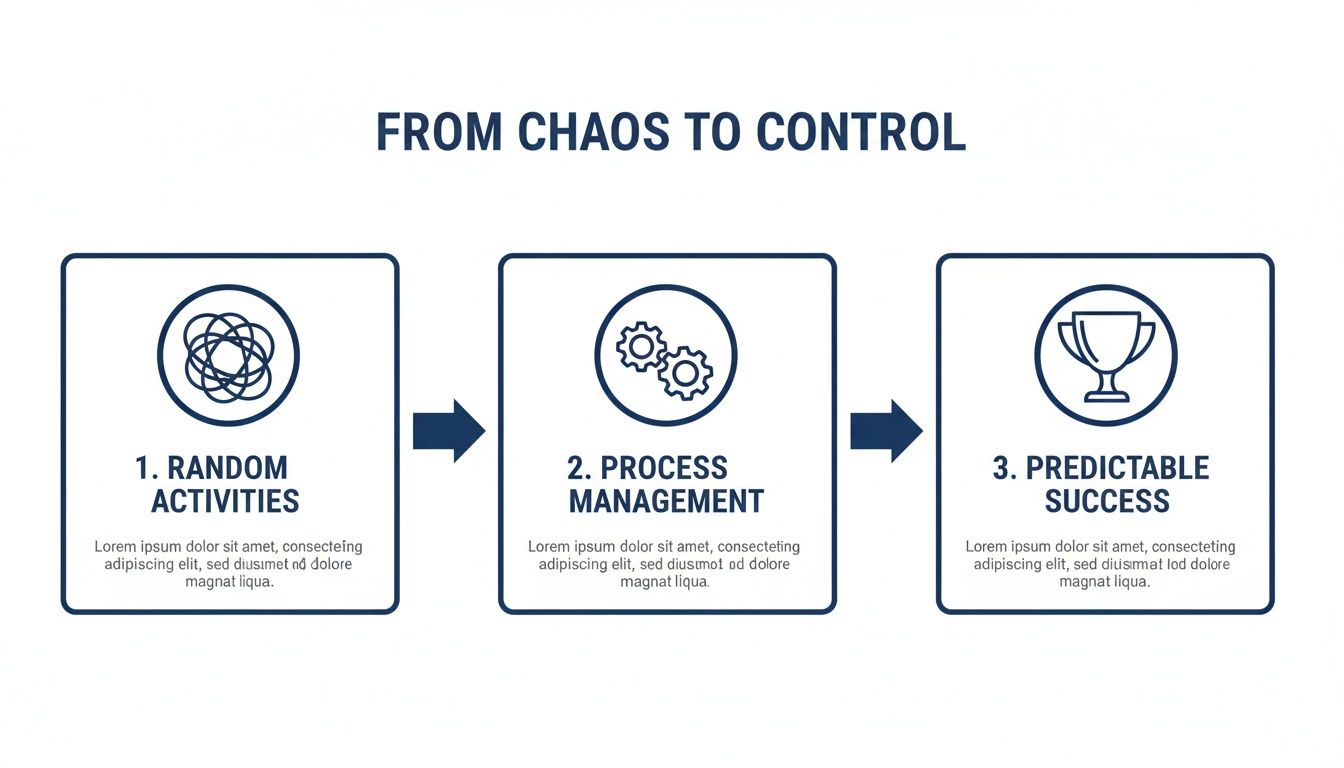
This visual really captures the essence of the lifecycle. It's the engine that brings order out of chaos, allowing you to hit your goals again and again.
Stage 1: Discovery and Mapping
Every journey starts somewhere, and in process management, it starts with discovery. You can’t improve what you don’t understand. This first step, Discovery and Mapping, is all about getting a brutally honest picture of how your processes actually work—not how you think they work.
Let’s say you want to improve your customer order fulfillment. In this stage, you’d trace every single step from the moment a customer clicks “buy” to the second the package lands on their doorstep. This means talking to the people on the ground doing the work every day—sales, warehouse staff, customer service—to create a visual map of the entire workflow.
This map shows the whole route, warts and all. The goal isn't to judge or fix anything yet. It’s simply to create a detailed blueprint of the "as-is" state, which is the critical foundation for spotting the real challenges and opportunities down the line.
Stage 2: Analysis and Design
With a clear map in hand, it’s time to put on your detective hat. The Analysis and Design phase is where you scrutinize that workflow for anything that’s slowing you down, causing errors, or wasting resources. Using our order fulfillment example, you’d look at your map and ask some tough questions.
- Where are the bottlenecks? Maybe orders are piling up waiting for manual approval before hitting the warehouse.
- What steps are redundant? Perhaps the sales and finance teams are both entering the same customer data into two different systems.
- Where are the risks for errors? That manual data entry step could be the source of all your incorrect shipping addresses.
Based on what you find, you can start designing a better, more efficient "to-be" process. This new design should directly address the problems you uncovered, creating a smoother, faster, and more reliable path forward.
The design phase is your chance to completely re-imagine the process. Ask yourself, "If we could build this from scratch to be as efficient as possible, what would it look like?"
Stage 3: Documentation and Implementation
A brilliant new process is useless if it only exists on a whiteboard or in your head. The next critical stage is Documentation and Implementation, where you turn that new design into clear, accessible, and easy-to-follow standard operating procedures (SOPs).
Good documentation ensures everyone knows exactly what their role is and how to execute their tasks consistently. You're translating the "to-be" map into practical instructions your team can actually use. Once it's documented, you roll it out. This means clear communication, training, and support to help everyone adapt to the new way of working.
Stage 4: Monitoring and Measurement
Okay, the new process is live. Time to sit back and relax, right? Not quite. Now comes the Monitoring and Measurement phase, where you track performance to see if it’s actually delivering the results you hoped for. This is where the data comes in. You'll need to define key performance indicators (KPIs) to measure success objectively.
For our order fulfillment process, those KPIs might include:
- Order-to-ship time: How long does it take from order placement to the package leaving the warehouse?
- Error rate: What percentage of orders are shipped with incorrect items or to the wrong address?
- Cost per order: What’s the total operational cost to get one order out the door?
Monitoring these numbers gives you hard proof of whether the changes are working. While research shows nearly half of organizations (45%) use process management mainly just to document their workflows, it's this monitoring step that truly closes the loop.
Stage 5: Optimization and Improvement
The final stage, Optimization and Improvement, is what makes process management a true cycle rather than a one-and-done project. Based on the data you’ve gathered, you can pinpoint new opportunities for refinement. This is the heart of continuous improvement.
Maybe your monitoring shows that while the order-to-ship time has dropped, the cost per order has unexpectedly gone up. That insight sends you right back to the analysis phase to figure out why. Perhaps a new automated tool is more expensive than you thought, or it requires more hands-on maintenance.
This continuous loop of monitoring and optimizing ensures your processes never get stale. It builds a culture where your whole team is constantly looking for better ways to work, keeping your business agile, efficient, and ready for whatever comes next.
Choosing The Right Process Management Framework
Once you see the entire process management lifecycle laid out, you hit a crossroads: what framework will guide your improvement efforts? Each business challenge has its own personality. That’s why picking the right approach is like choosing a training plan for different athletes.
Do you need to cut excess from a production line? Lean might be your best bet. Is defect reduction your obsession? Six Sigma steps into the spotlight. Or are you racing to keep up with shifting market trends? Agile could be the ticket.
Lean Eliminating Waste For Maximum Value
Lean zeroes in on waste—anything that consumes resources without adding value to the customer. It first emerged in manufacturing but has spread to sectors like healthcare and software development. The goal is to trim every unnecessary step so your operations move faster and costs drop.
Key Elements:
- Primary Goal: Maximize customer value while cutting out waste
- Best For: Manufacturing, logistics, supply chain, and any flow-driven environment
- Key Tools: Value Stream Mapping, 5S, Kanban
Imagine your warehouse piled high with unused inventory or approval loops that drag on for days. Lean teaches you to question every handoff: “Does this create value for the end user?” If the answer is no, it’s time for a trim.
Six Sigma Pursuing Perfection Through Data
Six Sigma brings data to the forefront. It’s all about measuring defects, understanding variation, and inching closer to flawlessness. In fact, the target is an astonishing 99.99966% accuracy rate. For industries like medical devices or aerospace, that kind of precision isn’t optional—it’s mandatory.
“If you can measure how many defects exist in a process, you can systematically figure out how to eliminate them and get as close to zero defects as possible.”
Six Sigma thrives on statistical tools: DMAIC, control charts, hypothesis testing. Speed takes a back seat. Instead, teams dive deep into root-cause analysis. Curious how to blend this rigor with Lean’s flow focus? Check out our guide on Lean Six Sigma principles.
Agile Embracing Change And Iteration
Agile flips the script when unpredictability reigns. Born in software development, it breaks projects into short cycles called sprints. This structure lets teams deliver, learn, and pivot—fast.
Think of a marketing crew launching a campaign. Trends can shift overnight. Agile encourages quick experiments, rapid feedback loops, and course corrections. No lengthy planning documents gathering dust—just continuous delivery and real-world insights.
Core Practices:
- Primary Goal: Boost responsiveness and accelerate value delivery
- Best For: Software development, marketing, R&D—any team facing evolving requirements
- Key Tools: Sprints, Scrum, Daily Stand-ups
Comparing Popular Process Management Frameworks
A side-by-side look at Lean, Six Sigma, and Agile to help you decide which framework best fits your business goals.
| Framework | Primary Goal | Best For | Key Tools |
|---|---|---|---|
| Lean | Eliminate Waste & Increase Speed | Manufacturing, Logistics, Supply Chain | Value Stream Mapping, 5S, Kanban |
| Six Sigma | Reduce Defects & Improve Quality | Healthcare, Finance, Engineering | DMAIC, Statistical Analysis, Control Charts |
| Agile | Increase Adaptability & Speed | Software Development, Marketing, R&D | Sprints, Scrum, Daily Stand-ups |
By lining up each framework’s strengths against your strategic objectives, you give your team a clear path—whether that’s cutting costs, boosting quality, or staying nimble in the face of change.
Choosing Your Framework
There’s no one-size-fits-all answer. Instead, match your core challenge to the framework that addresses it head-on. That’s how you empower your team with a proven roadmap to tackle inefficiencies, sharpen quality, or navigate uncertainty with confidence.
How Technology Is Revolutionizing Process Management
Process management has come a long way from the days of dusty binders filled with static flowcharts. Technology has dragged this discipline out of the theoretical and into a dynamic, real-time practice. We've moved beyond guesswork and manual updates to powerful tools that bring processes to life, making them intelligent and responsive.
The best way to think about this shift is to compare a paper road map to a live GPS. A paper map gives you one potential route, sure. But a GPS is constantly updating based on traffic, road closures, and your real-time speed, making sure you always have the most efficient path forward.
The Rise of Intelligent Process Hubs
Today's process management tech acts as a central nervous system for your entire operation. Specialized platforms have become intelligent hubs where processes aren't just stored—they're actively managed. These systems are now capable of automating tedious tasks, monitoring performance around the clock, and even predicting potential bottlenecks before they grind your business to a halt.
This is exactly where AI-powered SOP platforms like Whale come in. They create a single source of truth—a central hub for documenting, executing, and improving every key workflow. By weaving technology directly into your day-to-day operations, process management stops being a luxury for giant corporations and becomes a practical, accessible tool for any team.
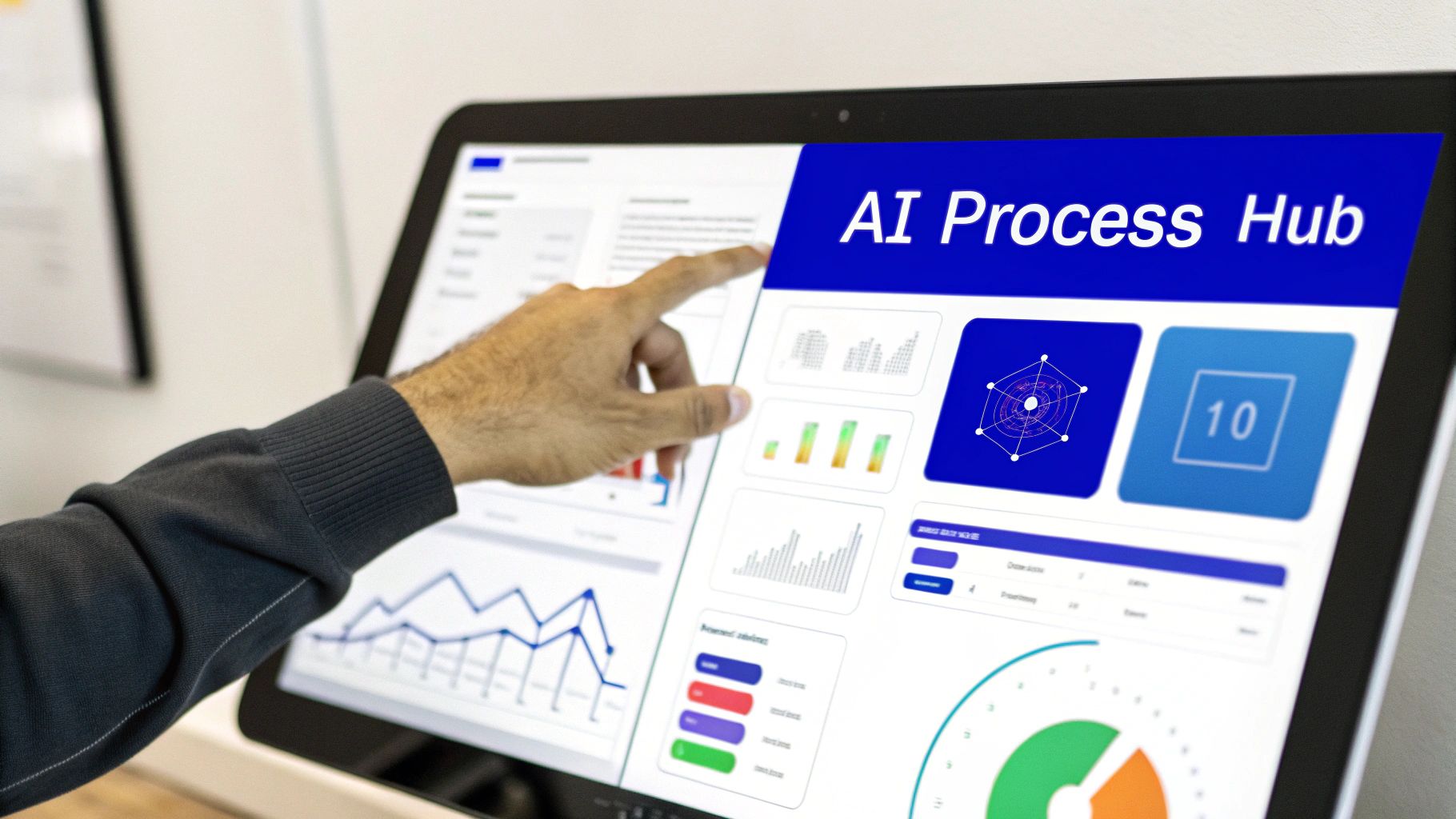
This evolution is all about moving toward centralized, data-driven platforms that give you instant insights into how your business is actually performing.
Automation and AI: The New Cornerstones
Artificial intelligence and automation are completely changing the game. By blending AI, machine learning, and Robotic Process Automation (RPA), companies are seeing massive efficiency gains. In fact, research shows that leveraging advanced analytics can boost productivity by up to 25%. Given those numbers, it's no surprise that 85% of organizations now make BPM solutions a core part of their digital strategy.
These tools are built to solve the classic headaches that have plagued process management for years:
- Outdated Documentation: AI can automatically flag SOPs for an update the moment a new tool is added or a workflow changes. Your documentation never gets stale.
- Inconsistent Performance: Automation is the key to consistency. It ensures repetitive tasks are done the exact same way every single time, wiping out human error.
- Hidden Inefficiencies: Advanced analytics can dig through performance data and pinpoint those tiny friction points that a human manager would never be able to spot.
If you're looking for a deeper dive, there are some great insights on automating business processes.
Technology doesn’t just make old processes faster; it enables entirely new ways of working. It empowers teams with the data and tools they need to take ownership of continuous improvement.
By adopting the right tools, you're not just reviewing processes periodically—you're building a system where process management is embedded in your team's daily rhythm. This is how you build a truly agile and resilient organization. To see how specific tools can drive these changes, check out our guide on business process management software.
Common Process Management Mistakes to Avoid
Jumping into a process management initiative is one of the smartest moves you can make to build a more efficient, scalable business. But even the best intentions can get sideswiped by a few common pitfalls. Knowing what they are ahead of time gives you the foresight to steer clear, ensuring your hard work pays off with real, lasting improvements.
Too many teams dive in headfirst, full of enthusiasm, only to watch their efforts grind to a halt because they missed a couple of critical details. This isn't about getting bogged down in complex theories; it's about the messy reality of changing how people work. The good news? These challenges are completely avoidable if you know what to look for.
Forgetting the Human Element
The single biggest mistake in process management is treating it like a purely technical problem. You can design the most brilliant, efficient workflow on paper, but if your team doesn't understand it, believe in it, or feel involved, it’s dead on arrival. This is exactly why a lack of team buy-in is the number one roadblock organizations hit.
When people feel like a new process is being shoved down their throats without their input, they'll naturally push back.
- The Mistake: Designing processes in an executive silo and then dropping them on the team as a finished product.
- The Fix: Pull your team into the conversation from day one. The people on the ground doing the work have priceless insights into what’s actually broken and how to fix it. Make them active partners in mapping and design, and you’ll build a powerful sense of ownership.
Boiling the Ocean
Another classic trap is trying to fix everything at once. When you’re staring down multiple clunky workflows, it's tempting to launch a massive, company-wide overhaul. This "boil the ocean" strategy almost always leads to burnout, confusion, and zero tangible results, killing all momentum before you can deliver any value.
A successful process management journey starts with a single, well-chosen step. By focusing your efforts, you can secure an early win that proves the value of the new approach and builds the confidence needed to tackle bigger challenges.
Pick one high-impact, low-complexity process to start with. Maybe it's a workflow that triggers frequent customer complaints or one that’s a known source of internal headaches. A quick win here proves the concept and generates the excitement you'll need for what comes next.
Setting and Forgetting New Processes
Launching a new process is the starting line, not the finish line. A frequent error is to implement a new workflow and immediately pivot to the next fire without ever looking back. If you aren't monitoring what you've built, you have no idea if the new process is actually any better than the old one.
Think of your processes like any other business asset—they need maintenance to perform.
- Define Success Metrics: Before you launch, decide what a "win" looks like. Is it a faster turnaround time? A lower error rate? A reduction in cost?
- Track Performance: Use Key Performance Indicators (KPIs) to measure the process against your goals. This gives you hard data on what’s working and what isn’t.
- Create a Feedback Loop: Schedule regular check-ins with the team to talk about how the process is holding up in the real world. This helps you catch small cracks before they become major fractures.
By sidestepping these common mistakes, you shift from simply documenting processes to actively managing them. This fosters a culture of continuous improvement, turning your operations into a true competitive advantage that’s ready to adapt and thrive.
Your First Steps in Process Management
You've got the theory down—the lifecycle, frameworks, and tech. Now, let's turn that knowledge into action. Kicking off your process management journey doesn't mean you have to flip the entire company upside down overnight. The real secret is to start small, prove the concept, and build momentum from there.

This simple, focused approach—tackling one manageable step at a time—is hands-down the best way to get started.
Select One Critical Process
First things first: pick a single workflow to zero in on. Resist the temptation to document every single thing your business does. Instead, choose a process that's either a known pain point or absolutely essential to your customer experience.
Good places to start include:
- Onboarding a new client: A slick, professional start can define the entire relationship.
- Fulfilling a customer order: This process directly shapes customer satisfaction and your brand's reputation.
- Handling a support ticket: Solving problems quickly and efficiently is what keeps customers coming back.
By focusing your energy on one high-impact area, you can score a tangible win that shows immediate value. That first success is what builds the confidence—and the buy-in from your team—to tackle bigger, more complex workflows down the line.
Document It Thoroughly
Got your process? Great. Now, map it out from beginning to end. This is where having a dedicated platform really starts to matter. An AI-powered SOP tool like Whale gives you a central hub to create, store, and share your documentation, making sure it’s always right there when your team needs it.
This disciplined approach is more than just a nice-to-have; it's a strategic move. By 2032, US-driven BPM technologies are expected to rack up over $200 billion in global productivity gains, and adoption in emerging markets is climbing by over 12% each year. The data points to one clear conclusion: businesses that get serious about modern process management are setting themselves up for huge efficiency gains. You can read more about the dynamic growth of the BPM market.
The goal isn't just writing steps down. It's about creating a single source of truth that gives your team the clarity to perform at their best, every single time, so you can scale effectively.
Taking these first practical steps lays the groundwork for a business that's more efficient, consistent, and ready for growth.
FAQs About Process Management
Whenever you start digging into process management, a few key questions always seem to surface. Getting good, straight answers is the best way to cut through the confusion and actually start applying these ideas to your business.
Let’s tackle some of the most common ones that come up.
Process Management Versus Project Management
This is probably the biggest mix-up we see. Process management and project management sound almost identical, and while both are about getting work done smarter, they apply to completely different kinds of work.
Here’s a simple way to think about it: process management is like running the day-to-day operations of a coffee shop. The whole point is to perfect a repeatable system for making a fantastic latte every single time. It's ongoing, focusing on consistency and efficiency.
Project management, on the other hand, is like planning the grand opening for that coffee shop. It's a one-time thing with a clear start and end date, a specific goal (open the shop!), and a dedicated team. Once the doors are open and the ribbon is cut, the project is done.
The easiest way to tell them apart: Processes are repeatable and ongoing, designed to deliver the same value over and over. Projects are temporary and unique, designed to hit a specific, one-time goal.
Benefits for Small Businesses
A common myth is that process management is only for giant corporations with layers of bureaucracy. The truth? Small businesses often see the biggest and fastest wins. For any company trying to grow, getting your processes nailed down is what separates scaling smoothly from scaling into total chaos.
Here’s what it does for you:
- Faster Employee Onboarding: When you have documented workflows, new hires can jump in and contribute way faster. This takes a massive training load off your senior people.
- Consistent Customer Service: Standardized processes guarantee every customer gets the same great experience, which is how you build a loyal following and a brand people trust.
- Scalability without Chaos: As you get more business, solid processes let you handle the increased volume without quality dropping or things falling through the cracks. It's the foundation you build on.
Timelines for Implementation
So, how long does this all take? The real answer is that it depends, but getting started can be quicker than you think.
You could map out and document a single, simple process in a day or two, especially if you have the right software to help. But the true magic of process management isn't a one-and-done task. It's an ongoing cycle of monitoring how things are going, listening to feedback, and constantly tweaking for the better. The goal isn't to create a dusty binder of rules, but a living system that grows and adapts right along with your business.