
Developing effective training plans for your staff isn't just a "nice-to-have" anymore—it's a core business strategy that directly fuels your team's productivity and your company's resilience. The days of dragging everyone into a conference room for a generic PowerPoint are long gone. Today's plans have to be targeted, data-driven, and tied to clear company goals to see any real return.
Why Generic Training Plans No Longer Cut It

Let's be honest—most staff training is a box-ticking exercise that rarely moves the needle. When training lacks purpose, the consequences are very real: disengaged employees, lagging productivity, and painful compliance gaps that expose the business to risk.
Those outdated "check the box" programs don't just waste time; they actively undermine your team's potential and your bottom line. A strategic approach, on the other hand, transforms learning from a cost center into a powerful driver of business growth. It becomes your competitive advantage.
The Shift from Obligation to Strategic Investment
Companies that invest in continuous, targeted learning aren't just surviving; they're thriving. This isn't about theory. It’s about connecting every training module directly to measurable business outcomes.
The global workforce is adapting to this new reality at a breakneck pace. In fact, a striking 50% of the global workforce has now completed training as part of long-term development strategies—a huge jump from just 41% in 2023. This trend, highlighted in the World Economic Forum’s Future of Jobs Report 2025, shows a massive worldwide shift toward upskilling to meet evolving job demands.
The real cost of poor training isn't the money spent on the program—it's the lost productivity, missed opportunities, and employee turnover that follows. Effective training is an investment in your company's most valuable asset: its people.
Connecting Training to Business Goals
A successful training plan doesn't start with content; it starts with a business problem you need to solve. By aligning every learning initiative with your company’s strategic objectives, you create a clear, direct path to success.
Here's what that looks like in the real world:
- Boosted Productivity: Well-trained employees simply make fewer mistakes and get things done faster. It's no surprise that companies with engaged staff often see a 17% increase in productivity.
- Higher Employee Retention: When people see a future at your company, they stick around. Investing in their skills shows you're invested in their career path, which is a massive factor in retention.
- Improved Compliance and Reduced Risk: In regulated industries, effective training isn't just a good idea—it's a requirement. A solid plan ensures everyone understands and follows critical procedures, minimizing costly errors. To see where things can go wrong, check out our guide on common employee training mistakes.
This guide will give you a practical framework for developing training plans that actually deliver results. We'll move you beyond generic templates and toward a system that builds a more capable, confident, and motivated workforce.
Pinpointing Skill Gaps with a Needs Analysis

Before you can build out a single training module, you have to know what problems you’re actually trying to solve. Guessing at your team's needs is a surefire way to waste time, budget, and morale.
The foundation of any plan that actually gets results is a thorough training needs analysis. This is what moves you from assumptions to a data-backed approach for identifying the real gaps between where your team is and where they need to be.
Think of it as a diagnostic tool. Instead of just throwing a generic training solution at a performance issue, you’re digging in to find the root cause. This isn’t just about boosting individual performance; it has a massive impact on keeping your best people around.
Employee retention really hinges on smart training plans. In fact, 45% of workers worldwide are more likely to stay if their employer ramps up development opportunities. The payoff is huge—companies that invest in training for engaged staff see 17% higher productivity and 21% greater profitability. But with job requirements expected to change by 50% by 2027, many employees feel like they’re being left behind. You can get more stats on how employee training impacts company performance at DevlinPeck.com.
Gathering Your Data
To find the right gaps, you need to collect information from multiple angles. Just relying on one method can give you a skewed, incomplete picture of what's really going on.
A multi-pronged approach is always best. Common methods include:
- Performance Reviews: This is your low-hanging fruit. Dig into individual and team performance data to spot recurring issues or areas where employees consistently miss the mark.
- Direct Observation: Just watch your team work. A warehouse manager might notice a consistent error in the packing process that’s causing shipping delays. You can’t get that insight from a spreadsheet.
- Surveys and Questionnaires: Ask your team directly what they need. Anonymous surveys can bring hidden frustrations or skill gaps to the surface that managers might otherwise miss.
- SOP Analysis: Your standard operating procedures are a goldmine of data. If a specific process repeatedly causes confusion or errors, it’s a flashing neon sign that the training around it needs to be fixed.
If you need a hand structuring this crucial first step, our detailed training needs analysis template can help you get organized.
To give you a better idea of which method to use, this table breaks down the most common approaches.
Choosing Your Method for Training Needs Analysis
This table breaks down the most effective methods for identifying skill gaps, helping you choose the right approach for your team and business goals.
| Analysis Method | What It Measures | Best For | Potential Pitfalls |
|---|---|---|---|
| Performance Reviews | Historical performance against set goals and competencies. | Identifying individual performance trends and recurring issues over time. | Can be subjective; may not capture future skill needs or team-wide gaps. |
| Direct Observation | Real-time execution of tasks and adherence to SOPs. | Uncovering procedural bottlenecks and on-the-job behavioral issues. | Time-intensive; presence of an observer might alter employee behavior. |
| Surveys/Questionnaires | Employee self-perception of skills, confidence, and training needs. | Gathering broad feedback quickly and identifying hidden pain points. | Responses can be biased; may not reflect actual performance deficits. |
| Interviews/Focus Groups | In-depth qualitative insights on challenges and team dynamics. | Exploring complex issues and understanding the "why" behind performance data. | Can be difficult to scale; requires skilled facilitation to avoid groupthink. |
| SOP/Work Analysis | Gaps between documented procedures and actual workflow execution. | Pinpointing breakdowns in standardized processes and compliance issues. | Doesn't measure soft skills or adaptable problem-solving abilities. |
Ultimately, a mix-and-match approach often yields the best results. For example, you might use survey data to identify a broad issue and then use focus groups to dig into the specifics.
From Gaps to Goals
Once you've spotted the skill gaps, the real work begins: connecting them directly to your business objectives. This is what separates strategic training from just random acts of learning.
Simply finding a weakness isn't enough. You have to understand how it’s hurting the business.
Let's say your analysis shows the sales team is struggling with the new CRM software. That's not just a tech problem. It directly undermines the business goal of improving sales forecasting accuracy. The training goal then becomes "Improve CRM proficiency to increase data accuracy by 15%," not just "Train team on CRM."
The point of a needs analysis isn't just to find what's broken. It's about finding the specific levers you can pull with training to drive measurable business outcomes. You're turning a problem into a growth opportunity.
A dedicated skills gap analysis template can be a huge help here, allowing you to map current skills against what’s truly needed for success.
Prioritizing Your Training Efforts
Let's be realistic: you’ll probably uncover more needs than you can tackle at once. The final piece of your analysis is prioritization. You have to figure out which skill gaps are causing the most pain or blocking you from reaching your most critical goals.
Imagine an HR lead’s analysis uncovers two big issues: a team-wide weakness in conflict resolution and a need for advanced spreadsheet skills. Both are valid. But if employee disputes are causing constant project delays and driving up turnover, addressing the conflict resolution gap is the clear priority. It has a much bigger and more immediate impact on business stability.
This methodical approach ensures that when you start building out your training plans, your efforts are targeted, relevant, and focused on what will actually move the needle for your business.
Setting Learning Objectives That Actually Mean Something
Alright, you’ve done the hard work of digging through your needs analysis and pinpointing the gaps. Now what? This is the part where we define what success actually looks like.
Vague goals are the absolute enemy of effective training. Seriously. Without clear, measurable targets, you’re just throwing spaghetti at the wall, hoping something sticks. You have no real way to know if your program worked, let alone prove its value to leadership.
This is where you shift gears from diagnosing a problem to architecting a solution. Think of it as building a bridge between knowing your team needs to "get better at customer service" and setting a tangible benchmark that forces real improvement. The difference is night and day.
The Power of the SMART Framework
There's a reason the SMART framework is a classic—it works. It forces you to ditch fuzzy intentions and get crystal clear on your objectives. Every goal gets filtered through this simple but powerful lens: is it Specific, Measurable, Achievable, Relevant, and Time-bound?
This isn't just fluffy business jargon; it's a practical checklist for creating total clarity.
Let’s see it in action. Here’s how we transform a common, well-meaning but ultimately useless goal into a powerful SMART objective.
Before SMART:
- Goal: "Improve the sales team's closing skills."
This feels right, but it's completely unmeasurable. What does "improve" even mean? How will you know when you get there? It gives you zero direction for designing the actual training content.
After Applying SMART:
- Objective: "Within 60 days of completing the advanced sales negotiation training, each member of the sales team will increase their individual close rate on qualified leads by 15%, as measured by our CRM data."
See the difference? Now you have a clear target, a deadline, and a precise metric for success. You can build a training program laser-focused on hitting that 15% mark.
From Objectives to Key Performance Indicators
With sharp objectives locked in, you can now define the Key Performance Indicators (KPIs) that will prove your training’s impact. These are the specific metrics you’ll actually track. The best training plans always mix both quantitative and qualitative measures to get the full story.
- Quantitative KPIs: These are the cold, hard numbers. Think percentages, dollars, and error counts. They're objective and easy to pull from your systems.
- Qualitative KPIs: These measure the softer stuff—changes in behavior, confidence, and attitudes. You'll often need surveys, observations, or direct feedback to capture this data.
Combining both gives you a 360-degree view. For example, seeing a drop in support ticket errors (quantitative) is great. But knowing team morale has also shot up (qualitative) shows you’ve created a much deeper, more lasting change.
Pro Tip: Always write learning objectives from the employee's point of view. They should clearly state what the employee will be able to do differently after the training. This makes the goal feel real and motivating for everyone involved.
Real-World Examples of Strong KPIs
Let's make this tangible. Imagine you just rolled out a new training program to sharpen the project management skills of your team leads. How do you measure if it worked?
Quantitative KPIs for Project Management Training:
- A 20% reduction in projects blowing past their original deadlines.
- A 10% decrease in budget overruns on all team-led initiatives.
- A 25% increase in the number of project milestones hit on time.
Qualitative KPIs for Project Management Training:
- Higher scores on post-training confidence surveys where leads rate their ability to handle scope creep.
- Positive feedback from team members on the clarity and organization of project plans.
- Managers observing a real improvement in how leads delegate tasks and communicate updates in team meetings.
These metrics do way more than just justify your training budget. They give you crucial feedback. If you see deadlines improving but budgets are still a problem, you know exactly where to focus your next training effort. This data-driven approach is how you build a learning culture that actually evolves with the business.
Designing Training Your Team Will Actually Use
Alright, you've got your objectives locked in. Now for the fun part: designing the actual training experience. This is where we move from goals on a spreadsheet to learning activities your team will find genuinely useful—not just another mandatory meeting they have to click through.
Let's be honest, the days of one-size-fits-all lectures are over. They just don't work. To create training that actually sticks, you need a flexible, blended approach. Your team is made up of individuals who learn in different ways and at different paces. A truly effective training plan meets them where they are.
Adopting a Blended Learning Model
Your secret weapon here is a blended learning model. It's exactly what it sounds like: mixing and matching different delivery methods to create a more dynamic and effective experience. Instead of forcing everything into a single format, you get to combine the best of several worlds.
This just makes sense. You wouldn't use a hammer to drive a screw, right? A complex new software system probably needs hands-on practice, while a simple policy update could be handled with a quick video.
Common elements you can mix into your plan include:
- On-the-Job Coaching: Nothing beats direct, hands-on guidance from a manager or mentor for practical skills. It's immediate and context-rich.
- Interactive E-Learning: Self-paced modules with quizzes and little simulations are perfect for letting people learn on their own schedule.
- Mentorship Programs: Pairing new folks with seasoned pros is a fantastic way to speed up learning and build stronger team connections.
- Instructor-Led Sessions: Whether they're virtual or in-person, these sessions are gold for group discussions and collaborative problem-solving.
Picking the right tool for the job has never been easier, thanks to the explosion in digital learning platforms. The Learning Management System (LMS) market is expected to hit a staggering $40.95 billion by 2029. That's not just a random number; it reflects a massive shift in how people want to learn. In fact, 58% of employees are asking for self-paced learning, and 68% still prefer learning on the job. You can read the full data on key employee training statistics at LevelUpLMS.com to see where things are headed.
Making Content Digestible and On-Demand
One of the biggest traps I see people fall into is creating these massive, monolithic training modules. Nobody has the time or the mental bandwidth for a three-hour training video. It’s just not realistic.
The solution is microlearning. It’s all about breaking down complex topics into small, focused, bite-sized pieces.
Imagine turning a dense, 50-page compliance document into a series of five-minute video modules, each with a quick quiz at the end. Suddenly, the information is far less intimidating and much, much easier to remember.
This diagram shows how you can take a fuzzy goal, sharpen it into a SMART objective, and then use that to define the specific KPIs you'll track.
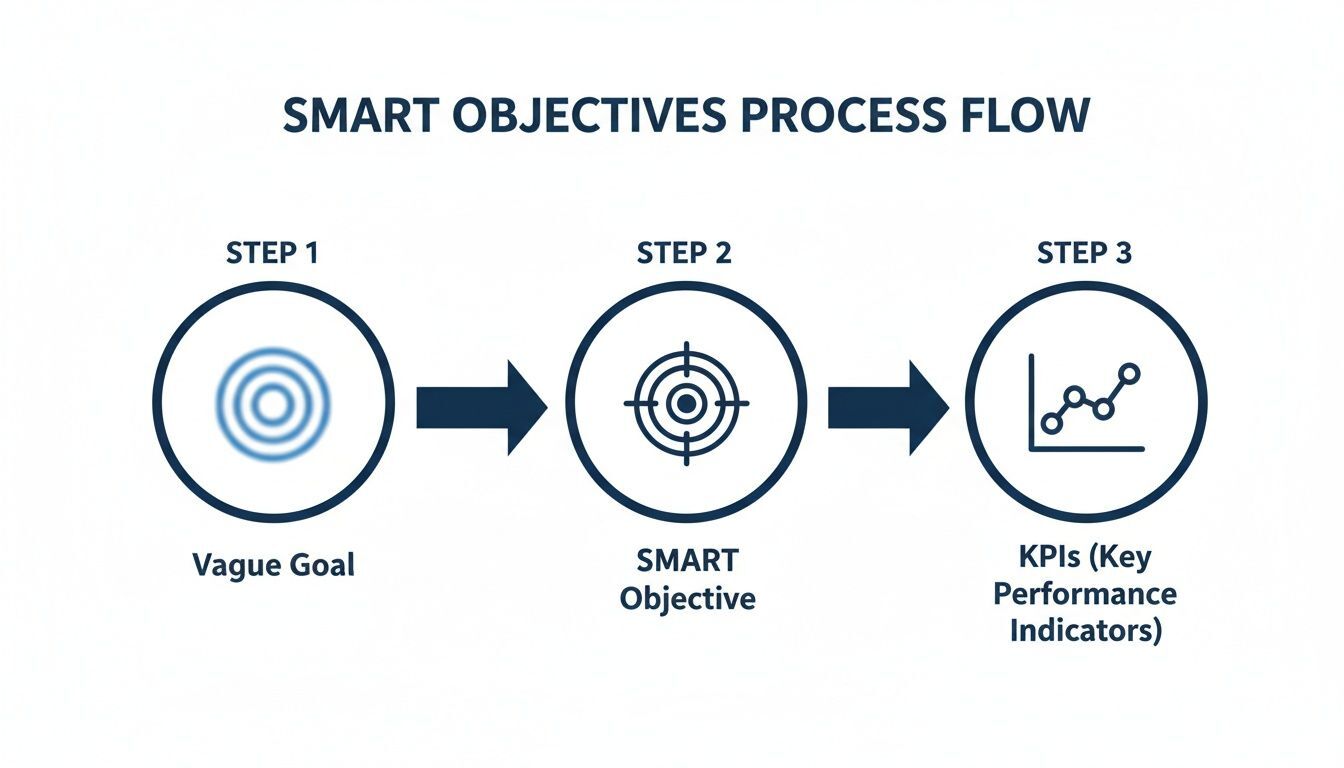
This is the exact thought process you need to design laser-focused training content that actually solves a problem.
This approach also makes your training available on-demand. When an employee runs into an issue, they don't want to dig through an old manual or a long video. They want a quick, two-minute guide they can find right now. This is how you transform learning from an isolated event into a daily, integrated part of the workflow.
The best training materials don't feel like a lecture; they feel like a lifeline. They are practical, accessible, and available at the exact moment of need.
Real-World Scenario: Turning Policy into Practice
Let's make this tangible. Imagine a compliance team needing to train the whole company on new data privacy regulations. The old-school way? A company-wide email with a 30-page PDF attached, followed by a mandatory, hour-long webinar. We all know how that goes—low engagement, even lower retention.
Here’s how they could tackle it with a modern, blended approach:
- The Hook: Kick things off with a short, engaging video from the CEO explaining why these new rules are so critical to the business and its customers. Make it personal.
- Bite-Sized Learning: Break the policy down into five distinct microlearning modules. Each one covers a specific topic, like "Handling Customer Data" or "How to Spot Phishing Attempts," using a mix of short videos, interactive graphics, and real-world examples.
- Quick Checks: At the end of each module, there's a quick, five-question quiz. Employees have to pass to unlock the next module, ensuring they're actually absorbing the info.
- A Living Resource: All these modules are uploaded to a central, searchable knowledge base. Six months down the line, if someone has a question about data handling, they can find the exact two-minute video they need in seconds.
This approach respects everyone's time, makes the information way more accessible, and gives you a clear, trackable record of who has completed the training. To really make it effective, incorporating proven online course tips can boost engagement even further.
By focusing on practical application and easy access, you create training people will actually turn to, making learning a continuous habit rather than a dreaded annual event.
Launching and Measuring Your Training Program
Let's be honest, a brilliant training plan is just a document until you actually bring it to life. The real magic happens in the execution—how you launch, measure, and refine the program. This is where your strategic goals turn into tangible skills and, more importantly, measurable business results.
This whole phase boils down to two things: momentum and feedback. You need a practical rollout that gets your team excited, not overwhelmed. Right after that, you need a solid system to listen, figure out what's working, and make smart tweaks.
Building a Realistic Rollout Timeline
The first domino to fall in a successful launch is communicating the "why." When your team understands the purpose behind the training and can clearly see what's in it for them—whether it's mastering a new tool to ditch tedious tasks or gaining a skill for their career—their buy-in goes through the roof.
Once you have that buy-in, the focus shifts to scheduling. A poorly timed launch can build resentment before anyone even clicks on the first module.
- Stagger the Rollout: Instead of a massive, company-wide launch, think about rolling out the training to smaller pilot groups first. This lets you iron out any kinks with a more forgiving audience.
- Block Dedicated Time: Don't just expect employees to cram training into their already packed schedules. Go ahead and block dedicated "learning time" on their calendars. It's a small gesture that shows the company truly values this process.
- Provide Clear Instructions: Make it painfully obvious how to access materials, who to ask for help, and what the deadlines are. A clunky technical experience is a surefire way to kill enthusiasm.
Measuring the Impact on Your KPIs
Okay, the program is live. Now your focus pivots to measurement. This is how you prove the program's value to leadership and, just as importantly, spot opportunities to make it even better. Those KPIs you defined earlier? They're now your yardstick for success.
Your measurement strategy needs to be more than just one-dimensional. The best approach combines hard data with actual human feedback. This blend gives you the full picture of how effective the program really is.
Key Measurement Tools:
- Post-Training Assessments: Use short quizzes or hands-on simulations to check for knowledge retention right after a session. This tells you if the core concepts landed.
- Performance Data: This is the big one. Give it 30-60 days, then dive into the operational data. Are you actually seeing that 15% reduction in errors you were aiming for? What about the 10% bump in productivity?
- Simple Feedback Surveys: Just ask people what they thought. What part was most helpful? What was confusing or a waste of time? This qualitative feedback is pure gold for refining your content.
Gathering all this information is absolutely crucial. For a deeper dive on execution strategies, you can learn how to build a successful employee training program in our comprehensive guide.
Effective measurement isn't about giving your training program a pass or fail grade. It's about creating a continuous feedback loop. This lets you adapt and improve, making sure your investment delivers real, long-term value.
The Critical Role of Version Control
In any business where processes are constantly changing, training content can become obsolete almost as fast as you create it. This is especially true for any training tied to your Standard Operating Procedures (SOPs). Without a system to manage updates, you're practically inviting teams to work from conflicting or flat-out wrong information.
This is where version control becomes a non-negotiable part of your training plan. It’s the only way to ensure that every time a process gets updated, the training materials are updated right alongside it—and everyone knows about it.
Imagine your IT team updates a critical cybersecurity protocol. The old way of doing things involved blasting a mass email with a new PDF attached, crossing your fingers that everyone reads it, and then trying to manually track who’s acknowledged the change. It's a system designed to fail.
A modern approach uses a centralized platform. When the IT manager updates that security SOP, the system can automatically:
- Archive the old version of the training module so it's out of circulation.
- Notify all relevant staff that a mandatory update is ready for them.
- Track completion rates to give you a clear dashboard of who is compliant with the new protocol.
This creates a single source of truth, wiping out the confusion and risk that comes with outdated documents. As your company grows and processes get more complex, it's the only sustainable way to guarantee consistency and compliance. This cycle of iterative improvement is what separates a static training program from a truly dynamic and effective one.
Common Questions About Staff Training Plans
Even with the perfect framework, questions always pop up once you start digging into the details of a training plan. Here are some of the most common hurdles I've seen managers and HR teams face, along with some practical advice to keep you moving.
How Do You Get Leadership Buy-In for a New Training Plan?
Getting the green light from leadership isn't about asking for money for training; it's about presenting an investment with a clear return. Don't start the conversation with the training program itself. Start with the problem it solves.
Use the data you pulled together during your needs analysis to paint a clear picture of the cost of doing nothing. Show them exactly how current skill gaps are impacting productivity, creating compliance headaches, or hitting the bottom line.
Once you’ve established the pain point, frame your plan in terms of dollars and cents. Instead of vague promises like "it will make us more efficient," get specific.
Give them a projection they can latch onto, like, "Based on our analysis, this training will reduce production errors by 10%, saving the company an estimated $50,000 this year." When you connect your plan to tangible metrics like customer retention or operational speed, it stops being an expense and becomes a strategic move they can’t afford to pass up.
What Is the Best Way to Train a Remote or Hybrid Workforce?
For remote and hybrid teams, a blended learning strategy is, without a doubt, the way to go. This approach mixes the flexibility of self-paced learning with the energy of live, collaborative sessions, which is perfect for a team scattered across different locations and time zones.
The backbone of this strategy is a centralized digital home for all your training materials, whether that's a knowledge base or an SOP management system like Whale. This becomes the single source of truth, giving people the freedom to learn on their own time while making sure everyone gets the same consistent, up-to-date info.
Here’s what that mix looks like in practice:
- Self-Paced E-Learning: Perfect for the foundational stuff and procedural training. Think short videos, interactive modules, and step-by-step guides that let employees learn at their own pace.
- Live Virtual Sessions: Save this time for the good stuff—Q&As, group brainstorming, and role-playing exercises where that real-time human interaction is irreplaceable.
- On-Demand Microlearning: This is your secret weapon. Giving your team instant access to bite-sized guides and checklists reinforces knowledge right when they need it, no matter where they are.
This combination truly gives you the best of both worlds: flexibility for your team without sacrificing consistency or the chance to build connections.
How Often Should We Update Our Staff Training Plans?
A formal, annual review of your overall training strategy is a good starting point, but in reality, your training plan needs to be a living document. If you wait a full year to make changes, you're pretty much guaranteeing your material will be obsolete.
A much better approach is to set up specific triggers that signal an immediate need to review and update a training module. This keeps your program nimble and locked in with the current needs of the business.
Key Triggers for an Update:
- A new piece of technology or software is rolled out
- Industry regulations or compliance standards change
- The company pivots its strategy or sets new goals
- Performance data flags a new or recurring skill gap
- A core Standard Operating Procedure (SOP) is updated
When you use a dynamic system for your training content, you can make these tweaks in real-time. That way, your training is always perfectly aligned with your processes, and your team is never working with outdated information.
How Can a Small Business Create a Training Plan on a Budget?
Small businesses can absolutely build powerful training programs without a huge budget. The trick is to be resourceful and focus on your most critical need first. Don't try to solve every problem at once; pinpoint the single biggest skill gap holding you back and tackle that.
Once you know where to aim, look inward. Your most valuable and cost-effective training assets are the experts you already have on your team.
- Peer-to-Peer Workshops: Ask your seasoned pros to lead short, informal workshops on things they do exceptionally well. It’s a great way to build skills across the team and it also gives your top performers a chance to shine.
- Simple Mentorship Program: Pair newer folks with experienced team members. It’s a low-cost, high-impact method for transferring that crucial institutional knowledge that never makes it into a manual.
- Focus on SOPs: Your best training tool is a clear, well-documented process. Building a central library of on-the-job training guides and Standard Operating Procedures is incredibly effective.
Today, many training platforms offer free or low-cost plans designed for small businesses. This lets you centralize all your documentation and create that single source of truth for your team without a big upfront investment, making effective training accessible to everyone.