
Let's cut to the chase: A policy is your organization's 'what' and 'why.' It lays out the guiding principles and rules of the road. A procedure, on the other hand, is the 'how'—it's the detailed, step-by-step instruction manual for putting those rules into practice.
Understanding The Core Difference Between Policy And Procedure
Think of it like this: a policy is the destination you plug into your GPS ("Get to the city center, and don't break any traffic laws"). The procedure is the turn-by-turn navigation that tells you exactly how to get there. One defines the goal and sets the boundaries; the other provides the precise path to follow.
Getting this distinction right is foundational. It's the key to building documentation that actually drives consistency, compliance, and operational excellence across your business.
A Quick Comparison
Policies are the big-picture, strategic documents. They reflect a company’s values and high-level objectives and are deliberately broad to allow for professional judgment where needed. Procedures are the exact opposite—they are tactical, narrow in scope, and intentionally rigid to make sure a specific task gets done the same way, every single time. Understanding the differences between policies and procedures is crucial for effective management. While policies provide a framework for decision-making, procedures lay out the specific steps needed to implement those decisions consistently. This distinction helps ensure that team members are not only aligned with the organization’s goals but also equipped to execute tasks efficiently.
This separation isn't just for show; it has a real impact on operations. A recent Deloitte survey found that companies with a clear line between policies and procedures reduced compliance violations by 47%. That translated to an average annual saving of $2.1 million.
To really see how they stack up, here’s a quick breakdown of their core differences.
Policy vs Procedure at a Glance
This table offers a simple, side-by-side view of what makes policies and procedures fundamentally different.
| Attribute | Policy | Procedure |
|---|---|---|
| Purpose | States the rule and guiding principle (The "What" & "Why") | Provides step-by-step instructions (The "How") |
| Scope | Broad, applies organization-wide or to major functions | Narrow, applies to a specific task or team |
| Detail Level | High-level, general principles | Detailed, specific actions and sequences |
| Flexibility | Allows for professional judgment and discretion | Rigid and must be followed exactly |
| Focus | Governance, risk management, and compliance | Efficiency, consistency, and task execution |
| Ownership | Senior leadership, HR, or legal departments | Department managers, team leads, or subject matter experts |
Ultimately, policies and procedures need each other to be effective.
Why This Matters
This isn’t just an academic exercise—it directly shapes how your teams operate day-to-day. A well-written "Workplace Safety" policy establishes that safety is a top priority. But it's the corresponding procedures—like "How to Operate the Forklift" or "Emergency Evacuation Steps"—that bring that policy to life on the ground floor.
A policy without a procedure is just a wish. A procedure without a policy lacks direction and authority. Both are essential for a scalable, well-managed organization.
Policies provide the strategic framework, and procedures give you the operational blueprint. It's also worth noting that procedures are just one piece of the puzzle. You'll also encounter processes, which are broader collections of related tasks. To dig deeper, check out our guide on the differences between processes and procedures.
What's a Policy All About in Business?
Think of policies as your company's constitution. They’re the high-level, formal statements that lay down the "what" and the "why" behind every major decision and action. These aren't just documents; they're the foundational pillars that hold up your entire operational structure, reflecting your core values, culture, and legal duties.
A policy intentionally avoids the nitty-gritty of daily tasks. Instead, it paints the big picture and sets the strategic direction. For example, a "Data Security Policy" isn't going to walk you through resetting a password. It will, however, state the company's firm commitment to protecting sensitive data and ensuring compliance with regulations like GDPR.
The Strategic Purpose of Policies
So, what’s the main job of a policy? To guide decision-making and manage risk across the board. It provides a consistent framework that empowers employees to act independently while keeping everyone aligned with the company's strategic goals. That’s why policies are intentionally broad.
A well-written policy always tackles a significant issue tied directly to the organization's mission. Key characteristics usually include:
- Broad Scope: Policies typically apply to the entire organization or at least major departments, not just a single team or task.
- High-Level Guidance: They spell out the rules and principles but don't get bogged down in the specific steps needed to follow them.
- Long-Term Stability: Policies are built to last. They’re updated infrequently, usually only when there's a major strategic shift or a change in the law.
Because of their strategic nature, policies are owned by the top brass. Senior leadership, often working with legal and compliance teams, is responsible for creating, approving, and championing these critical documents.
Policies in Action: Real-World Examples
To really get it, let's look at how policies work in a real business setting. Each example sets a clear rule that governs behavior and decisions, leaving the "how-to" details for procedures.
A Code of Conduct Policy is a classic. It defines expected ethical behaviors, like avoiding conflicts of interest and maintaining professionalism. It sets the standard for employee integrity but doesn't hand you a script for every possible workplace conversation.
Another common one is an Acceptable Use Policy (AUP) for company tech. This policy will clearly state that company resources (like laptops and networks) are for business purposes and must not be used for illegal activities. It sets firm boundaries for how technology should be used.
A policy is mandatory. It's not a suggestion or a best practice; it is a formal declaration from the governing body that sets a non-negotiable rule. This authority is what distinguishes it from other guidance documents.
This mandatory nature ensures that everyone, from the C-suite to frontline employees, is playing by the same rules. It's the engine that turns strategic vision into everyday organizational behavior. When you ask, "What is our company's stance on this issue?" the answer should always be in a policy. Understanding this makes the massive difference between a policy and a procedure crystal clear—since a procedure’s only job is to execute what the policy dictates.
If policies are the "what" and "why" of your business operations, procedures are the nuts-and-bolts "how." They are the essential link that turns a high-level rule into a concrete, repeatable action your team can follow. Think of a procedure as the ground-level blueprint that spells out the "how" and "when" for any given task, making sure everyone performs it with the same quality and consistency.
Unlike a broad, company-wide policy, a procedure is deliberately narrow and tactical. Its sole job is to crush ambiguity. A data security policy might declare the company's commitment to protecting information, but a procedure gives an employee the exact, sequential steps to make that happen.
From High-Level Rule To Step-By-Step Guide
Let's stick with that "Data Security Policy" example. This document lays down the non-negotiable rules for handling data. A procedure grabs that high-level mandate and shatters it into a practical, easy-to-follow workflow.
For instance, you might have a corresponding document called "Procedure for Responding to a Suspected Data Breach." This guide would leave zero room for guessing and would include very specific steps like:
- Isolate the affected system immediately by disconnecting it from the network.
- Notify the IT Security Manager via the designated emergency communication channel within 15 minutes of discovery.
- Document the initial findings in the official incident response log, noting the time, systems involved, and nature of the suspicion.
This is what procedures are all about: granular detail. If you want to get better at this, learning how to create standard operating procedures can give you some great insights into breaking down complex tasks.
Who Owns And Maintains Procedures
Procedures are living, breathing documents. Their ownership doesn't sit with senior leadership; it belongs to the people closest to the actual work. Department managers, team leads, and on-the-ground subject matter experts are the ones who should be creating and maintaining them. Their direct experience ensures the steps are accurate, practical, and efficient.
A procedure’s value lies in its specificity and currency. An outdated or vague procedure is often more dangerous than having no procedure at all, as it can create a false sense of security while leading employees to perform tasks incorrectly.
Because procedures are so tightly linked to specific tools, software, and workflows, they need to be updated far more often than policies. A simple software update, a change in team structure, or a new compliance rule can all trigger a procedural review. The best-run organizations get this. They know that this regular maintenance is non-negotiable for operational integrity. For more on this, check out our guide on how to write a standard operating procedure.
This constant need for updates really drives home a key difference:
- Policies are stable. They reflect core principles and rarely change.
- Procedures are dynamic. They have to adapt to the constantly shifting operational landscape.
At the end of the day, a solid procedure is the engine that drives consistency. It ensures that no matter who is doing the task, the outcome always meets the standard set by the policy. By turning abstract rules into clear, actionable steps, procedures give your team the confidence and precision they need to crush their roles every single day.
A Nuanced Look at Policies vs. Procedures
Knowing the basic definitions is one thing, but the real lightbulb moment happens when you compare policies and procedures in action. Placing them side-by-side reveals how they work together to build a strong, cohesive operational backbone for your business.
Let's break down the key differences.
Purpose: Guiding Principles vs. Direct Instructions
The most critical distinction is their core purpose. A policy is there to guide decisions. It lays out the company's official stance and sets the boundaries for everyone to operate within. For instance, a "Remote Work Policy" might state that the company supports flexible work to boost work-life balance while ensuring productivity and security. It doesn't tell you how to book a remote day; it just establishes the "why."
On the flip side, a procedure is all about instruction. It gives you the clear, step-by-step actions needed to follow a policy. Using the same example, a "Procedure for Requesting a Remote Work Day" would walk an employee through the exact process: submit a request via the HR portal at least 48 hours ahead, get your manager’s approval, and so on.
Policies answer the "what" and "why," setting the rules of the game. Procedures answer the "how," providing the playbook for winning it.
Scope: Company-Wide vs. Task-Specific
Scope is another huge giveaway. Policies are intentionally broad, applying across the whole company or at least to entire departments. Their high-level nature keeps them relevant for everyone, no matter their role. A "Code of Conduct" policy is a perfect example—it applies to every single person, from the CEO down to a summer intern.
Procedures, however, are laser-focused. They’re built for a specific task, department, or even a single role. The value is in the details. While the "Code of Conduct" is for everyone, a procedure like "Steps for Reporting an Ethical Violation" is a very specific workflow that only a few people in HR might ever need to execute.
This infographic neatly summarizes the key traits of a procedure.
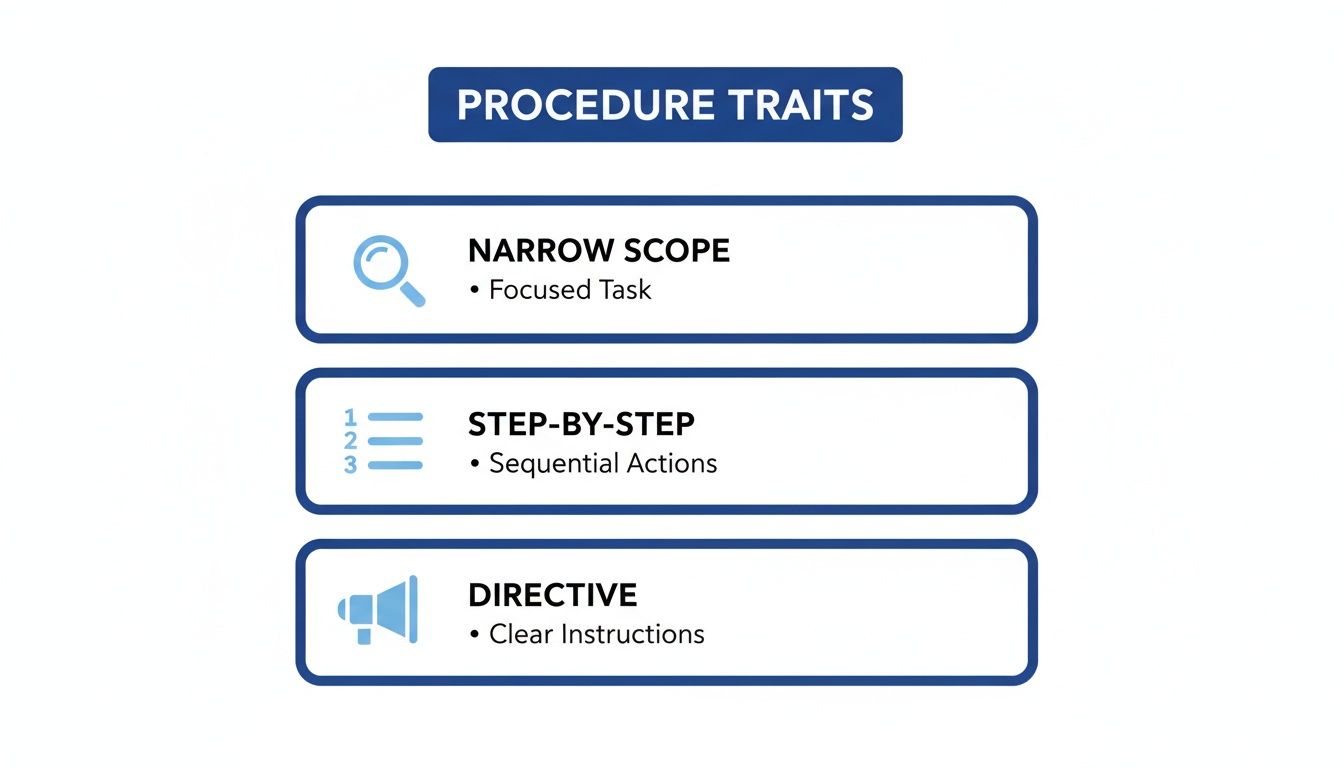
As you can see, procedures get their power from a narrow focus, sequential steps, and crystal-clear instructions.
Format and Tone: Principles vs. Checklists
The way each document is written and structured also tells a story. Policies have a formal, principled tone. They use broad language to outline rules and expectations, often including the consequences for not following them. Think of it as the company's constitution—it's a framework for good judgment.
Procedures are direct and instructional. You’ll often find them formatted as a numbered list, a checklist, or a flowchart. The language is simple and action-oriented, designed to be followed to the letter with no room for interpretation. It’s a tool, not a declaration.
Ownership and Accountability: Leadership vs. Frontline Managers
Who owns the document is a dead giveaway. Policies are owned by senior leadership. The C-suite, board members, or heads of legal and compliance are the ones who create, approve, and stand behind them. This high-level ownership is what gives policies their authority.
Procedures are owned by the people who actually do the work. Department heads, team leads, and subject matter experts are on the hook for creating and updating them. This ensures the steps are practical, accurate, and reflect the smartest way to get the job done.
Update Cadence and Flexibility
Finally, think about how often they change. Policies are built to last. They’re updated infrequently—maybe every couple of years—and usually only when there's a major strategic shift or a big change in regulations. They’re meant to be the bedrock.
Procedures, in contrast, are living documents. They need regular reviews and updates to keep up with new technology, tools, or team structures. A simple software update could make a procedure obsolete overnight.
This link between stable policies and dynamic procedures is a game-changer for managing risk. A recent PwC analysis found that companies with tightly linked policies and procedures cut regulatory non-compliance incidents by 56%. You can learn more by exploring some GRC best practices and seeing how they prevent expensive mistakes.
Real-World Scenarios Across Key Industries
Abstract definitions only get you so far. The real magic happens when you see policies and procedures working together on the ground. Let's look at how this plays out in a few different industries, turning high-level rules into the tangible, everyday steps that keep things safe, consistent, and compliant.
In each of these scenarios, notice how a broad policy sets the stage, but it’s the detailed procedure that actually gets the job done.
Manufacturing and Warehouse Logistics
In a buzzing factory or warehouse, there's zero room for error. A slip-up on the production line or a mistake in the fulfillment process can spiral into costly recalls, damaged products, and—worst of all—workplace injuries.
This is where a Quality Assurance Policy comes in. It’s the company's public commitment, stating something like: "All products must meet established quality benchmarks before shipment, ensuring customer satisfaction and brand integrity." This is the "what" and the "why"—a non-negotiable standard.
But how do you enforce that? You need a specific procedure. The SOP for Final Product Inspection provides the "how."
- Step 1: Grab the official Quality Checklist for that specific product from the document system.
- Step 2: Visually inspect the product under standardized lighting for any cosmetic defects, checking each item against the list.
- Step 3: Run a functional test with the designated equipment, making sure all mechanical and electronic parts work within the specified tolerances.
- Step 4: Log the results in the Quality Control Log, signing off only if every single criterion is met.
This step-by-step guide removes any guesswork. It guarantees every product is inspected the exact same way, every single time. Considering that fulfillment errors cost businesses billions each year, standardized procedures backed by clear policy can slash those mistakes by over 50%. Platforms like Whale are a game-changer here, using version control to keep procedures up-to-date and close training gaps. You can find more insights on how operational frameworks drive success on itlawco.com.
Finance and Banking
The financial world is built on a mountain of regulations. One wrong move can lead to massive fines and a damaged reputation, so crystal-clear documentation isn't just nice to have; it's essential for survival.
An Anti-Money Laundering (AML) Policy is a pillar for any financial institution. This document lays down the law: "We will actively prevent our services from being used for illicit financial activities by rigorously verifying customer identities and monitoring transactions."
That policy is brought to life by a rock-solid procedure. The Customer Identity Verification Procedure spells out exactly what a bank teller or compliance officer must do.
- Ask the new customer for two forms of government-issued ID.
- Scan both documents and run them through the approved software to verify they're authentic.
- Check the customer’s information against national and international watchlists.
- Record the verification date, time, and your name in the customer’s digital file before activating the account.
This procedure ensures every new account opening strictly follows the AML policy, creating an audit trail that can stand up to scrutiny.
A policy declares the commitment to compliance, but the procedure is the evidence that the commitment is being honored in daily operations.
Information Technology
For any modern company, tech is both its greatest asset and its biggest vulnerability. The IT department has to walk a fine line between empowering employees and protecting the company’s sensitive data.
The Acceptable Technology Use Policy lays down the ground rules. It broadly states the company's expectations: "Company-provided technology, including laptops and software, must be used for business purposes in a secure and responsible manner."
This principle is then translated into specific, actionable instructions. For example, a Procedure for Requesting New Software makes sure the policy is followed every time.
- Submit a software request through the official IT service portal.
- In the ticket, explain the business need for the software and list who needs access.
- The IT Security team reviews the software for known vulnerabilities and compatibility issues.
- Once approved, IT installs the software remotely and gives the user a secure license key.
This structured process stops employees from installing sketchy or unauthorized apps, which directly supports the goal of the Acceptable Use Policy. As you can see, policies provide the critical framework, but it's the procedures that drive the execution.
How To Turn Policies Into Actionable Procedures
A policy without a clear procedure is really just a good intention. To make those high-level rules mean something, you have to translate them into the step-by-step actions your team can actually follow every day. This is where you build a practical roadmap, bridging the gap from abstract principles to tangible workflows.
The whole process starts by breaking down a policy to pinpoint its core requirements. For example, a “Client Data Privacy Policy” is all about protecting sensitive information. The key actions involve how data is accessed, stored, and shared—and these actions become the foundation for your Standard Operating Procedure (SOP).
From Policy Statement To Actionable SOP
Once you've identified those core actions, the next step is building them into a clear, sequential guide. This is where modern tools can seriously speed things up. For instance, you can drop an existing policy document right into a platform like Whale and use AI to whip up a first draft of the procedure.
This AI-assisted draft gives you a solid starting point. From there, you can flesh it out with the specifics that make it truly useful:
- Embed Training Videos: Show, don't just tell. A quick video demonstrating how to properly encrypt a client file is way more effective than a wall of text.
- Add Quizzes: Make sure the information is sticking. Short quizzes after key sections can verify that your team understands critical compliance steps.
- Assign Ownership: Get rid of the ambiguity. Clearly state which roles are responsible for each step to ensure everyone is accountable.
Here’s a look at how a well-structured SOP looks inside a dedicated platform, turning a static policy into an interactive guide that people will actually use.
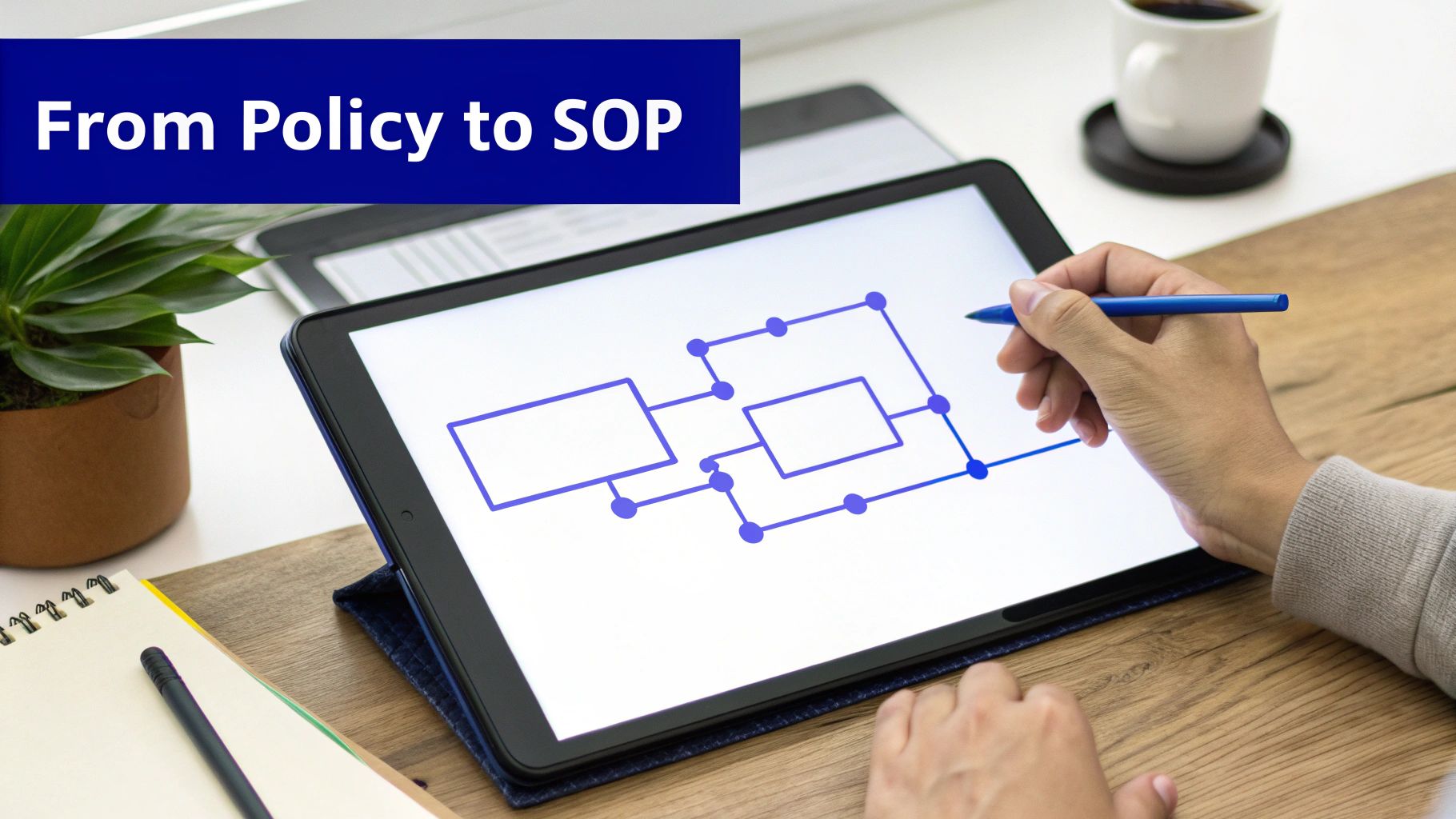
This visual approach makes even complex instructions easy to follow, ensuring your team can get things done consistently and correctly.
Building A Complete Workflow
Putting a policy into action isn't just about one document; it’s about creating a whole ecosystem of support. The best procedures are dynamic and plugged into the tools your team already uses daily. A "New Hire Onboarding Policy," for example, is only as good as the detailed, step-by-step procedure guiding the hiring manager and the new hire. For a real-world look at how this works, check out this guide on creating a structured onboarding process.
The ultimate goal is to make following the rules the easiest and most logical path for your employees. When a procedure is clear, accessible, and integrated into their workflow, compliance becomes the natural default.
By transforming your policies into actionable SOPs, you close the gap between strategy and execution. This doesn't just keep you compliant; it gives your team the clarity they need to do their jobs with confidence. If you need a head start, our comprehensive policies and procedures manual template is a great place to begin.
Frequently Asked Questions
Alright, let's wrap this up by tackling a few common questions that always seem to pop up when teams start getting serious about their documentation. These should clear up any lingering confusion and help you put all this theory into practice.
Can A Procedure Exist Without A Policy?
Technically, sure. But it’s a really bad idea.
A procedure without a policy backing it up is like a recipe with no context—it tells you how to mix the ingredients but doesn't explain why you're baking a cake in the first place. This disconnect almost always leads to confusion and inconsistent work.
Without a policy to give it authority, a standalone procedure is just a suggestion. The policy is what makes it official and ties the "how" to the company's bigger goals. Think of the difference between a policy and procedure as the difference between authority and action.
How Often Should Policies And Procedures Be Updated?
This is one of the clearest distinctions between the two, and it’s a crucial one to get right.
- Policies are the bedrock. They’re built to last and should only change when something significant happens, like a shift in regulations, laws, or the company's core strategy. You should review them annually, but you'll likely only update them every 2-3 years.
- Procedures are living documents. They have to keep up with the day-to-day reality of your operations. That means reviewing them at least once a year—sometimes quarterly—or any time a tool, process, or team structure changes. Frankly, an outdated procedure can cause more chaos than having no procedure at all.
A policy is the anchor, providing stability and direction. A procedure is the rudder, constantly adjusting to keep the ship on course through changing waters.
What Is The Relationship Between Policies Procedures And Processes?
These three aren't interchangeable; they represent a clear hierarchy, moving from a high-level overview down to the nitty-gritty details.
- Process: This is the big picture. A process is a sequence of related activities that, together, achieve a business goal. Think "employee onboarding."
- Policy: This governs the entire process. The "New Hire Policy" sets the rules for onboarding, like requiring background checks or setting deadlines for paperwork.
- Procedure: This is the most granular level. A procedure gives the step-by-step instructions for a single task within the process, like the "Procedure for Issuing a Company Laptop."