
At its core, the difference between a policy and a procedure is beautifully simple: a policy tells you the what and the why, while a procedure shows you the how.
Policies are the high-level guardrails that steer decision-making and keep everyone aligned with the company’s big-picture goals. Procedures are the nitty-gritty, step-by-step playbooks your team follows to actually put those policies into action.
Why Getting Policy vs. Procedure Right is a Game-Changer
Nailing this distinction isn’t just about getting your terms right—it’s the bedrock of a business that can scale without breaking. Get it wrong, and you'll feel it everywhere. Without clear policies, your teams are flying blind. Without clear procedures, they’re just making it up as they go.
This confusion quickly snowballs into bigger problems like inconsistent work, compliance headaches, and a whole lot of wasted time.
Let's make it real. Think about a common scenario:
- Your Work From Home Policy is the rulebook. It states the company supports remote work to boost work-life balance and attract talent (the why). It also lays down broad rules, like everyone must be online during core hours (the what).
- The Procedure for Requesting Remote Work is the instruction manual. It tells an employee exactly what to do: fill out Form HR-12, submit it through the HR portal at least 48 hours ahead of time, and wait for manager approval (the how).
A Clear Hierarchy Isn't Just Tidy—It's Strategic
Setting up a clear structure where big-picture policies flow down into detailed procedures is more than just good organization. It's a strategic weapon. Business process experts have shown time and again that companies with a solid documentation hierarchy onboard new hires faster, slash compliance risks, and deliver more consistent customer experiences.
Well-documented procedures mean a new team member can get up to speed and start contributing correctly without needing constant hand-holding. This is a massive advantage in fast-paced environments like call centers or warehouses. You can dive deeper into how this structure helps with business scaling and automation on sweetprocess.com.
Policy vs. Procedure: A Quick Comparison
To really hammer home the difference, let’s break it down side-by-side.
| Attribute | Policy (The Why and What) | Procedure (The How) |
|---|---|---|
| Purpose | Guides decision-making and keeps the company aligned with its goals. | Provides a step-by-step guide to get a specific task done right, every time. |
| Scope | Broad. Usually applies to the whole company or an entire department. | Narrow. Laser-focused on one repeatable action or task. |
| Focus | Sets the principles, rules, and desired outcomes. | Outlines the exact actions, the sequence they happen in, and what’s needed. |
| Flexibility | Written broadly on purpose to allow for professional judgment. | Highly specific and rigid to guarantee consistency and compliance. |
A Detailed Comparison of Policies and Procedures
To really get the difference between a policy and a procedure, you have to go beyond the dictionary definitions and see how they actually work in a business. A side-by-side look shows their unique roles, which will help you structure your company's internal documents with way more clarity and impact.
This deep dive will compare policies and procedures across four critical areas: their core purpose, operational scope, level of detail, and who typically creates them. You'll see how one guides the big-picture strategy while the other drives day-to-day execution.
This chart breaks down the core distinction pretty simply.
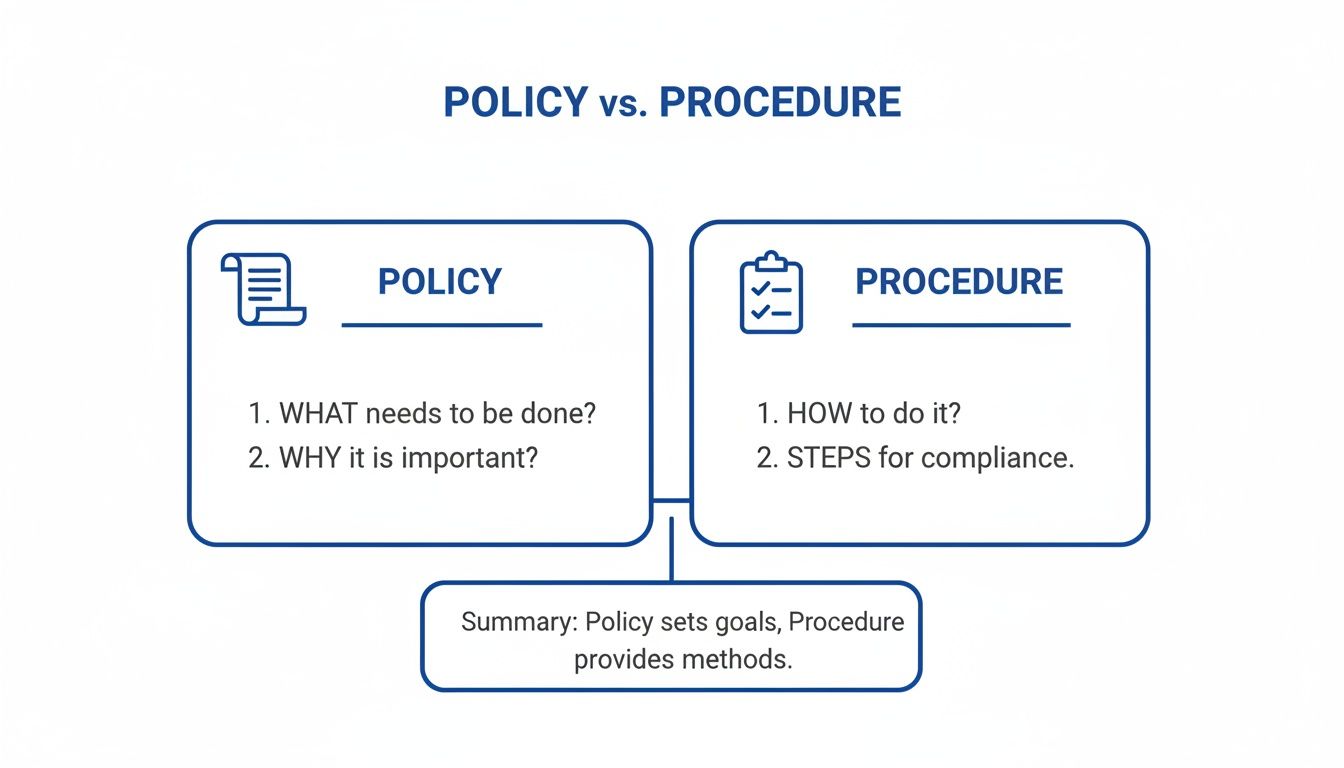
As you can see, policies answer the strategic "what" and "why," and procedures give you the tactical "how." It's a clear hierarchy for getting things done.
Strategic Purpose vs. Tactical Execution
The biggest difference between a policy and a procedure is its fundamental purpose. A policy is strategic. It sets the company's official position on an important issue and makes sure decisions line up with the business's main goals, values, and legal duties. It answers the questions, "What are our rules?" and "Why do we have them?"
On the other hand, a procedure is purely tactical. Its only job is to provide clear, step-by-step instructions for doing a specific task the right way, every time. It's the direct support for a policy, spelling out exactly what employees need to do to follow the rules. It answers the question, "How do I do this correctly?"
Key Insight: Policies give you the destination and the rules of the road. Procedures provide the turn-by-turn directions to get there. Trying to run a company by confusing the two is like trying to navigate a city with only a list of traffic laws.
For example, a Data Security Policy might state that all sensitive customer data must be encrypted. The matching Procedure for Encrypting a Customer File would then list the exact steps: open the file, select the approved encryption software, set a password using the company standard, and save it in a specific secure folder.
Organizational Scope vs. Task-Specific Focus
Another huge difference is scope. Policies are written to be broad. They're designed to apply across the whole company or, at the very least, a large department. They create a consistent framework that governs a wide range of activities, ensuring everyone is playing by the same rulebook.
- Policy Scope Example: A company's Code of Conduct Policy applies to everyone—from the CEO to a summer intern—no matter their role or location.
Procedures, however, are narrow and super-focused. They're written for a specific task done by a particular person or team. This limited scope makes sure the instructions are relevant and immediately useful to the person doing the work. A procedure for the marketing team will look completely different from one for the accounting department, even if both support the same company policy.
While procedures are about specific actions, it's good to know how they fit into the bigger picture. To see how all these pieces fit together, check out our guide on the differences between processes and procedures to round out your operational knowledge.
High-Level Principles vs. Granular Steps
The level of detail is probably the most obvious difference. A policy uses broad strokes, focusing on principles, rules, and outcomes instead of specific actions. This high-level view allows for professional judgment and flexibility while still enforcing a required standard.
Procedures are the complete opposite—they are all about the tiny details. They break a task down into a sequence of clear, simple steps that can be repeated over and over. There’s no room for guessing because the whole point is to eliminate mistakes and guarantee a consistent result. A good procedure leaves zero doubt about what to do next.
To make this crystal clear, here's a quick summary table that lays out the core differences at a glance.
Policy vs. Procedure: Key Differentiators at a Glance
| Attribute | Policy | Procedure |
|---|---|---|
| Purpose | Strategic: Answers "what" & "why." Sets rules and guidelines. | Tactical: Answers "how." Provides step-by-step instructions. |
| Scope | Broad: Applies organization-wide or to large departments. | Narrow: Applies to a specific task or role. |
| Focus | Sets guiding principles and outcomes. | Outlines a sequence of actions. |
| Level of Detail | High-level: General statements and rules. | Granular: Detailed, specific steps. |
| Flexibility | Allows for professional judgment within set boundaries. | Rigid and standardized to ensure consistency. |
| Owner | Typically senior leadership or management. | Usually department heads or subject matter experts. |
| Goal | To ensure compliance, consistency, and alignment with values. | To ensure efficiency, accuracy, and safety in execution. |
This table neatly contrasts how policies establish the framework for decision-making, while procedures provide the clear, actionable steps needed to operate within that framework effectively.
Example Comparison
- Expense Reimbursement Policy: "Employees will be reimbursed for reasonable and necessary business-related travel expenses. All claims must be submitted with original receipts within 30 days of incurring the expense."
- Procedure for Submitting an Expense Report:
- Log into the company's financial portal.
- Click the "New Expense Report" button.
- Enter the trip dates and purpose in the designated fields.
- For each expense, select the correct category from the dropdown menu (e.g., "Meals," "Transportation").
- Upload a scanned copy of the corresponding receipt for each line item.
- Click "Submit for Manager Approval."
This side-by-side comparison shows it perfectly: the policy sets the mandatory rule (30-day submission with receipts), while the procedure gives the exact clicks and actions needed to follow that rule.
Real-World Examples Across Different Industries
The theory is great, but seeing how policies and procedures actually work in the wild is what makes it all click. The way these documents are built and used changes a lot depending on the industry, each with its own unique risks, compliance rules, and operational targets. Let’s look at a few key sectors to see why separating policies from procedures isn't just a "nice-to-have"—it's an absolute necessity.

This distinction becomes critical in highly regulated fields. It's no surprise that global surveys consistently point to blurry or poorly defined policies and procedures as a leading cause of audit failures and hefty fines. This has fueled a massive demand for better governance tools, with the regulation management software market expected to jump from USD 1.7 billion in 2023 to USD 4.3 billion by 2032.
Healthcare Compliance and Patient Safety
In healthcare, the stakes couldn't be higher. We're talking about patient privacy, safety, and life-or-death situations. The Health Insurance Portability and Accountability Act (HIPAA) is a perfect example of how policies and procedures have to work together perfectly to maintain compliance and protect people's most sensitive information.
The Policy: A hospital’s Patient Privacy Policy is the high-level rulebook. It declares the organization's unwavering commitment to protecting patient health information (PHI) in every form, as HIPAA requires. It sets out the principles of confidentiality, defines what PHI is, and makes it clear that only authorized staff can access it for legitimate reasons.
The Procedure: To back that policy up, you’d have something like a Procedure for Accessing Electronic Health Records (EHR). This is the nitty-gritty, step-by-step guide for a nurse or doctor. It would detail exactly how to log into the EHR system, find a patient's file, document the reason for access, and log out securely to prevent anyone else from seeing it.
The policy sets the non-negotiable standard. The procedure ensures every single employee follows the exact same secure steps, creating a clear, auditable trail that proves the hospital is doing what it's supposed to.
Manufacturing and Workplace Safety
For any manufacturing business, safety isn't just a goal; it's a legal obligation enforced by agencies like the Occupational Safety and Health Administration (OSHA). A sharp line between policies and procedures is vital for preventing accidents and keeping employees safe.
A policy without a clear procedure is just a suggestion. In a high-risk environment like a factory floor, suggestions don't prevent accidents—repeatable, mandatory actions do.
Take a critical process like equipment maintenance.
The Policy: The Workplace Safety Policy states the company's commitment to a safe work environment and full compliance with OSHA. A core part of this policy would be the principle that all machinery must be completely de-energized before anyone performs maintenance to prevent it from starting up unexpectedly.
The Procedure: This is where the Lockout/Tagout (LOTO) Procedure comes in. It's the actionable checklist that brings the policy to life, laying out the exact sequence of steps: identify every energy source, shut down the machine, apply a physical lock and tag, and then test it to verify that it’s completely dead. For a closer look at how these guides are built, check out our article on standard operating procedure examples for some great templates.
Technology and Information Security
In the tech world, data is everything. Protecting it from breaches and securing the company’s digital backbone is priority number one. This requires a solid framework for managing how external software and services are brought into the company’s tech stack.
The Policy: An Information Security Policy lays down the law for protecting company data and systems. It would clearly state that all third-party software must pass a security review and get the green light from IT before it can be used for business. This policy is the shield that protects the company from vulnerabilities that insecure vendors might introduce.
The Procedure: The Procedure for Onboarding a New Software Vendor is the detailed workflow the team must follow. It includes steps like submitting a vendor request, making the vendor fill out a security questionnaire, scheduling a technical review with the security team, and getting formal sign-off from both the department head and IT before anything is purchased or implemented.
The pattern is the same across all these industries. The policy defines the "what" and "why," aligning with big-picture goals like compliance, safety, and security. The procedure delivers the "how"—the clear, repeatable steps that make sure everyone follows the policy the same way, every single time.
Why Separating Policies and Procedures Drives Growth
Figuring out the difference between a policy and a procedure isn't just a box-ticking exercise. It's a genuine strategy for unlocking sustainable growth. When you draw a clear line between the two, you create a framework for your business that is both rock-solid and surprisingly flexible.
This separation allows you to scale up without things spiraling out of control. Your internal docs transform from a dusty, static rulebook into a dynamic asset that actually fuels your progress. Policies act as the guardrails—the big-picture principles tied to your company's values and goals. They change rarely, providing a consistent direction even as you add new teams or enter new markets.
Fostering Scalability and Agility
The real magic kicks in when those stable policies are paired with nimble procedures. For example, your Remote Work Policy might not change for years, but the Procedure for Requesting a Home Office Stipend could be updated every quarter as you roll out new expense software.
This simple separation gives your teams the freedom to improve how they work without needing an executive sign-off for every tiny process tweak. That's a huge competitive advantage. It lets departments innovate and adapt on the fly, responding to new challenges without getting tangled in red tape.
Key Takeaway: Separating policies from procedures lets you keep high-level governance firm while allowing ground-level execution to be incredibly nimble. That balance is the secret sauce of any scalable organization.
Strengthening Risk Management and Compliance
From a risk standpoint, this distinction is critical. Auditors and regulators don't just want to hear that you're compliant; they want to see it. Policies show you've established official rules to meet your legal and ethical duties. As any successful business owner knows, defining essential HR policies to prevent legal challenges is a non-negotiable first step.
Procedures are the auditable proof that those policies are actually being followed. When an auditor asks how your company protects customer data, you can point to your Data Privacy Policy and then immediately show them the step-by-step Procedure for Anonymizing User Information. This two-tiered system makes proving compliance straightforward and dramatically reduces your legal exposure.
Accelerating Employee Onboarding and Training
A clear divide between the "why" and the "how" also massively improves your training. New hires get overwhelmed when you hand them a giant manual that mixes high-level rules with super-detailed instructions. A structured approach makes learning stick.
You can break the onboarding process down logically:
- Start with Policies: First, walk new employees through the core principles that govern their role. This is where they learn the company culture and the fundamental expectations for their behavior.
- Introduce Procedures: Once they understand the "why," you can introduce the specific, task-based procedures they'll use every day. This gives the instructions context, making them much easier to remember.
This way, employees don't just know what to do—they know why they're doing it. Someone who understands the reasoning behind a policy is far more likely to make good judgment calls in situations that aren't spelled out in a procedure. That deeper understanding creates a more responsible and autonomous team, which is exactly what you need to grow.
Putting Your Governance Structure into Action

Knowing the difference between policies and procedures is one thing. Building a living, breathing governance system that actually works is another challenge entirely. This is where you translate high-level rules into the concrete actions your team takes every single day.
It's all about creating a clear path from big-picture strategy to ground-level execution. A solid governance structure makes sure every task, no matter how small, lines up with your company's core goals and risk appetite.
To get started, a comprehensive document like an essential UK employment handbook can be a fantastic cornerstone. It helps you detail your company's core policies and start linking them to their matching procedures.
From Policy Principles to Procedural Steps
The real magic happens when you break down a policy into actionable procedures. It starts with deconstruction. You need to pull out the core, non-negotiable principles of a policy and then think through all the real-world situations where they come into play. This is how a broad rule becomes a series of specific, repeatable steps.
Take a simple Expense Reimbursement Policy. The main principle is straightforward: the company only pays for legitimate, pre-approved business expenses. But that one principle touches dozens of different scenarios, each needing its own set of instructions.
This is where you start building out separate Standard Operating Procedures (SOPs) for each distinct task, all sitting neatly under the umbrella of that single policy.
- SOP 1: Submitting a Mileage Claim: This procedure would walk someone through exactly how to log their mileage, what proof they need (like trip logs), and how to submit it through the company portal.
- SOP 2: Requesting Approval for a Software Purchase: This SOP would detail the steps for getting pre-approval, the kind of business justification required, and the spending limits for different managers.
- SOP 3: Claiming Meal Expenses During Client Visits: Here, you'd specify the per-diem limits, receipt requirements, and how to list attendees to stay compliant.
Each of these SOPs is a tactical response to the strategic "why" of the main policy.
Key Insight: A single policy rarely leads to a single procedure. A good policy is a foundation for a whole family of procedures, with each one designed to handle a specific task with total clarity and consistency.
This modular setup is a lifesaver. When something changes—say, you switch from one expense app to another—you only have to update one specific SOP. The overarching policy doesn't change, which provides stability and keeps things simple.
Managing Governance with Modern Tools
In the old days, managing all this was a nightmare. Policies were stuffed into binders on a shelf, and procedures were lost in a maze of shared drives. This led to version control chaos and people following outdated rules.
Today's documentation platforms are built to solve these exact problems. Modern tools let you build a single source of truth where the link between a policy and its related procedures is crystal clear. You can assign owners, track every update, and automatically notify teams when something changes. It guarantees everyone is on the same page.
That kind of operational clarity is priceless. When you’re ready to get your own documentation in order, a template can be a massive help. Our policies and procedures manual template provides a great framework for building out your own governance structure.
By turning abstract policies into actionable SOPs and managing them in one central place, you build a system that doesn't just check a compliance box. You create an engine for operational excellence that helps you scale.
Common Questions About Policies and Procedures
Even with crystal-clear definitions, you're bound to hit some practical roadblocks when you start building out your governance framework. Getting the nuances right is a game-changer for operations managers and compliance officers trying to keep everything running smoothly.
Let's tackle some of the most common questions that pop up when teams get serious about their internal documentation.
Can One Document Be Both a Policy and a Procedure?
It’s a tempting shortcut, but the short answer is a hard no. A single document can't effectively serve two masters.
Trying to cram both into one file creates a Frankenstein's monster of a document—too broad for someone who just needs to complete a task, and way too bogged down in detail for leadership. When policies get cluttered with step-by-step instructions, they become a nightmare to read, let alone update.
On the flip side, burying high-level rules inside a procedural document just adds noise. It makes it tough for an employee to tell the difference between a non-negotiable company rule and a simple instruction, which is a recipe for non-compliance. A clean break between the two ensures each document does its job effectively.
Key Takeaway: Keep them separate. Full stop. A policy sets the boundary ("what" and "why"), while a procedure provides the map to navigate within it ("how"). Mixing them up just muddies the water for everyone.
Who Should Be Responsible for Writing Policies Versus Procedures?
This is all about matching the document's scope to the right owner. You wouldn't ask an intern to write your company's financial strategy, right? The same logic applies here.
Policies are owned by leadership. Senior management and the executive team are on the hook for policies. These documents are the voice of the company's strategic goals, values, and appetite for risk. Your Chief Financial Officer, for example, should own the company's expense policy.
Procedures are owned by the experts on the ground. The people who do the work every day are the best ones to document it. Department heads, team leads, and subject matter experts should own the procedures for their specific tasks because they have the hands-on knowledge to make them accurate and practical.
This split ensures your high-level rules are tied directly to business strategy, while the nitty-gritty instructions are actually useful for the teams that rely on them.
How Often Should We Review Our Documentation?
There's no one-size-fits-all answer here. The review schedule really depends on the document's purpose and how much risk is attached to it. The worst thing you can do is let your documentation gather digital dust.
Here’s a solid starting point for your review cycle:
- High-Risk Policies and Procedures: Anything touching critical areas like workplace safety, data security, or financial compliance needs a close eye. Review these at least annually, or immediately following any major regulatory change.
- Medium-Risk Documentation: Think internal processes like employee onboarding or project management workflows. A review every 18 to 24 months usually does the trick.
- Low-Risk Guidelines: Simple administrative stuff, like how to book a conference room, might only need a refresh every two or three years—or whenever the tech or process changes.
Regular reviews aren't just busy work; they're essential for keeping your operations efficient and compliant. Letting this slide is just asking for someone to follow outdated instructions, creating risks you don't need.
Where Do Business Processes Fit In?
Great question. This is where the whole picture comes together. We’ve established that policies set the rules and procedures detail the steps for a single task. A business process, then, is the umbrella that connects a series of related procedures to achieve a bigger business goal.
Let's use employee onboarding as an example:
- Policy: "All new employees must be fully onboarded within their first week." (This is the high-level rule).
- Procedures: This single policy kicks off several distinct procedures, like:
- Procedure for Setting Up a New Workstation
- Procedure for Granting Software Access
- Procedure for Enrolling in Company Benefits
- Business Process: The "New Employee Onboarding Process" is the complete, end-to-end journey. It’s the master workflow that strings all those individual procedures together in the right order to get a new hire from day one to fully operational.
Simply put, a process is the macro-level view that links all the micro-level procedures. Nailing this hierarchy—from broad policies down to specific procedures, all organized into clear processes—is how you build an operation that can actually scale.