
An effective employee onboarding procedure isn't just a stack of paperwork—it's the strategic process that fully integrates a new hire into your company. It covers everything from cultural immersion to role-specific training, acting as the critical bridge between a signed offer and a genuinely productive team member. This structured journey is what gives them the tools, knowledge, and connections to start contributing from day one.
Why Your Onboarding Procedure Is Your First Retention Tool

Too many companies see onboarding as a one-day administrative chore: sign forms, grab a laptop, find your desk. This "welcome packet" mentality completely misses the point. The first 90 days are the most formative stage of an employee's time with you—it's where long-term commitment is either won or lost.
A deliberate, well-planned onboarding procedure is one of your most powerful levers for retention and productivity. It reframes the experience from a simple HR task into a core operational strategy, laying the foundation for an employee's entire journey.
The High Cost of a Poor Start
The data paints a pretty stark picture. Nearly 33% of new hires leave their job within the first 90 days. The financial hit is massive, with replacement costs averaging $4,700 for hiring alone, not to mention the thousands you just invested in their initial onboarding.
This isn't just about plugging a leak; it's about building a solid foundation. When a new hire feels lost, unsupported, or disconnected, their engagement plummets—and so does their potential contribution.
An unstructured onboarding process is like giving a new player a jersey but no playbook. They might be on the team, but they have no idea how to contribute to a win. True integration requires a clear plan of action from the very beginning.
Let's look at how this plays out in the real world. A little planning can make a world of difference between a chaotic start and one that sets someone up for success.
Impact of Onboarding on Key Business Metrics
The contrast between a poor and a structured onboarding process is clear when you look at the metrics that matter most.
| Metric | Poor Onboarding Outcome | Structured Onboarding Outcome |
|---|---|---|
| Employee Retention | High turnover within the first year, with a significant drop-off in the first 90 days. | 50% increase in new hire retention, building a more stable, experienced team. |
| Productivity | Slower ramp-up time; new hires take months to reach full productivity, if ever. | 62% boost in productivity, with new hires contributing meaningfully much faster. |
| Engagement | Low morale, feelings of isolation, and a lack of connection to company culture. | Higher engagement levels, stronger team connections, and a better cultural fit. |
| Recruitment Costs | Constant cycle of rehiring, leading to recurring costs of $4,700+ per replacement. | Reduced need for backfilling roles, leading to significant long-term cost savings. |
As you can see, investing in a structured onboarding experience pays off by strengthening the business from the inside out. It's not just a "nice-to-have"; it's a strategic imperative. If you want to dive deeper, you can find more onboarding statistics and trends that highlight these findings.
Real-World Onboarding Scenarios
Consider the difference in these two common scenarios:
- The Chaotic Start (Manufacturing): A new production line operator arrives to find their supervisor swamped, their safety gear isn't ready, and no one has time to walk them through the standard operating procedures. They spend the day feeling like they're in the way, trying to piece things together from busy colleagues. Their confidence is shot, and the risk of an early mistake is sky-high.
- The Structured Start (Tech): A new software developer logs in on day one to a pre-configured laptop, a calendar already populated with introductory meetings, and access to a central knowledge base with all the team's SOPs. Their assigned buddy is ready to walk them through their first small coding task, making them feel productive and connected from the get-go.
The second scenario doesn't happen by accident. It's the result of a thoughtful employee onboarding procedure that anticipates a new hire's needs and builds a clear path to success. When you centralize this process, you create the consistency needed for every new hire to succeed, no matter their role or department.
Building Your Pre-Boarding Checklist

A world-class onboarding experience doesn't start on day one. It begins the moment a candidate accepts your offer. This crucial window, known as pre-boarding, is your golden opportunity to transform their initial excitement into a genuine sense of belonging and confidence.
The whole point is to get rid of the logistical nightmares and first-day jitters before they even start. A thoughtful pre-boarding process shows you’re organized, you respect their time, and you’re genuinely thrilled to have them on board. It's the difference between a new hire feeling like a stranger and feeling like they’re already one of the team.
Administrative and IT Setup
First things first, let's get the nuts and bolts sorted out. Nothing kills the first-day vibe faster than a laptop that won't turn on or missing access to the one tool they need to do their job. Getting ahead of the IT and admin work is absolutely non-negotiable.
Your goal here is to get as much done digitally and in advance as possible. Send out all the necessary HR paperwork—think tax forms, direct deposit info, and employment contracts—through a secure portal. This simple step avoids that dreaded mountain of paper on their first morning.
On the tech side, your checklist should be crystal clear:
- Hardware Prep: Get their laptop, monitor, keyboard, and any other gear ordered and configured. Make sure it's all tested and ready to rock.
- Software and Access: Create their company email and set up their accounts for essential platforms like Slack, Microsoft Teams, or whatever project management tools you use.
- Workspace Setup: Whether they're in the office or working from home, their space needs to be ready. For remote hires, this means shipping their equipment so it lands on their doorstep a few days early.
Communication and Connection
While the logistics are vital, it's the human touch that really makes pre-boarding special. This is your chance to build a relationship and calm any pre-start anxiety. You don't need a complex strategy; a few well-timed messages can make all the difference.
Have their direct manager send a warm, personal welcome email about a week before their start date. This should lay out what to expect on day one, including the schedule, dress code (if you have one), and who to meet or message when they arrive or log in.
Don’t underestimate the power of a small gesture. A welcome kit with company swag, a handwritten note from the CEO, and a team photo can transform a standard pre-boarding process into a memorable experience that builds immediate loyalty.
Announcing their arrival to the rest of the team is another simple but powerful step. A day or two before they start, post a quick intro in your main team channel with their name, role, and maybe a fun fact they shared. This tiny action ensures they're greeted with warm welcomes instead of confused stares on their first day.
Essential Pre-Boarding Checklist Items
To make sure nothing slips through the cracks, your pre-boarding checklist needs to be detailed, with clear ownership for every single task. Here’s a sample breakdown you can steal and adapt for your own process:
| Category | Task | Owner |
|---|---|---|
| HR & Admin | Send and collect all digital paperwork (W-4, I-9, direct deposit). | HR |
| Add new hire to payroll and benefits systems. | HR | |
| IT & Tech | Order and configure laptop and necessary hardware. | IT |
| Create email and provision software accounts. | IT | |
| Manager Tasks | Send a personal welcome email with first-day details. | Manager |
| Schedule first-week introductory meetings. | Manager | |
| Assign an onboarding buddy or mentor. | Manager | |
| Team Actions | Send a welcome message to the team channel. | Manager |
| Prepare a small, manageable first task or project. | Team Lead |
With a structured approach like this, you ensure that when your new team member shows up, their first day is all about connection and learning—not confusion and paperwork. You’re setting them up for a great first day and, more importantly, for long-term success.
Nailing the First Day and First Week
The first week is where your onboarding process really sinks its teeth in. This is the time to turn those first-day jitters into real excitement and productivity. Forget the blurry office tour and the mad dash for a working laptop. A solid Standard Operating Procedure (SOP) makes sure this critical window is balanced, meaningful, and builds a foundation for success.
Day one is all about connection, not information overload. Of course, there's some admin to get through, but it shouldn't be the main event. A great first day makes your new hire feel welcomed, wanted, and totally clear on what’s happening next. This is where your pre-boarding work pays dividends, letting you shift the focus from paperwork to people.
Think of it less as a rigid schedule and more as a curated flow of positive moments that build on each other. You want them to leave feeling confident and ready for what’s ahead.
Structuring the Perfect First Day
Every interaction on day one is a chance to reinforce your company culture and show you're genuinely invested in your new hire's success. Rushing this is a classic mistake that leaves people feeling like an afterthought.
Here's a sample flow that gets the balance right:
- A Personal Welcome: The manager should be the one to greet them at the door. It’s a simple gesture, but it instantly creates a human connection and gives them a familiar face in a sea of new ones.
- Painless Tech Setup: Since you handled most of it in pre-boarding, this should just be a final check. Have an IT person on standby to help them log in, navigate the core tools, and answer any "how do I…?" questions.
- Team Lunch (Non-Negotiable): Get out of the office. An informal team lunch moves introductions from a stuffy conference room to a relaxed social setting. It’s the single best way to break the ice and start building real relationships.
- Give Them an Early Win: Assign a small, super-defined first task. Not a massive project, but something they can actually finish. For a developer, maybe it's a tiny bug fix. For a marketer, it could be pulling a quick report on a recent campaign. This gives them an immediate sense of accomplishment.
The best onboarding programs make sure a new hire walks out the door on day one with three things: a person they can ask for help (their buddy), a clear idea of what to do tomorrow, and the feeling that they made the right choice joining your team.
This approach—structured but personal—sends a powerful message: we have a plan for you, and we're glad you're here.
Building Out the Rest of the First Week
With day one in the bag, the rest of the week is about deepening their understanding and getting them integrated into the team. The goal shifts from general orientation to role-specific immersion. This is where having your SOPs documented in a central hub like Whale becomes a game-changer. No more relying on one person's memory; you have a consistent roadmap for every new person.
The first week's plan should be a healthy mix of guided learning, watching how things are done, and getting their hands dirty.
First Week SOP at a Glance
| Day | Focus Area | Example Activities |
|---|---|---|
| Tuesday | Core Tools & Processes | A guided tour of the main software they'll live in every day. Have them shadow a teammate for an hour to see real workflows in action. |
| Wednesday | Team & Cross-Functional Meetings | Introduce them to key people in other departments they'll be working with. Let them sit in on a team project meeting to get a feel for the rhythm and priorities. |
| Thursday | Role-Specific Deep Dive | Start the more focused training on their specific duties. Think short training videos followed by quick check-in quizzes to make sure the information is sticking. |
| Friday | Review & Look Ahead | The manager checks in to go over the week, answer any lingering questions, and set a couple of simple, clear goals for week two. |
This systematic approach prevents them from feeling like they're drinking from a firehose while ensuring all the critical knowledge gets passed on. By documenting these steps in an SOP, you create a repeatable and scalable onboarding process that builds confidence and gets your new hire up to speed way faster.
Structuring Success With A 30-60-90 Day Plan
That first week is a whirlwind, but great onboarding doesn't stop there. To really get a new hire from learning the ropes to actively driving results, you need a roadmap. This is where the 30-60-90 day plan comes in. It's an indispensable tool that lays out clear expectations and milestones for both the new employee and their manager.
This timeline visualizes the critical early stages of a new hire's journey, from their first-day welcome to achieving that all-important early win.
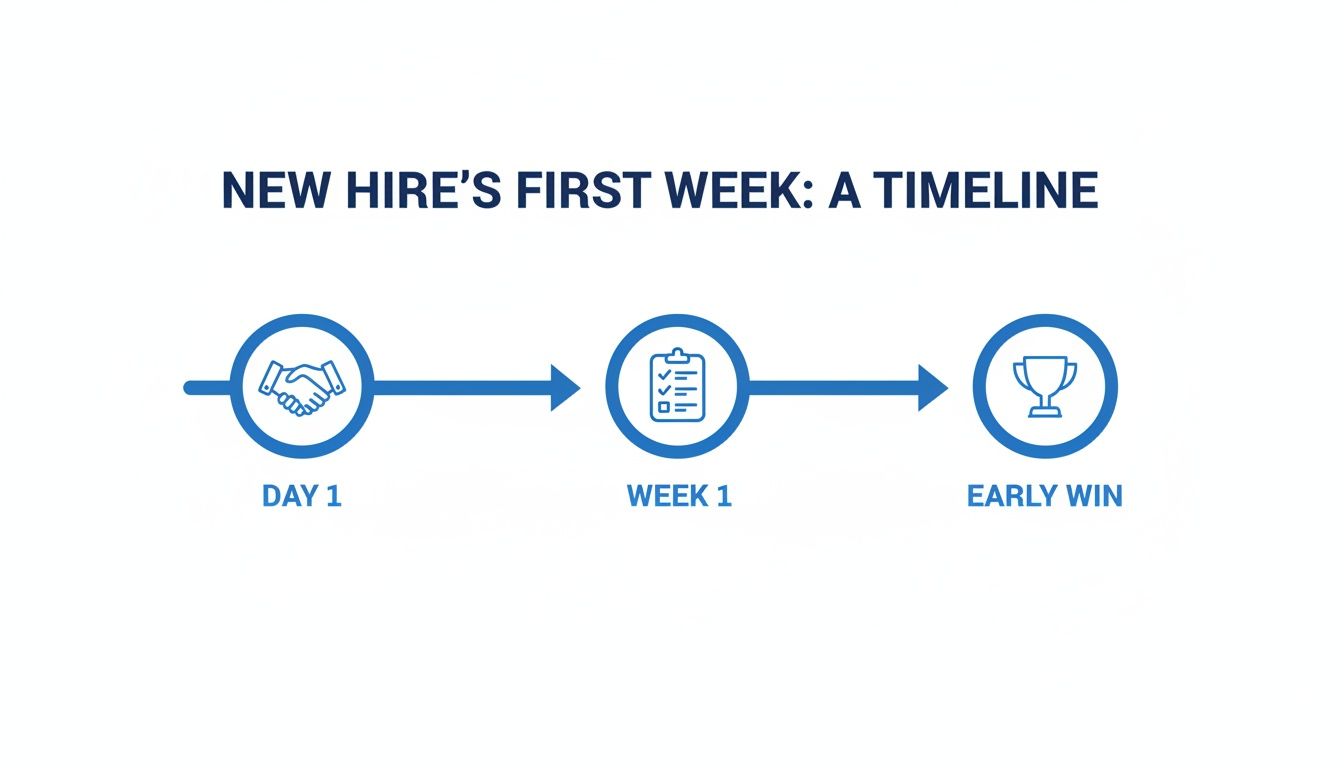
As you can see, a structured first week is all about building momentum and confidence, setting the stage for the crucial months ahead.
The First 30 Days: Immersion And Learning
The first month is all about being a sponge. The new hire’s main job is to listen, learn, and start figuring out how your company really works. This phase is about soaking up the foundational knowledge they’ll need to crush it later on.
Forget about massive results for now. Their energy should be focused on understanding the company culture, who the key players are, how things get done, and the core tools of the trade. Success here is measured by competency and confidence, not project delivery.
A few key objectives for this period:
- Mastering Core Tools: Getting comfortable with the essential software and platforms they’ll use every day.
- Understanding Team Dynamics: Learning who’s who, how the team talks, and the rhythm of the workflow.
- Meeting Key Stakeholders: Setting up intro chats with people inside and outside their immediate team.
- Absorbing Company Culture: Watching how meetings are run, how decisions are made, and how values are lived out.
The goal of the first 30 days isn't to see what the new hire can produce, but to see how well they can integrate. A successful first month is measured by questions asked and relationships built, not by tasks completed.
The Next 30 Days: Contribution And Application
Alright, time to shift gears from learning to doing. In the 30-to-60-day phase, the employee starts putting that new knowledge to work on real projects. They should be moving from shadowing others to taking on more hands-on tasks.
This is when they start collaborating more deeply and managing small, well-defined tasks with a bit more independence. The manager’s role changes too—from instructor to coach, offering guidance and feedback as the new hire tackles their first real challenges.
During this phase, their goals might look like this:
- Contributing to a Team Project: Owning a specific piece of a larger project.
- Handling Initial Solo Tasks: Completing assignments with minimal hand-holding to build confidence.
- Providing Feedback: Offering a fresh set of eyes on existing processes or workflows.
The Final 30 Days: Ownership And Initiative
By the 90-day mark, your new hire should be making the leap to a fully integrated team member. The focus pivots to ownership, initiative, and seeing the bigger picture. They should know their role well enough to fly solo and even start spotting ways to make things better.
This is when you really start to see the ROI on your onboarding efforts. They're no longer just following the playbook; they're helping you write the next chapter. They should feel confident enough to pitch ideas, troubleshoot problems, and manage their own workload.
To give this structure, here's a simple framework you can adapt.
Sample 30-60-90 Day Plan Framework
| Phase | Primary Focus | Example Goals | Success Metrics |
|---|---|---|---|
| Days 1-30 | Learning & Immersion | – Complete all required training. – Meet with 5 key team members. – Understand core product/service offerings. |
– Training completion certificates. – Positive feedback from colleagues. – Ability to articulate the company's value proposition. |
| Days 31-60 | Contribution & Application | – Take ownership of one small project. – Contribute actively in team meetings. – Identify one process improvement. |
– Successful project completion. – Tangible contributions to team goals. – Documented improvement suggestion. |
| Days 61-90 | Ownership & Initiative | – Lead a project or key initiative. – Proactively manage workload. – Set personal performance goals for the next quarter. |
– Measurable impact of the led project. – Consistently meets deadlines without reminders. – A clear, manager-approved plan for the next 90 days. |
A well-crafted 30-60-90 onboarding plan template helps map these goals out clearly.
At this stage, you should see them:
- Operating with More Autonomy: Juggling priorities and projects without constant check-ins.
- Identifying Opportunities: Suggesting improvements to make things run smoother.
- Building Strategic Relationships: Networking across departments to understand the business from all angles.
A solid 30-60-90 day plan is the backbone of any great onboarding procedure. It’s what turns a promising new hire into a valued, long-term asset.
Integrating Culture and Compliance Training
A great onboarding process does way more than just show someone the ropes of their new job. It’s about weaving them into the very fabric of your company. This means you have to blend the must-do compliance and tech training with a real sense of cultural immersion.
Get this right, and you’ll have a new hire who isn't just up to speed, but feels connected, confident, and like they truly belong from day one. It’s a delicate balance, though. Hit them with a firehose of dry compliance modules, and you'll see their eyes glaze over. But if you only focus on the fun cultural stuff, they might miss the essential knowledge they need to do their job safely and legally. The magic is in making it all feel like one cohesive experience.
Fostering Cultural Connection
You can't just hand someone an employee handbook and expect them to feel like part of the team. That sense of belonging comes from intentional, human-centered activities that make your company values feel real, not just like words on a wall.
Your mission here is to create genuine moments of connection. These small, personal touches are often what people remember most about their first few weeks. It shows you care about them, not just the role they're filling.
Here are a few simple but incredibly powerful tactics:
- The Onboarding Buddy System: Pair your new hire with a seasoned teammate—someone who isn't their direct manager. This gives them a safe person to ask all the "silly" questions, like "Is it cool to wear jeans on Friday?" or "Who's the best person in IT for a laptop issue?"
- Scheduled Coffee Chats: Don’t leave networking to chance. Be proactive and book a few short, 15-minute virtual or in-person chats with key people across different departments during their first couple of weeks. It’s a simple way to fast-track relationship building.
- Value-Based Storytelling: During orientation, have a leader share a real-life story about how the company lived out one of its core values. Hearing a concrete example of "customer obsession" in action is a hundred times more impactful than just seeing the phrase on a PowerPoint slide.
Making Compliance Engaging
Let's be honest: compliance training is non-negotiable, especially if you're in a regulated industry like finance or manufacturing. The real question isn't if you'll do it, but how. A check-the-box approach with dense documents and monotone videos is a surefire way to kill engagement and retention.
The goal of compliance training isn't just to prove someone completed it; it's to ensure they actually understand it. You have to make the material interactive and directly relevant to their role. That's how you turn a chore into a genuinely useful learning moment.
To make the training stick, break it down into bite-sized chunks. Use real-world scenarios they're likely to face. For example, instead of a generic data privacy module, give a marketing team member a quick quiz about how they'd handle a specific customer data request. For more ideas on this, check out our guide on making employee compliance training more effective.
Introducing Your Tech Stack
Finally, you need to get them comfortable with your company's technology without overwhelming them. One of the classic onboarding blunders is dumping a list of 15 software logins on a new hire with zero context. It’s a recipe for anxiety and a slow start.
The trick is a gradual, supported introduction. Start with the absolute essentials on day one—usually communication tools like Slack or Teams and their main work platform. Then, roll out other tools as they become relevant to their tasks.
A centralized knowledge base is your secret weapon here. Fill it with on-demand guides, quick video tutorials, and step-by-step SOPs they can pull up anytime. This empowers them to learn at their own pace and means they won't have to constantly interrupt colleagues for help. By blending these three pillars—culture, compliance, and tech—your onboarding process will build a truly well-rounded, fully integrated team member.
Measuring and Refining Your Onboarding Procedure
An employee onboarding procedure is never really “finished.” Think of it less as a static document and more as a living, breathing process. It needs to evolve right along with your company, your culture, and the roles you’re hiring for. To keep it sharp, you have to build a system for measuring what works and create a consistent feedback loop to keep getting better.
Without data, you're just guessing. Measuring your onboarding takes you from "I think it's going well" to knowing exactly what’s hitting the mark and, more importantly, what’s not. This approach turns vague feelings into actionable insights.
Key Onboarding Metrics to Track
To get the full picture of how effective your process really is, you'll want to look at both the hard numbers and the human experience. A few essential metrics will give you a solid foundation to start with.
- 90-Day Retention Rate: This is the ultimate pass/fail metric. If new hires are consistently sticking around past the critical first three months, that's a massive green flag. It’s a strong signal that your onboarding is successfully integrating and engaging them from the get-go.
- Time-to-Productivity: How long does it actually take for a new employee to start contributing in a meaningful way? Tracking this helps you figure out if your training is efficient and if you’re giving people the right tools to get up to speed quickly.
- New Hire Satisfaction Surveys: Direct feedback is pure gold. You can’t fix what you don’t know is broken. Regularly surveying new team members at key milestones gives you incredibly candid insights into their experience.
The most valuable feedback often comes from those who have just lived the experience. Their fresh perspective is your best tool for spotting gaps and friction points that seasoned employees might overlook.
By keeping a close eye on these KPIs, you can transform your employee onboarding procedure from a simple checklist into a dynamic system that actively drives retention.
Gathering Actionable Feedback
Surveys are your go-to tool for collecting this kind of qualitative data. The key to getting honest, useful responses is to send them out at specific intervals—we find the 30, 60, and 90-day marks work best. Keep the questions focused and throw in some open-ended ones to encourage people to give you the details.
For instance, at the 30-day mark, you could ask things like:
- "On a scale of 1-10, how well did your first week prepare you for your role?"
- "Was there anything you wish you had known before your first day?"
- "How helpful has your onboarding buddy been in answering your questions?"
This kind of feedback is the fuel for improvement. Use these insights to tweak your checklists, beef up your training materials, and just generally make the whole experience better for the next person. If you're ready for a deeper dive, you can learn more about how to measure your employee onboarding process in our detailed guide. When you treat onboarding as a process of constant improvement, it becomes a seriously powerful strategic asset.
Got Questions? We've Got Answers
Even the best-laid onboarding plans can hit a few snags. It’s only natural for questions to pop up. Here are some quick, no-nonsense answers to the things we hear most from HR managers and team leads trying to get their process just right.
How Long Should an Employee Onboarding Procedure Last?
Think months, not days. While the first week is definitely the most intense, a truly effective onboarding process needs to run for at least 90 days. This gives your new hire enough runway to go from just learning the ropes to becoming a confident, contributing member of the team.
For really complex or senior-level roles, some companies even stretch their structured programs out for a full year. That might sound like a lot, but it’s a smart move to ensure deep alignment with company strategy, culture, and those big, long-term goals.
What Is the Biggest Mistake Companies Make in Onboarding?
Easy. Treating it like a one-day administrative chore. We call it the "paperwork-and-pizza" approach. You throw a mountain of forms at the new hire, buy them lunch, and call it a day. This just overwhelms people and does absolutely nothing to build connections or make their role clear.
Onboarding is a journey, not a sprint. It should be a gradual, structured process that unfolds over weeks, focusing on role clarity, cultural fit, and building real relationships.
When you treat it like a process, your new person feels like a valued part of a well-oiled machine, not an afterthought you’re scrambling to accommodate.
How Can We Best Onboard Remote Employees?
Onboarding remote folks requires you to be way more intentional. You can't rely on hallway conversations or popping by someone's desk, so you have to build those connection points deliberately. A digital-first mindset is non-negotiable, with a central knowledge base for all training materials and SOPs to keep everyone on the same page.
Getting remote onboarding right boils down to a few key things:
- Over-communicate. Schedule frequent video check-ins, especially in the first few weeks. Don’t wait for them to ask for help.
- Engineer social time. Think virtual coffee chats, team lunches over video, or even online games. It feels a bit forced at first, but it works.
- Ship everything they need—and then some. Get their laptop, monitor, and any other tech to them before day one. And throw in a thoughtful welcome kit with some company swag to make them feel part of the team from the jump.
These steps are critical for making remote hires feel connected and supported, even if you never meet them in person.