
Employee training programs are how you give your team the skills they need to succeed, sharpen the abilities they already have, and get everyone pulling in the same direction toward your business goals. These aren't just a "nice-to-have" anymore; they're a must for boosting productivity, keeping your best people, and ultimately, growing your bottom line.
Why Modern Training Programs Are a Competitive Edge
Let's be real—those old-school, one-off training workshops? They usually fall flat. People forget what they learned a week later because it’s totally disconnected from their daily work. It's a waste of time and money. Today's world demands a smarter approach, one that turns training from a box-ticking exercise into a real competitive advantage.
Ignoring skill gaps is expensive. When your team doesn't have the right skills, productivity tanks, new ideas dry up, and your top talent starts polishing their resumes. It's no surprise that companies investing in solid training see 21% higher profitability on average. This is about more than just filling a few knowledge gaps; it's about building a team that can adapt to whatever the market throws at them.
Moving Beyond Outdated Models
The old way was to herd everyone into a conference room for a mandatory session that felt more like a punishment than a perk. Effective training today is all about building a culture where learning never stops. It's not an isolated event but an integrated system where knowledge is easy to find, always relevant, and woven right into the daily workflow.
Think of it this way: would you rather hand someone a paper map and wish them luck, or give them a live GPS that updates in real-time? Outdated training is the paper map. A modern program is the GPS, giving people guidance exactly when and where they need it.
To make this happen, you need one central place for all your training materials, SOPs, and company knowledge. When information is scattered across shared drives, old email chains, and dusty documents, it’s basically useless. A single source of truth ensures everyone is on the same page, which is critical for quality and consistency. To dig deeper into this, check out the key benefits of employee training that smart companies are cashing in on.
A recent study found that 70% of employees would think about leaving their current job for a company that actually invests in their development. That tells you everything you need to know: training isn't just a skill-building tool, it's a powerful way to keep your best people.
The Real Costs of Inaction
When you don't invest in proper training, the negative effects start to pile up. Employees feel stuck and undervalued without a clear path for growth, leading to disengagement. That means higher turnover, and the costs of recruiting, hiring, and losing all that built-up knowledge are staggering.
Just think about these all-too-common problems that pop up when training is an afterthought:
- Inconsistent Customer Service: Without a standard way of doing things, every team member handles customer problems differently. The result? A messy and unreliable customer experience.
- Operational Inefficiencies: When processes aren't documented and taught properly, people are left to guess or rely on "tribal knowledge." This leads directly to mistakes, delays, and wasted money.
- Compliance Risks: In certain industries, skipping training isn't just sloppy—it's illegal. It can lead to massive fines, legal trouble, and a black eye for your company's reputation.
At the end of the day, strategic employee training is about future-proofing your business. When you give every person on your team the tools and knowledge to do their best work, you’re not just improving individual performance—you’re building a stronger, more competitive company.
Building the Blueprint for Your Training Program
Jumping straight into creating content without a solid plan is like building a house without a blueprint. Sure, you might end up with something standing, but it almost certainly won't be what you or your team actually needs. A truly successful employee training program is built on a strategic foundation, ensuring every module and lesson has a clear purpose that ties directly back to business outcomes.
First things first: you need to figure out where you're going. This means getting way more specific than vague goals like "improve skills." Are you trying to cut onboarding time for new sales reps by 30%? Or maybe you want to boost compliance adherence in your finance team to a near-perfect 99%. Setting these concrete targets gives your program direction and makes it much easier to prove its value down the line.
Uncovering Critical Skill Gaps
You can't fix a problem you don’t fully understand. Think of a Training Needs Analysis (TNA) as your diagnostic tool for pinpointing the exact skills your team is missing. It’s a methodical way to identify the gap between where your employees’ skills are today and where they need to be to crush their goals. This isn't just about asking people what they think they need to learn; it's about aligning their development with the company's biggest strategic priorities.
To get the full picture, a proper TNA looks at your organization from three different altitudes:
- The 30,000-Foot View (Organizational Level): What training do we need as a company to hit our major business objectives this year?
- The Team Huddle (Team Level): Which departments or teams are lagging behind their performance targets, and why?
- The One-on-One (Individual Level): Which specific employees need a skills boost to perform their jobs more effectively?
This process has never been more critical. The skills gap is a huge challenge for businesses right now. In fact, 52% of workers know they need to pick up new skills in the next year just to stay relevant in their careers. Companies are feeling the heat, too— 88% are actively upskilling their employees every year just to keep pace with change.
The way we train has had to evolve to meet this challenge, moving from dusty old manuals to modern, targeted approaches that actually address these gaps.
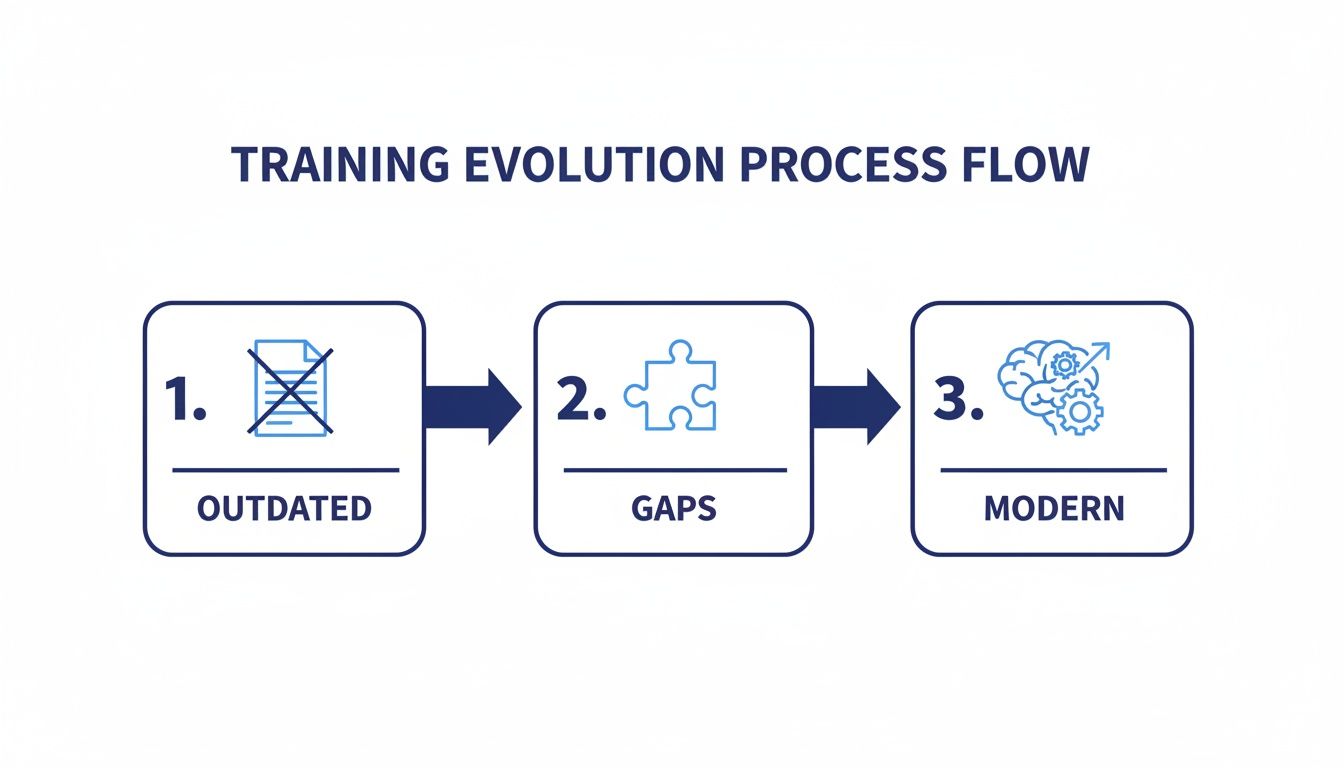
This shift is all about moving from reactive, one-size-fits-all training to proactive strategies that build a workforce that's always learning and ready for what's next. If you need a hand getting started, our comprehensive Training Needs Analysis template can guide you through the process step-by-step.
Before we move on, here's a quick checklist to help you structure your TNA and make sure you're asking the right questions.
Training Needs Analysis Checklist
This simple table can help guide you and your managers through the core steps of identifying what training is needed, where it's needed most, and why.
| Analysis Area | Key Question to Ask | Data Source Example |
|---|---|---|
| Organizational | What are our top 3 business goals for the next quarter/year? | Annual reports, strategic plans, executive goals |
| Team Performance | Which team is furthest from its KPIs, and what skills are lacking? | Performance dashboards, manager feedback |
| Individual Skill | Who on the team would benefit most from specific skill training? | 1:1 meeting notes, performance reviews |
| Future Needs | What new skills will we need in 6-12 months due to new tech/goals? | Industry trend reports, product roadmaps |
| Employee Input | What training do employees feel they need to do their job better? | Surveys, focus groups, suggestion boxes |
Running through this checklist ensures you're looking at the problem from all angles, combining hard data with valuable human insight.
Defining Clear Learning Objectives
Once you know what skills are missing, the next step is to translate those needs into clear learning objectives. These are hyper-specific statements that describe what an employee will actually be able to do after they finish a training session. They serve as a guide for both the person creating the content and the person learning it.
A good learning objective is always actionable and measurable. For instance, instead of a fuzzy goal like, "Employees will understand our new software," a much stronger objective is, "After this module, employees will be able to process a customer return using the new software in under three minutes without any help."
Think of learning objectives as your program's GPS. They give you a clear destination and help you map the most direct route to get there, making sure everyone arrives at the same point of understanding and capability.
This level of clarity is a game-changer. It helps you design laser-focused content and, just as importantly, lets you accurately measure whether the training actually worked.
Securing Leadership Buy-In
Even the most brilliantly designed training program can fall flat without support from the top. Getting buy-in from your leadership team is absolutely essential, and the secret is to frame your program as a strategic investment, not just another expense.
To do that, you have to speak their language: results and ROI.
Use your TNA findings and learning objectives to build a business case they can't ignore.
- Draw a direct line from the training to solving a major business headache (e.g., high employee turnover, low customer satisfaction scores).
- Show exactly how the program will move the needle on key metrics, whether that's productivity, sales figures, or operational efficiency.
- Present a clear budget, but immediately follow it up with a projection of the potential return on that investment.
When you can show leaders that putting $10,000 into a sales training program could realistically lead to a $100,000 bump in revenue, the conversation flips from being about cost to being about opportunity. This strategic alignment is the final piece of your blueprint, ensuring your program gets the resources and visibility it needs to make a real impact.
Creating Training Content People Actually Want to Use
Alright, your blueprint is locked in. Now comes the fun part: building the actual learning experiences that bring your employee training and development programs to life.
The goal here isn’t just to dump information on people. It's to create content so engaging and relevant that your team actively wants to use it. Forget dusty binders and death-by-PowerPoint; modern training needs to meet employees exactly where they are.
The days of one-size-fits-all training are long gone. To be effective, you need a blended approach, mixing different formats to suit various learning styles and on-the-job situations. After all, not every topic needs a full-day workshop, and you can't learn every skill from a PDF.
Diversifying Your Training Delivery Methods
The secret is matching the format to the function. Is it a complex, collaborative skill? A hands-on workshop is probably your best bet. A quick software update? A two-minute video tutorial is perfect.
Here are some of the most effective delivery methods to keep in your toolbox:
- Self-Paced E-Learning Modules: These are fantastic for foundational knowledge that employees can tackle on their own schedule. Think compliance training or introductory courses on company software.
- Interactive Virtual Sessions: A live, instructor-led session opens the door for real-time Q&A, breakout rooms for group activities, and immediate feedback. This makes them ideal for digging into more complex topics.
- Hands-On Workshops: For skills that truly require practice, nothing beats getting your hands dirty. This is where teams can apply new techniques in a safe environment, like sales role-playing or practicing a new manufacturing process.
If you're looking for inspiration, check out these practical professional development workshop ideas to make sure your sessions are both engaging and valuable.
From Dense Documents to Digestible Guides
One of the biggest hurdles in creating great training is turning sprawling, dense information into something that’s actually easy to consume. Nobody wants to sift through a 50-page manual just to find one simple answer.
This is where bite-sized learning, or microlearning, is a game-changer.
This approach breaks down massive topics into small, focused chunks. Instead of a single hour-long video, you might create a series of five-minute tutorials. It respects your employees' time and makes it far more likely they'll actually retain the information. One study found that 87% of learners picked up skills they could immediately apply to their jobs when the training was targeted and easy to access.

Think about these powerful microlearning formats:
- Quick-reference guides and checklists
- Short, targeted video tutorials
- Step-by-step Standard Operating Procedures (SOPs)
- Interactive quizzes and knowledge checks
Your team's time is their most valuable asset. The more you respect it by creating concise, high-impact content, the more they will engage with your training programs. Make it easy for them to find what they need, learn it quickly, and get back to work.
Using AI to Accelerate Content Creation
Now, creating all this varied content from scratch can feel pretty overwhelming. But modern tools are here to help. AI-powered platforms can dramatically speed up the process, turning existing documents into polished, ready-to-use training materials almost instantly.
Imagine uploading a long, technical procedure and having an AI generate a clear, step-by-step guide with an accompanying quiz in minutes. This isn't science fiction; it's how smart teams are scaling their training efforts today. For a deeper dive, our guide on how to write a training manual offers a structured approach you can supercharge with these tools.
An AI-powered platform like Whale lets you instantly organize and deliver all this content from a single source of truth.
This centralized approach means every team member gets the most current and consistent information, every time. No more outdated guides floating around in emails or shared drives.
By leaning on AI, you don't just save a ton of time on content creation; you build a more consistent and scalable training program. This frees up your subject matter experts to focus on big-picture strategy instead of getting bogged down in formatting documents. The result is a richer, more effective learning library that grows right alongside your company.
Launching Your Program for Maximum Impact
So you've built a brilliant training program with killer content. That's a huge win. But even the best employee training and development programs are completely worthless if nobody actually uses them.
Your launch isn't just the finish line; it's the starting block for adoption. A weak start can doom the entire initiative before it even gets going. A successful rollout is much more than a generic, company-wide email blast. It demands a thoughtful communication plan and a phased deployment that builds real momentum.
Crafting a Communication Strategy That Connects
Your launch communication needs to answer one critical question for every single employee: "What's in it for me?"
If you can't nail this, engagement will fall off a cliff. The trick is to tailor your messaging to different roles, highlighting the specific benefits they'll get out of it.
- For Sales Reps: This isn't just "training." It's a direct path to hitting quota faster and banking more commission. Frame it that way.
- For Customer Support: Emphasize how these new skills will help them crush their ticket queue more efficiently and cut down on those stressful escalations.
- For New Hires: Position the program as their personal roadmap to feeling confident and productive in record time. No more "sink or swim."
This targeted approach turns a mandatory directive into a valuable opportunity. It shows you get their day-to-day challenges and have built something specifically to help them win.
A classic mistake is focusing only on what the company gains. Your launch communication has to lead with employee value. When people see a clear path to personal growth or just making their job easier, they become advocates, not just participants.
The Phased Rollout: A Pilot Is Your Best Friend
Going from zero to a full, company-wide launch is a recipe for disaster. Trust me. A phased rollout, starting with a small pilot group, is a much, much smarter strategy. This gives you a chance to test everything in a controlled environment, iron out the kinks, and gather feedback before the main event.
Your pilot group should be a solid cross-section of your audience—mix in some enthusiastic early adopters with a few healthy skeptics. Their honest feedback is gold. It will help you spot confusing content, technical glitches, or gaps in your material before they affect hundreds of people.
Here’s what a phased launch timeline could look like:
Sample Launch Timeline
| Phase | Duration | Key Activities & Goals |
|---|---|---|
| Phase 1: Pilot | 2 Weeks | Deploy to a small test group (10-15 people). Gather intensive feedback on content clarity, platform usability, and engagement. |
| Phase 2: Refine | 1 Week | Analyze all the pilot feedback and make necessary adjustments to content and delivery. Fix any tech issues you found. |
| Phase 3: Expand | 4 Weeks | Roll out the program department by department or to a larger beta group. Start collecting testimonials and success stories. |
| Phase 4: Full Launch | Ongoing | Launch company-wide with a strong internal marketing push, using those success stories from the earlier phases to build hype. |
This deliberate approach not only polishes your program but also builds a groundswell of support. The positive buzz from your pilot group becomes powerful social proof that drives excitement for the full launch.
Weaving Training into the Daily Workflow
The ultimate goal here is to make learning a natural part of the job, not another task that disrupts it. The more you can integrate your training directly into the tools your team already uses every day, the higher your adoption rates will climb.
This is where contextual learning becomes a superpower.
Instead of making people log into a separate, clunky system, bring the knowledge directly to them.
- Embed quick reference guides right inside your CRM for the sales team.
- Link to troubleshooting SOPs from within your support ticketing system.
- Use integrations so your training materials are searchable directly from Slack or Microsoft Teams.
When the answer to a question is just a click away within their existing workflow, using the training becomes the path of least resistance. This seamless integration proves your employee training and development program isn't just another item on their to-do list—it's an essential tool for doing their job better, right now.
Measuring What Matters and Driving Continuous Improvement
Launching your training program is a huge win, but it’s just the starting line. The real magic happens when you figure out what’s working, what isn't, and why. This is where measurement comes in, transforming your employee training and development program from a one-off project into a system that gets better and better over time.
You can't prove the value of your training without solid data. Let's be honest, tracking completion rates is easy, but it tells you almost nothing about whether the training actually made a difference. The goal is to get past the surface-level vanity metrics and connect what you're doing to real, tangible business results.

From Simple Feedback to Business Impact
A classic framework for this is the Kirkpatrick Model, which breaks down evaluation into four straightforward levels. Forget the dense theory—let's make it actionable.
- Level 1 Reaction: Did they like it? This is your ground floor, easily captured with a quick post-training survey. Ask about relevance, instructor quality, and overall satisfaction.
- Level 2 Learning: Did they actually learn anything? Use pre- and post-training quizzes to see if their scores improved. Simple, but effective.
- Level 3 Behavior: Are they using it on the job? This is where it gets interesting. You’ll need to observe employees or gather manager feedback to see if the new skills are being applied. Performance reviews are great for this.
- Level 4 Results: Did it move the needle for the business? This is the ultimate proof of ROI. Did sales jump? Did customer sat scores improve? Did production errors decrease?
Starting with simple feedback is totally fine, but the real power comes from connecting the dots all the way to Level 4. When you can definitively show that a specific program led to a 15% reduction in support tickets, you’ve built a business case that nobody can argue with.
Tracking the Right KPIs
Your specific Key Performance Indicators (KPIs) will depend on your program's goals, but you need to track metrics that tell a clear story. Don’t just collect data for the sake of it; choose KPIs that directly reflect the change you want to see.
Here are a few powerful KPIs to consider:
- Time-to-Competency: How quickly does a new hire become fully productive? A solid training program should shrink this timeline.
- Skill Adoption Rate: What percentage of trained employees are actually using the new skill? This is a great gut-check on how practical your content really is.
- Error Reduction: For any role where precision is key, tracking a drop in mistakes after training provides direct, undeniable proof of impact.
- Employee Engagement and Retention: Are employees who participate in development programs more engaged? Are they sticking around longer? This ties your efforts directly to talent management.
The Kirkpatrick Model provides a structured way to think about these metrics. It helps ensure you're not just measuring reactions but are tracing the impact all the way to the bottom line.
Key Metrics for Measuring Training Program ROI
| Kirkpatrick Level | Metric to Track | Example Measurement Tool |
|---|---|---|
| Level 1: Reaction | Participant satisfaction scores, content relevance ratings | Post-training surveys (e.g., SurveyMonkey, Google Forms) |
| Level 2: Learning | Pre- and post-training assessment scores, skill demonstrations | Quizzes, knowledge checks, practical skill tests within your LMS |
| Level 3: Behavior | On-the-job application of skills, manager observations | 360-degree feedback, performance reviews, behavioral checklists |
| Level 4: Results | Change in key business metrics (e.g., sales, productivity) | Business intelligence dashboards, CRM data, financial reports |
Tracking these KPIs systematically helps you build a compelling narrative around the value your training program delivers, making it easier to secure buy-in and resources for future initiatives.
Your data is a feedback loop, not just a report card. Use the insights you gather to pinpoint what's resonating and what needs to be reworked. If a module has high completion rates but low skill adoption, the content might be engaging but not practical enough for the real world.
Creating a Cycle of Continuous Improvement
The data and feedback you gather are the fuel for optimization. A modern training program is never really "done." It should evolve right alongside your business, adapting to new challenges, technologies, and goals.
This commitment to ongoing learning is a significant driver of the market's explosive growth. Since 2000, e-learning has seen a staggering 900% increase, and the global Learning Management System (LMS) market is expected to hit $40.95 billion by 2029. This isn't a fluke; it's driven by companies that recognize the absolute necessity of agile, data-informed training.
A key part of this is embracing the principles of what makes continuous professional development for career success so powerful—it's about creating a culture of learning, not just a series of events.
This means you need a regular rhythm for reviewing your program’s performance.
- Collect Feedback Consistently: Don't just wait for an annual review. Use pulse surveys and regular check-ins to keep a finger on the pulse.
- Analyze Your KPIs Quarterly: Set aside time each quarter to really dig into your data. What trends are emerging? Where are the biggest opportunities?
- Update Content Proactively: When a process changes or you get feedback about a confusing guide, fix it immediately. Centralized platforms like Whale make it easy to ensure everyone always has the most current version, instantly.
By embracing this cycle of measuring, analyzing, and refining, you turn your training program into a strategic asset. It becomes a living system that not only closes today's skill gaps but also prepares your team for whatever comes next.
Got Questions About Your Employee Training Program?
Even the best-laid plans run into real-world hurdles. When you're in the trenches managing an employee training and development program, questions are going to pop up. Let's get into some of the most common ones I hear from managers and HR leaders.
Forget high-level theories for a minute. We're talking about the practical, day-to-day challenges of keeping people engaged, stopping content from becoming a chaotic mess, and making it all work without a blank check.
How Do You Actually Keep Employees Engaged with Ongoing Training?
Here’s the hard truth: engagement isn’t about flashy tech or gamification. It’s about being useful. If your training doesn’t solve a real-world problem for an employee or help them see a path forward in their career, they just won't make time for it. The secret is making learning directly valuable and ridiculously easy to get to.
Think about friction. Every extra click, login screen, or confusing menu is another reason for someone to give up. True engagement happens when learning is woven right into the daily workflow, not something that pulls them out of it.
To get your team genuinely invested, focus on these moves:
- Be the Solution: Frame every single module around a common roadblock or a "how-to" that makes their job less frustrating. When training delivers an immediate "aha!" moment, people will actively look for it.
- Make It Quick: Nobody has time for a two-hour webinar on a Tuesday morning. Chop your content into bite-sized pieces—think short videos, interactive checklists, or quick-reference guides that give them answers in under five minutes.
- Show, Don't Just Tell: Let your team learn from each other. Feature short success stories from colleagues who used a specific training to close a deal or fix a recurring issue. That kind of social proof is more powerful than any top-down mandate.
What's the Best Way to Manage and Update All Our Training Materials?
For any team that's growing, having a "single source of truth" isn't a luxury—it's a necessity. When your training guides, SOPs, and videos are scattered across Google Drive, old email chains, and people's desktops, you’ve got a recipe for disaster. Someone in sales could be using a pricing guide that's six months out of date without even knowing it.
A centralized knowledge platform like Whale is really the only way to solve this at scale. It guarantees that everyone—from the intern starting Monday to the seasoned department head—is working from the most current information. Always.
This is about more than just storage; it's about active, living knowledge management.
The real danger of scattered information isn't just that it's outdated. It's the slow erosion of trust. When your team can't rely on the training materials you provide, they stop using them. Period. And then your whole program loses credibility.
You need a system with dead-simple editing tools and built-in version control. This empowers your subject matter experts to jump in and make updates on the fly, keeping your content library fresh without creating a bottleneck for your HR or L&D team.
How Can We Pull Off an Effective Training Program on a Shoestring Budget?
A tight budget doesn't mean you have to scrap your plans. It just forces you to get creative and resourceful. The most valuable training assets you have are already on your payroll: your in-house experts.
Start by looking around. Who are your top performers? Who are the people everyone goes to for answers? These are your secret weapons. Empower them to document what they do best. Not only is this peer-to-peer content practically free to create, but it's also often far more relatable and impactful than a generic off-the-shelf course.
Here’s how to make it happen on a budget:
- Tap into Your Internal Talent: Ask your top sales rep to record a quick screen-share video on how they handle common objections. Get your most efficient project manager to build a step-by-step checklist for kicking off a new project.
- Use Everyday Tools: You don't need a fancy production studio. Simple screen recording software (like Loom or even QuickTime) and free design tools (like Canva) are more than enough to create high-quality, professional-looking guides and tutorials.
- Focus on the Biggest Fire: Pour your limited resources into the one or two training areas that will solve your most critical business problems right now. This could be essential compliance training or mastering a core job function that's causing holdups.
By delivering a quick, tangible win in a high-priority area, you can show a clear return on investment. That success story makes it a whole lot easier to walk into your next budget meeting and make the case for expanding your employee training and development program.