
A process management strategy is what turns a bunch of isolated, everyday tasks into a high-powered engine for your business. It’s not about just writing down steps in a manual that collects dust. Instead, think of it as a living, breathing blueprint for how your company operates, innovates, and grows—making sure every single action is purposeful and locked into your bigger business goals.
What a Process Management Strategy Really Means
Let's ditch the dry, academic definitions for a minute. Picture a high-performance pit crew during a big race. Every single person has a specific job, and they nail it flawlessly, every time, under intense pressure. That kind of precision is no accident. It’s the result of a meticulously planned and endlessly practiced strategy.
That, in a nutshell, is what a process management strategy does for your organization.
Without a strategy, your processes are just a random collection of disconnected activities. With one, they become your secret weapon for sustainable growth. This strategic layer transforms chaotic workflows into a predictable system that delivers consistent results, whether you're bringing on a new client, closing a support ticket, or launching a new product.
Moving From Chaos to Coordinated Action
So many businesses run on informal, ad-hoc processes that just live inside a few key employees' heads. That might work for a while, but it's a huge risk as you start to scale. What happens when that one person who knows everything leaves? How do you guarantee every customer gets the same fantastic experience?
A process management strategy tackles these questions head-on by creating a single source of truth for how work gets done. It’s all about intentionally designing, documenting, and constantly improving the "how" behind your business operations.
This deliberate approach gives you some serious advantages:
- Predictable Quality: Tasks get done the right way, every time, leading to reliable outcomes for your customers and stakeholders.
- Simplified Scaling: It becomes way easier to onboard new team members and grow your operations without performance taking a nosedive.
- Enhanced Efficiency: You can finally spot and eliminate bottlenecks, wasted steps, and redundancies, which saves you both time and money.
- Stronger Competitive Edge: An optimized operational engine means you can deliver better products and services faster than your rivals. You can learn more about how to turn your process into a competitive advantage in our detailed guide.
Most companies start with undocumented, chaotic workflows. A formal strategy brings order, consistency, and a foundation for growth. The difference is night and day.
Ad-Hoc Workflows vs Strategic Process Management
| Aspect | Ad-Hoc Processes (No Strategy) | Formal Process Management Strategy |
|---|---|---|
| Consistency | Results are unpredictable; quality varies by employee. | Consistent, high-quality outcomes are the norm. |
| Efficiency | Hidden bottlenecks and wasted effort are common. | Processes are optimized to remove friction and save resources. |
| Knowledge | Critical information is "tribal knowledge" in people's heads. | Knowledge is documented and accessible to everyone. |
| Onboarding | Training is slow, inconsistent, and depends on who's available. | New hires get up to speed quickly with standardized training. |
| Scalability | Growth creates chaos and often breaks existing workflows. | The business can scale smoothly without sacrificing quality. |
| Improvement | "Good enough" is the standard; there's no system for change. | Continuous improvement is built into the company culture. |
Moving from the left column to the right is a game-changer. It's the leap from surviving to thriving.
The Link Between Process and Performance
To really get what a process management strategy means, you have to see its tight relationship with effective process and performance management. A strategy without metrics is just a nice idea sitting on a shelf; performance data is what brings it to life.
This connection helps you measure what actually matters, proving that your streamlined operations are directly moving the needle on big goals like revenue growth and customer satisfaction.
The core takeaway is simple: your process management strategy provides the framework, and performance management provides the feedback loop that drives continuous improvement.
A business without a process strategy is like a ship without a rudder. It might move forward, but it has no control over its direction, speed, or ability to navigate challenges. The strategy is what gives you intentional control over your destination.
Ultimately, adopting this mindset is about building an organization that's resilient, adaptable, and incredibly efficient. It’s the foundation that lasting success is built on, turning your day-to-day operations into a finely-tuned machine.
The Pillars of a Powerful Process Strategy
A truly effective process management strategy doesn't just materialize out of thin air. It’s built on a rock-solid foundation of four interconnected pillars that give it structure, accountability, and a clear road to operational excellence.
Think of them like the legs of a table—if even one is wobbly or missing, the whole system teeters on the edge of collapse.
These pillars are what transform a static plan into a dynamic, living part of your company's DNA. They make sure processes aren't just written down and forgotten, but are actually understood, followed, measured, and always getting better.
This visual shows how a real strategy can turn scattered, disconnected tasks into a powerful, coordinated engine for your business.
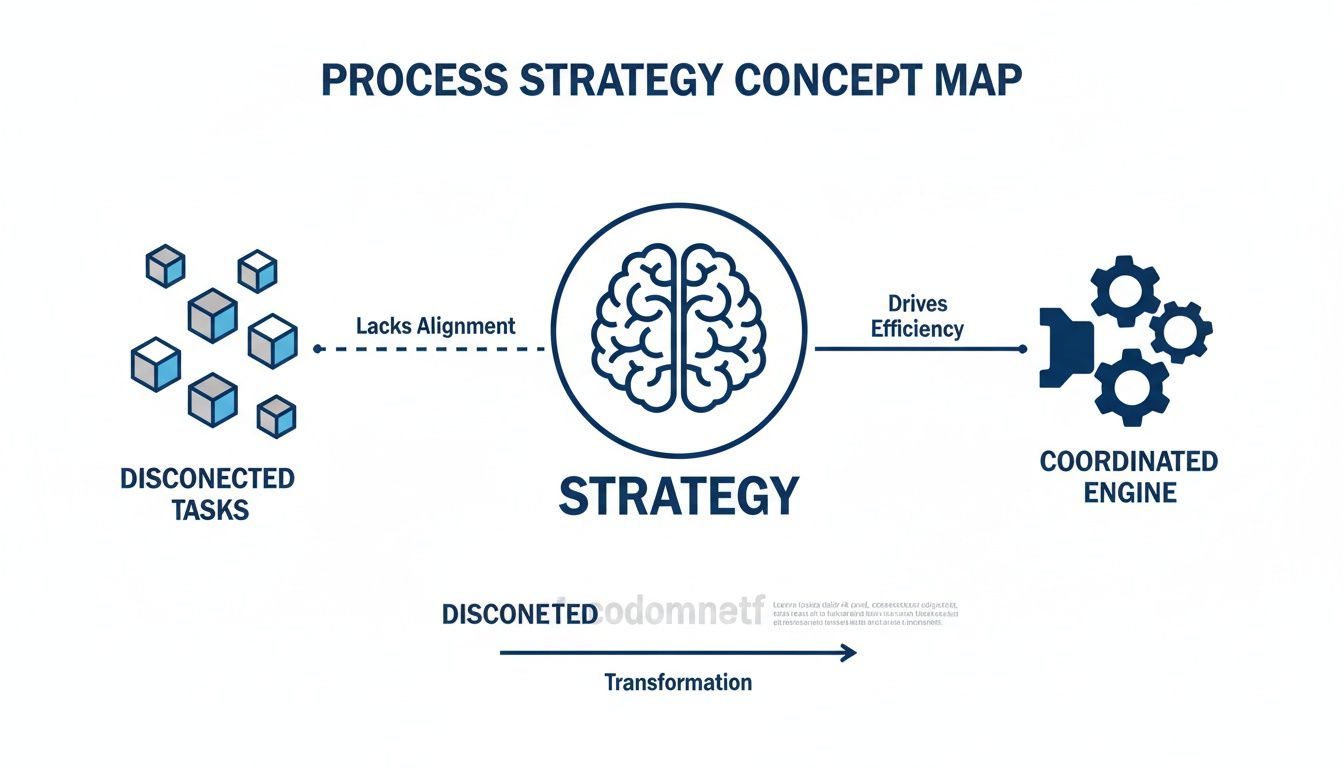
Moving from chaos to coordination only happens when you build on that solid foundation. Let's break down the four pillars that make it all possible.
Pillar 1: Process Documentation and Mapping
The very first pillar is Process Documentation. This is your company's operational playbook—the single source of truth that spells out exactly how work gets done. Without it, you’re flying blind, relying on "tribal knowledge" that’s locked away in the heads of a few key people. That’s a huge business risk.
Good documentation is way more than just a simple checklist. It often includes visual process maps that clearly show the flow of work, where decisions need to be made, and how tasks are handed off between people or departments. This level of clarity strips away ambiguity and ensures everyone is on the same page, leading to consistent, top-notch results every time.
Pillar 2: Clear Process Ownership
A process without an owner is an orphan, destined to be neglected. The second pillar, Clear Ownership, means assigning a specific person or role to be the "champion" for each core process. This person isn't always the one doing every step, but they are absolutely responsible for the process's overall health and performance.
The process owner has a few key jobs:
- Monitoring performance against the metrics you've set.
- Gathering feedback from the team on the ground.
- Spotting opportunities to improve and streamline things.
- Making sure the documentation is always accurate and up-to-date.
This accountability is everything. When someone is responsible, processes are far less likely to become stale, ignored, or broken. They have a guardian angel looking out for their success.
Pillar 3: Performance Metrics and KPIs
You can't improve what you don't measure. That brings us to the third pillar: Performance Metrics, also known as Key Performance Indicators (KPIs). These are the hard numbers that tell you if a process is actually working and hitting its goals.
For a customer support team, a critical metric might be Average Ticket Resolution Time. For a sales team, it could be the Lead-to-Conversion Rate. These KPIs give you objective proof of what's happening, pulling you out of the world of guesswork and into data-driven decision-making.
By tracking the right KPIs, you gain an early warning system. Dips in performance can alert you to potential issues long before they become massive problems, letting you be proactive instead of constantly putting out fires.
To really get this right, you have to break down complex workflows into measurable parts. For a great example, check out these essential strategies for webinar management. The same logic applies to any function in your business, from marketing to finance.
Pillar 4: A Culture of Continuous Improvement
The final, and perhaps most important, pillar is Continuous Improvement. A process management strategy isn't a "set it and forget it" project. It’s about creating a living feedback loop where processes are constantly reviewed, tweaked, and optimized based on performance data and team input.
This is where the other three pillars all come together. The documentation gives you the starting point, the owner drives the effort, and the metrics show you exactly where to focus. This cycle—often called Plan-Do-Check-Act (PDCA)—builds a culture where everyone is empowered to find smarter ways of working. It's what keeps your organization agile, efficient, and ready for whatever comes next.
Putting Your Process Management Strategy into Action
A well-defined process management strategy on a whiteboard is great, but it’s just theory. The real magic happens when you move it off the page and into the daily grind where it can deliver actual results. But how do you do that without totally overwhelming your teams?
The secret is to forget the "big bang" rollout. Throwing everything at your company at once is a surefire way to create chaos and resistance.
A phased approach is smarter. It’s about building momentum, getting buy-in one step at a time, and showing—not just telling—your team how these new processes make their work life better. By starting small, proving the concept, and scaling intelligently, you turn a top-down mandate into a collaborative journey.

Launching a High-Impact Pilot Program
The best place to begin is with a pilot program. Think of it as your proof of concept. Your goal is to pick one single, high-impact process that’s a known source of pain or has a big effect on the bottom line. Is your client onboarding process a total mess? Is your inventory system costing you money? Those are perfect candidates.
Manage this pilot with a few clear goals in mind:
- Demonstrate clear ROI: Show a measurable win, like slicing the client onboarding time in half or slashing order fulfillment errors.
- Gather authentic feedback: Get honest input from the people who actually live the process every single day. Their insights are gold.
- Create internal champions: A successful pilot turns the team involved into your biggest advocates. They’ll be the ones telling everyone else how great the new way is.
By focusing on one area, you keep the scope manageable, lower the risk, and create a powerful success story to fuel the wider rollout.
Refining and Scaling Based on Feedback
Once your pilot wraps up, don't just immediately scale it. The next step is all about learning. Take a beat to analyze the results and, most importantly, listen to what the team has to say. What worked? What was clunky? This is your chance to fine-tune the process before you push it out to everyone else.
This feedback loop is what makes or breaks adoption. People are far more likely to get behind a system they helped build. Once you’ve made those improvements, you can start a phased rollout to other departments.
A process management strategy that is forced upon a team will always face resistance. A strategy that is built with them will be championed by them. Employee involvement isn't a "nice-to-have"; it's the foundation of successful implementation.
This methodical expansion means each new team gets the benefit of the lessons learned from the last stage. It makes every step of the rollout smoother than the one before. For compliance-heavy industries like finance and manufacturing, this systematic approach highlights the tangible ROI of process strategies. Firms implementing robust Business Process Management (BPM) suites report 20-40% faster onboarding and 15-25% cost savings in training. To explore these findings further, you can read the full report on BPM market trends.
A Mini-Playbook for Client Onboarding
Let's make this real. Here’s a quick playbook for standardizing a new client onboarding process—a common pain point where a good strategy makes a huge difference.
Step 1: Map the Current Process
Get the team in a room and map out every single step of your current onboarding journey, from the moment a contract is signed to the client's first "aha!" moment. Pinpoint every bottleneck, redundant task, and point of friction.
Step 2: Define the Ideal Future State
Now, design the new, improved process. Use a tool like Whale to document each step so there's no confusion. Make sure every task has a clear owner (e.g., Sales hands off to the Account Manager, who then kicks off the technical setup).
Step 3: Set Clear Success Metrics
You can't improve what you don't measure. Establish KPIs to track your success. For onboarding, great metrics include:
- Time to First Value (TTFV): How fast does a new client get a meaningful win from your product or service?
- Client Satisfaction Score (CSAT): Survey clients right after onboarding to see how you did.
- Support Tickets in First 30 Days: A low number here is a great sign that your onboarding was clear and effective.
This kind of step-by-step approach ensures your strategy isn't just an abstract idea but a practical tool that drives real business results.
How Modern Tools Elevate Your Process Strategy
A brilliant process management strategy on paper is a great start, but let's be honest—it’s not enough to actually drive change. To bring that strategy to life, you need an execution platform. Think of it as the central nervous system for your entire operation.
Modern tools are what transform your carefully documented plans from static files into a dynamic, living system that weaves itself into daily work.
This is where the game shifts from just documenting processes to truly empowering your team to execute them flawlessly. Without the right tools, even the best-laid plans can fall flat, becoming just another binder collecting dust on a shelf. The real goal is to make your processes accessible, actionable, and always getting better.

This kind of setup is exactly what we're talking about—a smart, centralized hub for managing every company process. It’s how you turn an abstract strategy into tangible, everyday operational excellence.
From Documentation Bottlenecks to AI-Assisted Creation
One of the biggest hurdles in process management has always been the sheer grunt work of documentation. Teams are swamped, and your subject matter experts almost never have the spare time to sit down and write out detailed procedures.
This is where today’s tools offer a massive advantage.
AI-assisted content creation completely smashes this common bottleneck. Instead of staring at a blank page, your teams can generate clear, step-by-step Standard Operating Procedures (SOPs) in a fraction of the time. This doesn't just speed up the initial rollout of your strategy; it makes keeping everything current way easier.
Platforms like Whale are built to solve this exact problem. They act as a single source of truth, centralizing all your team’s knowledge and making it instantly accessible. When every single person knows exactly where to find the right procedure, ambiguity evaporates and consistency becomes the new normal. For a deeper look, check out our guide on finding the right process documentation software for your business.
Ensuring Everyone Uses the Right Playbook
Another classic process headache is version control. Nothing tanks productivity faster than an employee following an outdated procedure, which can lead to costly mistakes, compliance nightmares, or terrible customer experiences. Manually updating and emailing documents across the company is a recipe for disaster.
Modern process platforms solve this with built-in version control. When a process gets an update, the changes are instantly live for everyone. This guarantees your team is always working from the most current, approved version of any playbook or guide. No more risk of old information causing new problems.
A process management strategy is only as strong as its adoption. If processes are hard to find, difficult to understand, or out-of-date, they won't be used. Modern tools are designed to remove these barriers, making compliance the path of least resistance.
This is especially critical in highly regulated industries. North America leads the Business Process Management market, partly because BPM has delivered some dramatic results—like cutting process cycle times by 40-60% in banking. Airtight SOPs are non-negotiable for regulations like Sarbanes-Oxley (SOX), where using the correct procedure is everything. Discover more insights about the BPM market and its impact.
Making Processes Actionable and Improvable
At the end of the day, the whole point of a process strategy is to improve business outcomes. Modern tools give you the data and feedback loops you need to actually make that happen. Instead of just documenting a process and hoping for the best, you can track its usage, gather feedback from the team, and measure its impact.
This is what turns your strategy into a cycle of continuous improvement. You can see which procedures are actually being used, pinpoint where employees get stuck, and collect suggestions for how to make things better—straight from the people on the front lines. This data-driven approach means you're refining operations based on reality, not just assumptions.
- Training and Onboarding: Build quizzes and training modules right into your process documents to make sure people actually understand them.
- Accessibility: Put information inside the tools your team already uses every day. This removes friction and encourages people to actually use the resources.
- Performance Metrics: Track engagement and feedback to see how well your processes are landing and where the opportunities for improvement are.
By putting these capabilities to work, your process management strategy stops being a theoretical exercise and becomes a real asset that drives daily efficiency and long-term operational strength.
Common Process Management Mistakes and How to Dodge Them
Even a brilliant process management strategy can fall apart during the rollout. Knowing the common pitfalls is like having a map of a minefield—it helps you navigate around the dangers that derail even the best-laid plans.
Steering clear of these mistakes is what separates a strategy that lives in a binder from one that actually drives business results. One of the biggest blunders is treating process management as a one-and-done project. Teams will map everything out, celebrate the launch, and then let the new processes slowly drift into irrelevance. This static approach completely ignores the fact that businesses evolve, and your processes have to keep up.
Lacking Genuine Leadership Buy-In
Here's a classic mistake: confusing a leader's approval with their genuine buy-in. Approval is just a signature on a document. Buy-in is when leaders actively champion the strategy, model the right behaviors, and consistently talk about why it matters. Without that, your initiative will feel like just another flavor-of-the-month corporate project that everyone ignores.
To dodge this, you need to go beyond a slide deck. Show them tangible ROI by starting small with a pilot project that tackles a major pain point. When you can walk into their office with a concrete win—like cutting new hire onboarding time by 30% or slashing errors in a key workflow—their support will shift from passive agreement to active advocacy.
Creating Overly Complex Processes
Another common trap is designing processes that are technically perfect but a total nightmare to use in the real world. When you create a workflow that’s too rigid, bureaucratic, or just plain complicated, your team will find a way around it. Guaranteed. This "shadow IT" or informal workaround completely undermines the goal of standardization.
The solution is simple: involve the end-users from day one. The people doing the work are your best source of insight into what’s practical and what isn’t. When you co-create processes with them, the final version is both efficient and user-friendly, which sends adoption rates through the roof. You can learn more about how to sidestep these issues by reviewing common mistakes in documenting processes.
A process that looks perfect on a flowchart but is ignored by the team is a failed process. The ultimate measure of success is adoption, not theoretical perfection.
Failing to Manage Change Effectively
Just dropping new processes on your team without a clear communication plan is a recipe for resistance. If employees don't get the "why" behind the changes, they'll naturally be skeptical, maybe even hostile. This is especially true if they feel like a new system is being forced on them without any context.
This challenge is huge in high-growth markets. For instance, amid APAC's digital boom, effective Business Process Management is key to addressing high talent churn. By standardizing SOPs, companies can cut training costs by 20% using AI-driven tools for quizzes and updates. You can find more insights about the global BPM market on fortunebusinessinsights.com.
To prevent this backlash, you need a solid communication strategy that covers:
- The "Why": Clearly explain the problems the old process was causing and the specific benefits the new one will bring to them and the company.
- The "What": Break down exactly what is changing and what's expected of each person. No ambiguity.
- The "How": Provide great training and make sure all the documentation is easy to find—a centralized platform like Whale is perfect for this, so no one ever feels lost.
By getting ahead of these common mistakes, you can build a process management strategy that's not only resilient but also one your team will actually get behind and use.
Answering Your Top Process Strategy Questions
Jumping into a formal process management strategy can feel like a huge undertaking, especially if you feel like you’re starting from ground zero. A bunch of practical questions usually pop up right away, but trust me, the answers are more straightforward than they seem. Let's knock out the most common ones so you can get moving with confidence.
Where Do I Start If My Business Has No Formal Processes?
I get it. If your business currently runs on "tribal knowledge" and a series of informal, unwritten rules, the thought of documenting everything is enough to make you want to quit before you start. But here's the secret: start small and go for a quick win. Don't try to boil the ocean.
Pick just one area that’s a known headache or a task your team does over and over. Good candidates are usually things like:
- Handling new customer inquiries: This directly hits your revenue and customer experience. A little improvement here goes a long way.
- Onboarding a new employee: A chaotic onboarding is a waste of everyone's time and a terrible first impression for new hires.
- Processing a client payment: Simple mistakes in this process can create massive cash flow and relationship headaches.
Zero in on one of these. By proving the value of process management on a small scale, you'll build the momentum and buy-in you need to tackle the bigger, more complex stuff later.
How Can I Ensure My Team Actually Uses The Processes?
This is the million-dollar question. You can create the most beautiful process documents in the world, but they're worthless if they just collect digital dust. Getting your team to actually follow them comes down to three things: accessibility, ownership, and accountability.
First, make your processes impossible to miss. Using a central hub like Whale puts SOPs right inside the tools your team already uses. No more "I couldn't find it" excuses. Next, pull your team into the creation process. When people help build the solution, they're way more invested in using it. Finally, tie process consistency into performance conversations to show that this isn't just busywork—it's a valued part of doing a great job.
The goal is to make the right way the easiest way. When processes are clear, accessible, and practical, your team will see them as helpful tools, not bureaucratic hurdles.
What Is The Difference Between Process and Project Management?
This is a big one, and the confusion is totally understandable. They both aim to make the business better, but they focus on completely different kinds of work.
Here’s a simple way to think about it:
Process management is like running the day-to-day kitchen in a restaurant. It’s about the repeatable, ongoing activities that make the business function—taking orders, cooking the food, cleaning the tables. The goal is to make these daily tasks as efficient, consistent, and high-quality as possible, every single time.
Project management, on the other hand, is like that same restaurant planning a one-off wedding catering event. It’s a temporary effort with a specific start date, a firm end date, and a unique goal. Once the wedding is over, the project is complete.