
A process tells you what you’re trying to achieve and why, while a procedure gives you the step-by-step instructions on how to get it done.
It's a simple distinction, but it's one that trips up a lot of teams.
The Difference Between Processes and Procedures
Let’s get this straight from the start: “process” and “procedure” are not interchangeable. Mixing them up isn't just a language mistake; it creates hidden friction in your daily operations.
Getting this right is the first step toward building a company playbook that gives your team both the structure they need to be consistent and the flexibility they need to innovate. Get it wrong, and you end up with either rigid, creativity-killing rules or vague guidelines that just lead to chaos.
A process is the big-picture view. It outlines the major stages you go through to hit a strategic goal, like "New Employee Onboarding." The aim is to get a new hire fully integrated, and the process maps out the key phases: recruitment, hiring, orientation, and training. It’s all about the goal.
A procedure, on the other hand, is the nitty-gritty instruction manual for a single task within that process. It's tactical, sequential, and designed to be followed to the letter to ensure consistency every single time.
"A process is your strategic 'what,' designed for outcomes. A procedure is your tactical 'how,' designed for consistency. Confusing the two is like trying to navigate a city with a world map—you know the general direction but have no idea which streets to take."
A Simple Analogy: The Road Trip
Let's make this even simpler. Imagine you're planning a road trip from Los Angeles to New York.
- The Process: The process is "Drive from LA to NY." It's the overall mission. This involves a few key stages: planning your route, booking places to stay, packing the car, and, of course, the actual driving. The why is to get across the country safely and on schedule.
- The Procedure: The procedures are the detailed guides for specific tasks you might encounter along the way. Think "How to Change a Flat Tire" or your "Daily Vehicle Safety Checklist." These are your step-by-step instructions: "Step 1: Loosen the lug nuts," "Step 2: Jack up the car," and so on. No guesswork involved.
This isn't just about semantics; it's the foundation of building systems that can actually scale. This quick visual shows exactly how the strategic goal (the process) relies on the tactical steps (the procedure).
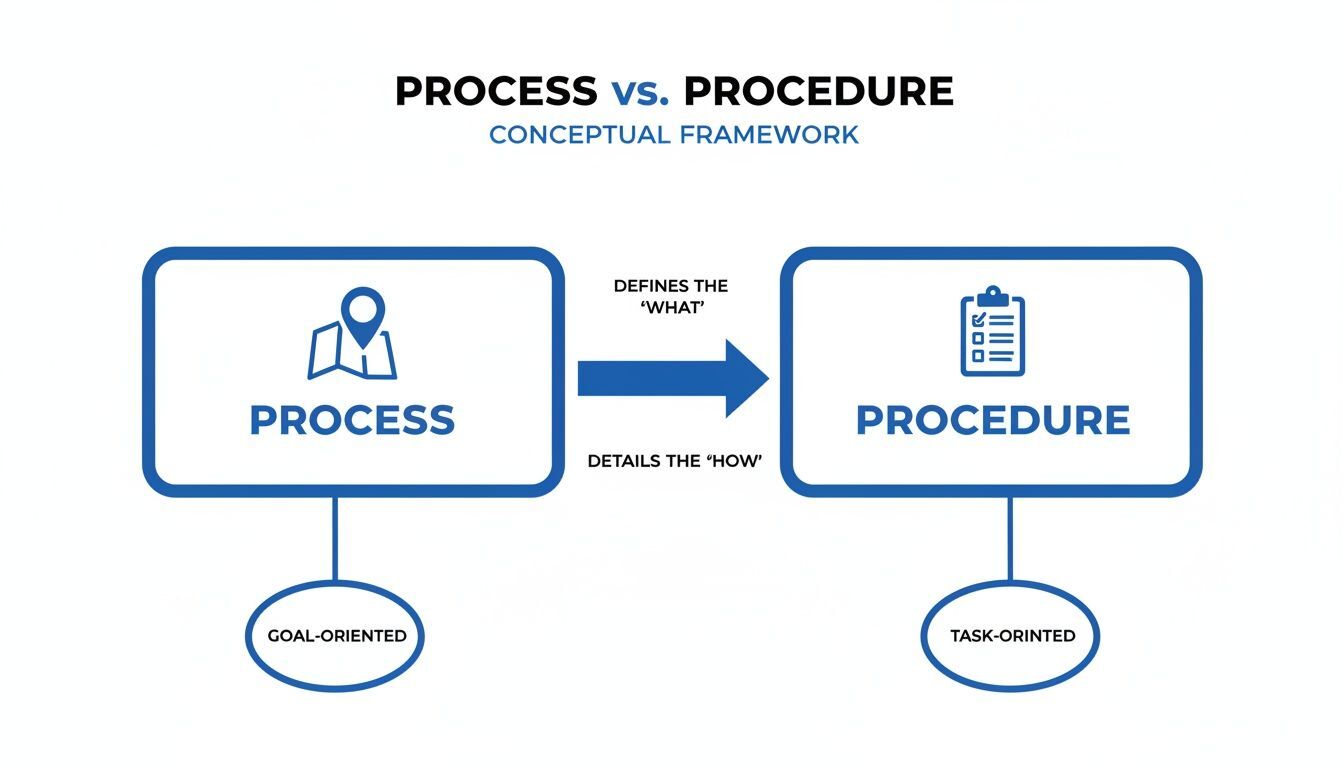
As you can see, procedures are the essential building blocks that make a larger process reliable and repeatable.
Process vs Procedure At a Glance
To make it crystal clear, here’s a quick side-by-side comparison.
| Attribute | Process (The 'What' and 'Why') | Procedure (The 'How') |
|---|---|---|
| Focus | Strategic outcomes and goals | Tactical, step-by-step execution |
| Scope | High-level, broad (e.g., onboarding) | Narrow, task-specific (e.g., setting up a laptop) |
| Flexibility | More flexible; adaptable to change | Rigid and specific; designed for consistency |
| Detail Level | Outlines major stages and milestones | Provides detailed, actionable instructions |
| Purpose | To define what needs to be done and why | To explain how to perform a specific task |
| Example | Customer Support Process | Procedure for Issuing a Refund |
This table should help you quickly differentiate between the two as you start documenting your own operations.
Why This Distinction Matters for Your Business
When you really get the difference, you can build systems that are both strong and adaptable. Your core processes can stay the same even when the procedures underneath them need to change because of new tools, team members, or regulations.
A great way to manage and unify all of this is through Integrated Management Systems. This kind of framework helps businesses bring all their different policies and operational workflows under one roof, creating a single source of truth.
And this isn't just a "nice to have." The numbers show that formalizing operations is critical for growth. The global market for Standard Operating Procedure Management was valued at USD 124.8 billion in 2023 and is expected to explode to USD 914.9 billion by 2032. It’s clear that businesses are betting big on solid operational systems to succeed.
Why Clear Systems Are Your Blueprint for Growth

Without a solid operational blueprint, trying to grow your business feels less like a controlled climb and more like a chaotic freefall. We’ve all seen it: one company struggles with every new hire, reinventing the training wheel while service quality swings wildly from one day to the next. The team is stuck in a constant state of firefighting, solving the same problems over and over because nothing is ever written down.
Now, picture a business built on a foundation of well-defined processes and procedures. Growth here is predictable. It's manageable. New team members get up to speed in record time because they have a clear playbook to follow. Service delivery is remarkably consistent, creating the kind of reliable customer experience that builds serious trust and loyalty. implementing process management techniques for growth allows businesses to identify inefficiencies and optimize workflows. This strategic approach not only boosts productivity but also enhances employee satisfaction by providing clarity in their roles. As a result, companies can adapt swiftly to market changes, positioning themselves for sustained success.
This isn't about bogging everyone down with rigid, bureaucratic rules. It's about building a stable platform that empowers your team to execute flawlessly. This, in turn, frees up leadership to focus on the big picture instead of getting sucked into daily emergencies.
From Chaos to Control
That leap from reactive problem-solving to proactive system-building is what separates businesses that scale from those that just stagnate. When you document your systems, you turn tribal knowledge—that critical information trapped in the heads of a few key employees—into a shared, accessible company asset.
The moment you make that shift, you'll see immediate, tangible benefits that hit your bottom line.
- Accelerated Onboarding: New hires don't need to shadow senior staff for weeks on end. They can follow clear procedures, slashing training time and becoming productive team members much, much faster.
- Reduced Errors and Rework: When everyone follows the same proven steps, costly mistakes and frustrating inconsistencies plummet. This is a direct boost to your efficiency and protects your profit margins.
- Consistent Customer Experience: Your brand promise gets delivered the same way, every time. It doesn't matter if a customer interacts with a brand-new employee or a ten-year veteran.
This isn't just theory. A case study of a manufacturing firm found that implementing comprehensive SOPs led to a 67% reduction in product defects, cut new hire training time in half from four weeks to two (a 50% decrease), and lowered annual production costs by 20%. You can learn how standardizing operations drives success and see exactly how they pulled it off.
By documenting how work gets done, you're not just creating a manual. You're building a scalable engine for quality and consistency—the two pillars of sustainable growth.
Building Your Foundation for Scale
Clear processes and procedures do more than just clean up today's tasks; they get your business ready for tomorrow's challenges. As your team grows, you simply can't rely on word-of-mouth instructions to maintain quality. A documented system becomes your single source of truth, making sure every new office, department, or team member is working from the same playbook.
This foundation is also a massive risk mitigator. Think about it: when critical operational knowledge lives with only a few people, what happens when they leave? Their departure can cripple a department. Documented procedures ensure business continuity by turning that knowledge into a permanent company resource.
Ultimately, defining your operations is an investment in predictability. It transforms messy, unpredictable growth into a manageable, step-by-step system where success becomes repeatable and scalable. It allows you to confidently add new clients, launch new products, or bring on new employees, knowing the underlying structure can support the expansion without cracking under the pressure. That operational maturity is the true blueprint for building a business that lasts.
How to Document Your Operations Effectively
Let's be honest: creating documentation that just sits on a virtual shelf collecting dust is a massive waste of everyone’s time. The real goal is to build a living, breathing knowledge base that becomes your team’s single source of truth—the very first place they look when they need an answer.
Effective documentation for your processes and procedures isn't about creating some rigid, bureaucratic manual. It’s about providing the kind of clarity that empowers your team to act with confidence.
The secret? A user-first mindset. Stop writing for a compliance auditor and start writing for the person who actually has to do the job. Is the task simple and repetitive? A checklist is probably perfect. Does it involve a bunch of "if this, then that" decisions? A visual flowchart will be their best friend. Matching the format to the task is the first, most crucial step in creating documentation people will actually use.
Choosing the Right Format for the Task
Not all tasks are created equal, so your documentation shouldn't be either. One of the biggest mistakes is forcing everything into the same dense, text-heavy format. That’s a surefire way to guarantee nobody reads it. Instead, think like a great teacher and pick the best tool for the lesson.
- Simple Checklists: These are your best bet for routine, sequential tasks where every step needs to be completed in order. Think daily opening duties for a retail store, setting up a new client in your system, or running a pre-flight check before a marketing campaign goes live.
- Step-by-Step Guides: Perfect for tasks that need a bit more detail than a checklist but are still pretty linear. These guides often shine with screenshots, quick descriptions, and links to other helpful resources for each step.
- Flowcharts: When you're dealing with complex workflows that have multiple decision points or branching paths, a flowchart is your hero. They visually map out all the "if-then" scenarios, making it incredibly easy to see how different choices change the outcome.
- Video Tutorials: Nothing beats a good video for showing how to navigate software or perform a physical task. A quick two-minute screen recording can often explain things way better than pages and pages of text.
When you select the right format, the information instantly becomes more digestible and useful. This dramatically increases the chances of it being followed correctly every single time.
Writing with Absolute Clarity
Once you’ve nailed down the format, your next mission is clarity. Ambiguity is the sworn enemy of consistency. The goal is simple: write instructions so clear that a brand-new hire could follow them flawlessly without needing to tap anyone on the shoulder for help.
To get there, use simple, direct language. Ditch the jargon, acronyms, and corporate-speak unless they're absolutely essential. And if you must use them, make sure you define them the first time they appear.
A well-documented procedure leaves no room for interpretation. It should answer who, what, when, and how for every critical step, turning institutional knowledge into an accessible, actionable company asset.
Break down big, complex actions into smaller, bite-sized steps. Instead of a vague instruction like, "Configure the new account," get granular:
- Navigate to the 'Admin' panel.
- Click 'Create New User'.
- Enter the user’s full name and email address.
- Assign the 'Standard' permission level from the dropdown menu.
This level of detail eliminates all the guesswork and ensures the task gets done the exact same way, every time. If you really want to level up, take a look at the most common mistakes to avoid when documenting your processes to make sure your efforts truly pay off.
Creating a Consistent SOP Template
Consistency in your documentation's structure is just as critical as the clarity of its content. A standardized template makes your entire knowledge base predictable and a breeze to navigate.
When every SOP follows the same layout, team members instinctively know where to find the purpose, the scope, or the step-by-step instructions. They're not hunting for information; they're acting on it.
This table breaks down the essential elements that every solid SOP template should have.
Essential Elements of an Effective SOP Template
| Component | Purpose | Example |
|---|---|---|
| Title | Clearly identifies the procedure | "How to Process a Customer Refund" |
| Procedure ID & Version | Provides a unique identifier for version control | "FIN-REF-001, v2.3" |
| Purpose Statement | Explains why this procedure exists and what it achieves | "To ensure all refunds are processed consistently and accurately." |
| Scope | Defines who this procedure applies to and when | "Applies to all Customer Support Tier 2 agents." |
| Roles & Responsibilities | Clarifies who is responsible for each part of the procedure | "Agent is responsible for steps 1-4; Manager for final approval." |
| Step-by-Step Instructions | The core "how-to" section with clear, actionable steps | "1. Open the customer record in the CRM…" |
| Related Documents | Links to other relevant processes or policies | "See: Customer Satisfaction Policy (POL-CS-004)" |
Using a consistent template is what transforms a random collection of documents into a cohesive, professional knowledge base that becomes the true backbone of your operations.
Bringing Your SOPs to Life in Your Company
So you’ve created crystal-clear documentation for your processes and procedures. That’s a huge win, but honestly, it’s only half the battle. The most common reason new systems fail isn't the quality of the documents; it's that nobody uses them. Static SOPs are useless if they just gather dust in a forgotten folder.
The real challenge is getting those carefully crafted documents to become a living, breathing part of your company culture. This takes more than a company-wide email with a link to a shared drive. Success comes down to smart communication, real training, and getting genuine buy-in from the people on the ground.
This is where you turn static text into dynamic action and forge real operational excellence.
Rolling Out New Procedures for Maximum Impact
How you introduce a new procedure can make or break its success. A thoughtful rollout builds excitement and shows people you're making their lives easier. A clumsy one just creates resistance and confusion right from the start. The goal is to make it feel like a helpful step forward, not a top-down mandate.
Before you even get into the "how," start with the "why." Explain the headaches the new procedure solves and what's in it for the team—less guesswork, fewer mistakes, more time for the work that actually matters.
Then, make the training hands-on and interactive. Ditch the dry lecture and use real-world scenarios that let your team practice the new steps in a low-stakes environment. This builds confidence right along with competence.
- Communicate Clearly: Announce changes well in advance and explain the logic behind them.
- Provide Hands-On Training: Run workshops and simulations, don't just send memos.
- Designate Champions: Find a few early adopters who can mentor their peers and spread a positive vibe.
Establishing a Strong Governance Rhythm
Procedures go stale. It's a fact. Without a system to keep them current, your perfectly documented SOPs will become outdated and irrelevant, and your team will lose trust in the whole system. Good governance is what stops this from happening.
This means you need a clear rhythm for review and ownership. Every single procedure needs a designated process owner—a specific person who is responsible for its accuracy and effectiveness. This creates accountability and ensures someone always has eyes on it.
An SOP without an owner is an orphan. It will inevitably become neglected and outdated. Assigning clear ownership is the single most important step in building a sustainable documentation culture.
Set up a scheduled review cycle—quarterly or annually works well—to formally check if a procedure is still effective and accurate. You'll also want to use version control to track every change, making it easy to see what was updated, when, and by whom. This structure turns your SOPs from one-off projects into company assets that are managed continuously. If you want more ideas to boost adoption, you can get your processes followed by everyone with a few proven techniques.
Fostering a Culture of Continuous Improvement
Ultimately, you want to create an environment where operational excellence is everyone's job, not just a management thing. The people on the front lines are the real experts in how work gets done, and their insights are pure gold. Empowering them to contribute is how you unlock continuous improvement.
Create a simple, frictionless way for employees to suggest updates or flag inefficiencies. This could be a dedicated Slack channel, a simple form, or a feature built right into your SOP software.
When an employee's suggestion leads to a real improvement, celebrate it publicly. This recognition shows their input is valued and encourages others to speak up. Before you know it, you'll have a culture where everyone feels a sense of ownership over the company’s processes and procedures, turning them into a dynamic system that's always getting better.
Using Technology to Streamline Your Systems
Having great documentation is one thing, but the tools you use to manage your processes and procedures can either launch you forward or become a massive bottleneck. For too long, the default has been a chaotic mess of shared drives, conflicting spreadsheets, and Word documents nobody's touched in years. This isn't just disorganized; it's a direct threat to your consistency and efficiency.
When information is scattered everywhere, your team wastes precious time hunting for the right version of a procedure. Or worse, they just give up and use outdated instructions. This digital scavenger hunt is a recipe for inconsistent work, expensive mistakes, and a whole lot of frustration. It’s exactly the kind of operational weak point that modern technology was built to fix.
The solution is to ditch the static, disconnected files and move to a single, intelligent knowledge hub.
The Old Way vs. The Modern Approach
Let's put the old-school method of managing operational knowledge side-by-side with what a dedicated platform brings to the table. It's a night-and-day difference.
The Old Way: Knowledge is fragmented across Google Drive, Dropbox, and random local hard drives. Version control is a nightmare, relying on file names like
Onboarding_Checklist_FINAL_v2_updated.docx. Finding anything is slow, painful, and unreliable.The Modern Approach: A single source of truth holds every process and procedure. Information is instantly searchable, version control is automatic, and updates get pushed to the entire team in real time. Everyone is quite literally on the same page.
This isn’t just a simple upgrade. It transforms your documentation from a dusty, neglected archive into an interactive, indispensable tool your team actually wants to use.
Supercharging Your Systems with an AI Platform
An AI-powered SOP platform like Whale is designed to solve the biggest headaches that come with managing processes. It doesn't just store your documents; it brings them to life. By centralizing everything, these platforms make critical information pop up exactly when and where your team needs it most.
Picture a new support agent handling a tricky refund request. Instead of digging through folders, the correct procedure appears right inside their CRM. That kind of immediate, contextual guidance is what turns good documentation into great performance.
This screenshot shows how a centralized platform presents information clearly, making it easy to find and follow.
The clean interface and powerful search mean finding the right procedure takes seconds, not minutes.
A dedicated SOP platform acts as your company's central nervous system, ensuring that the right information flows to the right person at the right time, creating operational harmony.
Features like AI-assisted content creation can also dramatically speed up the documentation process itself. Instead of staring at a blank page, you can generate a clear, step-by-step procedure from a simple prompt or a quick video recording of a task. This saves countless hours and makes it infinitely easier to get critical knowledge out of your experts' heads and into the system.
You can explore our complete guide on process documentation software to see how different tools stack up.
The explosive demand for these platforms is all over the market trends. The global SOP software market was valued at around USD 1.2 billion in 2023 and is projected to more than double, hitting USD 2.7 billion by 2032. This incredible growth shows just how seriously the business world is taking specialized tools for managing operational knowledge.
Ultimately, adopting the right technology is about more than just getting organized. It’s about building a smarter, more resilient operation where consistency is the default, training is seamless, and continuous improvement is just part of your daily workflow.
Common Questions About Processes and Procedures

As you move from theory to action and start building your company’s operational playbook, you’re going to have questions. This is where the real work begins, and it’s perfectly normal to hit a few snags. This section digs into the most common sticking points we see when teams get serious about documenting their processes and procedures.
Think of this as your go-to FAQ, built to give you clear, straightforward answers that cut through the noise. We want to get ahead of your concerns and give you the confidence to turn your documentation efforts into a true engine for growth.
How Much Detail Is Too Much?
This is the classic Goldilocks problem of documentation. Go too vague, and you open the door to guesswork and mistakes. Get too granular with every single click, and people will feel micromanaged and tune out completely.
The trick is to write for your audience and the task's complexity. A solid rule of thumb? Provide just enough detail for a new, competent team member to get the job done right without having to ask for help.
- For routine tasks: Keep it simple. A checklist often does the job perfectly.
- For complex tasks: Break them down into logical chunks. Use screenshots or quick videos to demystify tricky parts, but skip the stuff that's common knowledge for the role.
Your documentation should empower your team, not drown them in details. Zero in on the critical steps and decision points that guarantee a consistent, high-quality result.
How Do We Start If We Have Nothing?
Staring at a blank page is tough, but here's the good news: you’re not starting from scratch. Your business is already running, even if the "how" lives inside your team's heads. The first step is to simply watch, listen, and capture what’s already happening.
Kick things off with a high-impact, low-effort area. Find a process that’s a known source of errors or bottlenecks. Nailing this first will deliver a quick win and prove the value of documentation right out of the gate.
- Pick a Priority Process: Choose a core operation like "customer onboarding" or "monthly invoicing."
- Shadow the Expert: Ask your go-to person for that task to walk you through it. Record them or take detailed notes.
- Draft a V1: Turn those notes into a basic step-by-step guide. Don't aim for perfection; just get it down.
- Test and Refine: Hand the draft to a newer employee and watch them work. Every question they ask is a golden opportunity to make the procedure clearer.
This simple, iterative loop is way more effective than trying to build a perfect, all-encompassing SOP library from day one.
The goal isn't to document everything at once. It's to build momentum by solving one real problem at a time. Each documented procedure is a building block for a more stable, scalable operation.
What Is the Difference Between a Policy and a Procedure?
This one trips up a lot of people, but the distinction is crucial for running a tight ship. Policies, processes, and procedures exist in a clear hierarchy, each with its own job to do.
| Component | Purpose | Level of Detail |
|---|---|---|
| Policy | The high-level rule or guiding principle. | Very low; it states what the rule is and why it matters. |
| Process | The sequence of major stages to hit a business goal. | Medium; it outlines what needs to happen in phases. |
| Procedure | The detailed, step-by-step instructions for one task. | Very high; it explains how to do something, step by step. |
Let's make it real. A company might have an "Information Security Policy" that states all sensitive data must be protected. This policy guides the "New Client Data Entry Process." Inside that process, you’ll find a specific "Data Encryption Procedure" that gives the exact steps for an employee to secure a file.
Policies set the rules of the road, processes draw the map, and procedures give you the turn-by-turn directions.
How Do We Handle Constantly Changing Procedures?
In a fast-moving business, procedures can feel outdated the moment you hit "publish." That’s not a failure—it's a sign of growth. The answer isn't to stop documenting; it's to build a system that embraces change.
This is where tools like an AI SOP platform become a game-changer. Forget static documents lost in shared drives. A centralized platform makes updates instant and painless.
Here’s how you manage change like a pro:
- Assign Clear Ownership: Every single procedure needs a designated owner who is responsible for keeping it fresh.
- Set a Review Cadence: Schedule regular check-ins (quarterly is a good start) to formally review for accuracy.
- Create a Feedback Loop: Make it dead simple for your frontline team to flag issues or suggest better ways of doing things. They're the first to know when something is broken.
- Use Version Control: A modern system tracks every change automatically, so you always know you're working with the latest and greatest version.
When you treat your processes and procedures as living documents inside a dynamic system, they become a reliable asset, not a dusty archive.