
A quality management system implementation is all about standardizing your processes to boost efficiency and ensure your product or service is consistently top-notch. It's a structured way to define, document, and maintain the procedures that keep customers happy and regulators satisfied. Done right, it moves way beyond simple compliance and becomes a powerful engine for business growth.
Why a QMS Is Your New Competitive Edge

Let's stop thinking of a QMS as just a compliance checkbox. In today's market, it’s a core strategic move. The old way of doing things—reactive quality control, where you just fix problems after they happen—is a recipe for disaster. It’s expensive, it wrecks your reputation, and it leaves you constantly playing catch-up.
The true costs of not being compliant can be brutal. We're talking product recalls, hefty regulatory fines, and losing customer trust that can take years to win back. This pressure is only getting worse, with internationally recognized standards like ISO 9001 becoming a baseline expectation for many customers.
From Cost Center to Growth Driver
A modern quality management system implementation completely flips this script. Instead of being a cost center focused on dodging penalties, it becomes a proactive machine for creating value. When you build quality into every single workflow, you shift the entire company’s mindset from firefighting to continuous improvement.
This transition unlocks some serious business advantages:
- Boosted Efficiency: Standardized processes kill the guesswork and rework. This cuts down on waste and frees up your team to focus on work that actually moves the needle.
- Unbreakable Customer Trust: When you consistently deliver high-quality products and services, you build a loyal customer base that knows you'll deliver on your promises, every single time.
- Informed Decision-Making: A solid QMS gives you clear data and insights into how your operations are really performing, making it easy to spot bottlenecks and find new opportunities for growth.
A QMS creates a framework where quality isn't just an outcome—it's woven into the very fabric of your company culture. It’s about building a system that self-corrects and gets better over time.
The Accelerating Need for Structure
The push for formal quality systems is getting stronger every year. Since the ISO 9001:2015 standard rolled out, over 1.1 million organizations worldwide have gotten on board. On top of that, regulatory inspections jumped by 15% between 2021 and 2023, forcing companies in sectors like manufacturing and healthcare to get more structured.
The trend is obvious: companies that treat their processes as a competitive advantage are the ones pulling ahead, leaving the reactive ones in the dust.
This guide is for the operations managers and scaling startups who need to see how a project this complex can become a massive win for the business.
Laying a Solid Foundation for Your QMS
A successful quality management system isn't something you can just throw together. The real work starts before you even think about mapping a process. It's all about getting strategic, defining your goals, and making sure everyone who matters is on board. Think of it as pouring the concrete foundation for a house—if you mess this part up, the whole structure will be wobbly for years to come.
So many QMS projects fall flat right out of the gate. Why? Because teams dive straight into the tactics. They start writing procedures without answering the big questions first: What are we actually trying to achieve here? And why does it matter to the business? This is how you end up with a QMS that’s all theory and no practice—a binder on a shelf, completely disconnected from how people actually work.
Define Your Scope and Business Objectives
First things first: decide what your QMS will actually cover. Are you focusing on a single department, a specific product line, or the entire organization? It's tempting to go big, but starting with a narrower scope can be much easier to manage. On the other hand, a broader scope is where you'll see the biggest impact. The key is to make sure your scope directly supports real, tangible business objectives.
And please, don't just aim for "better quality." That's not a goal; it's a wish. Get specific and tie your QMS to metrics that matter.
- Reduce customer complaints by 20% in the next year.
- Decrease production defects by 15% over the next two quarters.
- Cut down new hire onboarding time by 30%.
When your goals are measurable like this, proving the ROI of your QMS becomes a whole lot easier. It also keeps everyone motivated. A critical piece of this groundwork is creating a unified GRC strategy, which makes sure your quality initiatives are pulling in the same direction as your wider governance and risk management goals.
Secure Genuine Leadership Buy-In
Let me be blunt: without a real commitment from the top, your QMS initiative is dead in the water. Leadership holds the keys to resources, authority, and the vision needed to push this kind of change through. You need them to be active champions, not just passive approvers who sign a piece of paper.
To get them truly invested, you have to build a rock-solid business case. Forget the technical jargon about ISO clauses; speak their language. Frame the QMS in terms of financial impact, competitive advantage, and risk mitigation. Show them the hard numbers on how poor quality is currently costing the business—in rework, returns, and frustrated customers who walk away.
This isn’t just a formality. When leaders are actively involved, it sends a crystal-clear message to the entire company that quality isn’t just a department—it’s a core business priority.
Assemble Your Cross-Functional QMS Team
You absolutely cannot build a QMS from an isolated silo. Success hinges on a dedicated, cross-functional team that brings different perspectives from across the business. This is the crew that will drive the project from the initial planning stages all the way through rollout and beyond.
Your team should have people from:
- Operations: They live and breathe the day-to-day workflows.
- Quality Assurance: They’re your technical experts.
- Engineering/Product: They know the product inside and out.
- Customer Support: They have a direct line to customer pain points.
This mix of perspectives is what makes a QMS practical and relevant. It ensures you’re building something that solves real problems for the entire organization, not just checking a box for the quality department.
A QMS built by a diverse team is a QMS that actually gets used. When people feel they have a stake in its creation, they are far more likely to adopt and maintain it.
Conduct a Thorough Gap Analysis
Before you can build anything new, you have to know where you're starting from. A gap analysis is basically a reality check—a systematic review of your current processes versus the requirements of your chosen standard (like ISO 9001) or your own internal quality goals.
This is more than a documentation audit. You need to get on the floor and see how work actually gets done. Trust me, you’ll almost always find a huge difference between the procedures written down and what happens in the real world. This analysis will shine a light on your strengths, your weaknesses, and the exact areas that need attention.
Understanding these gaps is critical for creating a realistic project plan and knowing where to focus your energy. For a deeper dive into managing all the paperwork this uncovers, you can explore our guide on effective document control procedures.
The growing investment in this space shows just how important this is. The QMS software market was valued at USD 10.40 billion in 2023 and is projected to hit USD 26.21 billion by 2032. That's not just a trend; it’s a clear signal that businesses see quality management as a strategic priority for staying competitive. You can explore further QMS market trends in this detailed market analysis.
Turning Your Workflows into Actionable SOPs
Alright, with your foundation set, it’s time to roll up your sleeves and get into the real meat of your quality management system. This is where your high-level planning meets the day-to-day reality of how your team actually gets work done. The mission? To turn your operational workflows into clear, straightforward Standard Operating Procedures (SOPs) that people will actually use.
Forget those old-school, text-heavy manuals that sit on a shelf collecting dust. Modern SOPs are living, breathing guides. They empower your team, slash errors, and build the consistency you need to scale. But here's the secret: you have to understand how work gets done now before you can even think about improving it.
Map Your Processes Before You Write Anything
Before you can standardize a single task, you need to see it clearly. That's where process mapping comes in. It's the simple act of visually laying out a workflow from start to finish. I've seen this exercise become an absolute game-changer for teams—it forces you to confront all the hidden inefficiencies, redundant steps, and frustrating bottlenecks that people have been quietly working around for months.
And please, get your frontline team involved. They're the real experts here. Their insights are pure gold for creating a map that shows what’s really happening, not just what management thinks is happening.
This detailed work builds directly on the foundational flow you’ve already established—defining the scope, getting buy-in, and assembling your team.
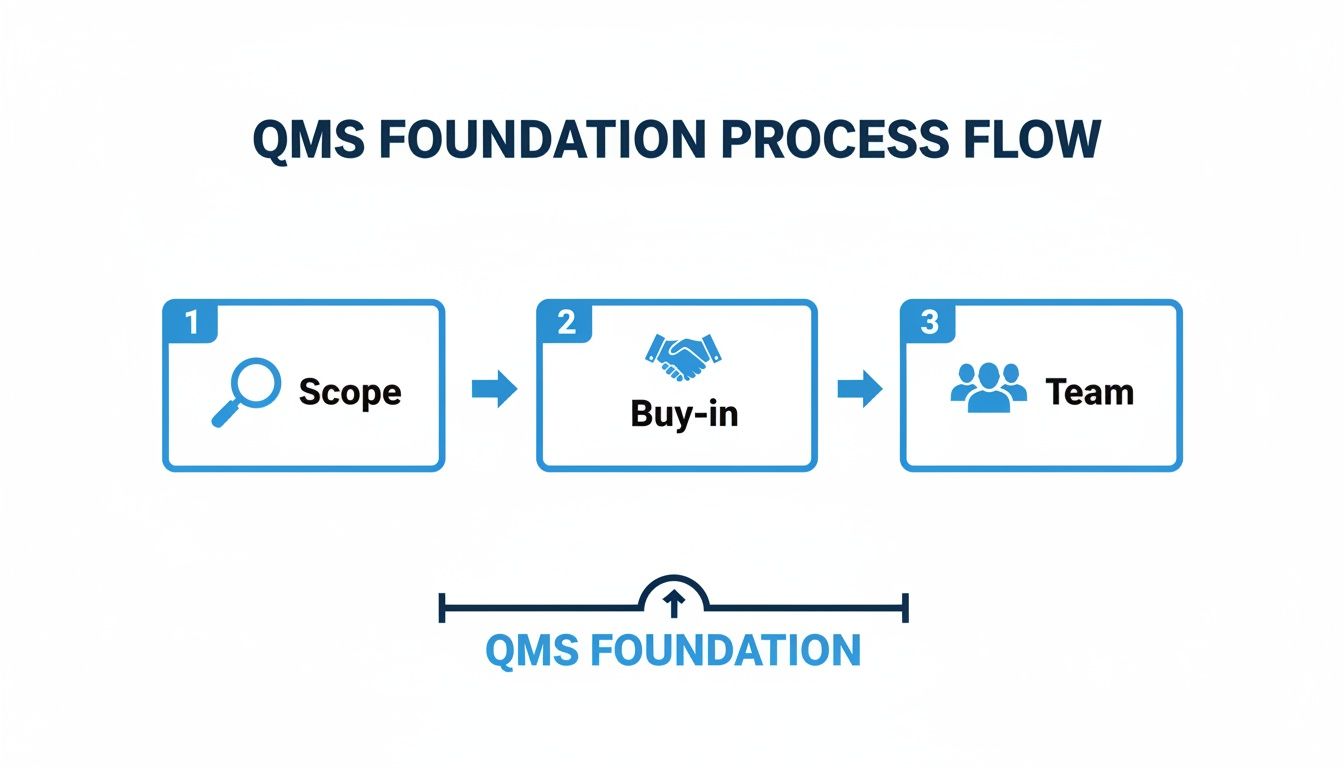
As this visual lays out, a solid implementation starts with that strategic alignment. You need your scope, buy-in, and team locked in before you ever start documenting.
Once you have a clear map, you can start digging in with the right questions:
- Where do things most often break down or get delayed?
- Which steps are clunky and manual but could be automated?
- Are we creating unnecessary back-and-forth between people or departments?
Answering these questions helps you design a smarter, more efficient process before you immortalize it in an SOP.
Write for Clarity and Action
Now it's time to write. The golden rule is simple: write for the person doing the job, not for a quality auditor. Use plain language, short sentences, and an active voice. If a brand-new hire can't pick it up and run with it, it’s not a good SOP.
Here are a few tips I've learned for making SOPs that actually stick:
- Go Heavy on Visuals: Screenshots, quick video clips, and simple diagrams beat a wall of text every time. A platform like Whale makes it incredibly easy to embed this kind of rich media right into your procedures.
- Explain the "Why": Take a sentence to explain the purpose behind a process. When people understand why a step matters, they're far more likely to do it right.
- Break It Down: Use checklists and numbered steps to guide people through complex tasks. It makes even the most daunting process feel manageable.
An SOP is only effective if it's used. Make your procedures so clear and accessible that following them is easier than asking a coworker for help. This is how you build a culture of consistency.
As you develop your SOPs, you'll want to make sure they hit certain quality benchmarks. This Quality SOP Spec Rubric can be a handy template to guide your writing and formatting.
Ditch the Old Tools and Speed Things Up
Trying to create, format, and distribute SOPs with traditional documents is a painfully slow and error-prone process. This is where modern, AI-powered platforms completely change the game for your quality management system implementation.
An AI-powered SOP platform like Whale can help you transform scattered notes and messy process maps into structured, searchable guides in a fraction of the time.
A modern SOP platform allows for the easy creation of visually engaging and easy-to-follow procedures. Instead of hunting through a shared drive for the right version of a doc, your team has a single source of truth.
Traditional SOPs vs Modern AI-Powered Processes
A look at the old, manual approach to creating SOPs versus the streamlined, intelligent method used by today's top-performing teams.
| Feature | Traditional Method (Word/Docs) | AI-Powered Platform (Whale) |
|---|---|---|
| Creation | Manual typing, copy-pasting images. Very time-consuming. | AI-assisted writing, screen recording, and auto-generated steps. |
| Accessibility | Buried in shared drives or email. Hard to find the right version. | Centralized, searchable knowledge hub. Instantly accessible. |
| Updates | A nightmare. Distribute new files, hope people delete the old ones. | Real-time updates pushed to everyone. Full version control. |
| Engagement | Static text and images. Often ignored. | Interactive guides with videos, GIFs, and checklists. |
| Training | Separate process. Email documents and hope they get read. | Integrated training flows with quizzes and progress tracking. |
This centralization is non-negotiable for a functional QMS. It kills confusion and ensures everyone is working from the exact same playbook. For a deeper dive into the nuts and bolts, check out our guide on how to write a standard operating procedure that your team will actually want to read.
Creating a Living System for Knowledge and Training
Having perfectly written SOPs is only half the battle. If your team can’t find them when they need them—or worse, they pull up an outdated version from six months ago—you’re setting them up to fail.
This is exactly how a "documentation graveyard" is born: a shared folder full of well-intentioned procedures that no one trusts or uses. A successful quality management system implementation hinges on turning your documentation into a living, breathing resource.
It’s all about building a reliable system that keeps your knowledge fresh, accessible, and accurate. At its core, this comes down to solid document control. You need one single source of truth that kills the confusion of multiple versions floating around in emails or different drives. When everyone knows exactly where to go for the correct procedure, you eliminate ambiguity and build a foundation of consistency.
This central hub isn't just a storage location; it’s the heart of your QMS. It’s where your standards live, and it’s the engine that powers your training and day-to-day operations.
Establishing Robust Document Control
Effective document control is the backbone of any quality system. It’s the set of practices that ensures your information is reliable and has integrity. Without it, you can’t prove compliance, manage changes effectively, or trust that your team is following the right steps. Modern platforms like Whale build these controls right into the system, taking the manual work off your plate.
Here are the essential components you need to get right:
- Version History: Every document needs a clear audit trail. Who made a change, what did they change, and when? This is non-negotiable for traceability and a key requirement for standards like ISO 9001.
- Access Permissions: Not everyone needs to edit every single SOP. Setting clear roles—like viewers, editors, and admins—prevents accidental changes and ensures only authorized people can modify critical procedures.
- Automated Review Cycles: Documents don't stay relevant forever. A great system lets you set automated reminders for process owners to review and update their SOPs on a schedule, like every six or twelve months. This simple step keeps knowledge from going stale.
The goal of document control is simple: ensure the right person has access to the right version of the right document at the right time. Anything less introduces risk and inefficiency into your operations.
Weaving Your QMS into New Hire Onboarding
Once your documentation is controlled and centralized, you can make it the engine of your training program. You'll see the most immediate impact on new hire onboarding.
Instead of drowning new employees in a stack of papers or a series of disconnected meetings, you can guide them through a structured learning path directly within your QMS platform.
Imagine a new production associate joining your team. Their onboarding plan could be a series of assigned SOPs, each with a quick quiz to check for understanding. They can learn the core safety protocols, machine operation steps, and quality check procedures at their own pace, with everything they need in one place.
This approach nails a few key things:
- It ensures consistency. Every new hire gets the exact same high-quality training, based on official, approved procedures.
- It shrinks the "time to productivity." New team members start contributing faster because they have a clear, on-demand resource for their questions.
- It frees up manager time. Managers can stop repeating basic instructions and focus on high-value coaching and mentoring.
Making Training an Ongoing Activity
Training isn't a one-and-done event; it’s a continuous part of a healthy quality culture. Your QMS has to support this by making knowledge easy to find right when it's needed.
When an employee on the factory floor is unsure about a specific calibration step, they shouldn’t have to hunt down a supervisor. They should be able to pull up the relevant SOP on a tablet and get an instant, clear answer.
This is where features like embedded guides and searchable knowledge bases really shine. By integrating your QMS into the daily workflow, you turn it from a static library into an active performance support tool. It becomes a natural part of how work gets done, reinforcing your quality standards with every single task. That constant reinforcement is what makes the principles of your QMS stick and become a real part of your company culture.
Measuring What Matters for Continuous Growth

Let's be clear: a quality management system isn't a project you check off a to-do list. It's the engine that powers continuous improvement. And like any engine, it needs a dashboard with the right gauges telling you how it's performing. Without clear metrics, you're just flying blind, hoping your new processes are actually making a difference.
The goal is to get past the vanity metrics and dial in on the Key Performance Indicators (KPIs) that truly matter to your business goals. You need numbers that tell a story—about efficiency, customer happiness, and product quality. This is how your QMS goes from being a rulebook to a source of genuine business intelligence.
Selecting KPIs That Truly Matter
Your KPIs should be a direct echo of the goals you set way back in the planning phase. If your main objective was to slash production errors, then your top KPI should be the defect rate. Simple as that. If you wanted happier customers, you’d better be tracking Customer Satisfaction (CSAT) scores or your Net Promoter Score (NPS).
Don't get bogged down tracking dozens of things. Start with a handful of powerful KPIs that give you a clean, high-level read on your system’s health.
Here are a few real-world examples from different parts of a business:
- Manufacturing: First Pass Yield (FPY) is a fantastic metric. It shows the percentage of products made perfectly the first time, no rework needed. It’s a direct measure of how efficient your process really is.
- Customer Support: Look at your Average Resolution Time for support tickets. A spike in this number can instantly flag a bottleneck in your workflow or a gap in team training.
- Product Development: The Number of Engineering Change Orders (ECOs) post-launch tells you a lot about how solid your initial design and review processes are.
- Supply Chain: Tracking the Supplier Defect Rate helps you gauge the quality of what's coming in the door, which has a massive downstream effect on your final product.
When you track numbers this specific, you can pinpoint exactly where things are going right and where they need a little help.
Conducting Productive Internal Audits
The word "audit" tends to make people sweat. But a good internal audit isn't an interrogation; it's more like a collaborative health check for your processes. You’re just verifying that what's documented is what's happening in reality and, more importantly, finding opportunities to make things even better. It’s not about blame, it’s about making the system stronger.
A smart internal audit program runs on a clear schedule and scope. Maybe you audit the procurement process this quarter and tackle customer onboarding next. Using a platform like Whale streamlines this whole thing. Auditors can pull up the official SOPs right there, log findings against specific steps, and generate a report that’s clear and immediately actionable.
Think of internal audits as a conversation with your processes. They tell you if what you designed on paper is working in the real world and where the system can be made stronger.
The payoff here is huge. When a QMS is measured and managed well, studies show companies can see defect rates drop by up to 50%, operational costs fall by 20-30%, and customer satisfaction scores jump by 15-25% in the first year alone. Just look at the risk: in 2023, US retailers recalled a staggering 759 million defective units. A robust QMS catches those issues long before they become a massive problem. In fact, a global survey revealed that 44% of quality leaders are prioritizing defect reduction over the next two years, proving the direct link between QMS performance and the bottom line. You can find more on the quality management market from SNS Insider.
Driving Improvement with Management Reviews
All the data you’re gathering from KPIs and audits feeds into one crucial event: the management review. This is a formal, scheduled meeting where leadership digs into the QMS performance data. It's the feedback loop that keeps your quality system locked in with the company's bigger strategic goals.
During these reviews, your team needs to come prepared to discuss the story the data is telling:
- Performance Against Goals: Are we hitting our KPI targets? If not, what’s the real reason why?
- Audit Findings: What were the big takeaways from our latest internal audits?
- Customer Feedback: What are customers saying about our quality, both good and bad?
- Resource Needs: Does the team need more support, tools, or training to make the QMS work better?
This is where the rubber meets the road. Based on this data, leadership can decide to funnel resources to fix a nagging issue, green-light a process change, or set brand-new quality goals for the next quarter. This regular, data-backed rhythm is what keeps a QMS from getting stale and ensures it’s always adding real value.
Common Questions About QMS Implementation
Once you start digging into a quality management system implementation, the practical questions bubble to the surface. You've got the big picture, you're mapping out processes, but then the real-world "what ifs" and "how longs" start popping up. This is totally normal.
To get you past these final hurdles, we've rounded up the most common questions from operations managers and team leads who have been exactly where you are right now.
How Long Does a Typical QMS Implementation Take?
This is always the first question, and the only honest answer is: it depends. The timeline for getting a QMS up and running varies wildly depending on your company's size, complexity, the scope you've set, and how many people you have working on it.
For a small to mid-sized business zeroing in on its core processes, a well-planned implementation usually takes around 6 to 12 months. If you're a larger enterprise or operate in a heavily regulated space like pharmaceuticals, you should probably budget for 12 to 18 months, or even a bit longer to get everything buttoned up.
A few key things will either speed you up or slow you down:
- The state of your current documentation: If you’re starting from a blank page, it’s going to take longer.
- Employee availability: Pulling people off their daily work for training requires a lot of coordination.
- Leadership commitment: When management is actively involved, they can smash through roadblocks and keep things moving.
Using a platform like Whale can definitely give you a boost, especially when it comes to documenting everything and getting people trained. When you can create SOPs faster and give people on-demand resources, you can realistically cut that timeline by 20-30%.
What Are the Biggest Challenges to Expect?
It’s interesting—the biggest headaches are almost never technical. They’re cultural. Building the system is one thing; getting people to actually use it every day is a whole different ballgame.
Here are the top three hurdles you should be ready for:
- Resistance to Change: People get used to their old ways. Introducing new processes, even if they're better, can feel like a major disruption. The only way around this is to bring employees into the process early, be crystal clear about why the changes are happening, and show them how it makes their own jobs easier.
- Lack of Leadership Buy-in: If the leadership team isn't visibly championing the QMS, it's dead in the water. A project this big needs consistent, vocal support from the top, or it will never be seen as a priority.
- A Mess of Documentation: Trying to build a QMS on a foundation of scattered, outdated, or non-existent procedures is a recipe for failure. This is exactly why getting everything into a single source of truth from day one is so important.
The success of your QMS will be determined more by your people than your platform. Focus on communication, training, and building buy-in from day one.
What Is the Difference Between Implementation and Certification?
This one trips a lot of people up. Think of it this way:
Implementation is the internal work. It’s the process of designing, documenting, and rolling out your quality management system to meet a specific standard, like ISO 9001. This covers all the steps we've talked about in this guide. Once it's implemented, your QMS is officially "live" and running inside your company.
Certification, on the other hand, is the external proof. It’s the formal stamp of approval from an accredited third-party organization (a registrar) confirming that your implemented QMS meets every single requirement of the standard. This involves an external audit where they comb through your documentation and watch your processes in action.
You can absolutely have a fully implemented QMS without being certified. But for many businesses, certification is a must-have to land major customers or meet regulatory demands. It’s a public signal that you’re serious about quality.
Can We Implement a QMS Without Expensive Software?
Technically, yes. You could try to cobble together a system with spreadsheets, shared drives, and a bunch of Word docs. But that approach gets messy—and risky—fast.
Without a dedicated system, you'll constantly be fighting fires with:
- Version Control: Someone will inevitably grab and use an old, outdated SOP.
- Audit Trails: Trying to prove who did what and when becomes a manual nightmare during an audit.
- Accessibility: Your team will waste precious time just trying to find the right document.
The risk of falling out of compliance goes through the roof in that kind of setup. Modern platforms like Whale are built to solve these exact problems. They give you the structure, automation, and single source of truth you need to run a QMS without all the chaos, saving you far more in time and risk than they cost.