
A Sales Standard Operating Procedure (SOP) is more than just a document—it's the official playbook that lays out your company's proven best practices for every single part of the sales process.
Think of it as a step-by-step guide ensuring every team member handles tasks with the same level of excellence. From prospecting and qualifying leads all the way to closing deals and handing off new clients, an SOP makes success a repeatable formula, not just a stroke of luck.
Why Your Sales Process Needs a Real Playbook
Let's be honest, a disorganized sales process is a recipe for missed quotas and burned-out reps. When every salesperson is just winging it, your results are all over the map. You end up with inconsistent messaging, messy lead handoffs between SDRs and Account Executives, and painfully long ramp-up times for new hires.
I've seen it happen time and time again at mid-size tech companies. Valuable leads, the lifeblood of the business, consistently fall through the cracks. The SDRs do their job qualifying prospects but forget to capture key bits of information. Then, the AEs get a cold handoff with zero context.
The result? The AE has to re-qualify the lead, which wastes everyone's time and makes the company look completely disorganized to the prospect. This isn't a rare occurrence; it happens every single day in businesses that lack clear guidelines.
A well-crafted sop for sales acts as the glue that holds your team together and makes excellence the standard. It shifts your organization from depending on a few "rockstar" performers to empowering the entire team with a methodology that actually works. This isn't just another document to file away in a forgotten folder; it’s a living, breathing playbook that turns your team's success into a reliable engine for growth. A great sales SOP can even become a cornerstone of a business playbook for growth across the entire organization.
To really see the difference, let's contrast the daily grind of a team without an SOP against one that has a clear, standardized process.
From Sales Chaos to Predictable Revenue
| Common Challenge Without an SOP | Solution Provided by a Sales SOP |
|---|---|
| Inconsistent lead qualification and messy handoffs | Standardized criteria for MQLs/SQLs and a clear handoff checklist |
| New hires take months to become productive | A structured onboarding path with clear steps, scripts, and resources |
| Unpredictable quarterly forecasts | Uniform sales stages that make pipeline reviews accurate and reliable |
| Customer experience varies from rep to rep | Consistent messaging and engagement protocols for a unified brand voice |
| Reps waste time figuring out "what's next" | A clear, documented process for every action, from first call to final signature |
This isn't just about getting organized; it's about driving tangible business outcomes. When everyone is aligned and following the same proven process, you unlock some serious benefits.
- Faster Onboarding: New hires can hit the ground running and become productive in weeks, not months, because their training roadmap is already laid out for them.
- Consistent Customer Experience: Every prospect gets the same high-quality, professional engagement, which does wonders for your brand's reputation.
- Improved Forecasting Accuracy: With standardized stages and criteria, sales leaders can finally predict revenue with confidence instead of just guessing.
A sales SOP transforms your sales motion from an art practiced by a few into a science mastered by all. It’s the foundation for scaling your revenue engine predictably and efficiently.
This structured approach directly impacts your bottom line. Research consistently shows that companies with solid, data-driven sales operations achieve around 15% higher quota attainment and 20% faster sales cycles. This is huge, especially when you consider that most sellers spend only about 25% of their time actually selling. A well-designed SOP helps reclaim that lost time by making key activities second nature.
Mapping Your Winning Sales Motion
The best sales SOPs aren't dreamed up in a boardroom. They're uncovered on the front lines, reflecting the real-world tactics your top reps are already using to close deals. If you want to build a playbook that actually works, you have to start by understanding what’s already winning.
This means you need to map your current sales motion—not based on assumptions, but by sitting down with your A-players. These reps have a treasure trove of undocumented knowledge: their unique ways of handling objections, their go-to discovery questions, and the subtle things they do to build rapport. Your first job is to become a journalist and dig up those hidden gems.
Once documented, a solid SOP transforms a tangled, chaotic process into a clear path toward predictable revenue. It’s the difference between hoping for growth and building a system for it.
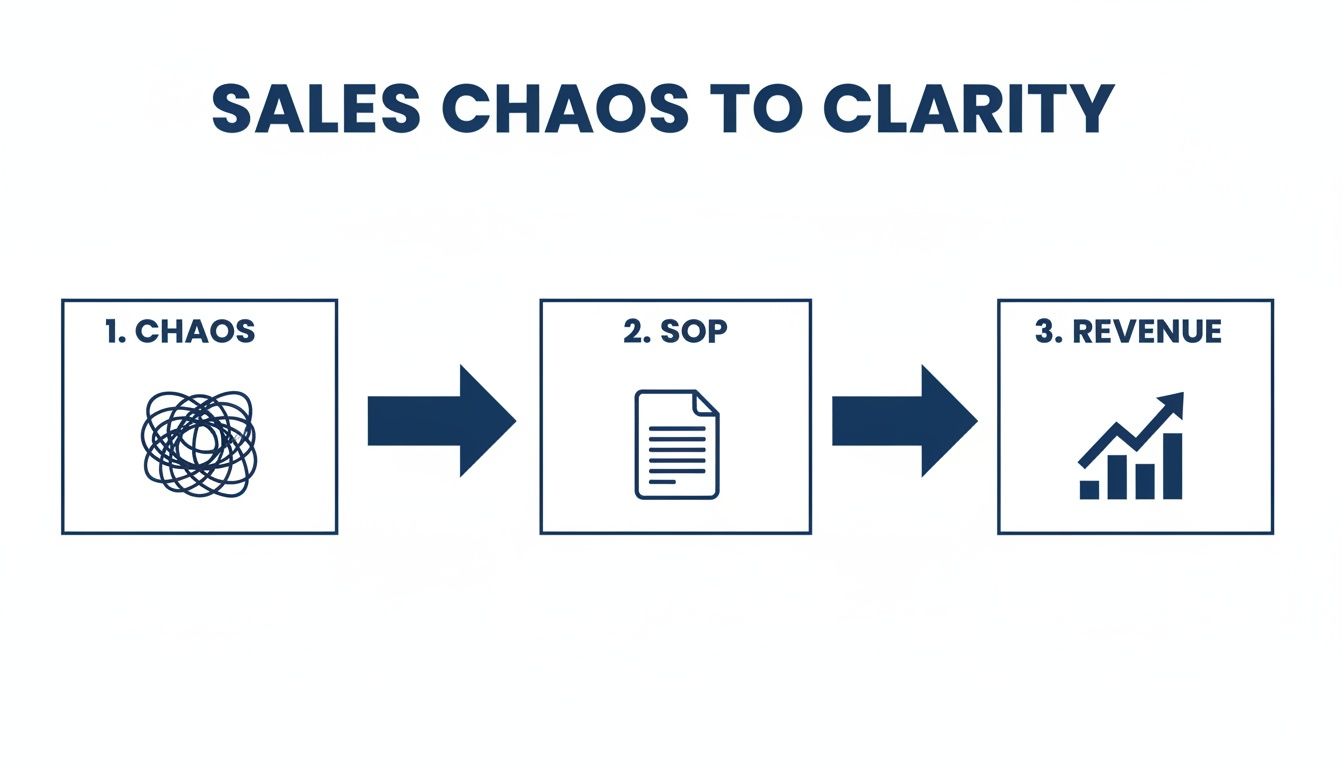
By standardizing what your best people do naturally, you create a system that elevates everyone.
Define Your Key Sales Cycle Stages
After you've mined those insights from your top performers, the next move is to give that knowledge some structure. You need to organize it around the key stages of your sales cycle. While every company’s process has its own flavor, most follow a similar journey from "hello" to "closed-won."
The goal here is absolute clarity. Define each stage with non-negotiable entry and exit criteria. This is how you ensure every opportunity in your CRM is accurately categorized, which leads to more reliable forecasting and smoother handoffs between team members.
A typical B2B sales cycle usually includes stages like these:
- Lead Qualification: The first checkpoint. Is this prospect a good fit for what we sell?
- Discovery Call: The initial deep-dive conversation to truly understand their pain points, goals, and who holds the purse strings.
- Product Demonstration: A tailored walkthrough of your solution, laser-focused on solving the problems you uncovered during discovery.
- Proposal & Negotiation: Laying out the formal offer and navigating the back-and-forth on price, terms, or scope.
- Closing: The final handshake where contracts are signed and the deal is officially won.
Your SOP must be crystal clear about what it takes to advance a deal. For example, a deal can't move from "Discovery Call" to "Product Demonstration" until the rep has confirmed budget, authority, and timeline in the CRM. No exceptions.
This isn't about micromanagement; it's about eliminating ambiguity and getting everyone on the same page. If you're building this from the ground up, starting with a proven B2B sales process template can give you a solid framework to build upon.
Document the Actions for Each Stage
With your stages locked in, it’s time to get granular. What specific actions, questions, and information are required at each step? This is where your sales SOP transforms from a high-level map into a genuine, actionable playbook—something a new hire could pick up and run with.
Let’s use the Lead Qualification stage as an example, applying a framework like MEDDPICC (Metrics, Economic Buyer, Decision Criteria, Decision Process, Implicate Pain, Champion, Competition) to guide the process.
Example: SOP for Lead Qualification
- Entry Criteria: An inbound lead arrives, or an outbound prospect agrees to a call.
- Key Actions:
- The assigned rep must research the prospect's company and LinkedIn profile within 2 hours of assignment.
- The rep conducts the initial call to validate fit and gather intel.
- Must-Ask Questions:
- "What key metrics are you personally responsible for improving?" (Metrics)
- "Who ultimately signs off on new software purchases like this?" (Economic Buyer)
- "What are the most important criteria your team will use to evaluate a solution?" (Decision Criteria)
- CRM Data Capture:
- All relevant MEDDPICC fields must be populated.
- The prospect's primary pain point must be summarized in the "Notes" section.
- Exit Criteria: The lead must meet at least 4 of the 7 MEDDPICC criteria before being converted to a qualified "Opportunity."
By building out this level of detail for every single stage, you create a comprehensive guide that does more than just standardize your process. It becomes your team's single source of truth and an indispensable training tool that shows everyone exactly how your best reps win, time and time again.
The Core Components of a High-Impact Sales SOP
A genuinely useful SOP for sales is way more than a simple checklist; it's a comprehensive resource that reps actually want to use. To get there, you need to pack it with specific, actionable components that cover every critical part of the sales motion. Think of it as building a library of best practices, not just a single rulebook.
These components are the foundational pillars of your entire sales strategy. They ensure everyone from a brand-new SDR to a seasoned Account Executive operates from the same playbook, eliminating guesswork and standardizing what excellence looks like across the board.
This kind of structure is what turns an abstract sales process into a concrete, repeatable system that drives real results.
Prospecting and Lead Generation Guidelines
This is where it all begins. Your SOP can't just tell reps to "go prospect"—it needs to show them exactly how with proven tactics for finding and engaging potential customers.
This section should include:
- Ideal Customer Profile (ICP): A crystal-clear description of your perfect customer. Get granular on industry, company size, common pain points, and the key buyer personas you’re targeting.
- Email Cadence Templates: Proven, ready-to-use email sequences for different scenarios, like cold outreach, post-demo follow-ups, and re-engagement campaigns.
- Cold Call Openers: Specific, field-tested scripts and talking points to help reps nail the first 30 seconds of a call and grab a prospect's attention.
Lead Qualification and Handoff Protocols
Okay, so you've got an engaged lead. How do you know if they're a genuine opportunity? This component is absolutely critical for preventing wasted time and ensuring a smooth, fumble-free transition from your Sales Development Reps (SDRs) to your Account Executives (AEs).
Global sales benchmarks show that 59.9% of sales teams are on track to meet revenue targets despite economic pressures. According to insights from Nektar.ai, those results are tightly linked to how rigorously teams manage their processes—from qualification criteria to handoff protocols. This just highlights how important it is to codify these rules in your SOP.
A Sales-Qualified Lead (SQL) isn't just a "good feeling." It's a prospect that meets a predefined, non-negotiable set of criteria. Your SOP must define this with absolute clarity.
For example, an SDR qualifies a lead only after confirming three key criteria: budget authority, a clear need, and a project timeline within the next six months. The SOP then dictates that the SDR must update specific CRM fields and use a calendar scheduling link to book the discovery call for the AE. This ensures a flawless, informed handoff every single time.
CRM Hygiene and Rules of Engagement
A messy CRM is a sales leader's nightmare. This part of the SOP establishes the ground rules for data management and territory ownership, preventing internal squabbles and making sure your data remains a valuable asset.
Key elements to define include:
- Mandatory CRM Fields: Which fields must be completed before a deal can advance to the next stage?
- Stage Update Protocols: What are the specific entry and exit criteria for each pipeline stage? No more "happy ears" moving deals forward prematurely.
- Activity Logging Standards: How should calls, emails, and meetings be recorded to create a clear history of engagement?
- Rules of Engagement: This is huge. You need clear guidelines for lead ownership, territory assignments, and how to handle disputes when they pop up. This ensures fairness and keeps the team focused on selling, not fighting.
Integrating Your Tech Stack Into the SOP
Your tech stack can either be a massive sales accelerator or a source of endless frustration. The difference usually boils down to how well you bake it into your SOP for sales. Without clear marching orders, expensive tools gather digital dust and reps just fall back into their old, comfortable habits.
The real goal here is to make technology feel like a natural, invisible part of your team's day-to-day grind.
This means you have to embed your tools right into your documented procedures. Your SOP shouldn't just mention your CRM; it needs to show reps exactly how and when to use it at every single stage of the sales cycle. This is how your SOP becomes the human-friendly guide that actually governs your sales tech, pushing up adoption and making sure everyone's on the same page.

This kind of practical approach is what guarantees you get a real return on your software investment. For a deeper dive into building out your toolkit, check out our guide on creating a tool stack for scaling businesses.
Defining Tool-Specific Protocols
To get practical, you need to create specific protocols for each of your key sales tools. Think about the most critical activities your team performs—the ones with the biggest impact—and then document precisely how technology fits into them.
This documentation could cover things like:
- AI Sales Dialer: Define the playbook for outreach sequences. Be specific about which contact lists to use, the exact number of touchpoints required before you mark a lead as cold, and how to properly log call outcomes.
- Conversational Intelligence: Standardize how reps use tools like Gong or Chorus. A great SOP might require reps to review one of their own demo calls each week and leave time-stamped comments for their manager to review.
- Automated Lead Scoring: Clearly map out what actions bump up a lead's score (like visiting the pricing page) and at what score threshold a lead officially gets handed over from marketing to sales.
For example, a killer SOP rule could be: "All AI-generated call notes from our conversational intelligence tool must be reviewed, edited for accuracy, and tagged with key topics in the CRM within 24 hours of the call." It’s a simple step, but it ensures your data is solid and makes every follow-up sharper.
With the explosion of AI in sales, getting this right is more critical than ever. By 2025, around 81% of sales teams report investing in AI, and those who use it are seeing higher revenue growth. But here's the kicker: sellers still spend a mind-boggling 75% of their time on non-selling activities. A crystal-clear SOP that dictates how and when to use these powerful tools is the only way to turn that investment into efficient, repeatable results. You can find more sales analysis insights over on Martal.ca.
By weaving these specific, tool-based instructions into your SOP, it becomes the single source of truth that powers both your people and your platforms. It's the bridge connecting your high-level strategy to the daily clicks and calls, ensuring every action taken with technology is perfectly aligned with your sales goals. This alignment is what separates the teams that just have tools from the teams that truly master them.
How to Launch and Maintain a Living Sales Playbook
So, you've built your sales SOP. That's a huge milestone, but let’s be real—it's only half the battle. A brilliant playbook that just sits on a virtual shelf collecting digital dust is completely useless. The real magic happens when you bring it to life, turning a static document into a dynamic guide your team actually wants to use.
The initial rollout is your first big test. You're aiming for excitement, not eye-rolls. A classic mistake is the top-down mandate, where the playbook feels like just another set of rules. Instead, launch your SOP for sales with a hands-on training session. Walk through real-world scenarios and, most importantly, explain the "why" behind each process.
The secret to adoption? Show reps exactly how the SOP helps them crush their numbers. Frame it as a toolkit for their success—a collection of proven strategies from your top performers—not just another hoop to jump through.
When reps see the playbook as a way to make their jobs easier and more profitable, they’ll become its biggest champions.
Securing Team Buy-In and Driving Adoption
Getting your team to embrace the new SOP starts way before the official launch day. The single most effective way to get buy-in is to involve them in creating it from the get-go. When salespeople help build the playbook, they feel a sense of ownership. They're invested, which makes them far more likely to use it consistently.
Here are a few practical strategies to drive adoption:
- Show, Don't Just Tell: During the launch training, run role-playing exercises straight from the SOP. For example, have them practice a lead handoff using the new CRM checklist. This makes it tangible.
- Make it Accessible: Don't bury your SOP in a maze of folders. It needs to be instantly available right where your reps work every day, ideally integrated directly into your CRM.
- Lead by Example: Sales managers have to live and breathe the SOP. Use its terminology in coaching sessions, pipeline reviews, and team meetings. This constant reinforcement signals that it's here to stay.
Establishing a Cadence for Review and Refinement
Markets change, buyer behaviors evolve, and new tools pop up all the time. Your SOP has to adapt, or it will become obsolete faster than you think. A static playbook is a dead playbook. The key is to set up a formal rhythm for reviewing and refining it.
A quarterly review is a fantastic starting point. This isn't just a meeting to read through the document. It’s a data-driven session designed to pinpoint what's working and, more importantly, what isn't.
Get into the weeds and analyze your core metrics:
- Stage-by-stage conversion rates
- Sales cycle length
- Average deal size
If you spot a bottleneck—maybe deals are consistently stalling out after the demo stage—that's your cue to revisit that section of the SOP. Use this data to sharpen your processes, update your scripts, and make sure your playbook remains the undisputed source of truth for sales excellence.
Burning Questions About Sales SOPs
Even with the best plan, you're going to have questions when you start building out your sales SOPs. It just comes with the territory.
Let's tackle some of the most common questions sales leaders ask. Getting these right will help you dodge the usual mistakes and build a playbook that your team actually uses to win.
How Long Should Our Sales SOP Actually Be?
Forget about page count. Focus on usability.
A killer SOP is as long as it needs to be for clarity, but as short as possible to be useful in the real world. A punchy, 5-page guide that a rep pulls up daily is worth infinitely more than a 50-page monster of a document that just collects digital dust.
Start small. Document your most critical, high-impact processes first—think lead qualification or the sales-to-customer-success handoff. You can always expand from there. Using a modern platform helps keep things bite-sized and searchable, rather than creating one giant, intimidating file.
How Do I Get My Sales Team to Actually Use the SOP?
If you want your team to use the SOP, you have to nail two things: involvement and value. If your reps see this as just another top-down mandate from management, it’s dead on arrival.
The secret is to position the SOP as a tool for their success. This isn't about micromanaging; it's a playbook filled with proven strategies to help them close more deals and, frankly, make more money.
Here's how to make that happen:
- Bring Them In Early: Get your top performers involved in building the thing. When they have a hand in creating the playbook, they take ownership. They'll become your biggest champions.
- Put It Where They Work: Don’t bury it in a forgotten folder on a shared drive. The best tools surface procedures right inside your CRM, giving reps the answers they need at the exact moment a question pops into their head.
- Train and Reinforce: Launch the SOP with practical training—role-playing scenarios, not a boring slideshow. After that, managers have to keep it alive by referencing it constantly in coaching sessions and pipeline reviews.
What Is the Biggest Mistake to Avoid?
The single biggest mistake is creating your SOP in a vacuum and then treating it like it’s set in stone.
An SOP written entirely by leadership, without any input from the reps actually on the front lines, is guaranteed to miss the mark. It won’t reflect the real-world nuances of how deals actually get won, and your team will push back on it immediately.
Just as bad is the "set it and forget it" mentality. Your market, your buyers, and your tools are always changing, so your sales process has to evolve, too. Schedule regular reviews—at least quarterly—to update your playbook based on performance data and team feedback. A great sales SOP is a living document, not a museum piece.