
Institutional knowledge is the secret sauce of your business. It's the sum of everything your team knows—the collective wisdom, experience, and information that defines how your company really works. It covers the official procedures, sure, but more importantly, it includes all the invaluable shortcuts, learned lessons, and intuitive solutions your veteran employees have picked up over the years.
What Is Institutional Knowledge, Really?
Think of your company as a high-end restaurant kitchen. The cookbooks and printed recipes on the shelf? That's your explicit knowledge. It's all the documented, easy-to-share stuff that’s straightforward to teach.
But the real magic happens with the head chef’s instincts. It's knowing the precise moment a sauce is ready just by its smell, or which local farm has the best tomatoes on a Tuesday. This is tacit knowledge—the kind you can only get from being in the trenches, day in and day out.

True institutional knowledge is the blend of both. It's the complete recipe book—written and unwritten—that makes your business unlike any other. This is the collective intelligence that keeps your team operating like a well-oiled machine.
To make this crystal clear, let's break down the two types of knowledge side-by-side.
Explicit vs Tacit Knowledge at a Glance
This table quickly compares the documented, tangible knowledge with the intuitive, experience-based wisdom that exists within your team.
| Knowledge Type | Definition | Examples | How to Capture It |
|---|---|---|---|
| Explicit Knowledge | Information that is easy to write down, share, and explain. It’s structured and codified. | Employee handbooks, SOPs, training manuals, process diagrams, sales scripts, compliance checklists. | Document it in knowledge bases, create SOPs, record training videos, and build official playbooks. |
| Tacit Knowledge | The intuitive, experience-based "know-how" that’s difficult to put into words. It’s personal and context-specific. | A top salesperson’s instinct for closing a deal, a veteran engineer’s troubleshooting intuition, an HR manager's gut feeling during an interview. | Mentorship programs, job shadowing, storytelling sessions, expert interviews, apprenticeship models. |
Understanding the difference is the first step. The real challenge—and where the value lies—is in capturing both before they disappear.
The Value and Fragility of Company Wisdom
This hidden asset is the backbone of your operational efficiency, innovation, and customer experience. It helps new hires ramp up faster and keeps teams from repeating costly mistakes. It's incredibly valuable.
It's also dangerously fragile.
When an experienced employee leaves, they don't just take their laptop with them; they take a piece of the company's brain. This intellectual capital is difficult and expensive to replace.
This risk is bigger now than ever. An early 2025 Gallup report found that 51% of employees are actively looking for new jobs. That statistic should be a wake-up call for any business leader—your most valuable asset could walk out the door tomorrow.
Protecting this knowledge isn't optional; it requires a deliberate strategy. Operations managers and HR leaders can turn this fragile wisdom into a durable, accessible company resource. A great starting point is our guide on knowledge management for dummies, which breaks down the fundamentals.
Ultimately, capturing this knowledge isn't just an administrative chore. It's a strategic imperative for long-term survival and success.
The True Cost of a Corporate Brain Drain
When a long-time employee walks out the door, they take far more than just their laptop. They take a piece of your company’s collective memory with them—a painful process known as corporate brain drain.
This isn't some abstract HR theory; it creates immediate, tangible friction that you can feel across your entire operation.
Think about it. Your most seasoned project manager, Sarah, just put in her notice. Who else knows that quirky workaround to get the ancient accounting software talking to the new CRM? Or remembers why the team switched from Supplier A to Supplier B two years ago—a move that saved the company a fortune? Her departure creates a vacuum, leaving the rest of the team scrambling to reinvent the wheel.
That’s not just an inconvenience. It’s a direct hit to your bottom line.
The Ripple Effect of Lost Knowledge
The fallout from losing this kind of institutional knowledge spreads like wildfire, disrupting everything from day-to-day tasks to major projects. Suddenly, you’re dealing with:
- Painfully Slow Onboarding: New hires take forever to get up to speed because they can't just ask someone about the unwritten rules and shortcuts that veterans knew by heart.
- The Same Old Mistakes: Without the context of past failures, teams are doomed to repeat them. It's a costly cycle of wasted time, materials, and money.
- Productivity Nosedives: Your team is now spending precious hours hunting for information or solving problems that were already figured out years ago, pulling them away from work that actually moves the needle.
- Single Points of Failure: When an entire process lives inside one person's head, their departure can bring critical operations to a screeching halt.
This operational drag adds up fast. The loss of know-how from employee turnover is a massive financial drain on businesses.
The total cost of this corporate brain drain is staggering. Some estimates put it as a $47 million annual opportunity for large U.S. enterprises alone.
That figure should tell you just how much value is locked inside your employees' heads. In fact, research shows that 98.5% of employees are convinced that better knowledge sharing across departments would make them more productive. And 46% say simply having better access to information would make their days way more efficient, according to a recent Bloomfire survey. Read the full research about knowledge sharing importance.
From Annoyance to Outright Crisis
At first, the gaps left by a departing team member might seem like minor bumps in the road. A project gets pushed back a week, a client asks a question no one can answer, a simple task suddenly takes three times as long.
But these small inefficiencies compound over time.
Without a system to capture and pass on this vital knowledge, every resignation chips away at your company's foundation. Morale plummets as the remaining team gets bogged down by constant roadblocks and rework. Before you know it, what started as a manageable inconvenience has morphed into a full-blown operational crisis, making it nearly impossible to scale, innovate, or keep up with the competition.
Protecting your institutional knowledge isn't just a "nice-to-have"—it's a matter of survival.
Proven Methods for Capturing Company Wisdom
Turning your company's invisible wisdom into a real, lasting asset isn't a one-off project. It requires a solid playbook for capturing both the straightforward procedures and the subtle expertise that actually drives success. You're building a system, not just ticking a box.
The best place to start is by tackling the low-hanging fruit: your explicit knowledge. This is the "what" and "how" of your day-to-day operations.
Systematizing Explicit Knowledge
The first step is getting all that explicit knowledge out of people's heads, inboxes, and random documents. The goal is to put it all into one central, easy-to-access spot. This simple move creates consistency and makes sure everyone has the right information when they need it.
Here are three pillars for getting this done:
- Centralized Knowledge Base: This becomes your company’s single source of truth. Think of it as a digital library where employees can instantly find answers to anything, from HR policies to technical troubleshooting guides.
- Standard Operating Procedures (SOPs): Clear, step-by-step SOPs are the foundation of operational excellence. They document the best way to get a task done, ensuring quality and consistency no matter who’s doing the work. For more on this, check out the importance of SOPs in modern business.
- Workflow Mapping: Visually mapping out your critical processes helps everyone see the bigger picture and how tasks connect. This clarity is great for spotting bottlenecks and finding ways to improve, all while making complex workflows much easier to follow.
Getting all this documented is a huge win, but it only solves half the puzzle. The deeper, more intuitive wisdom of your team requires a more personal approach.
Unlocking Tacit Knowledge
Tacit knowledge—that gut feeling, the intuition, the "know-how" that comes from years of experience—can't just be written down in a guide. Capturing it means creating opportunities for it to be shared and observed firsthand. This is where building a culture of knowledge sharing becomes absolutely critical.
Failing to capture this wisdom leads to "brain drain," a problem that directly slows down onboarding, causes the same mistakes to happen over and over, and tanks productivity.
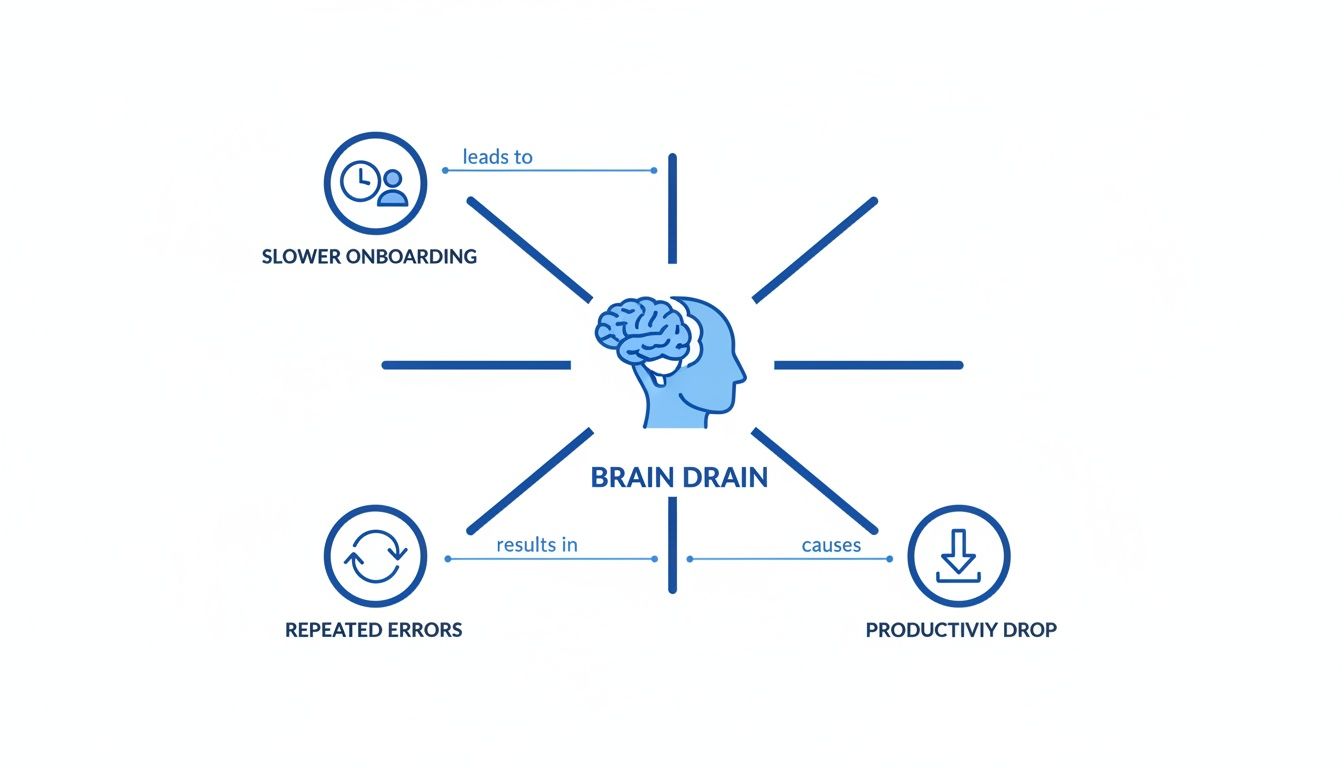
Each of these issues underscores just how urgent it is to turn individual expertise into a shared company asset before it walks out the door.
The best ways to transfer tacit knowledge are all about human interaction and structured observation.
Building a sustainable knowledge-sharing culture isn't about forcing documentation; it's about making the act of sharing wisdom a natural and valued part of daily work.
Consider these powerful methods:
- Mentorship Programs: Nothing beats pairing a seasoned expert with a newer employee. It creates a direct line for transferring those nuanced skills and strategic ways of thinking that you can't learn from a manual.
- Peer-Led Training: Think "lunch and learns" or workshops led by your own internal subject matter experts. This empowers employees to teach each other practical, on-the-ground skills in a way that really sticks.
- Strategic Exit Interviews: Don't just go through a standard checklist. Use exit interviews to uncover deep insights. Ask departing employees about the undocumented processes, the key relationships they built, and the critical lessons they learned in their role.
Not sure which method fits your needs? This table breaks down the best use cases for different knowledge capture techniques.
Table: Knowledge Capture Methods and Their Best Use Cases
| Method | Knowledge Type (Tacit/Explicit) | Best For (Team/Department) | Implementation Tip |
|---|---|---|---|
| SOPs & Knowledge Base | Explicit | Operations, HR, IT, Compliance | Start with the 20% of processes that cause 80% of questions. Use templates to stay consistent. |
| Workflow Mapping | Explicit | Product, Sales, Customer Success | Use a visual tool like Miro or Lucidchart to make the process interactive and collaborative. |
| Mentorship Programs | Tacit | All departments, especially for leadership and specialized roles | Create a structured program with clear goals and check-in points to ensure it's effective. |
| Peer-Led Training | Tacit & Explicit | Sales, Marketing, Engineering | Empower your internal experts by giving them the time and resources to prepare and lead sessions. |
| Strategic Exit Interviews | Tacit | All departments | Develop a set of open-ended questions focused on "what isn't written down" to guide the conversation. |
Ultimately, a successful system combines these approaches. To put it all together, it helps to build a practical knowledge management strategy that focuses on capturing, organizing, and actually using your company's wisdom. By blending systematic documentation with a culture of mentorship and sharing, you protect your most valuable asset: your people's knowledge.
Using AI to Build a Living Knowledge Base
Traditional methods for capturing all that valuable company knowledge—think thick manuals and lengthy mentorship sessions—are great, but they can be painfully slow and resource-intensive. Technology is changing the game, transforming static documents into a dynamic, "living" asset that actively helps your team get stuff done. This is where AI-powered platforms come in, offering a much smarter way to protect and share your company’s collective wisdom.
Instead of chaining someone to a desk for hours to manually write out every single step of a process, these tools do the heavy lifting. Just imagine an employee hitting "record" on their screen while they complete a task. In minutes, AI can analyze that recording and spit out a perfect step-by-step guide, complete with screenshots and crystal-clear instructions. A task that used to take half a day is now done in less time than it takes to drink a cup of coffee.
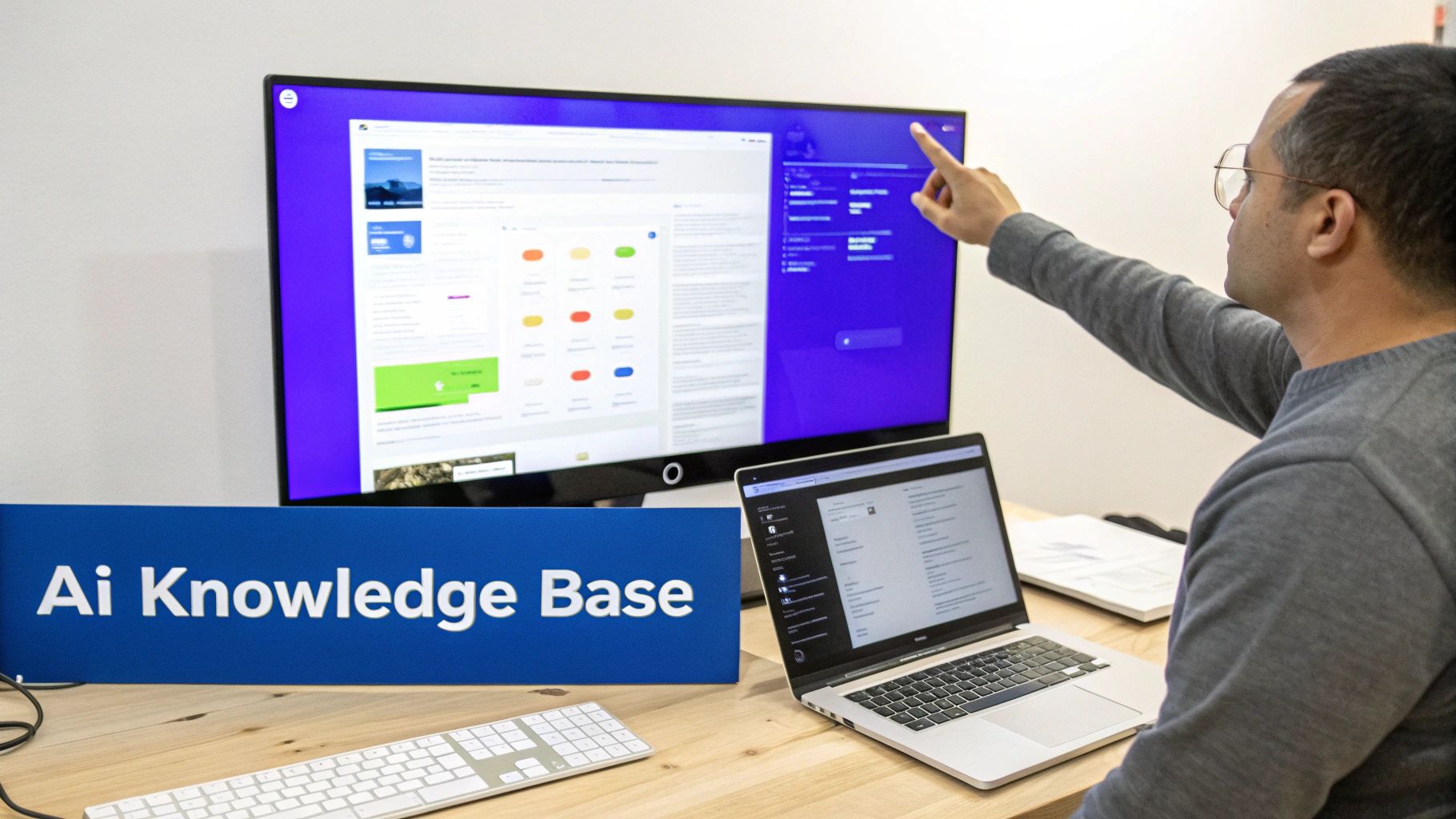
This kind of centralized system organizes all your crucial knowledge in one place, making it instantly available to everyone. No more digging through scattered documents, chasing down colleagues for answers, or working off outdated information.
Smarter Tools for a Smarter Team
Beyond just creating documents, AI makes your knowledge base intelligent. It stops being a dusty digital binder and becomes an indispensable tool your team actually uses every day. These systems are designed to deliver answers, not just documents, which is a huge shift in how teams find information and work more efficiently.
Here are a few features that make a massive difference:
- Intelligent Search: Employees can ask questions in plain English—like "How do I process a refund for a VIP client?"—and get an immediate, precise answer pulled directly from your documented procedures. It kills the frustrating hunt through endless folders.
- Automated Version Control: AI helps manage updates seamlessly, ensuring everyone is always working from the most current version of a process. For compliance and quality control, this is an absolute must.
- AI-Driven Learning: Some platforms can even generate quizzes and training modules straight from your SOPs. It's a fantastic way to reinforce learning and check that everyone is up to speed.
This move to smarter tech has a direct, measurable impact on how well your company runs, especially during onboarding. With a solid system in place, new hires can ramp up 50% faster because they have day-one access to a treasure trove of best practices. While old-school onboarding can cost over $4,200 per employee, AI-driven approaches can slash that figure by 30-50%. That's a clear and compelling return on investment.
From Documentation to Empowerment
Let’s be clear: adopting AI for knowledge management isn't about replacing the human element. It's about augmenting it. When you automate the tedious parts of documentation, you free up your senior experts to focus on what they do best—high-value mentorship and tackling strategic problems.
The goal is to empower your team with a centralized, always-on source of truth that makes training, collaboration, and daily execution more effective and less frustrating.
When you're looking at AI for your knowledge base, a crucial step is picking the right engine. Different platforms use different technologies, so understanding how to compare AI models effectively will help you choose a solution that actually fits your operational needs.
This approach transforms knowledge management from a defensive chore you do to prevent brain drain into a proactive strategy for growth. You're building a resilient, intelligent ecosystem where your company's wisdom isn't just sitting there—it's actively working for you. To dig deeper into this, check out our guide on the role of AI in employee training.
How Winning Teams Protect Their Knowledge
It’s one thing to talk about protecting institutional knowledge in theory. It’s another to see it play out in the real world, where the rubber meets the road. Let’s dive into a few scenarios that operations, HR, and compliance leaders deal with every single day to see the direct, measurable impact of smart knowledge management.

These examples aren't just abstract concepts. They show how a real commitment to capturing and sharing wisdom builds a more resilient, efficient, and competitive company.
The Warehouse That Cut Damage by 20%
A big distribution center had a nagging problem: product damage. They had a standard training manual, sure, but a shocking number of fragile items were still being packed incorrectly. This led to costly returns and, even worse, ticked-off customers. The issue wasn't the written procedure; it was all the unwritten tricks of the trade known only by their veteran packers.
These seasoned pros had developed dozens of subtle, unspoken techniques over the years—how to brace a specific box, the perfect way to distribute weight, which packing materials were really best for certain items. None of this gold was in the official handbook.
So, they launched a simple knowledge-sharing initiative. They asked the experts to record short videos of their packing methods on their phones. These clips were uploaded to a central knowledge base, tagged by product type, and made instantly available to everyone on the packing floor via tablets.
The result? A 20% drop in product damage within just three months. By turning that tacit "know-how" into a shared, explicit asset, the company saved thousands in replacement costs and saw a huge jump in customer satisfaction.
This small shift turned individual expertise into a scalable, company-wide best practice.
The Startup That Halved Onboarding Time
For a tech startup in hyper-growth mode, hiring fast was everything. The problem was, their onboarding process was a major bottleneck. New hires would spend weeks shadowing different people, asking the same questions over and over, and slowly trying to piece together how anything got done. It was slowing down productivity and frustrating everyone involved.
The HR and operations teams decided to build a "living" onboarding hub. Using an AI-powered platform, they created a library of crystal-clear SOPs, training videos, and process guides. It covered everything from setting up a development environment to submitting an expense report.
New hires got access on day one. Instead of constantly tapping colleagues on the shoulder, they could find immediate answers to most of their questions themselves.
The impact was immediate. The company cut its average onboarding time in half, getting new engineers and salespeople contributing in weeks instead of months. This move didn't just accelerate growth; it fostered a more empowered, self-sufficient culture right from the start.
The Manufacturer That Aced Its Audit
A mid-sized manufacturing firm was in a heavily regulated industry where compliance was everything. Their biggest headache was ensuring every single employee followed the latest safety procedures, which were always changing. Keeping paper binders up-to-date was a nightmare, and the risk of someone using an outdated procedure on the factory floor was very real.
They scrapped the binders and moved every safety protocol into a version-controlled, single source of truth. Any update to a procedure was automatically pushed to the right teams, complete with a clear record of when the change was made and who acknowledged it.
When the auditors showed up, the compliance manager didn't break a sweat. They just granted the auditors access to their centralized system, which showed a perfect, auditable trail of every procedure and update. The firm passed its audit with flying colors, dodging huge potential fines and cementing its reputation for safety and quality.
How to Measure the ROI of Your Knowledge Strategy
Investing in your company’s knowledge isn't just another line item on the expense sheet; it's a strategic move that pays real dividends. But to get buy-in from leadership, you need to prove it. Anecdotes are nice, but hard numbers are what really turn heads.
The goal is simple: connect your knowledge management efforts directly to the bottom line. You need to show how capturing and sharing wisdom makes the entire organization more efficient, effective, and ultimately, more profitable.
Key Metrics That Tell the Story
So, where do you start? Look for measurable changes in these critical areas—the kind of numbers that speak for themselves.
- Faster Onboarding: How quickly do new hires hit their stride and become fully productive? A solid, accessible knowledge base can slash that ramp-up time by giving them answers on demand instead of making them hunt for information.
- Fewer Internal Support Tickets: Track the number of requests hitting IT, HR, or other internal support teams. When people can find solutions themselves, those ticket counts drop, which is a clear sign of increased self-sufficiency.
- Lower Error Rates: Keep an eye on mistakes happening in production, customer service, or compliance filings. When your team has instant access to the right procedures, costly errors naturally go down.
- Happier, More Engaged Employees: Use quick surveys to ask your teams how easy it is to find the information they need to do their jobs. Less frustration almost always leads to higher satisfaction and better retention rates.
By tracking these simple yet powerful KPIs, you can build a compelling business case. You can demonstrate that a strong knowledge strategy isn't an expense, but a direct contributor to profitability and growth.
This kind of data changes the conversation entirely. It’s no longer about a "nice-to-have" initiative; it's about a core driver of business success.
FAQs about Institutional Knowledge
How Can We Motivate Employees to Document Knowledge?
You have to make it easy and part of the culture, not just another task on their to-do list. Use tools with AI SOP generators that do most of the heavy lifting. Nobody wants to spend hours writing documentation from scratch.
Recognize the people who share their knowledge, maybe in team meetings or company-wide announcements. And most importantly, leadership needs to walk the walk. When managers are actively documenting and sharing what they know, it sends a clear message that this is how we do things here.
What’s the Biggest Mistake to Avoid?
Without a doubt, the biggest mistake is waiting until it’s too late. So many companies only start thinking about what is institutional knowledge when a key person hands in their notice. By then, you’re just scrambling to grab bits and pieces, and the full picture is already gone.
The only way to win is to be proactive. Build knowledge sharing into your daily rhythm with easy-to-use tools, ongoing training, and real mentorship. It should be a living, breathing part of your company, not a last-minute rescue mission.
Is Knowledge Management Practical for Small Businesses?
It’s not just practical—it's a lifeline. In a small team, losing just one key person can throw your entire operation into chaos and slam the brakes on growth.
Modern, scalable platforms have made knowledge management totally affordable and simple to get started with. If you build a solid foundation with a central system early on, your processes and wisdom will grow right along with your company. You’ll be preventing future headaches and setting yourself up to scale smoothly.