
Employee onboarding procedures are the secret sauce for turning a promising new hire into a thriving, long-term team member. It’s the roadmap you build to guide them through their first days, weeks, and months—covering everything from culture and tools to the specifics of their role. Think of it less as paperwork and more as the foundation for their success.
Why Structured Onboarding Is No Longer Optional
Let's be honest: the old-school, "here's your desk, good luck" approach is dead. And for good reason. Treating onboarding as a one-day administrative chore isn’t just unwelcoming; it’s a massive drain on your company's resources.
When a new hire’s first impression is chaos, it sets a terrible precedent. It creates a confusing, isolating experience that all too often leads to early turnover, painfully slow productivity ramp-ups, and a culture that feels more like a collection of individuals than a cohesive team. A messy start screams, "We don't really value your contribution."
On the flip side, well-defined employee onboarding procedures are a strategic investment. They offer a clear path that makes a new team member feel supported, informed, and ready to contribute. This isn't about micromanaging. It's about systematically removing the friction that stops talented people from doing their best work right from the get-go.
The True Cost of a Bad First Impression
Think about the real-world ripple effects of a poor onboarding experience. A new software engineer who can't get access to the right code repositories for a week isn't just sitting idle—they're getting frustrated and feeling like an outsider. A sales rep who doesn't get clear training on your CRM is more likely to flounder, miss targets, and question if they made the right move.
These seemingly small failures snowball into significant business headaches:
- Sky-High Turnover Costs: Replacing an employee can cost anywhere from half to two times their annual salary. When you lose new hires in their first six months, those costs multiply fast.
- Painfully Slow Productivity: Without a clear structure, the time it takes for a new hire to become fully productive (your "time-to-productivity") drags on for months, representing lost output and revenue.
- A Disconnected Culture: Onboarding is your primary tool for passing on your company culture. A haphazard process leads to an inconsistent understanding of your values and a weaker, less unified team.
Before we dive into the ROI, let's put this in perspective. Here’s a quick comparison of what you stand to gain with a structured process versus what you’re likely losing with an informal one.
The ROI of Structured Onboarding vs. Ad-Hoc Onboarding
| Metric | Structured Onboarding Impact | Ad-Hoc Onboarding Risk |
|---|---|---|
| Employee Retention | 82% improvement in new hire retention. | High early turnover; costs can reach 2x the employee's salary. |
| Productivity | New hires become fully productive ~70% faster. | Protracted ramp-up time, leading to lost output and missed targets. |
| Engagement | New hires feel supported, connected, and clear on expectations. | Confusion and isolation lead to disengagement and lower morale. |
| Cultural Cohesion | Reinforces company values and builds a strong, unified team. | Inconsistent cultural understanding and a fragmented team environment. |
| Managerial Time | Frees up managers to focus on strategic coaching. | Managers are bogged down with repetitive, basic questions. |
The numbers don't lie. A systematic approach is a win-win, creating a stronger team and a healthier bottom line.
The Measurable ROI of a Systematic Approach
Putting formal employee onboarding procedures in place is one of the highest-impact things an operations or HR leader can do. The return isn't just a better "vibe"—it's backed by hard data.
A structured onboarding process doesn't just make new hires feel welcome—it directly impacts the bottom line. It's a foundational business strategy for reducing churn and accelerating the path to meaningful contribution.
Research consistently proves that a systematic approach pays off big time. For example, companies with formal onboarding see a 50% jump in employee retention and a 62% boost in new hire productivity.
Digging deeper, research from the Brandon Hall Group is even more compelling. Their findings show that a strong onboarding process can improve new hire retention by a staggering 82% and boost productivity by over 70%. You can read the full research on new hire statistics here.
This data builds an undeniable business case. It transforms onboarding from a simple HR task into a critical driver of sustainable growth. By creating a predictable and positive experience, you're building a more stable, skilled, and engaged workforce—and that’s a massive competitive advantage.
Designing Onboarding That Adapts To Each Role
A one-size-fits-all onboarding checklist is a recipe for disaster. Let’s be honest: an in-office sales executive needs a completely different first-week experience than a remote software engineer. Your employee onboarding procedures have to reflect that reality.
Creating adaptive onboarding isn’t about making more work for yourself. It’s about delivering targeted, relevant information that gets a new hire confident and contributing faster. The idea is simple: match the onboarding experience to the role’s specific demands, tools, and what success actually looks like for them.
Mapping The Role-Specific Journey
To get this right, you need to think beyond a single, company-wide checklist. Instead, break the onboarding journey into key phases and customize the content for each role. Think of it as a personalized roadmap guiding your new hire from the moment they accept the offer through their first 90 days.
- Pre-boarding (The Week Before Day One): This is all about handling logistics and building excitement. Sure, everyone needs to get their basic HR paperwork sorted, but the role-specific magic happens here. For a marketing manager, you might send over the company's brand guidelines and a few key campaign reports. For a developer, it could mean sharing access to a sandboxed coding environment and documentation for the primary tech stack.
- The First Week (Orientation and Immersion): The first week should be a mix of general company culture immersion and a deep dive into role-specific tools and processes. A customer support agent's first week should be jam-packed with mastering the help desk software and shadowing experienced agents. A finance analyst, on the other hand, would spend their time getting comfortable with accounting systems and reviewing recent financial statements.
- The First 30 Days (Training and First Wins): This is where you introduce structured learning and small, manageable projects. A new sales hire should be working through product training modules and jumping on their first co-selling calls with a mentor. You could assign a project manager a small, low-risk internal project so they can learn the company's project management style and who the key stakeholders are. The goal is to give them a tangible "win" to build that early momentum.
This infographic shows exactly how moving from a chaotic process to a structured, role-based one is a direct line to company growth.
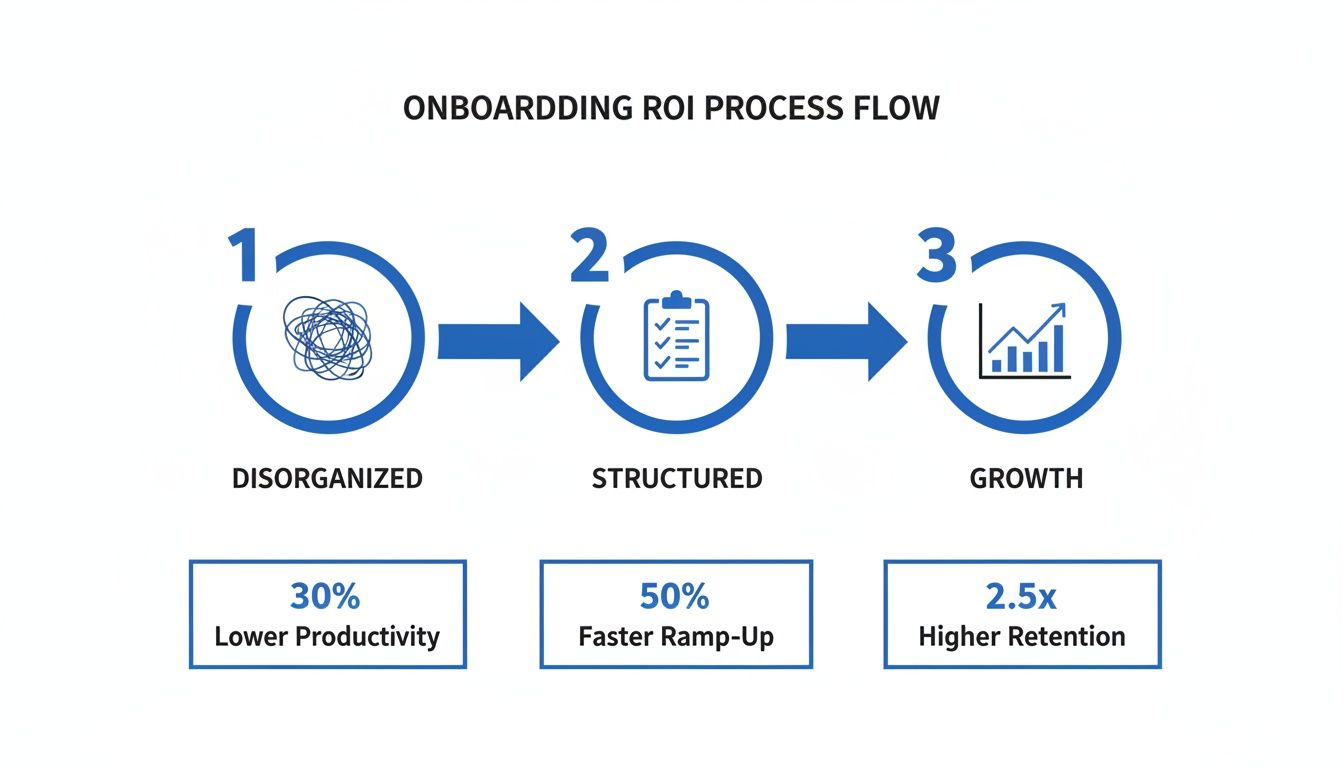
It’s a powerful reminder that intentional, structured systems are what turn a new hire into a thriving team member.
Practical Customization Examples
Let's see how this plays out with two very different roles. A generic checklist would leave both of these new hires feeling lost, but a customized one sets them up for success from the get-go.
Scenario A: Onboarding a Remote Software Engineer
Their world is technical, often asynchronous, and focused on getting plugged into a distributed team.
- Custom Checklist Item: "Complete setup of local development environment and successfully run the application's test suite by end of Day 2."
- First Project: "Fix a pre-selected, low-priority bug from the backlog to learn the code submission and review process."
- Key Introduction: A scheduled 1:1 with the DevOps lead to understand the deployment pipeline.
Scenario B: Onboarding an In-Office Sales Executive
Their world is social, product-focused, and all about building relationships and understanding the customer.
- Custom Checklist Item: "Shadow three different account executives on customer calls by the end of the first week."
- First Project: "Create a mock sales presentation for a key product and present it to the team for feedback."
- Key Introduction: Lunch with the head of marketing to understand lead generation and sales collateral.
The best employee onboarding procedures don't just tell a new hire what to do; they show them how to succeed within the unique context of their role. Personalization is the key to accelerating their impact.
Building Your Adaptive Framework
Don't worry, creating these workflows doesn't have to be some monumental task. Start by identifying the major job families in your company—think Engineering, Sales, Marketing, and Operations.
From there, sit down with department heads and map out the critical knowledge and skills someone needs to acquire in their first 90 days. This collaborative approach makes sure the onboarding plan is actually practical and aligned with what each team needs. You can even use some must-have employee onboarding templates to get a running start on structuring these role-specific guides.
When you invest the time to design adaptive onboarding, you send a clear message to every new hire: we get you, we value what you bring to the table, and we're giving you exactly what you need to succeed from day one. That level of intention is what separates a forgettable onboarding from a world-class experience that boosts both retention and performance.
Cultivating The Human Element In Your Onboarding

You can have the most polished software and perfectly documented employee onboarding procedures, but without a genuine human connection, it can all feel a bit cold. Let's be real: technology is great for streamlining tasks, but people are what build relationships.
Ultimately, it’s the direct manager and the immediate team who decide whether a new hire feels like a valued colleague or just another name on a checklist. Your processes will fall flat if the people running them aren't engaged. This is where you pivot from simply processing a new employee to truly integrating a new team member.
Empowering Managers To Be Onboarding Champions
A manager's involvement is the single biggest factor in a new hire's success. All too often, managers treat onboarding as an HR task, only stepping in after the initial orientation is done. That hands-off approach is a recipe for disengagement.
You need to train your managers to be coaches, not just taskmasters. Give them a clear playbook and the right tools to own the onboarding journey for their direct reports.
- Structured 1:1 Meetings: Don't just leave check-ins to chance. Give managers a template for weekly 1:1s during the first 90 days. These meetings should go beyond project updates, including questions like, "What's one thing that surprised you this week?" or "Who have you met that you’d like to connect with again?"
- Goal-Setting Guidance: Provide a simple framework for setting clear 30-60-90 day goals. This cuts through the ambiguity and gives both the manager and the new hire a roadmap for what success looks like.
- Facilitating Introductions: The manager should act as a connector, making key introductions that go beyond the immediate team. This means connecting new hires with the cross-functional partners they'll actually be working with.
The impact here is massive. Research shows that onboarding is 3.5 times more effective when managers are actively involved. Still, about a third of new hires say they wish they had more guidance from their manager. Closing that gap isn't just good management; it's a strategic move. You can discover more insights about employee onboarding statistics to see the full picture.
Implementing A Successful Buddy System
While managers provide direction, it's the peers who provide context and camaraderie. A solid buddy system is one of the best ways to get a new hire plugged into your company culture and the day-to-day workflow. It gives them a safe, informal person to ask all the "silly questions" they might be hesitant to bring to their manager.
A buddy isn't a mentor; they're a cultural guide and a friendly face. Their job is to help the new hire navigate the unwritten rules of the office—how meetings really run, the best Slack channels for quick questions, or even just where to find the best coffee.
The goal of a buddy system is to answer the questions a new hire doesn't know they should be asking. It bridges the gap between formal procedures and the reality of daily work life.
For this to actually work, it needs a little structure. Don't just randomly assign buddies. Pick enthusiastic, high-performing employees who genuinely want to help. Give them a simple guide with a few suggested activities, like a coffee chat in the first week, a co-working session, and a check-in at the 30-day mark. The effect is huge, with 56% of new employees saying a buddy or mentor helped them settle in significantly.
This one-two punch of an engaged manager and a supportive peer creates a powerful support network. It ensures that your carefully designed employee onboarding procedures are delivered with empathy, making new hires feel like they belong—and making them want to stay.
Using Technology To Streamline And Scale Onboarding
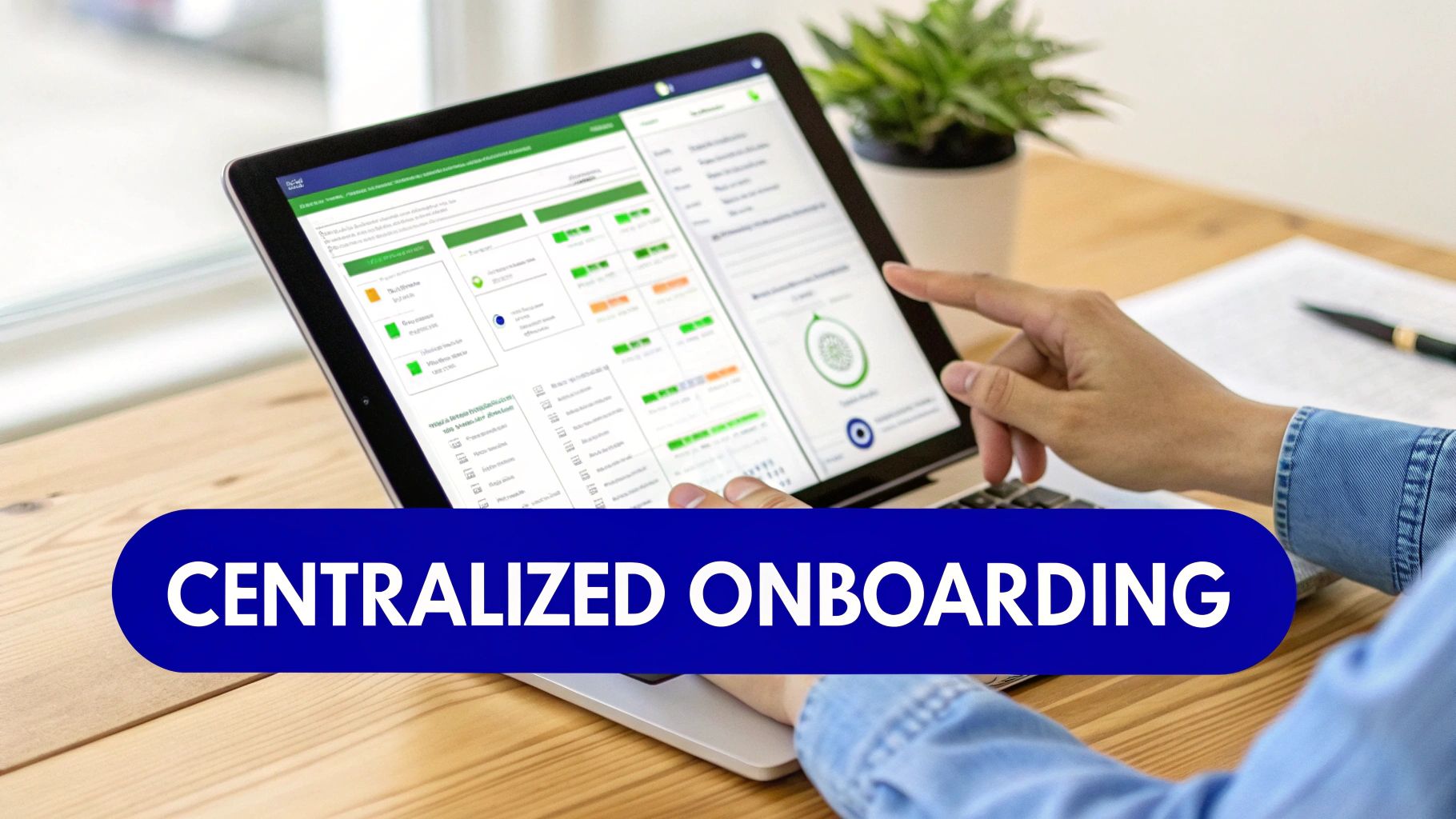
Designing a thoughtful, human-centric onboarding plan is a massive win. But even the most brilliant strategy will crumble if it lives in scattered Google Docs, outdated spreadsheets, and siloed email threads. This is where the right tech stops your plans from just being good ideas and turns them into a flawless, scalable reality.
To make your employee onboarding procedures stick, you need a single source of truth. Relying on shared drives or trusting individual managers to keep things updated is a recipe for chaos. One new hire gets an old checklist, another misses a crucial training video, and before you know it, no two employees are getting the same experience.
This problem gets amplified for remote and hybrid teams. How can you guarantee a new developer in another time zone gets the same quality onboarding as someone at HQ? Without a centralized hub, it's nearly impossible. Technology is what closes that gap, creating one unified experience for everyone, everywhere.
Creating A Single Source Of Truth
The main job of any good onboarding tech is to centralize everything a new hire needs. Imagine one place where every policy, procedure, training module, and checklist is organized and instantly accessible. This isn't just a digital filing cabinet; it's a living, breathing system.
Platforms like Whale are built from the ground up for exactly this. They transform static, boring documents into an interactive knowledge base that people actually want to use.
- Standard Operating Procedures (SOPs): Every process, from setting up software to submitting an expense report, is documented and easy to find.
- Training Guides: Forget walls of text. You can embed videos, quizzes, and other interactive elements to make learning engaging.
- Role-Specific Playbooks: All those custom onboarding plans we talked about? You can build them out as dedicated playbooks and assign them directly to new hires.
By pulling all this information into one spot, you eliminate the constant "who do I ask about this?" questions that drain managers' time and leave new hires feeling lost. The answer is always in one place, ready whenever they need it.
From Static Documents To Dynamic Workflows
But the real magic happens when you move beyond just storing information. A dedicated platform turns passive documents into active, trackable workflows. A PDF checklist is easy to lose or ignore, but a digital workflow creates accountability and gives you full visibility into the process.
Let's say a growing marketing agency just brought on three new account managers at once. In the old days, the Head of Ops would be drowning in manual work—sending individual emails, trying to track progress in a messy spreadsheet, and constantly reminding managers about their tasks. It was a nightmare of inefficiency.
Now, using a platform like Whale, she creates a single "Account Manager Onboarding" playbook. The second a new hire is added to the system, that playbook is automatically assigned.
A centralized system transforms onboarding from a series of manual, disconnected tasks into an automated, consistent, and measurable process. It's the operational backbone of a world-class employee experience.
This dashboard gives managers an immediate, high-level overview of all company processes and training materials. You can see what's being used, what's out of date, and where your knowledge gaps are.
The Benefits Of A Tech-Driven Approach
Of course, a centralized system saves a ton of administrative time, but the real benefits go much deeper. A structured, tech-enabled process delivers a far better experience for the new employee.
- Unwavering Consistency: Every new hire gets the exact same high-quality information, building a strong and equitable foundation from day one.
- Clear Accountability: Managers and new hires can see exactly what’s done and what’s next. No more confusion over who is responsible for what.
- Self-Service Empowerment: New employees can find answers on their own, which builds their confidence and reduces their reliance on others for basic info.
- Effortless Scalability: Hiring one person or twenty? The process is the same. The system scales with your growth without piling on more administrative work.
For teams ready to take the next step, exploring how to implement automated employee onboarding can be a total game-changer. When you connect your well-designed plan to a powerful platform, you create employee onboarding procedures that aren’t just effective—they’re built to last as your company grows.
Measuring And Improving Your Onboarding Process
Let's be clear: a great employee onboarding process is never truly "done." It has to evolve. If you treat onboarding as a "set it and forget it" task, you're missing out on the single biggest opportunity for improvement.
The goal isn't just to build a process, but to create a living system that adapts as your company grows, roles change, and your team's needs shift.
This means shifting from a one-time setup to an ongoing cycle of iteration. It’s about looking at your process with a critical eye, gathering real data, and having the courage to fix what's broken. This is how you take a good onboarding program and make it a truly great one that consistently pays off.
To get there, you need a culture that embraces a growth mindset. This encourages everyone, from the leadership team to the newest hire, to see challenges as chances to get better.
Identifying KPIs That Actually Matter
You can't improve what you don't measure. Vague feelings about whether onboarding is "working" just don't cut it. You need to anchor your efforts in concrete key performance indicators (KPIs) that tell a clear story.
Forget the vanity metrics. Let's focus on the numbers that tie directly to business outcomes and the new hire's experience. Here’s what I recommend tracking:
- 90-Day Retention Rate: This is the ultimate pass/fail grade. If new hires are walking out the door within three months, it's a massive red flag. It tells you something is fundamentally broken in how you integrate and support them.
- Time-to-Productivity: How long does it actually take for a new person to start contributing in a meaningful way? You'll need to work with department managers to define what "productive" looks like for each role and then track that timeline. A long ramp-up period usually points to gaps in training or access to the right resources.
- New Hire Satisfaction Scores (NPS): This is so simple yet so powerful. At the 30, 60, and 90-day marks, ask new hires to rate their onboarding experience on a scale of 1-10. It gives you a clean, quantifiable pulse on their sentiment.
- Manager Satisfaction: Don't forget the other side of the equation. Survey your managers. How prepared are their new hires? Did they feel supported by the process? Their feedback is gold.
Gathering Honest Feedback for Real Insights
KPIs tell you what is happening, but qualitative feedback tells you why. You have to create safe channels for new hires to share their honest thoughts without worrying about looking bad. I've found a mix of methods works best.
Anonymous surveys are a fantastic starting point. Ask specific, open-ended questions at key milestones:
- End of Week One: "What was the most confusing part of your first week?"
- 30-Day Mark: "What one tool or piece of information do you wish you had sooner?"
- 90-Day Mark: "How well did your role's reality match the expectations set during onboarding?"
Your onboarding process is filled with blind spots that you can't see from the inside. Honest, critical feedback from new hires is the only flashlight that can illuminate them.
Beyond surveys, you need to have real conversations. Structured check-ins are crucial. These aren't just status updates; they are dedicated feedback sessions. Have someone from HR or a dedicated onboarding coordinator conduct 30-day and 90-day check-ins with every single new hire.
These one-on-one talks can uncover the nuanced issues a survey will always miss—things like team dynamic challenges or unclear communication styles. If you want to learn more about structuring these check-ins, check out our guide to measuring your employee onboarding process.
Turning Data into Actionable Improvements
Collecting all this data is completely pointless if you don't do anything with it. You need to establish a regular rhythm for review—quarterly is a great place to start. Get the key people in a room: HR, operations, and a few managers from different departments.
Look for patterns. Are new engineers consistently reporting a slow time-to-productivity? That's your signal to dive deep into their technical onboarding. Are multiple people mentioning confusion around a specific company policy? That's your cue to go rewrite that section in your knowledge base.
By combining the hard data with human stories, you can pinpoint the exact friction points in your process. This data-driven approach lets you make targeted, high-impact improvements. It ensures your employee onboarding procedures don't just stay relevant—they become a powerful engine for retention and growth.
Got Questions About Your Onboarding Procedures?
Even with a solid plan, you're bound to run into a few practical questions. When you start digging into your employee onboarding procedures, the same challenges and "what ifs" tend to pop up. Let's tackle the questions we hear most often from HR and operations leaders trying to get this right.
How Long Should an Employee Onboarding Procedure Last?
Think of effective onboarding as a marathon, not a sprint. The initial orientation might just be a week, but a truly comprehensive onboarding process should run for at least 90 days. Why so long? Because that's the timeline a new hire needs to go beyond the basics and actually integrate into the team and the company.
Anything shorter is a huge risk. You end up leaving employees feeling disconnected and unprepared right when they're supposed to start flying solo.
Here’s a rough breakdown of that 90-day journey:
- The First Week: This is all about the fundamentals—logistics, getting a feel for the company culture, and meeting the immediate team.
- The First Month: The focus shifts to role-specific training. They should be taking on their first small-scale projects and getting their hands dirty.
- The First 90 Days: Now we're talking about performance. This period is for digging into bigger goals, building relationships across different departments, and feeling like a genuine part of the company.
What's the Single Biggest Mistake Companies Make With Onboarding?
Hands down, the most common mistake is treating onboarding like a one-day information dump that’s all about paperwork. This approach completely misses the entire point of the exercise. It might check a compliance box, but it does absolutely nothing to build a new hire's confidence, create a sense of connection, or help them understand the company culture.
The goal isn't just to process a new person. It's to successfully integrate a new team member. The minute you forget the human element and focus only on an administrative checklist, you've already failed.
Another massive—and equally damaging—mistake is pushing the new hire's direct manager to the sidelines. When managers aren't trained and empowered to lead the onboarding process for their own people, the new employee is left completely adrift. They have no clear direction and no primary person to turn to for support, which pretty much torpedoes the whole experience.
How Can We Keep Onboarding Consistent for Remote Employees?
For remote and hybrid teams, consistency comes down to two things: centralization and intentional communication. You absolutely cannot leave the remote experience up to chance and hope for the best.
First, you need a single source of truth for everything. All your checklists, training guides, and company policies must live in one centralized spot, like a knowledge base or an SOP platform. This is the only way to guarantee that someone working from another country is using the exact same playbook as the person at HQ.
Second, you have to overcompensate with structured communication to make up for the organic connections that happen in an office. This means scheduling regular video check-ins, setting up virtual team introductions and social hangouts, and creating very clear digital channels (like a dedicated Slack channel) where remote folks can get quick answers without feeling like they're shouting into the void. Without that deliberate effort, it's incredibly easy for remote employees to feel isolated and completely out of the loop.