
It’s a classic business mix-up: process vs procedure. The difference seems simple on the surface, but nailing it is the first real step toward building operations that actually scale. Think of it like this: a process is the big picture, the strategic ‘what’ and ‘why’ of achieving a goal. A procedure is the tactical ‘how’—the granular, step-by-step guide for a single task within that process.
Clarifying the Core Distinction
People throw these terms around interchangeably, but that's where the trouble starts. A process gives you the entire journey map, while procedures are the turn-by-turn directions for each leg of the trip. Get the hierarchy wrong, and things get messy fast.
Let's say "Onboarding a New Client" is your process. That’s a big goal with multiple stages—signing contracts, setting up accounts, initial training, you name it. Each of those stages has its own procedure. For instance, there's a specific, repeatable set of steps an account manager follows to create a new user profile in your software. That’s the procedure.
Why does this matter so much? Without a solid process, your procedures become a jumble of disconnected tasks. People end up duplicating work or, even worse, missing critical steps. On the flip side, a process without clear procedures is just a nice idea on a whiteboard with no reliable way to get it done. This is exactly where inefficiency creeps in and costly errors are born.
A process gives you the strategic map to your destination, but a procedure tells you exactly how to drive the car, turn by turn, to get there safely and consistently every single time.
Process vs Procedure at a Glance
To really hammer this home, let's break down the key differences. This table lays out how processes and procedures operate on totally different levels—one is about the broad, strategic outcome, and the other is about flawless tactical execution. Using this framework helps you see where you need a high-level map and where you need a detailed checklist.
| Dimension | Process (The 'What and Why') | Procedure (The 'How') |
|---|---|---|
| Scope | Broad and high-level, often crossing multiple departments or teams. | Narrow and specific, focused on a single, discrete task. |
| Purpose | To achieve a significant business objective or outcome (e.g., launch a product). | To ensure a task is completed consistently, safely, and correctly. |
| Level of Detail | A sequence of major stages or activities. It shows what happens. | A granular, step-by-step set of instructions. It shows how it happens. |
| Flexibility | More adaptable; can be adjusted to meet changing strategic goals. | Rigid and standardized to guarantee uniform results and compliance. |
| Output | A valuable outcome for the business or customer (e.g., a resolved support ticket). | A correctly completed task (e.g., a properly filled-out form). |
Once you see the distinction, you can start building an operational structure that gives your team both the context they need to make smart decisions (the process) and the exact instructions they need to execute perfectly (the procedure).
Exploring the Key Dimensions of Difference
To really get the difference between a process and a procedure, you have to go beyond the simple dictionary definitions. We need to break them down across a few key operational dimensions. Each one shows a unique contrast, highlighting why one acts as the high-level map and the other as the turn-by-turn directions.
This is the best way to think about it: a process shows you the overall journey, while procedures detail the specific stops and actions along the way.
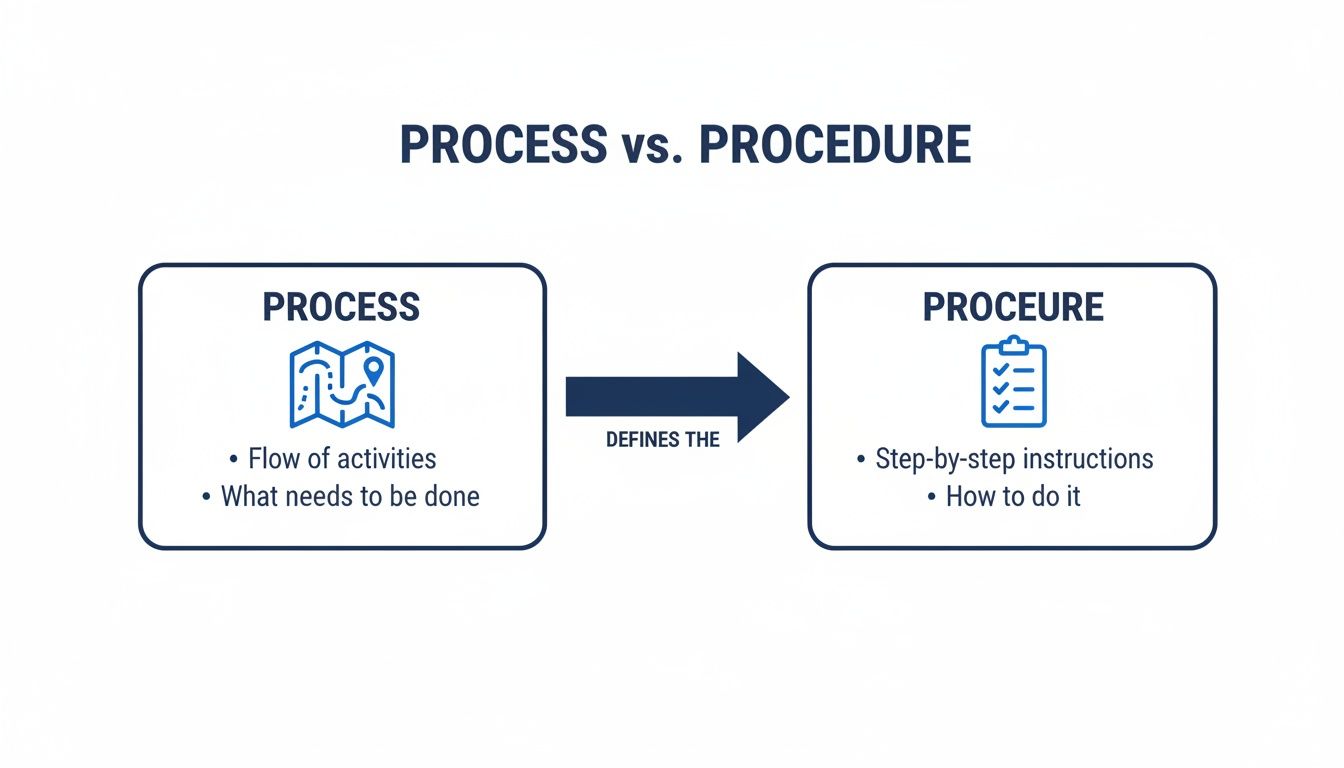
This visual makes it clear: the process is the big picture, and a procedure is the ground-level instruction set that brings a small piece of that picture to life.
Scope and Granularity
The most obvious difference is their scope. A process is big-picture, a macro-level view of how a major business outcome gets achieved. It almost always cuts across multiple departments, ropes in different teams, and connects a series of major activities.
Think of a "New Product Launch." This process pulls in marketing, sales, product development, and finance. It’s a massive workflow all aimed at one huge company goal.
A procedure, on the other hand, is zoomed all the way in. It's micro-level, detailing the exact clicks, steps, and actions to get one single task done within that larger process. A perfect example would be a procedure for "How to Add a New Product SKU to the Inventory System"—a specific, granular task done by one person in one department.
Sequence and Order
How things flow also tells you a lot. Processes often have a flexible sequence. The order of the main stages can shift based on new information or a change in strategy. The end goal is what matters, and the path to get there can have a few detours.
Take a "Customer Support Ticket Resolution" process. The general flow is always there (log, diagnose, resolve, close), but the specific activities might change order depending on how tricky the customer's problem is.
Procedures, however, are all about rigid, step-by-step order. You follow the sequence exactly as written to guarantee consistency, quality, and safety. Going off-script can cause errors, failed quality checks, or even security risks. There's zero room for winging it when you're following a procedure like "Calibrating a Manufacturing Sensor."
Ownership and Actors
Who does the work is another major clue. Processes are usually owned by cross-functional teams or a dedicated process manager who keeps an eye on the whole end-to-end flow. The people involved, the "actors," come from all over the company.
The "Employee Onboarding" process is a classic example. It requires tight coordination between HR, IT, and the new hire’s manager. No single person is executing that entire process alone.
Procedures are the opposite. They are typically assigned to a specific role. The procedure "How to Set Up a New Employee's Laptop" is owned and performed entirely by an IT specialist. The instructions are written specifically for that person to follow perfectly.
A process organizes the collaboration of many roles to achieve a shared objective. A procedure empowers a single role to execute their part of that objective flawlessly.
Objectives and Outcomes
What does a "win" look like? For a process, the objective is tied directly to a strategic business goal. The outcome is something valuable for the company or its customers—things like increased revenue, better customer satisfaction, or a successfully launched marketing campaign.
For a procedure, the objective is purely tactical. Success is measured by whether the task was completed consistently and accurately. The outcome isn't a business result but a correctly executed action, like a properly filed expense report. These small wins are essential, but they're a means to an end, not the end itself. For a deeper dive into how procedures form the backbone of larger operational strategies, check out our guide on the relationship between processes, SOPs, and work instructions.
Flexibility and Variability
Processes are built to be adaptable. They give you a framework that can handle some variability and can be tweaked as the business changes. A "Marketing Campaign Development" process, for instance, has to allow for creative freedom and strategic pivots based on what the market is doing.
Procedures are designed for the complete opposite reason: to kill variability. They are standardized to produce the exact same result every time, no matter who is doing the task. This rigidity is absolutely critical in fields like finance or manufacturing, where consistency is everything.
Measurement and Metrics
Finally, how you measure success is completely different.
- Process Metrics: Success is tracked with key performance indicators (KPIs) that reflect business impact. You're looking at things like Cycle Time, Customer Satisfaction (CSAT) Scores, or Conversion Rates.
- Procedure Metrics: Success here is about following the rules. Key metrics include Compliance Rate, Error Rate, and Task Completion Time.
This is a crucial distinction. You measure a process to see if it’s hitting its strategic targets, but you measure a procedure to make sure it's being followed to the letter.
Seeing Processes and Procedures in Action
It's one thing to talk about the difference between a process and a procedure in theory, but seeing it play out in the real world is where the lightbulb really goes on. These abstract ideas become practical, powerful tools when you see how different industries use them to tighten up operations, lock in quality, and keep people safe.
Let's dive into a few concrete examples. By grounding these concepts in specific, everyday business scenarios, you’ll immediately see why separating the "what" from the "how" is so critical.
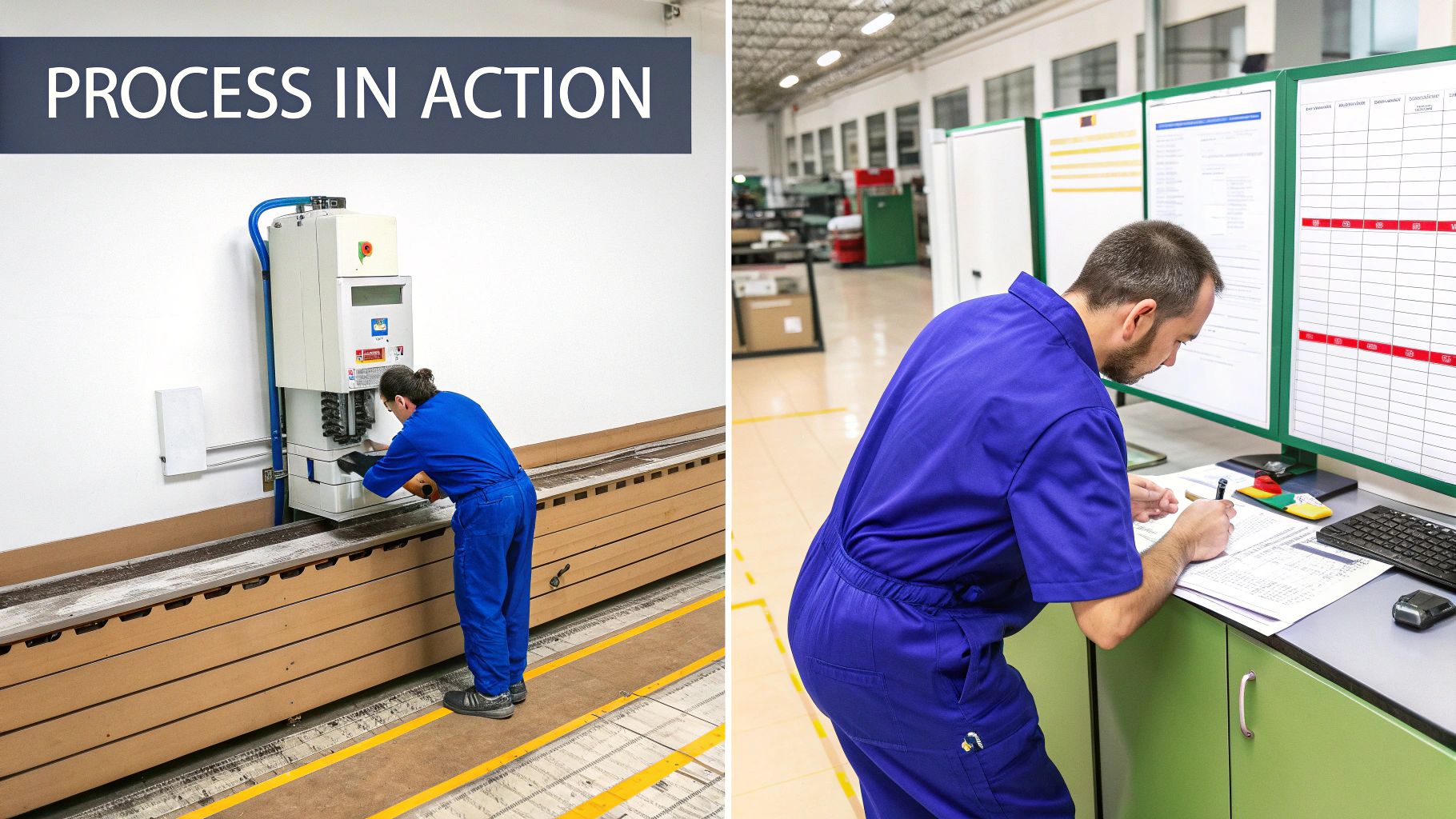
Manufacturing Quality Control
In manufacturing, consistency isn't just a goal; it's everything. A single misstep can spiral into costly defects, blown deadlines, and serious safety issues. This makes the distinction between a process and a procedure absolutely fundamental.
The Process: Quality Control Assurance
Think of the Quality Control Assurance process as the high-level roadmap for ensuring every single product that rolls off the line is perfect. It’s a strategic overview connecting different stages and teams to achieve one big goal: a flawless product.
- Inputs: Raw materials, production schedules, quality specs.
- Primary Activities: Inspecting materials, running in-production checks, final product testing, analyzing defects.
- Output: A finished product certified to meet all quality benchmarks.
- Responsible Roles: Quality Control Manager, Production Supervisor, Assembly Line Workers.
This process sets the framework, but it doesn't get into the nitty-gritty of how to perform each check. That's where procedures take over.
The Procedure: Machine Calibration Steps
Buried within that big QC process is a small but vital task: calibrating a specific piece of testing equipment. The Machine Calibration procedure provides the exact, non-negotiable instructions for this job.
- Inputs: The specific machine, a calibration tool, the manufacturer's manual.
- Primary Activities: Powering down the machine, connecting the calibration device, adjusting settings to benchmark values, running a test cycle, logging the results.
- Output: A perfectly calibrated machine with a documented record of its accuracy.
- Responsible Role: A certified Maintenance Technician.
See the difference? The procedure's rigidity ensures every technician calibrates the machine the exact same way, eliminating guesswork and guaranteeing reliable test results across every shift.
Finance Department Operations
When it comes to finance, accuracy and compliance are the name of the game. A tiny error in a single procedure can create massive headaches in the larger financial process, which is why absolute clarity is needed at both levels.
The Process: Monthly Account Reconciliation
The Monthly Account Reconciliation process is the entire workflow for making sure the company's books are accurate. It's the system that confirms the numbers inside the company match the numbers from the bank.
- Inputs: Bank statements, general ledger entries, transaction records.
- Primary Activities: Gathering all financial documents, comparing internal records against external statements, hunting down discrepancies, and making adjusting entries.
- Output: A reconciled financial statement that confirms the books are clean.
- Responsible Roles: Controller, Staff Accountant, Accounts Payable/Receivable Clerks.
The Procedure: Invoice Approval Workflow
One of the most important steps in that reconciliation process is approving a vendor's invoice. The Invoice Approval procedure is a strict, step-by-step guide designed to prevent fraud and ensure every payment is properly documented.
- Inputs: A vendor invoice, the matching purchase order.
- Primary Activities: Verifying the invoice against the purchase order, confirming goods were received, getting a manager's signature, and coding the expense to the right account.
- Output: An approved invoice, ready to be paid.
- Responsible Role: An Accounts Payable Clerk.
Mastering the difference between process and procedure moves a team from simply doing tasks to understanding how their specific actions contribute to a larger, strategic outcome.
IT and Employee Onboarding
For any IT department, efficiency and security are top priorities. The process of getting a new employee set up in the company’s digital world is a multi-stage affair, and each stage relies on precise procedures to get it right.
The Process: New Employee Onboarding
The New Employee Onboarding process is a big-picture, cross-functional effort to get a new hire ready to go from day one. It’s a collaboration between HR, IT, and the hiring manager to ensure a smooth start.
- Inputs: A signed offer letter, employee details, departmental role requirements.
- Primary Activities: Creating HR records, setting up system access and email, prepping hardware, scheduling orientation sessions.
- Output: A fully onboarded employee with all the tools and access they need to do their job.
- Responsible Roles: HR Coordinator, IT Specialist, Hiring Manager.
The Procedure: Workstation Setup Guide
One of IT's most critical onboarding tasks is setting up the new employee's computer. The Workstation Setup procedure is a detailed checklist that guarantees every device is configured securely and consistently, every single time.
- Inputs: A new laptop, the company's standard software image, the employee's login credentials.
- Primary Activities: Installing the operating system, deploying standard company software, configuring security tools (like antivirus and VPN), and testing network connectivity.
- Output: A secure, fully functional workstation, ready for the new employee.
- Responsible Role: An IT Support Technician.
In every one of these examples, the process gives you the strategic "why," while the procedure delivers the tactical "how." This clean separation allows for big-picture flexibility in the process, all while ensuring rock-solid consistency and quality in the procedures that make it all happen.
Why This Distinction Is Critical for Growth
Let's be honest: getting bogged down in the difference between a "process" and a "procedure" can feel like a pointless debate over semantics. But for any business serious about scaling, it’s one of the most important distinctions you can make. Nail this, and you’re building a predictable, resilient foundation for growth. Get it wrong, and you're just managing chaos.
When you have well-defined processes, you give your leadership team a "30,000-foot view" of the entire operation. This big-picture perspective is essential for making smart calls on where to put resources, spotting bottlenecks before they become disasters, and finding real opportunities for innovation. Without it, you’re just running a collection of disconnected tasks, not a cohesive business engine.
Driving Consistency and Reducing Risk
If processes are the strategic view, then procedures are your ground game. They provide the detailed, step-by-step instructions that make operational consistency possible. Whether it's a new hire on their first day or a ten-year veteran, everyone performs critical tasks the same way, every time. This dramatically cuts down on errors and ensures your customers get a uniform, high-quality experience.
This kind of standardization is also a powerful form of risk management. It minimizes the chances of compliance slip-ups, safety incidents, and the kind of expensive mistakes that can cripple a growing company.
Think of it this way:
- Processes set the destination and map out the major milestones.
- Procedures make sure you hit each milestone safely and correctly.
Understanding how these two levels work together is fundamental if you're looking for how to improve operational efficiency. This structure is what turns your day-to-day operations from a fragile liability into a scalable asset.
When your team has both the high-level 'why' from a process and the detailed 'how' from a procedure, they are empowered to execute with both context and confidence. This combination is the bedrock of a scalable company culture.
A Foundation for Scalable Systems
For any growing company, the leap from seat-of-your-pants operations to structured systems is a huge challenge. The process-versus-procedure framework is your blueprint for making that jump. It gives you a systematic way to document how your business actually runs, which is absolutely essential for training new people and delegating work effectively.
Clear procedures don't just help with training; they accelerate it. New hires become productive faster and don't have to constantly lean on senior staff. This frees up your most experienced people to focus on high-value, strategic work instead of answering the same basic questions over and over again. You end up with a self-sufficient team that can run smoothly, even as you add more people. To take it a step further, you can explore a variety of process improvement ideas to fine-tune your systems.
This isn't just theory—the benefits are proven. Since the ISO 9001 standard brought formal process management into the mainstream, businesses have seen measurable gains. Companies that adopt this clear, process-first approach often see a 15-25% increase in the predictability of their results and can slash operational cycle times by up to 30% simply by aligning resources more effectively.
By separating the strategic 'what' from the tactical 'how,' you build a business that is not only efficient today but is engineered for tomorrow's growth. This clarity isn't just an operational detail; it's the core architecture of a company built to last. It ensures that as you add more customers, more employees, and more complexity, your foundation supports that growth instead of crumbling under the weight.
How to Document Your Operations Effectively
Knowing the difference between a process and a procedure is a great first step, but the real magic happens when you document them effectively. This is where theory turns into tangible results.
Your documentation strategy can be the difference between a well-oiled machine and a constant point of failure. The secret is knowing when to stay high-level with a process map versus when to dive deep into a detailed Standard Operating Procedure (SOP).
Think of a process map as your starting point—a bird's-eye view. It’s a visual overview that shows the major stages, key decision points, and where work gets handed off between teams. It answers the "what" and the "why," giving everyone a clear line of sight into how their piece of the puzzle fits into the bigger picture.
An SOP, on the other hand, is the "how." It's the nitty-gritty, step-by-step guide for a specific task within that larger process. You don’t need an SOP for every single thing you do. But for tasks that are repetitive, critical for quality, or carry a high risk of error? You absolutely do.
From Process Mapping to Procedural Clarity
If you want to create documentation people actually use, you have to work from the top down. Start with the big-picture business process and then break it down into smaller, manageable chunks. This approach ensures every procedure you write is tied directly to a larger company goal.
Here’s a simple framework we use:
- Identify the Core Process: Pick a major workflow. Good examples are "Customer Onboarding" or "Fulfilling an E-commerce Order."
- Map the Major Stages: Outline the key phases from beginning to end. For customer onboarding, this could look like "Contract Signing," "Account Setup," and "Initial Training Call."
- Pinpoint Critical Tasks: Now, look inside each stage and find the specific, repeatable tasks. In the "Account Setup" stage, a crucial task would be "Creating a New User Profile in the CRM."
- Develop the Procedure (SOP): This is where you write the step-by-step instructions for that specific task. Detail every click, every field to fill out, and every confirmation needed so anyone can do it perfectly, every single time.
Following this hierarchy prevents you from creating a bunch of random, disconnected procedures. Instead, you build an interconnected system where team members can see both the 10,000-foot view and the ground-level instructions they need to get the job done right.
Bridging the Gap with Modern Documentation Tools
Let’s be honest: traditional documentation usually fails. It’s static, buried in a shared drive nobody can find, and becomes outdated the minute you hit "save." This is exactly what modern knowledge management platforms like Whale are built to fix, creating a single, dynamic source of truth for your entire team.
When you mix up processes and procedures, you get chaos. But when you clearly define them through documentation, you unlock scalability. In fact, organizations that get this right see 25-40% efficiency improvements. And with industry surveys showing that a staggering 60% of teams struggle with outdated documents, features like version control are no longer a nice-to-have; they're essential.
Effective documentation isn’t just about writing things down; it’s about creating a living system that empowers your team with the right information at the exact moment they need it.
Platforms like Whale move way beyond simple text documents, offering features that make your team's knowledge easy to find and act on:
- AI-Powered SOP Creation: These tools can instantly turn a screen recording or a quick text prompt into a fully structured, step-by-step procedure. This slashes the time it takes to document critical tasks.
- Centralized Knowledge Hub: No more hunting through different drives or apps. Everything lives in one searchable place, so everyone is literally on the same page.
- Version Control: This feature is a lifesaver. It automatically archives old versions and makes sure only the most current procedure is in use, eliminating the risk of someone following bad instructions.
- Integrated Training Modules: You can build quizzes and knowledge checks right into your procedures. It’s an incredible way to verify understanding, especially for onboarding and continuous training.
By putting these kinds of tools to work, you can build a robust documentation system that doesn't just collect dust. It becomes an active, integrated part of how you operate, driving consistency and making your business better every day. For a deeper dive, check out our guide on how to write standard operating procedures that actually deliver value.
The Role of Automation in Modern Operations
Technology has completely changed the game for how businesses run, and automation is front and center in refining both processes and procedures. Getting the difference between a process and a procedure is absolutely critical here, because you apply automation tools to each one very differently to hit distinct operational goals.
Process automation is all about the big picture. It uses tools like Business Process Management (BPM) software to manage an entire workflow from start to finish, connecting different stages, teams, and systems along the way. The goal here is strategic: boost overall efficiency, give everyone better visibility into what’s happening, and make sure the whole process moves smoothly toward its business objective. It’s about making the entire journey smarter.
On the other hand, procedural automation is tactical and laser-focused. It uses technologies like Robotic Process Automation (RPA) to handle specific, repetitive, rule-based tasks within a procedure. The goal is to stamp out human error, crank up the speed, and free up your people from mind-numbing work. It automates the "how," not the "what."
Automating the Journey vs. the Steps
Let’s look at a typical customer support department to see this in action. It's a perfect example.
- Process Automation: Think about the entire "Customer Support Ticket Lifecycle." You can automate this whole journey. The system manages the flow from the second a ticket is created, through triage, assignment to the right team, escalation if needed, resolution, and finally, sending out a customer satisfaction survey. A BPM tool oversees this entire sequence to ensure no ticket ever falls through the cracks.
- Procedural Automation: Now, inside that bigger process, there’s a specific procedure for "Assigning a Ticket to a Tier 2 Agent." An RPA bot can automate these exact steps: it reads the ticket's category, checks a database for the right agent based on their skills and availability, and instantly updates the ticket field. This one task is done in a flash, with zero errors.
Automation's impact on distinguishing processes from procedures has driven massive efficiency gains, with businesses reporting 20-30% reductions in process completion times. Procedures, the rigid task blueprints, gain from rule-based consistency, slashing human errors in repetitive workflows like expense approvals or quality checks by up to 40%. For HR and training pros in SMBs, this means onboarding times can drop by 50%, as digital procedures enable self-paced learning. You can learn more about these impactful workflow statistics on Kissflow.com.
Ultimately, automation makes both levels of your operation stronger. By automating processes, organizations get strategic control and a bird's-eye view of performance. By automating procedures, they lock in tactical precision and consistency right down to the task level. To see how artificial intelligence can streamline operational processes and boost productivity, consider how to transform workflows with AI for real estate agents. This dual approach—automating the strategic "what" and the tactical "how"—is what helps modern businesses become not just more efficient, but more resilient and ready to scale.
Got Questions? We’ve Got Answers.
As you start untangling processes and procedures, a few common questions always pop up. Let's tackle them head-on so you can move forward with confidence.
Can a Process Have Only One Procedure?
Yes, absolutely. A simple process like "Submitting a Weekly Timesheet" might only need a single, straightforward procedure. The goal is small and self-contained, so one set of steps gets the job done.
But don't get too used to that. Most of the time, strategic business processes are much bigger beasts. Think about a process like "Hiring a New Employee"—it's not one task, but a whole series of them. You'll have separate procedures for posting the job, screening resumes, conducting interviews, and making an offer. The process defines the big picture, while each procedure guides you through a specific part of the journey.
Which Should I Document First: a Process or a Procedure?
Always, always, always map the process first. You have to know the destination before you can write the directions. Defining that high-level flow—the strategic "what" and "why"—gives you the context needed to make sure every action has a purpose.
Starting with procedures without a clear process map is a recipe for disaster. You end up with a messy collection of disconnected tasks that don't add up to anything meaningful. It's like buying all the ingredients for a meal without knowing what you're trying to cook.
Once everyone is aligned on the overall process, then you can zoom in and write the detailed, step-by-step procedures for each piece of the puzzle. This top-down approach is the only way to ensure every procedure actually supports the larger business goal.
How Often Should I Review Processes and Procedures?
These aren't "set it and forget it" documents. But they don't need the same amount of attention.
Procedures need frequent check-ups. Because they are tactical, step-by-step guides, they are easily broken by small changes in software, tools, or regulations. A good rule of thumb is to review your most critical procedures quarterly, or anytime a system they rely on gets an update. You don't want your team working from an outdated playbook.
Processes are more stable. Since they outline your broader strategy, they don't change nearly as often. Plan to review your core processes annually or whenever your company makes a major strategic pivot. This ensures they still line up with your long-term vision and haven't gone stale.