
Employee Onboarding & Training
11 Best ClickUp Alternatives in 2026 (Tested & Compared)

In this article
Last updated: 14 August 2026
Looking for the best ClickUp alternative? ClickUp is the biggest name in project management software for a reason. It is genuinely powerful, and for teams that need one tool to run every workflow, it is hard to beat.
But “powerful” and “right for you” are not the same thing. The most common reasons people go looking for a ClickUp alternative are not really complaints about ClickUp. They are mismatches between what ClickUp is built for and what the team actually needs:
- You just want simple task management, not a platform with hundreds of configurable views and settings.
- Your team is spread across desktop, mobile and web, and ClickUp’s mobile experience feels like an afterthought next to the web app.
- Automations take longer to set up than the work they are meant to save, especially for non-technical team members.
- You need documentation and SOPs, not just task tracking. ClickUp Docs exists, but it is a feature bolted onto a project management tool, not a system built around how knowledge and training actually work in a growing company.
Whatever your reason, this list covers the best ClickUp alternatives across every use case, from all-purpose workspaces to dedicated documentation and training platforms, so you can find the one built for the problem you are actually trying to solve.
Key Takeaways
- ClickUp is still the strongest all-purpose project management tool on the market. Most alternatives trade some of its breadth for simplicity, speed, or a sharper focus on one job.
- The right alternative depends on why you are leaving, not on which tool has the most features. Complexity, mobile performance and automation friction are the three most common reasons teams switch.
- If your real problem is documentation, SOPs or training rather than task tracking, a dedicated tool like Whale will outperform ClickUp, and every general PM tool on this list, on that specific job.
- Free plans vary more than they look. Notion is unlimited for solo use but block-limited beyond one member; Monday and Asana cap free use at 2 users; Airtable caps at 5 editors; Trello caps at 10 collaborators per Workspace; and Smartsheet, Process Street and Trainual have no free plan at all.
- Annual and monthly rates differ by 20 to 30% on most tools here. Every price below states which basis it is on, and was checked against the vendor’s own pricing page in August 2026. Confirm current rates before you commit.

How We Evaluated These Tools
We looked at each tool across five factors that matter most when you are switching off ClickUp: ease of use and onboarding time, core feature depth, pricing transparency, documentation and knowledge management capability, and how each platform performs on mobile. Every price in this article was verified against the vendor’s own live pricing page in August 2026, in US dollars, with the billing basis stated. Where a vendor publishes no price, or publishes no limit for its free plan, we say so rather than estimating. SaaS pricing shifts more often than review articles do, so confirm current rates directly with the vendor before you buy.
ClickUp Alternatives at a Glance
| Tool | Best For | Starting Price | Free Plan | Standout Feature |
|---|---|---|---|---|
| Whale | SOP documentation, onboarding and training | Free forever ($0, 10 members); Scale from $249/mo billed annually | Yes, free forever up to 10 members | AI writing assistant turns screen recordings into finished SOPs; Alice answers employee questions from your own docs |
| Notion | Flexible docs plus light project management | $10/member/mo billed annually ($12 monthly), Plus | Yes, unlimited for solo use | Unlimited pages and blocks on the free plan |
| Asana | Task management with a gentle learning curve | $10.99/user/mo billed annually ($13.49 monthly), Starter | Yes, up to 2 users | Unlimited automations and Gantt/timeline views on Starter |
| Monday.com | Visual, colourful workflow tracking | $9/seat/mo billed annually ($12 monthly), Basic | Yes, up to 2 seats | AI credits and workflow automation on every paid tier |
| Airtable | Database-style project and data management | $20/seat/mo billed annually ($24 monthly), Team | Yes, up to 5 editors | Relational databases with a spreadsheet-simple interface |
| Smartsheet | Enterprise teams needing spreadsheet-style PM | $9/member/mo billed annually ($12 monthly), Pro | No, 30-day trial only | Formulas and functions inside a full project management layer |
| Trello | Simple Kanban task boards | $5/user/mo billed annually ($6 monthly), Standard | Yes, up to 10 collaborators per Workspace | Fastest tool on this list to learn, with no onboarding needed |
| Process Street | Turning recurring workflows into checklists | No published pricing, contact sales | No, 14-day trial only | Conditional logic and enforced task order inside workflows |
| Trainual | Structured employee onboarding and role clarity | No published pricing, contact sales | No free plan or trial published | Role-based onboarding with an org chart and accountability mapping |
| Wrike | Complex workflows across multiple teams | $10/user/mo billed annually, Team | Yes, limits not published | Advanced reporting with PowerBI and Tableau integration |
| Basecamp | Centralised project communication | $15/user/mo billed monthly, Pro | Yes, 1 project, 20 users, 1GB | Flat-rate option that scales predictably for larger teams |
Prices verified against each vendor’s live US pricing page, August 2026. Wrike publishes no seat or storage limit for its free plan, and Process Street publishes no pricing for any tier, so neither is estimated here.
1. Whale: Best for SOP Documentation, Onboarding & Training
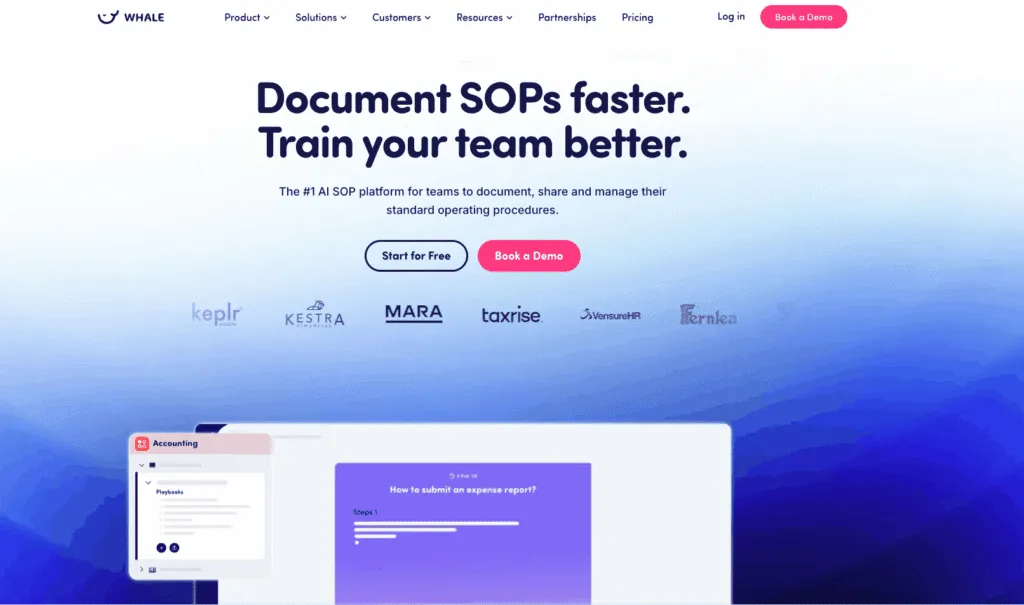
Here is the honest framing: Whale is not really a ClickUp competitor in the traditional sense. ClickUp is a project management platform. Whale is an AI-powered documentation, training and knowledge management platform. If your team’s frustration with ClickUp is that tasks live in ClickUp but nobody actually knows how to do the task, that is the gap Whale is built to close.
If you are weighing up both tools directly, our ClickUp comparison goes deeper on the head-to-head.
Whale is best for: operations, HR and L&D teams that need to turn “how we do things” into documented, trainable, searchable process, not just a place to assign tasks.
Key features:
- AI Writing Assistant that turns screen recordings and rough notes into polished, step-by-step SOPs
- Alice, an AI assistant trained on your own company content, answering employee questions in natural language instead of sending people back to a folder search
- Role-based training flows and AI-generated quizzes to onboard new hires consistently
- Compliance tracking, so you can see who has read a policy or completed training rather than guess
Pros:
- Built specifically for documentation and training, not project tracking with docs bolted on
- AI drafts SOPs directly from screen recordings, cutting documentation time significantly
- Quick to set up and use without a steep learning curve
Cons:
- Not a project management tool: you will still want a task tracker alongside it if that is a separate need
- AI features on lower tiers are credit-limited, so heavy documentation teams should budget for a higher tier
Pricing:
- Free forever for up to 10 members, no credit card required.
- Scale is $399/month billed monthly, or $249/month billed annually, with unlimited members and 3 creators included.
- Advance is $799/month billed monthly, or $499/month billed annually, with unlimited members and 5 creators included.
- Enterprise pricing is available on request.
The verdict: if you are evaluating ClickUp because your team cannot find or follow a consistent process, Whale solves a different, and often more urgent, problem than ClickUp ever could.
2. Notion vs ClickUp: Best for Flexible Docs and Light Project Management
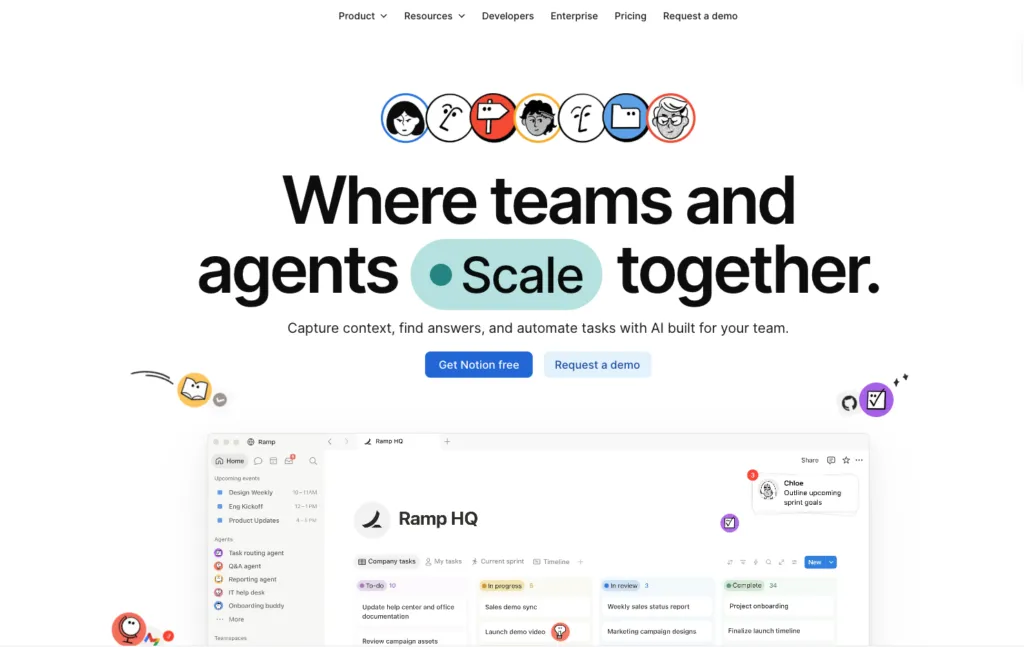
Notion combines notes, databases and lightweight project tracking into one workspace. It is the tool most commonly recommended as a general ClickUp alternative, because it covers similar breadth without ClickUp’s density of settings.
Notion vs ClickUp
| Feature | Notion | ClickUp |
|---|---|---|
| Best for | Flexible docs, wikis and light project tracking | Teams wanting one tool for tasks, docs and chat |
| Free plan | Yes, unlimited for solo use; block-limited from 2 members, 10 guests | Yes, unlimited members and guests, 60MB storage |
| Starting price | Plus, $10/member/month billed annually ($12 monthly) | $7/user/month billed annually ($10 monthly), Unlimited |
| Mid tier | Business, $20/member/month billed annually ($24 monthly) | Business, $12/user/month billed annually ($19 monthly) |
| Top tier | Enterprise, custom quote | Enterprise, contact sales |
| Pricing model | Per member, with full AI access gated behind Business | Per user, with AI sold as a separate add-on on any tier |
| AI features | Full AI Agents and Ask Notion on Business and up | ClickUp Brain, a flat $9/user/month add-on |
| Documentation/SOPs | Strong: wikis and databases are core to the product | ClickUp Docs, one feature among many |
| Project management | Light: database views can approximate task tracking | Deep, including Gantt and dependencies |
Notion is best for: small teams and startups that want one flexible workspace for docs, wikis and simple task tracking.
Key features:
- Unlimited pages and blocks for solo use, even on the free plan
- Cross-database relations so records can reference each other
- Native AI search and summarisation on Business and above
Pros: highly customisable, genuinely useful free tier for one person, and a gentler learning curve than ClickUp.
Cons: weaker native automation and reporting than ClickUp for complex project tracking, and the free plan becomes block-limited as soon as you add a second member.
Pricing: free for individuals. Plus is $10/member/month billed annually or $12 billed monthly; Business is $20/member/month billed annually or $24 billed monthly; Enterprise is a custom quote.
3. Asana vs ClickUp: Best for Teams That Want Task Management Without the Complexity
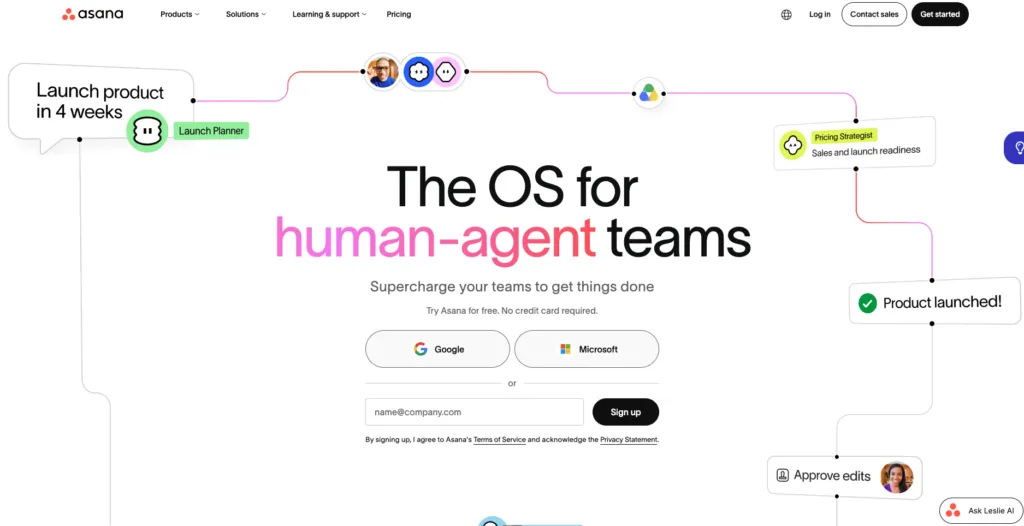
Asana is one of the most direct ClickUp alternatives for teams that specifically want project and task management, minus ClickUp’s configuration overhead.
Asana vs ClickUp
| Feature | Asana | ClickUp |
|---|---|---|
| Best for | Task management with a gentle learning curve | Teams wanting one tool for tasks, docs and chat |
| Free plan | Yes, up to 2 users can collaborate free | Yes, unlimited members and guests, 60MB storage |
| Starting price | Starter, $10.99/user/month billed annually ($13.49 monthly) | $7/user/month billed annually ($10 monthly), Unlimited |
| Mid tier | Advanced, $24.99/user/month billed annually ($30.49 monthly) | Business, $12/user/month billed annually ($19 monthly) |
| Top tier | Enterprise, custom quote | Enterprise, contact sales |
| Pricing model | Per user, with a notable jump from Starter to Advanced | Per user, scaling more gradually |
| AI features | AI Studio bundled, with a credit allowance on every paid tier | ClickUp Brain, a flat $9/user/month add-on |
| Documentation/SOPs | Not a focus: task and portfolio first | ClickUp Docs, one feature among many |
| Standout capability | Automation bundles, portfolio tracking, 270+ integrations | Broadest single-tool feature set on this list |
Asana is best for: creative teams, agencies and mid-size companies that want structured task management with a shorter ramp-up time.
Key features:
- Automation bundles that package rules, custom fields and templates for reuse across projects
- Portfolio view for tracking multiple projects from one dashboard
- Native integrations with more than 270 tools
Pros: intuitive interface and strong reporting on higher tiers.
Cons: advanced reporting and automation sit behind higher-priced tiers, and the free plan only covers two collaborators.
Pricing: free for up to 2 users. Starter is $10.99/user/month billed annually or $13.49 billed monthly; Advanced is $24.99/user/month billed annually or $30.49 billed monthly.
4. Monday vs ClickUp: Best for Visual Workflow Tracking
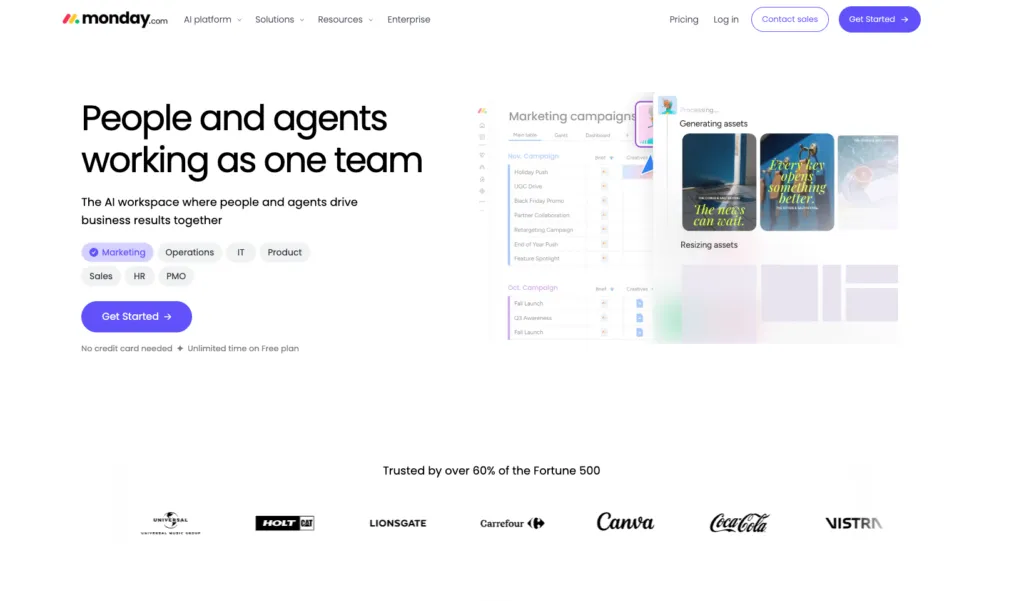
Monday.com trades ClickUp’s density of features for a cleaner, more colourful interface built around boards.
Monday.com vs ClickUp
| Feature | Monday.com | ClickUp |
|---|---|---|
| Best for | Visual, colourful workflow tracking | Teams wanting one tool for tasks, docs and chat |
| Free plan | Yes, up to 2 seats | Yes, unlimited members and guests, 60MB storage |
| Starting price | Basic, $9/seat/month billed annually ($12 monthly) | $7/user/month billed annually ($10 monthly), Unlimited |
| Mid tier | Standard, $12/seat/month billed annually ($14 monthly) | Business, $12/user/month billed annually ($19 monthly) |
| Upper tier | Pro, $19/seat/month billed annually ($24 monthly) | Enterprise, contact sales |
| Top tier | Enterprise, custom quote | — |
| Pricing model | Per seat, with AI credits bundled into paid tiers | Per user, with AI sold as a separate add-on |
| AI features | AI credits included on every paid tier, with periodic credit promotions | ClickUp Brain, a flat $9/user/month add-on |
| Documentation/SOPs | Not a focus: board and item first | ClickUp Docs, one feature among many |
Monday is best for: teams that think visually and want project status to be obvious at a glance, without digging through nested views.
Key features:
- Fully customisable visual boards
- Strong native mobile app
- No-code workflow automation
Pros: easy to onboard new team members, with strong visual reporting.
Cons: the free plan is limited to 2 seats, so most teams will need a paid plan quickly.
Pricing: free for up to 2 seats. Basic is $9/seat/month billed annually or $12 billed monthly; Standard is $12 annually or $14 monthly; Pro is $19 annually or $24 monthly; Enterprise is a custom quote.
Monday has a better user experience for large teams, while ClickUp works best for smaller tech-savvy teams
 Allisa BouletteContent specialist, Zapier blog
5. Airtable vs ClickUp: Best for Database-Style Project Management
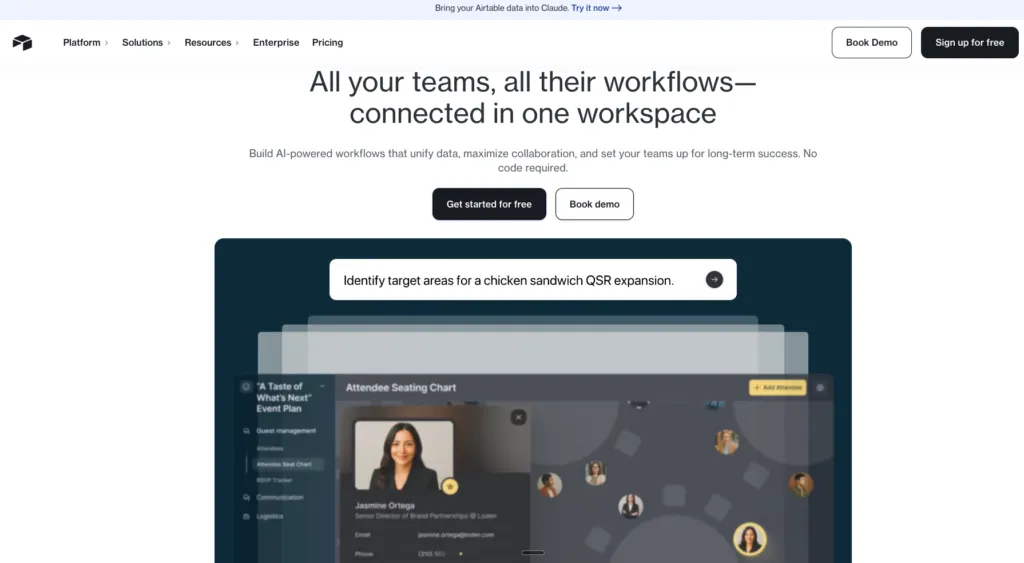
Airtable behaves like a spreadsheet with the relational power of a database, which makes it a strong choice for teams that think in structured data rather than task lists.
Airtable vs ClickUp
| Feature | Airtable | ClickUp |
|---|---|---|
| Best for | Database-style project and data management | Teams wanting one tool for tasks, docs and chat |
| Free plan | Yes, up to 5 editors, unlimited bases, 1,000 records per base | Yes, unlimited members and guests, 60MB storage |
| Starting price | Team, $20/seat/month billed annually ($24 monthly) | $7/user/month billed annually ($10 monthly), Unlimited |
| Mid tier | Business, $45/seat/month billed annually ($54 monthly) | Business, $12/user/month billed annually ($19 monthly) |
| Top tier | Enterprise Scale, custom quote | Enterprise, contact sales |
| Pricing model | Per seat, with a notably higher entry price than most tools here | Per user, cheaper entry at every tier |
| AI features | Built-in AI from the Team tier up, 500 credits per editor per month on free | ClickUp Brain, a flat $9/user/month add-on |
| Documentation/SOPs | Not a focus: relational database first | ClickUp Docs, one feature among many |
| Standout capability | Interface Designer for building custom internal apps | Broadest single-tool feature set on this list |
Airtable is best for: teams managing structured data alongside project work, such as content calendars, inventory, or anything with many interrelated fields.
Key features:
- Interface Designer for building custom internal apps
- Native integrations with Jira, Salesforce and Tableau
- Automated trigger-action workflows
Pros: extremely flexible data modelling, and strong for teams with data-savvy users.
Cons: a steeper learning curve for non-technical team members, limited built-in team communication, and the highest paid entry price on this list at $20/seat/month.
Pricing: free for up to 5 editors. Team is $20/seat/month billed annually or $24 billed monthly; Business is $45 annually or $54 monthly; Enterprise Scale is a custom quote.
6. Smartsheet vs ClickUp: Best for Enterprise Teams That Think in Spreadsheets
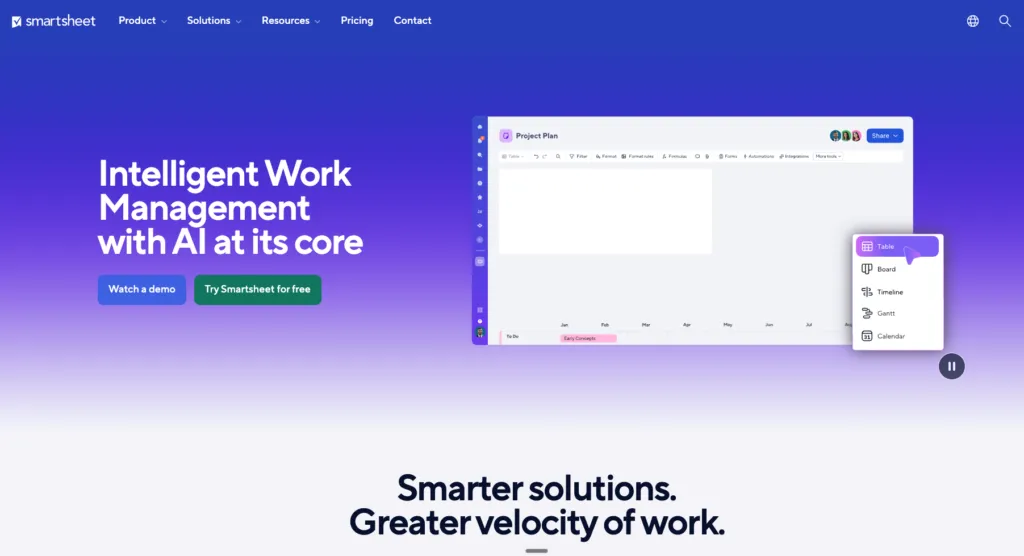
Smartsheet is built for teams that already run their operations out of spreadsheets and want that familiarity with more project management horsepower underneath.
Smartsheet vs ClickUp
| Feature | Smartsheet | ClickUp |
|---|---|---|
| Best for | Enterprise teams needing spreadsheet-style PM at scale | Teams wanting one tool for tasks, docs and chat |
| Free plan | No free plan, 30-day free trial only, no card required | Yes, unlimited members and guests, 60MB storage |
| Starting price | Pro, $9/member/month billed annually ($12 monthly), 1 to 10 members | $7/user/month billed annually ($10 monthly), Unlimited |
| Mid tier | Business, $19/member/month billed annually ($24 monthly) | Business, $12/user/month billed annually ($19 monthly) |
| Top tier | Enterprise, custom quote | Enterprise, contact sales |
| Pricing model | Per member, with unlimited free Contributors alongside paid Members | Per user, scaling more gradually |
| AI features | Limited: mostly reporting and automation rather than generative | ClickUp Brain, a flat $9/user/month add-on |
| Documentation/SOPs | Not a focus: spreadsheet and grid first | ClickUp Docs, one feature among many |
| Reporting | Very strong, with resource management on Business and up | Solid dashboards, deeper on the Business tier |
Smartsheet is best for: enterprise and mid-market teams managing large, complex project portfolios.
Key features:
- Built-in formulas and functions
- Native integrations with Google Workspace, Microsoft 365 and DocuSign
- No-code automated workflows for reminders and approvals
Pros: powerful for large-scale reporting, and the familiar spreadsheet interface reduces training time.
Cons: no free plan at all, the Pro tier caps at 10 members, and there is a real learning curve for teams unfamiliar with spreadsheet logic.
Pricing: no free plan; a 30-day trial is available without a card. Pro is $9/member/month billed annually or $12 billed monthly, for 1 to 10 members; Business is $19 annually or $24 monthly; Enterprise is a custom quote.
7. Trello vs ClickUp: Best for Simple Kanban Boards
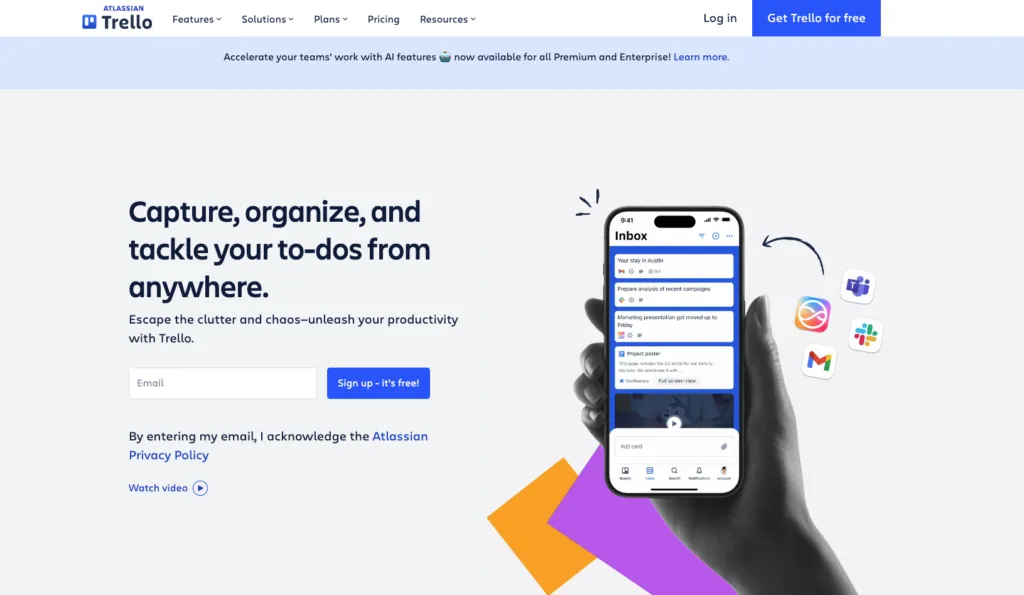
Trello is the tool most people picture when they think “simple Kanban”, and it remains the fastest option on this list to learn.
Trello vs ClickUp
| Feature | Trello | ClickUp |
|---|---|---|
| Best for | Simple visual Kanban boards with almost no learning curve | Teams wanting one tool for tasks, docs and chat |
| Free plan | Yes, up to 10 collaborators per Workspace, unlimited cards | Yes, unlimited members and guests, 60MB storage |
| Starting price | Standard, $5/user/month billed annually ($6 monthly) | $7/user/month billed annually ($10 monthly), Unlimited |
| Mid tier | Premium, $10/user/month billed annually ($12.50 monthly) | Business, $12/user/month billed annually ($19 monthly) |
| Top tier | Enterprise, $17.50/user/month billed annually | Enterprise, contact sales |
| Pricing model | Per user, published tiers, cheapest paid entry point here | Per user, published tiers |
| AI features | Included from the Standard tier up, with no separate add-on | ClickUp Brain, a flat $9/user/month add-on |
| Documentation/SOPs | Not a focus: card based, with no real docs structure | ClickUp Docs, one feature among many |
| Views | Board standard; Calendar, Timeline, Table and Dashboard on Premium | Multiple views across all paid tiers |
Trello is best for: small teams or solo users who want visual task tracking without any setup overhead.
Key features:
- Drag-and-drop Kanban cards
- Butler automation bot for rule-based triggers
- More than 150 Power-Ups for lightweight integrations
Pros: extremely intuitive, a genuinely useful free plan, and the cheapest paid tier on this list.
Cons: lacks the advanced project management features, such as dependencies and resource planning, that larger teams eventually need.
Pricing: free for up to 10 collaborators per Workspace. Standard is $5/user/month billed annually or $6 billed monthly; Premium is $10 annually or $12.50 monthly; Enterprise is $17.50/user/month billed annually.
8. Process Street vs ClickUp: Best for Turning Recurring Work Into Checklists
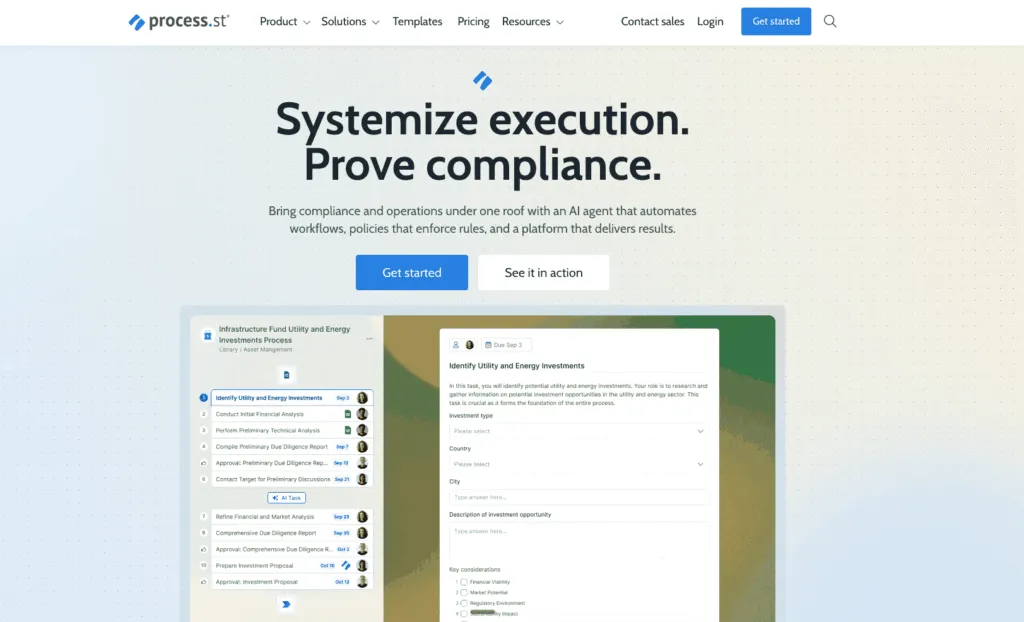
Process Street sits closer to Whale’s category than to ClickUp’s. It is built around turning repeatable processes into structured, followable workflows rather than general task tracking.
Process Street vs ClickUp
| Feature | Process Street | ClickUp |
|---|---|---|
| Best for | Enforcing step order in recurring, compliance-heavy workflows | Teams wanting one tool for tasks, docs and chat |
| Free plan | No free plan, 14-day trial of Pro only, no card required | Yes, unlimited members and guests, 60MB storage |
| Starting price | No published pricing on any tier, contact sales | $7/user/month billed annually ($10 monthly), Unlimited |
| Pricing model | Custom quote, per seat, with all active users billable | Per user, published tiers |
| Top tier | Enterprise, custom quote | Enterprise, contact sales |
| AI features | Cora AI compliance agent, monitoring and flagging workflow risk | ClickUp Brain, a flat $9/user/month add-on |
| Documentation/SOPs | Core focus: conditional logic and enforced task order | ClickUp Docs, one feature among many |
| Compliance | SOC 2 Type 2, with HIPAA on Enterprise | Not a primary focus |
Process Street is best for: operations teams that need to enforce a specific order of steps for recurring processes, such as employee offboarding or client onboarding.
Key features:
- Conditional logic within workflows
- Enforced task order and approvals
- Custom data set records for tracking process outcomes
Pros: strong for compliance-heavy, repeatable processes.
Cons: no published self-serve pricing at all, so every plan requires a sales conversation, which slows evaluation considerably.
Pricing: not published. Process Street lists three tiers (Startup, Pro and Enterprise) and every call to action is a demo request, so budget planning requires a sales call. A 14-day trial of Pro is available without a card.
9. Trainual vs ClickUp: Best for Structured Employee Onboarding and Role Clarity
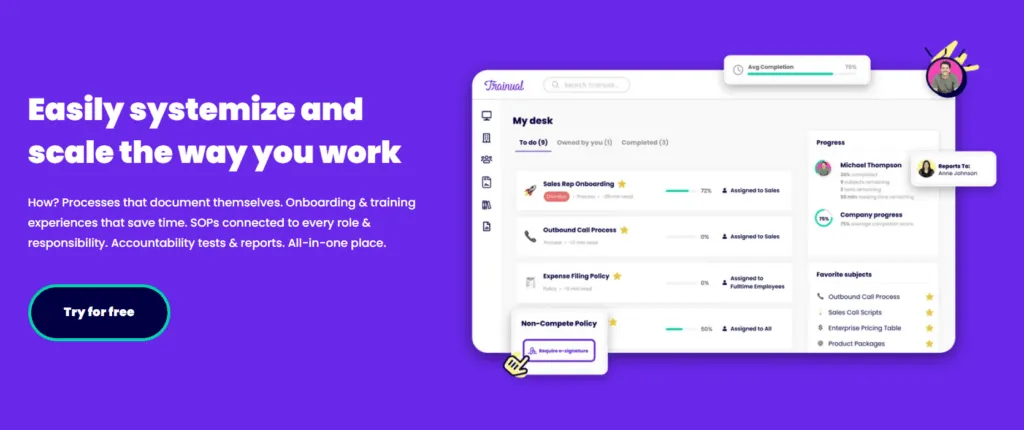
Trainual is the other tool on this list that sits in Whale’s category rather than ClickUp’s. It is built for documenting how a company works and turning that into role-based onboarding, so it is not really a ClickUp replacement. In practice teams often run it alongside ClickUp, connecting the two through Zapier, rather than choosing between them.
Where Trainual is distinctive is org design: alongside the documentation itself it maps roles, responsibilities and reporting lines, which makes it a strong fit for companies formalising structure as they scale.
Trainual vs ClickUp
| Feature | Trainual | ClickUp |
|---|---|---|
| Best for | Structured onboarding, role clarity and process documentation | Teams wanting one tool for tasks, docs and chat |
| Free plan | None published, and no free trial listed on the pricing page | Yes, unlimited members and guests, 60MB storage |
| Starting price | No published pricing on any of its four tiers, contact sales | $7/user/month billed annually ($10 monthly), Unlimited |
| Tiers | Core, Pro, Premium and Enterprise, all gated behind a demo request | Enterprise, contact sales |
| Pricing model | Custom quote, plus a one-time $1,000 implementation fee for guided onboarding | Per user, published tiers |
| AI features | AI-assisted documentation and AI-powered knowledge search with Q&A | ClickUp Brain, a flat $9/user/month add-on |
| Documentation/SOPs | Core focus: documentation, training paths, testing and tracking | ClickUp Docs, one feature among many |
| Standout capability | Org chart, accountability chart and the Delegation Planner | Broadest single-tool feature set on this list |
Trainual is best for: growing companies that need onboarding and role definition to become repeatable, and that have budget approval to go through a sales process rather than self-serve.
Key features:
- Unlimited AI-assisted documentation, with flowcharts and 500+ customisable templates
- AI-powered knowledge search with question-and-answer responses
- Role-based training by group, with due dates, testing, tracking and reporting
- Org chart, accountability chart and the Delegation Planner for mapping responsibilities
- Built-in screen recording, video embedding and searchable video transcriptions on Pro and up
- E-signatures, SCORM storage, SSO and custom branding on the higher tiers
Pros: genuinely purpose-built for onboarding rather than task tracking, with unusually strong org-design features and a large template library.
Cons: no pricing is published for any tier, so every evaluation starts with a sales call; there is no free plan or published trial to test it first; and a one-time $1,000 implementation fee applies to the guided onboarding option.
Pricing: not published. Trainual lists four tiers (Core, Pro, Premium and Enterprise) and every call to action is a demo request. The only figure it publishes is a one-time $1,000 implementation fee for guided onboarding. If you want to compare it with Whale directly, including on price transparency, see our Whale vs Trainual comparison.
10. Wrike vs ClickUp: Best for Complex, Cross-Team Workflows
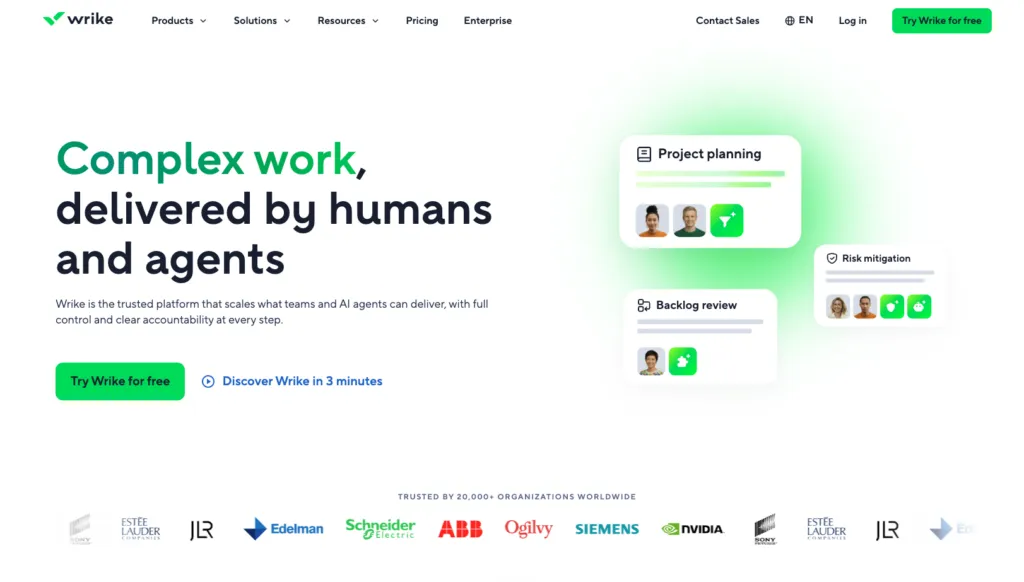
Wrike is built for larger organisations running multiple concurrent projects across departments that need to stay coordinated without duplicating work.
Wrike vs ClickUp
| Feature | Wrike | ClickUp |
|---|---|---|
| Best for | Cross-functional teams needing dependencies and reporting | Teams wanting one tool for tasks, docs and chat |
| Free plan | Yes, but Wrike publishes no seat or storage limit for it | Yes, unlimited members and guests, 60MB storage |
| Starting price | Team, $10/user/month billed annually | $7/user/month billed annually ($10 monthly), Unlimited |
| Mid tier | Business, $25/user/month billed annually | Business, $12/user/month billed annually ($19 monthly) |
| Top tier | Pinnacle and Apex, custom pricing | Enterprise, contact sales |
| Pricing model | Per user, annual billing only, self-serve up to 15 users | Per user, monthly or annual |
| AI features | AI writing assistant from the Team tier up | ClickUp Brain, a flat $9/user/month add-on |
| Documentation/SOPs | Not a focus: task and workflow first | ClickUp Docs, one feature among many |
| Reporting | Strong, with PowerBI and Tableau integration on Business and up | Solid dashboards, deeper on the Business tier |
Wrike is best for: agencies and enterprise teams managing complex, cross-functional projects.
Key features:
- Advanced custom reporting with PowerBI and Tableau integrations
- Cross-functional tagging to avoid duplicate project setup
- Client and stakeholder collaboration tools
Pros: strong reporting depth, and a free tier to trial the product.
Cons: the breadth of features creates a learning curve similar to ClickUp’s, paid tiers are annual-billing only, and Wrike does not publish the limits on its free plan, which makes it hard to evaluate without contacting them.
Pricing: a free tier exists but its limits are not published. Team is $10/user/month and Business is $25/user/month, both billed annually; self-serve purchase covers up to 15 users. Pinnacle and Apex are custom priced.
11. Basecamp vs ClickUp: Best for Centralized Team Communication
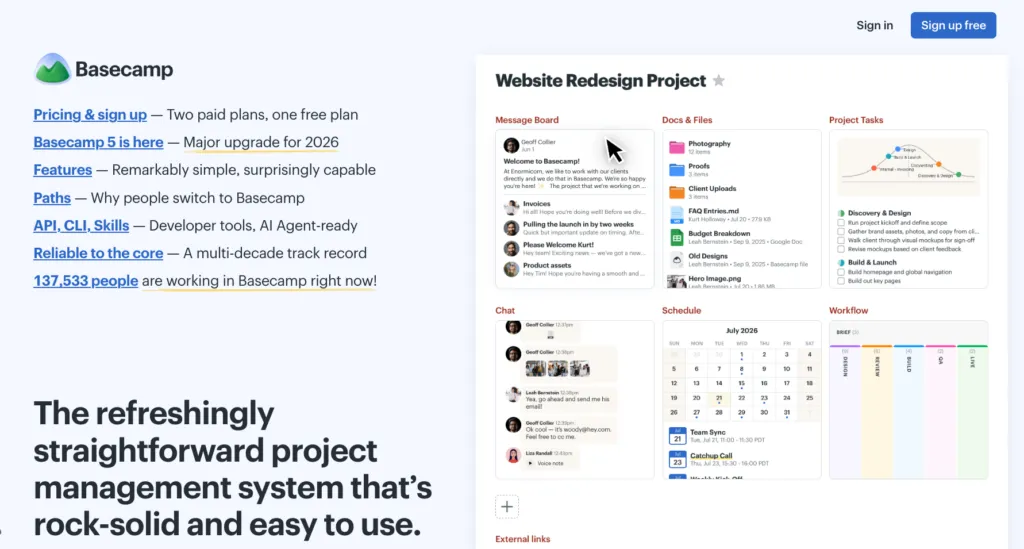
Basecamp trades granular project management features for a cleaner, calmer approach to keeping teams aligned and communicating.
Basecamp vs ClickUp
| Feature | Basecamp | ClickUp |
|---|---|---|
| Best for | Teams wanting simple project communication | Teams wanting one tool for tasks, docs and chat |
| Free plan | Yes, 1 project, up to 20 users, 1GB storage | Yes, unlimited members and guests, 60MB storage |
| Starting price | Pro, $15/user/month billed monthly | $7/user/month billed annually ($10 monthly), Unlimited |
| Flat-rate option | Pro Unlimited, $299/month flat for unlimited users, billed annually, 5TB | Business, $12/user/month billed annually ($19 monthly) |
| Top tier | Pro Unlimited is the top tier | Enterprise, contact sales |
| Pricing model | Per user on Pro, flat rate on Pro Unlimited | Per user, scaling with headcount |
| AI features | None built in | ClickUp Brain, a flat $9/user/month add-on |
| Documentation/SOPs | Message boards and docs, but not SOP structured | ClickUp Docs, one feature among many |
| Learning curve | Minimal, intentionally simple | Steeper, typically 2 to 4 weeks to proficiency |
Basecamp is best for: small to mid-size teams that want project management and team communication in one place, without ClickUp’s configuration depth.
Key features:
- Automatic check-ins to replace status meetings
- Hill Charts for visual progress tracking
- Flat, predictable pricing regardless of team size on Pro Unlimited
Pros: a genuinely usable free tier, flat pricing that scales well for larger teams, and a minimal learning curve.
Cons: limited workflow automation compared with ClickUp or Wrike, and the free tier caps out at one project.
Pricing: free forever for 1 project, up to 20 users and 1GB storage. Pro is $15/user/month billed monthly. Pro Unlimited is a flat $299/month for unlimited users with 5TB of storage, billed annually.
Which ClickUp Alternative Should You Choose?
- Choose Whale if your real problem is not task tracking: it is that processes live in people’s heads, onboarding takes too long, or nobody can find the current version of an SOP.
- Choose Notion or Airtable if you want a flexible, all-purpose workspace and do not need heavy project management structure.
- Choose Asana or Monday.com if you want dedicated project management with a shorter learning curve than ClickUp.
- Choose Smartsheet or Wrike if you are an enterprise team that needs advanced reporting and cross-team coordination at scale.
- Choose Trello if you want the simplest possible visual task board and nothing more.
- Choose Process Street if your priority is enforcing consistent, ordered steps in recurring processes.
- Choose Trainual if you want structured onboarding paths and role clarity, and are comfortable going through sales to get a price.
- Choose Basecamp if you want predictable flat pricing and calmer, communication-first project management.
Most teams that leave ClickUp are not looking for a smaller version of ClickUp. They are looking for the tool that was actually built for the one thing they need most. If that is turning tribal knowledge into documentation your team will actually use, start with Whale for free and see the difference a purpose-built tool makes.
Lisa Steingold is the Content Marketing Manager for Whale. She's authored 4 books and is obsessed with helping teams unlock the next level of growth. (And riding her bicycle)