
In this article
Looking for a Scribe alternative? While Scribe is a reliable SOP recording tool that generates step-by-step guides, it may not meet every business’s needs.
In this guide, we’ll explore the best alternatives to Scribe, highlighting tools that offer advanced features like team onboarding, workflow automation, and collaborative training capabilities.
Full disclosure: We write this article as a Scribe alternative ourselves. However, we believe Whale and Scribe solve different problems and each tool has its use case. Scribe has a solid platform and we wrote this article only to offer alternatives to those who are already looking for them based on their specific use case.
Key Takeaways
- Scribe is an SOP recording tool. It does a great job of turning a process you can click through into a clean, shareable step-by-step guide in minutes.
- Capture and documentation are two different jobs. Choose the tool that suits your use case.
- Consider your use case for your Scribe alternative. Before evaluating specific tools, it is important to identify the key criteria for training documentation. Not every alternative addresses the same needs, so clear priorities simplify the decision process.
- Top Scribe alternatives. Whale is best for training and operations management, Tango is the closest direct screenshot alternative, and Loom is great for quick, asynchronous video updates.
What is Scribe?
Scribe is a process documentation tool that records what you do in your browser and turns it into a step-by-step guide, capturing screenshots automatically as you click. You switch on the browser extension, run through a process once, and get a written guide out of it.
It is built around fast capture rather than around storing and maintaining a documentation library. Scribe offers a free Basic plan, paid Pro tiers and a custom Enterprise tier, and the pricing table below shows how those compare with the alternatives in this guide.
Top 11 Scribe Alternatives
| Tool | Main output type | AI voiceover / narration | Best for |
|---|---|---|---|
| Whale | Screenshots, video, and SOPs in a knowledge base | Yes, AI writing assistant for text | Full SOP system, training, and onboarding |
| Glitter AI | Written SOP and video walkthrough from one recording | Your own narration, transcribed rather than a synthetic voice | Capturing the reasoning behind each step, not just the clicks |
| SOPX | Video SOPs with a clip, screenshot and text on each step, from screen recordings or phone footage | Your own narration of the video, turned into steps | Documenting physical work and screen workflows in one place |
| Tango | Annotated screenshots | No | Direct Scribe-like visual SOPs |
| Guidde | Video + screenshots | Yes | AI-narrated video walkthroughs |
| Iorad | Interactive tutorials | No | Learner practice and simulations |
| Loom | Video recording | No (AI summaries available) | Quick async explanations |
| Folge | Annotated screenshots | No | Offline, local-only storage |
| Trainual | Text-based SOPs and training paths | No | Formal training programs with tracking and e-signatures |
| UserGuiding | In-app tooltips and product tours | No | Product onboarding and self-serve user adoption |
| ClickUp | Docs + task management, with a video clip feature | No | Teams already running project management in ClickUp who want docs bundled in |
Scribe Pricing and Alternatives Pricing
| Tool | Pricing |
|---|---|
| Whale | Free: $0/month, 1 creator, up to 10 members. Scale: $399/month billed monthly, or $249/month billed annually, 3 creators. Advance: $799/month billed monthly, or $499/month billed annually, 5 creators. Enterprise: pricing on request. |
| Scribe | Basic: Free. Pro Personal: $25/seat/month billed yearly, or $35 billed monthly, 1-seat minimum. Pro Team: $13/seat/month billed yearly, or $17 billed monthly, 5-seat minimum. Enterprise: custom. |
| Glitter AI | Free: $0, 10 guides. Pro: $16/seat/month billed annually ($192/seat/year). Team: $12/seat/month billed annually ($720/year for 5 seats). Enterprise: custom. |
| SOPX | Free trial: 14 days, 5 AI SOPs, up to 100 teammates, no card. Pro: $12/user/month, or $9/user/month billed annually ($108/user/year). Enterprise: custom, for 100+ users or multiple sites. |
| Tango | Free: $0. Pro Team: $15/user/month (3+ users). Pro Personal: $22/user/month (1 to 2 users). Enterprise: custom. |
| Guidde | Free: $0/creator/month. Pro: $19/creator/month billed annually ($29 billed monthly). Business: $39/creator/month billed annually ($59 billed monthly). Enterprise: custom. |
| Iorad | Free: public tutorials only, unlimited. Individual: $200/month. Team: $500/month, 1 seat included, $50/month per extra seat. Enterprise: custom. |
| Loom | Starter: Free, 25 videos with a 5-minute cap. Business: around $15 to $18/user/month. Business + AI: around $20 to $24/user/month. Enterprise: custom. |
| Folge | Free: $0. Personal License: $89 one-time. Business License: $155/seat one-time. |
| Trainual | Core, Pro, Premium, and Enterprise tiers. Exact pricing available on request. |
| UserGuiding | Starter: $299/month. Growth: $599/month. Enterprise: custom. Usage-based (MAU) pricing, figures shown at 2,400 monthly active users. |
| ClickUp | Free Forever: $0. Unlimited: $10/user/month. Business: $19/user/month. Enterprise: custom. |
Pricing was checked against each vendor’s public pricing page at the time of this update. Loom figures are approximate, and Trainual publishes tier names only, with exact figures available on request.
Why look for a Scribe alternative?
Scribe does one thing well and the free plan means most teams can try it without a decision. These are the reasons teams still move.
- There is no training layer. Scribe produces a guide. It does not assign that guide to a new hire, quiz them on it, or record that they read it. If onboarding is the reason you started documenting, capture on its own leaves the job half done.
- Nothing tells you which guide is now wrong. There is no owner, no review interval and no health signal on a Scribe guide, so a library of them quietly goes stale and the first person to notice is the person who follows the outdated one.
- Browser clicks only. A machine changeover, a cleaning cycle, a warehouse pick or anything that happens outside a browser tab falls outside what Scribe can record.
- Per-seat cost compounds. Every person who captures, edits or publishes needs a paid seat. At five people on Pro Team that is $780 a year, which is cheap. At 50 it is $7,800 a year, and the shape of the bill is what changes the decision, not the sticker price.
- The headline rates need annual billing. Pro Personal is $25 per seat per month on annual billing and $35 monthly. Pro Team is $13 annually and $17 monthly. Budget on the basis you will actually use.
- Branding and export sit behind the first paid step. The free Basic plan carries Scribe’s branding and records web apps only. Company branding, screenshot editing and redaction, desktop and mobile capture, and export to PDF, HTML and Markdown all arrive with Pro.
❌ Ultimately Scribe only Scribes, I.e., it doesn’t offer additional features like allowing you to train people on what’s been recorded
If you need a tool that offers more than just recording steps, exploring Scribe alternatives could provide better value and functionality for your team.
1. Whale vs. Scribe
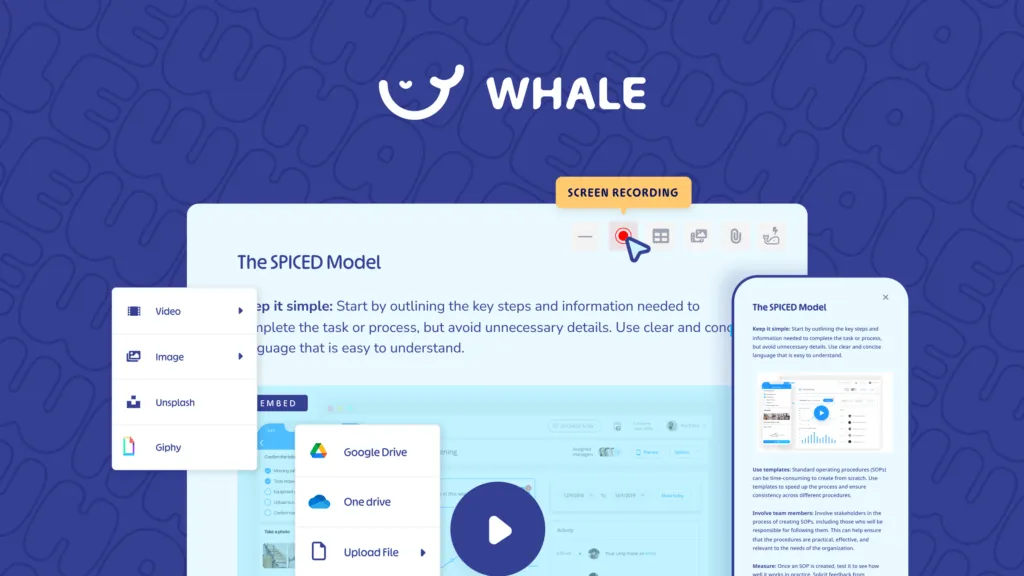
Whale stands out for its versatility in creating SOPs, training programs, and automated onboarding processes.
If you’re looking for a tool where you could step record, screen record, start from scratch, automate onboarding with processes, train your teams with quizzes….and more, then you need Whale!
With Whale, you get;
- ✅ Faster ramp-up time for new hire onboarding
- ✅ Automated employee training
- ✅ Centralized SOPs, processes, and company knowledge
- ✅ Knowledge your team can access in the moment of need
- ✅ The ability to access processes anywhere, anytime
- ✅ To eliminate repetitive questions
Best Features:
- Whale’s step recorder
- Video to SOP capability
- Automated training and onboarding tools, including quizzes
- Ability to hide sensitive data during screen recording
- The Whale MCP connects SOPs to your company’s agentic workflows
Pros:
- More than one way in. With Whale, the step recorder builds a guide from your clicks while you work, an uploaded video or screen recording converts into a written SOP, the AI SOP Writer drafts from rough notes, and existing PDF and Word files import and become editable SOPs. Scribe captures browser clicks, so anything that started as a video, a document or a conversation has to be rebuilt by hand. The capture tools are all on the free plan, and more than 100 templates mean you are not starting from a blank page.
- Documentation that does not quietly go stale. Every SOP carries version history, an owner and a review interval, so it comes back for re-approval instead of drifting. An AI health score on each SOP shows how complete and current it is, and Knowledge Health flags where the gaps are before someone hits one. Version history runs 90 days on Scale, a year on Advance and unlimited on Enterprise. Capture tools give you a guide and no way to know which of your guides is now wrong.
- Findable at the moment someone needs it. Everything lives in one searchable knowledge base organized into boards, libraries and playbooks, rather than as a collection of individual links. Alice answers questions in plain language from your own SOPs and cites which document the answer came from, the CoPilot browser extension surfaces the right process inside the tool someone is already working in, and Whale MCP lets Claude, ChatGPT or Cursor read your live documentation over OAuth. Conversational search and MCP are available from the Scale plan, with a trial of Whale AI on the free plan.
Cons:
- AI features run on monthly credits rather than being unmetered. The Free plan includes 20 credits, Scale 50 per creator per month and Advance 100.
- Whale is not a great fit for small teams. The free plan covers up to 10 members, but the first paid tier is $249/month billed annually, which is a real step up once you outgrow it.
Pricing:
- Free forever for up to 10 members with 1 creator, no credit card required.
- Scale is $399/month billed monthly, or $249/month billed annually, with 3 creators included.
- Advance is $799/month billed monthly, or $499/month billed annually, with 5 creators included.
- Enterprise pricing is available on request.
See the full Whale pricing page.
The Whale step recorder
The Whale step recorder browser extension automatically builds step-by-step training processes WHILE you work, so you don’t have to stop working in order to document.
The Step Recorder captures every click as you work. You get a video of the process, annotated screenshots, and a written step-by-step guide. Teams document 84% faster with the Whale Step Recorder.
Let your documents write themself with the Whale screen recorder.
How to install the step recorder on Whale
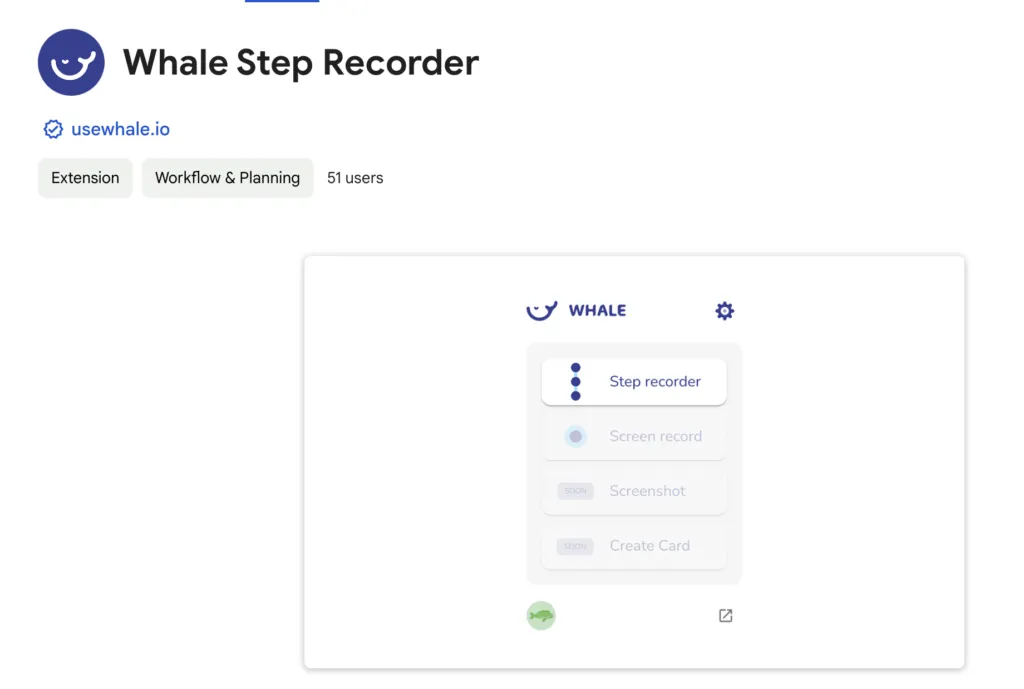
Follow these steps to turn your step recording into a process that aligns your whole team;
- Install the Chrome extension
- Go to the platform where you want to record a specific process
- Start your step recorder and go through all the steps you need to
- Stop recording when you’re done
- The step recorder will now generate the steps separately as cards in Whale
- Simply review and tweak your process as needed
- Share it with your team!
The Whale step recorder has features like;
✅ Being able to hide sensitive data. So, if you’re working in a CRM tool or in a browser where you don’t want to show certain information, you can just hide that information.
Get the easy Scribe alternative to help align your team faster ➜
Why customers love Whale
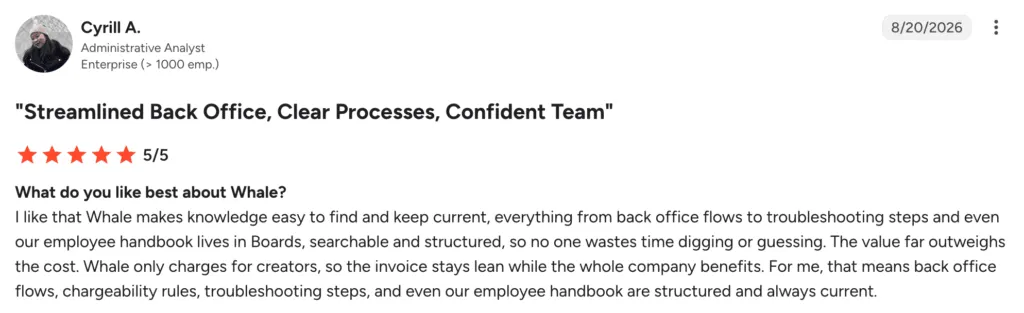
Whale on G2
So you’re looking for a tool that does more than simply act as a step recorder? You want to document your processes and use them to unlock growth in your business?
With Whale, you can get started for free and unlock growth immediately.
For a direct side-by-side of Whale and Scribe, read the full Whale vs. Scribe comparison.
2. Glitter AI vs. Scribe
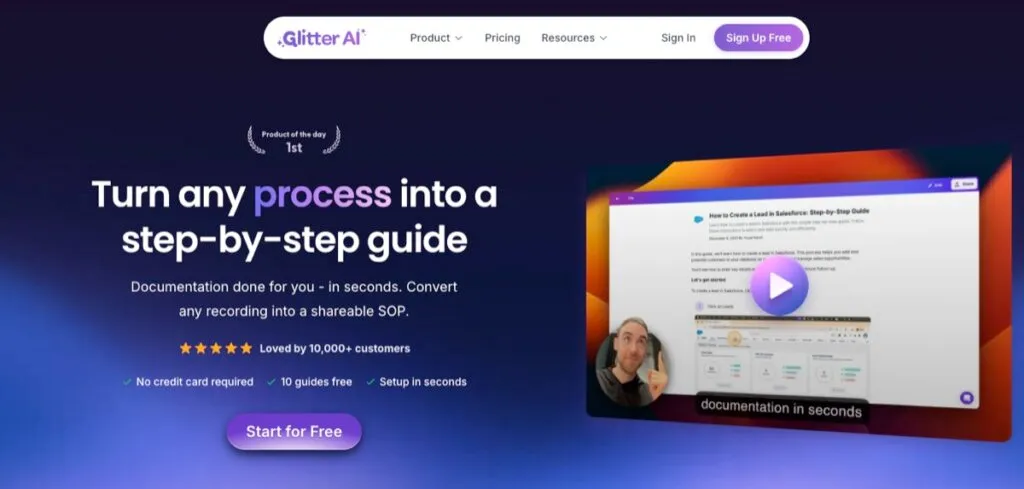
Glitter AI is an AI documentation tool that turns one screen recording into both a written SOP and a video walkthrough. You talk through the process while you work, and it captures your voice, your clicks and your hover actions, then writes the steps, selects the screenshots and keeps the original video next to the finished guide. For teams leaving Scribe, it is the closest alternative that records the reasoning behind each step rather than just where to click, and it can also turn an existing video into a guide.
Best Features
- One screen recording produces both a written, screenshot-by-screenshot SOP and a video walkthrough, so you do the work once and get both formats
- Voice narration transcribed into the steps, which captures why a step happens rather than only what to click
- Existing video converts into documentation: upload a screen recording, a meeting recording or footage of a real-world process and it becomes a step-by-step guide
Pros 👍
- Guides are available in 99 languages, which helps if you are documenting for a team spread across regions
- SOC 2 Type II certified, and Glitter AI states it has never used customer content to train AI models
- A genuine ongoing free tier of 10 guides rather than a time-limited trial, with exports to PDF, HTML and Markdown
Cons 👎
- It documents processes, it does not run training programs. There are no courses, quizzes or completion tracking, so teams that need to assign training and verify it was done pair it with a platform like Whale
- Recording length is capped by plan, from 5 minutes on the free tier up to 60 minutes on Enterprise
- Glitter AI publishes annually billed rates only, so the cost of a month-to-month plan is not stated on its pricing page
Pricing
- Free: $0, 10 guides, 5-minute recording limit.
- Pro: $16 per seat per month billed annually ($192 per seat per year), unlimited guides.
- Team: $12 per seat per month billed annually ($720 per year for 5 seats).
- Enterprise: custom pricing.
3. SOPX vs. Scribe
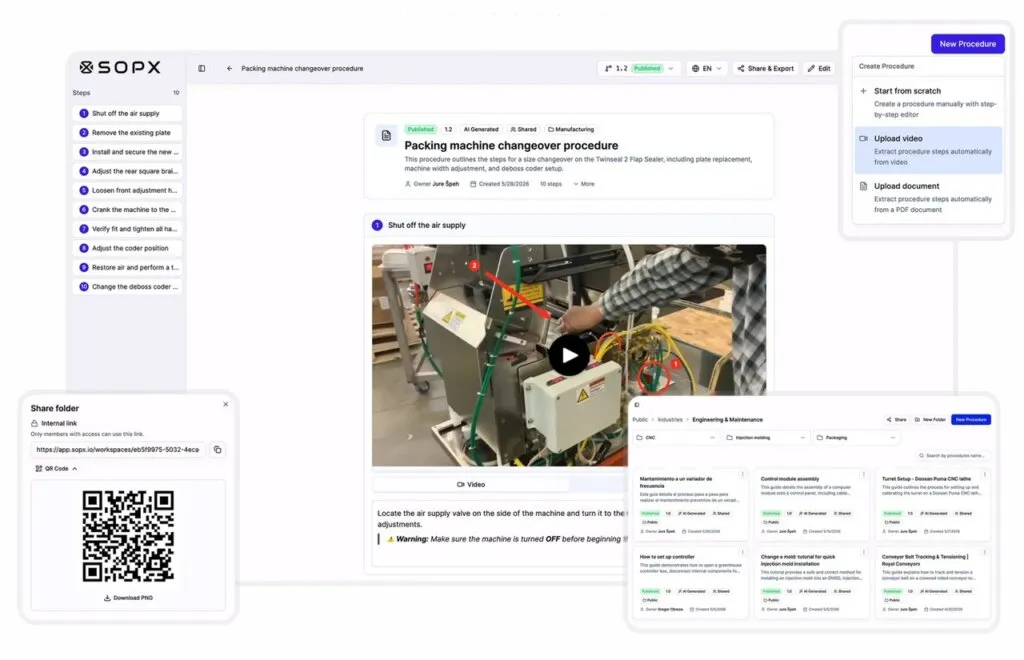
SOPX is an AI documentation platform that covers both kinds of process, on-screen and off. Scribe captures browser clicks, so a machine changeover, a cleaning cycle or a warehouse pick falls outside what it can record. SOPX takes a video of either, a screen recording or phone footage of physical work, and the AI pulls out the steps, trims a video clip for each one and drafts the descriptions, returning a structured SOP in minutes. The procedures then live in SOPX, versioned and searchable, and can be run as a checklist that records who completed each step, with a QR code at the workstation so the version an operator opens is the current one.
Best Features
- Screen recordings and phone video both become step-by-step SOPs, with an auto-trimmed video clip on each step, annotated key frames and AI-drafted purpose, scope and safety details
- AI translation into 50+ languages with a side-by-side review, so a bilingual supervisor can correct terminology before the translated version goes live, and operators open the procedure by QR code and read it in their own language
- Existing PDF work instructions import and convert into structured, editable SOPs, so a binder of legacy documents does not have to be retyped
Pros 👍
- One tool for software workflows and physical work, so teams that have both do not run two tools to document them
- Self-serve with no sales call and no implementation project, and the 14-day trial runs without a credit card
- Version history with restore, plus per-step comments that let an operator flag an outdated step without being able to edit it, which is what keeps a procedure current on a floor where the process keeps changing
Cons 👎
- It documents procedures and tracks that they were run, it does not run a training program. There are no courses, learning paths or quizzes, so teams that need structured onboarding and training records pair it with a platform like Whale
- No browser extension that captures clicks as you work. Screen workflows have to be recorded and uploaded, so Scribe is stronger on live capture
- Video length is capped by plan, 10 minutes on the trial and 20 minutes on Pro and Enterprise, with up to 40 minutes available on Enterprise by request
Pricing
- Free trial: 14 days, 5 AI-generated SOPs, 3 AI translations, up to 100 teammates, no credit card.
- Pro: $12 per user per month, or $9 per user per month billed annually ($108 per user per year). Unlimited AI SOPs and translations, up to 100 users.
- Enterprise: custom pricing, for 100+ users or multiple sites. Adds SSO, SCIM 2.0 provisioning and custom branding.
4. Tango vs. Scribe
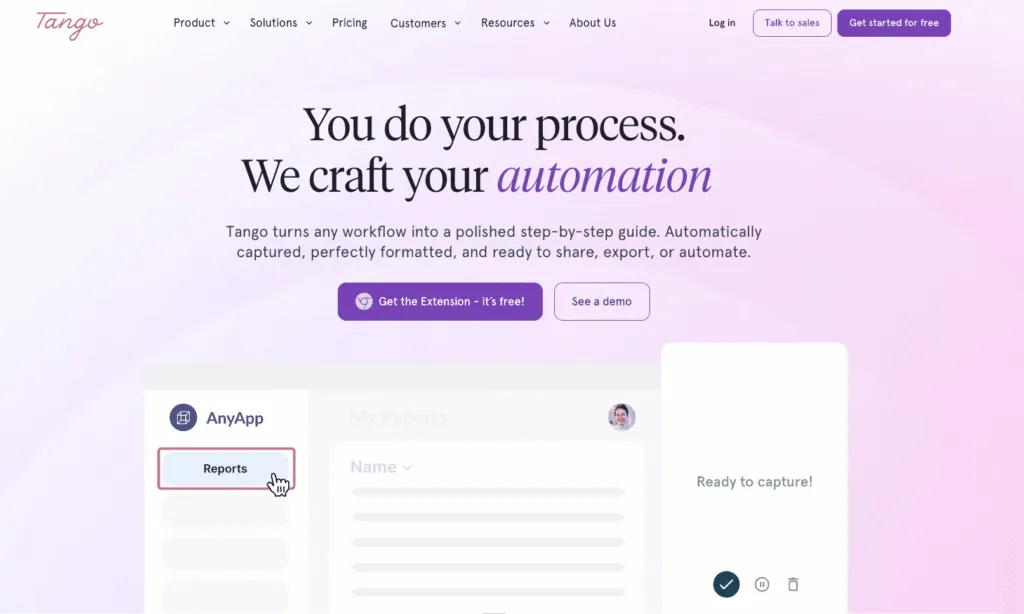
Tango is a documentation tool built for teams that want their guides to get used once they exist. Like Scribe, it captures workflows automatically and turns them into step-by-step guides with screenshots. The difference shows up after the guide is made: instead of stopping at a shareable document, Tango can turn that same workflow into in-app guidance that walks a user through the process live, inside the tool where they’re working.
Best Features
- Automatic workflow capture via browser extension or desktop app
- In-app guidance (“Guide Me”) that shows users exactly where to click, live inside the tool
- Real-time automation that can complete repetitive steps on a user’s behalf, with approval built in before anything saves
Pros 👍
- Genuinely differentiated from a pure screenshot tool once you use the in-app guidance features
- Free plan includes browser capture and sharing for small teams
- Strong fit for onboarding new software or standardizing a process across a team
Cons 👎
- The in-app guidance and automation features are the real value here, but they add complexity most one-person or lightweight use cases don’t need
- Team pricing requires a 3-seat minimum to access the lower per-seat rate
Pricing
- Free plan available.
- Pro Team: $15 per user per month, starts at 3 users.
- Pro Personal: $22 per user per month, for 1 to 2 users.
- Enterprise: custom pricing.
5. Guidde vs. Scribe
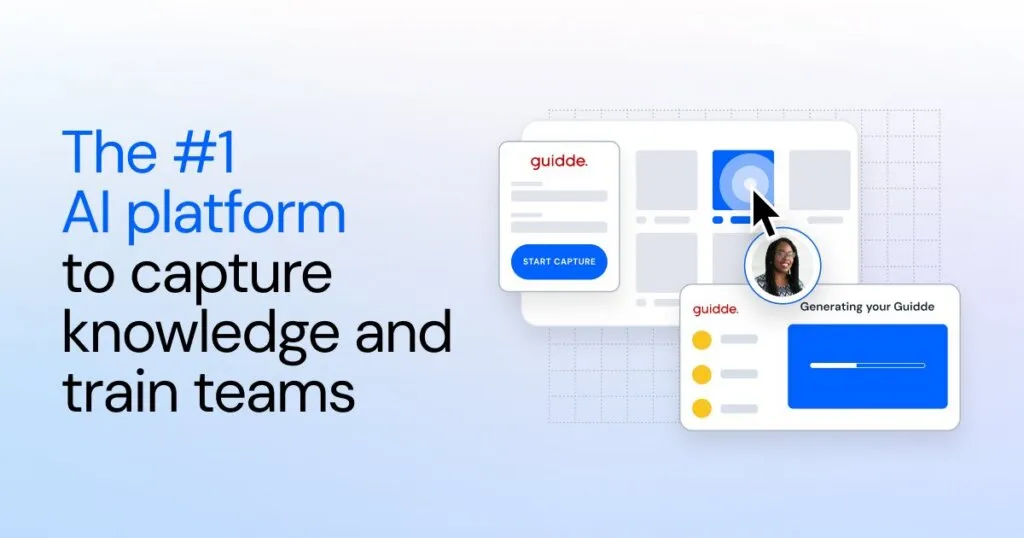
Guidde takes a different approach than Scribe entirely. Instead of a step-by-step screenshot guide, it turns a single screen recording into a narrated video walkthrough, complete with AI-generated voiceover, captions, and annotated steps. It’s built for teams who want to explain a process on video rather than only document it.
Best Features
- One-take screen recording that generates both a video and a written guide from the same capture
- AI voiceover and captions in multiple languages, no need to record narration yourself
- Guides can be pushed directly inside the applications where employees or customers are working
Pros 👍
- Genuinely useful for training and customer-facing content where a walkthrough communicates more than a screenshot sequence can
- Multi-language voiceover support is a real differentiator for global teams
- Free plan covers up to 25 videos, enough to properly test the tool before paying
Cons 👎
- Video-first format takes longer to review and edit than a screenshot guide, even with AI doing the narration
- Free and Pro plans carry a Guidde watermark until you upgrade to remove it
- Less suited to fast, lightweight internal documentation than a pure screenshot tool
Pricing
- Free: $0 per creator per month, up to 25 videos.
- Pro: $19 per creator per month billed annually ($29 billed monthly).
- Business: $39 per creator per month billed annually ($59 billed monthly).
- Enterprise: custom pricing.
6. Iorad vs. Scribe
Iorad works similarly to Scribe on the surface: switch on the browser extension, record your process, and it generates a step-by-step guide automatically. Where it stands apart is what you can do with that guide afterward. Iorad can turn it into an interactive tutorial that lets someone click through the actual steps themselves, rather than just reading about them.
Best Features
- Automatic capture that generates a guide as you work, similar to Scribe’s core flow
- Converts guides into interactive, click-through tutorials for hands-on practice
- Large integrations library, including Canva, ClickUp, Confluence, Intercom, and HubSpot
Pros 👍
- The interactive tutorial format is genuinely useful for training people who learn better by doing than by reading
- Free plan supports unlimited tutorials, provided they’re publicly accessible
- Strong integration support if your team already lives in tools like Confluence or Intercom
Cons 👎
- Less intuitive out of the box than Scribe, so expect a learning curve before it clicks
- Free tier only covers public sharing. Keeping content private or sharing with a team requires a paid plan
- Doesn’t offer the broader SOP or knowledge-base structure some teams need beyond individual tutorials
Pricing
- Free: unlimited public tutorials.
- Individual: $200 per month for private tutorials.
- Team: $500 per month, 1 seat included, $50 per month per extra seat.
- Enterprise: custom pricing.
7. Loom vs. Scribe
Loom is a straightforward video recording tool that lets you record your screen and voice. It’s an ideal alternative for those needing to create video-based how-to guides and training materials.
Best Features
- Screen and camera recording options
- Supports one-click integration with Google Workspace, Slack, and other tools
- Offers transcription and captioning in over 50 languages
Pros 👍
- Loom is easy to use, allowing users to record and share videos quickly. Its intuitive interface makes it accessible for users of all levels of technical expertise.
Cons 👎
- While Loom is great for video recordings, it lacks advanced editing features. It ultimately requires a knowledge base in order to store videos as processes and use them for team training.
Pricing
- Starter: Free, up to 25 videos with a 5-minute recording cap.
- Business: around $15 to $18 per user per month.
- Business + AI: around $20 to $24 per user per month.
- Enterprise: custom pricing.
Ratings
Loom is rated 4.7 out of 5 on G2.
8. Folge vs. Scribe
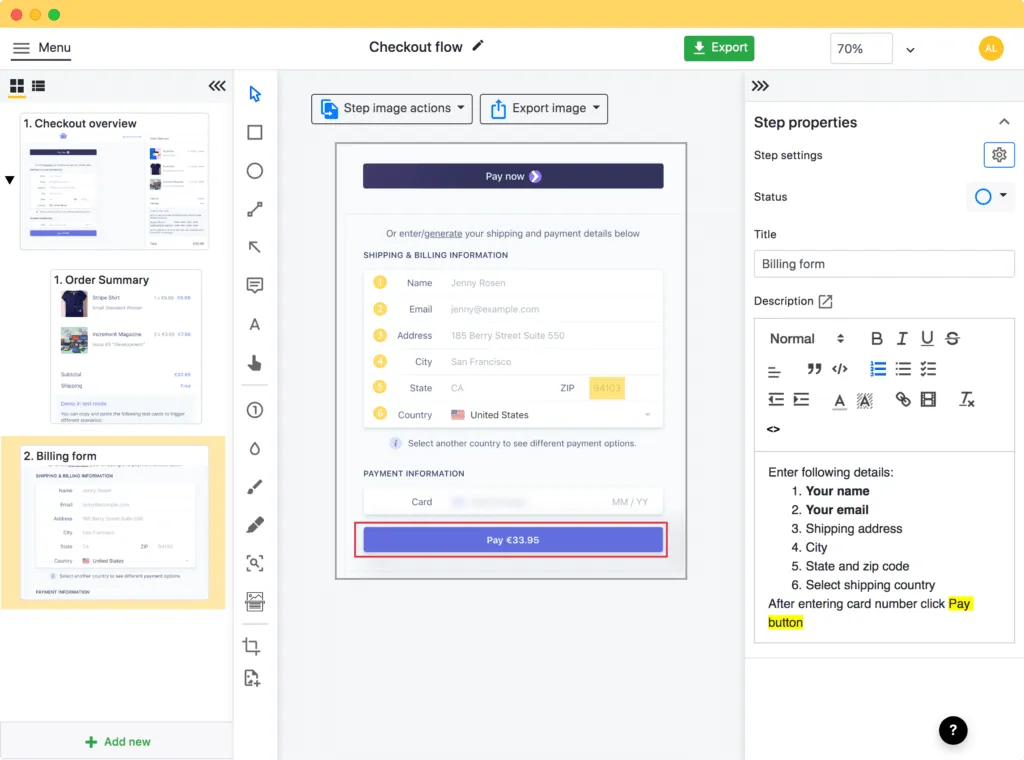
Folge is a simple, free, and powerful desktop tool to create, manage, and share your processes and knowledge.
Best Features:
- Annotation tools for screenshots
- Customizable export options in various formats (PDF, Word, etc.)
- No recurring monthly fees for licenses
Pros 👍
- If you’ve tried to make a tutorial guide in Word or PowerPoint, you’ll love how easy Folge is in comparison.
- Export options in seven formats.
Cons 👎
- It can be a little bit of a learning curve on how to set up and collect screenshots and coordinate documents.
- Backup/restore from a cloud solution within the software is unavailable.
Pricing
- One-time purchase, no subscription.
- Free plan available for 3 guides.
- Personal license: $89 one-time.
- Business license: $155 per seat, one-time.
Ratings
Folge is rated 4.8 on Capterra
9. Trainual vs. Scribe
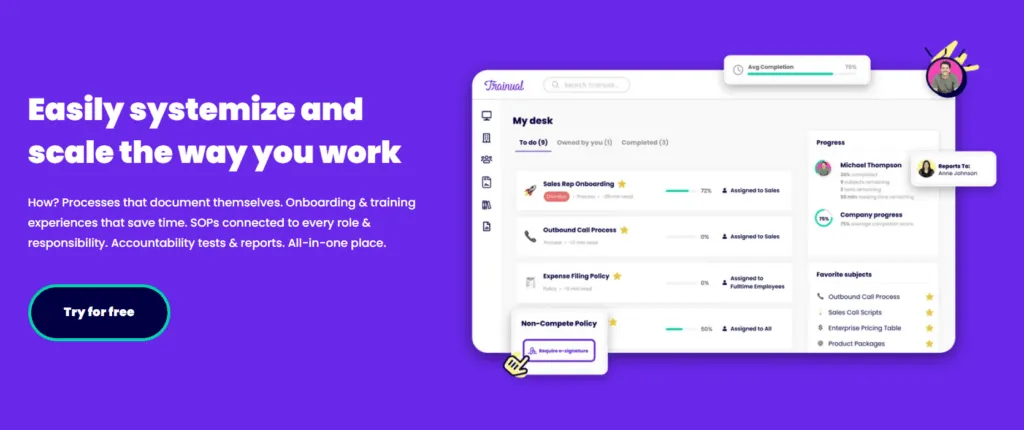
Trainual is a documentation and training platform built for formal training programs, with tracking and e-signatures.
Pros 👍
- Trainual allows businesses to centralize their training materials, making it convenient to manage and update training content from one place.
Cons 👎
- The setup process, even with already having documentation in place, can be burdensome, and the flow of how to use the software can be confusing.
Pricing
- Trainual offers Core, Pro, Premium, and Enterprise tiers.
- Exact pricing is available on request.
Ratings
Trainual is rated 4.7 out of 5 on G2.
10. UserGuiding vs. Scribe
UserGuiding is a user onboarding platform that allows you to create product walkthroughs and interactive guides without coding. This tool is a good Scribe alternative if your main focus is product or customer onboarding.
Pros 👍
- UserGuiding offers an intuitive and easy-to-use interface, making it accessible for users with varying technical skills.
Cons 👎
- UserGuiding’s pricing may be a drawback for small businesses and startups, as it might be relatively expensive compared to some other similar tools.
- The analytics could be more detailed and user-friendly.
Pricing
- Starter: $299/month.
- Growth: $599/month.
- Enterprise: custom pricing.
UserGuiding prices by usage rather than per seat. The figures above apply at 2,400 monthly active users (MAU) and scale with your user count.
Ratings
Userguiding has a rating of 4.2 out of 5 on ProductHunt based and 4.7 out of 5 on G2
11. ClickUp vs. Scribe
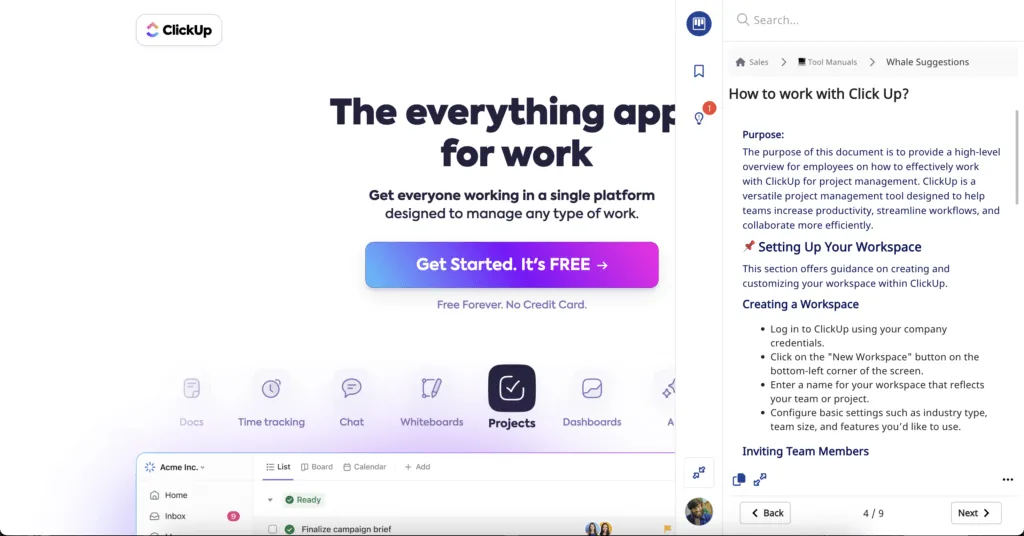
Although primarily a project management platform, ClickUp offers robust tools for documentation, including ClickUp Docs for building SOPs and onboarding materials.
Best Features:
- ClickUp’s Clip feature allows you to create training and SOP videos quickly.
- Multi-functional, with tools for project management, task assignments, and collaborative features.
Pros:
- One-stop solution for project management and documentation
- Strong integration with other project tools
Cons:
- Wide feature set can feel overwhelming for new users
Pricing: Free Forever plan available. Unlimited: $10 per user per month. Business: $19 per user per month. Enterprise: custom pricing.
The Bottom Line? Find the Best Scribe Alternative
Each Scribe alternative on this list offers unique features, from cost savings to enhanced collaboration. Whether you’re looking to streamline onboarding, create professional SOPs, or integrate with your current tools, there’s a solution to fit your needs.
Using a Scribe alternative for screen recording can be beneficial for various reasons including cost (Scribe is pricier than most of the alternatives on the market) and compatibility.
It’s also important to consider your business context and added features like being able to turn recordings into processes.
If you want to take your recordings to the next level as use them as processes, suggest taking a look at Whale.
Key Terms & Further Reading on Scribe
Key Definitions
Knowledge management definition
Helpdesk ticketing system definition
Additional resources
Onboarding checklist for manager
Related blog posts
Lisa Steingold is the Content Marketing Manager for Whale. She's authored 4 books and is obsessed with helping teams unlock the next level of growth. (And riding her bicycle)