

In this article
In today's complex regulatory landscape, managing compliance with spreadsheets and scattered documents isn't just inefficient; it's a significant business risk. From GDPR and SOC 2 to industry-specific mandates in finance, manufacturing, and healthcare, the stakes are incredibly high. A single misstep can lead to hefty fines, reputational damage, and operational chaos. This is where dedicated compliance management software becomes a strategic necessity, transforming compliance from a reactive, manual burden into a streamlined, automated, and proactive process.
But the market is crowded with options, each promising a complete solution. How do you cut through the noise to find a platform that genuinely fits your specific operational needs, budget, and industry vertical? This guide is designed to provide that clarity. We've created a comprehensive, buyer-focused roundup of the 12 best compliance management software solutions and resources available. To truly understand the value of these platforms, it's vital to first grasp What Is Compliance Management and its overarching importance for modern businesses.
We'll move beyond generic marketing claims to offer a practical, in-depth analysis of each tool. You will find a detailed breakdown of key features, ideal use cases for teams in operations and HR, and an honest assessment of limitations. For each option, we provide screenshots and direct links to help you evaluate the user experience firsthand. This resource is built to help you make an informed decision, equipping you with the knowledge to select the right software to protect and scale your business effectively.
1. Whale
Best For: SOP- and Training-Centric Compliance Management
Whale stands out as a premier choice for organizations where compliance is deeply intertwined with standard operating procedures (SOPs) and employee training. It transforms process documentation from a static, cumbersome task into a dynamic, accessible knowledge base, making it a powerful contender for the best compliance management software, especially for process-driven teams. The platform's core strength lies in its ability to create, manage, and disseminate critical procedures, ensuring every team member operates from a single source of truth.
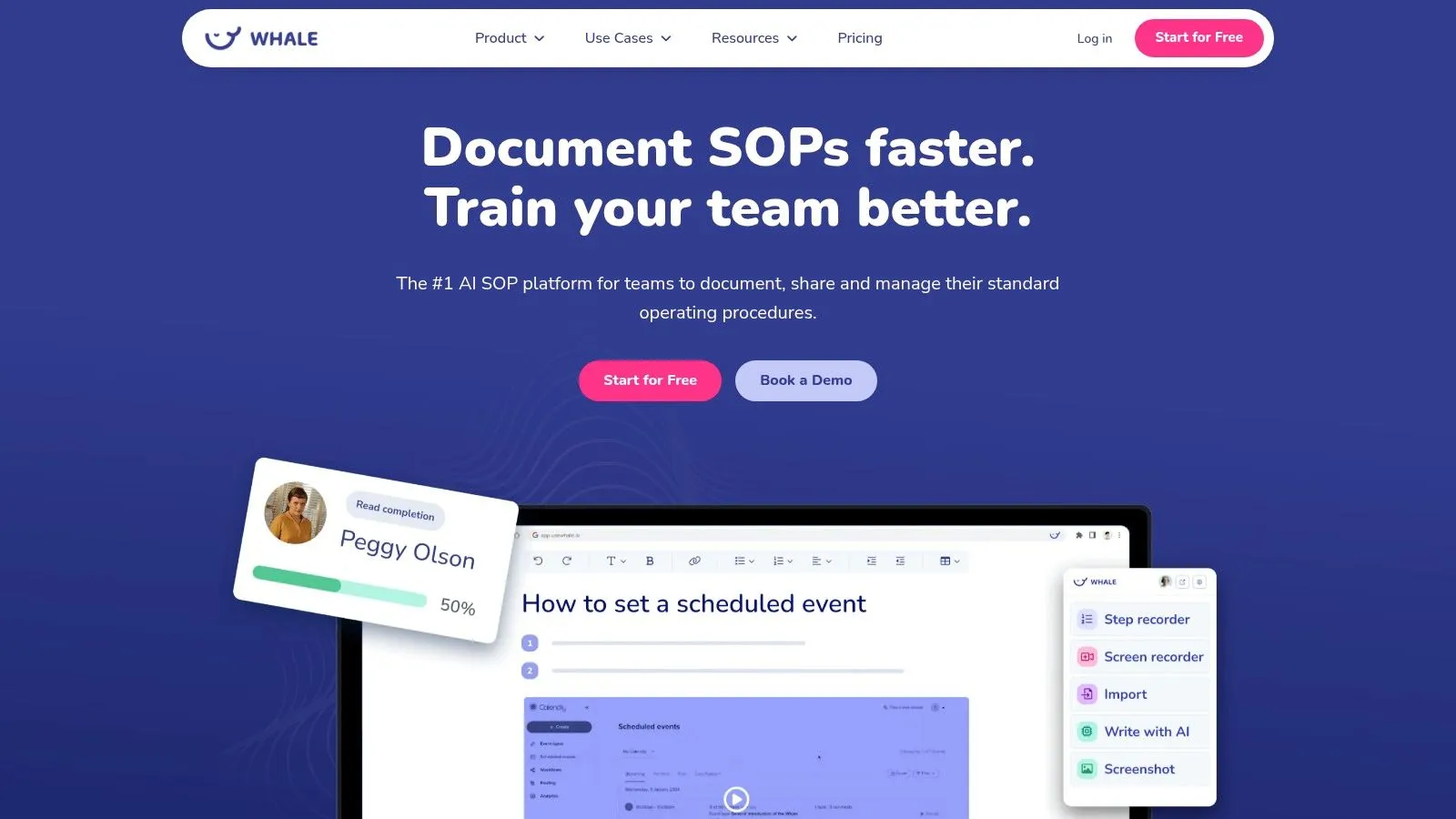
Unlike traditional compliance systems that focus solely on audits and regulatory checklists, Whale emphasizes the human element. Its AI-powered tools accelerate the creation of clear, step-by-step guides, importing existing documents and converting them into structured, actionable content. This approach directly addresses a common compliance failure point: outdated or inaccessible procedural information.
Standout Features & Use Cases
Whale’s feature set is built to ensure procedural adherence and verifiable training, which are critical for regulated industries.
- AI-Accelerated Documentation: Operations managers can use the AI assistant, Alice, to instantly generate SOPs from existing manuals or unstructured notes. This significantly reduces the administrative burden of documenting complex compliance workflows, such as those required for ISO 9001 or financial reporting standards.
- Version Control & Centralization: A key compliance requirement is ensuring everyone uses the most current procedure. Whale’s built-in version control and automated update notifications eliminate the risk of employees following obsolete guidelines, a critical function in manufacturing and logistics where process changes are frequent.
- Integrated Training & Quizzing: Human Resources and training teams can leverage Alice to automatically create quizzes from SOP content. This provides a measurable way to confirm employee understanding of safety protocols, data privacy policies, or other compliance-related tasks, with analytics to track completion and identify knowledge gaps.
- Industry-Specific Templates: The platform offers ready-to-use templates for sectors like finance, IT, and manufacturing. This provides a solid foundation for building out compliance frameworks, saving valuable time during implementation.
Implementation and Pricing
Whale promotes a low-friction adoption path. You can start with a free trial without needing a credit card, allowing teams to evaluate its core functionality firsthand. For more complex needs, Certified Whale consultants are available to assist with tailored implementations, ensuring the platform aligns with specific industry regulations.
While specific pricing for enterprise tiers requires contacting their sales team, the availability of a free trial, an ROI calculator, and extensive customer support resources makes it accessible for organizations to assess its value before committing.
Learn more at usewhale.io.
2. OneTrust
OneTrust is a comprehensive governance, risk, and compliance (GRC) platform best suited for large organizations navigating complex, multi-domain regulatory landscapes. Its strength lies in integrating privacy, third-party risk management (TPRM), and technology risk into a single, cohesive system. This makes it a powerful choice for enterprises needing to manage global standards like GDPR, CCPA, and ISO 27001 in one place. The platform excels at automating traditionally manual tasks, such as data subject requests (DSRs), risk assessments, and incident response workflows.
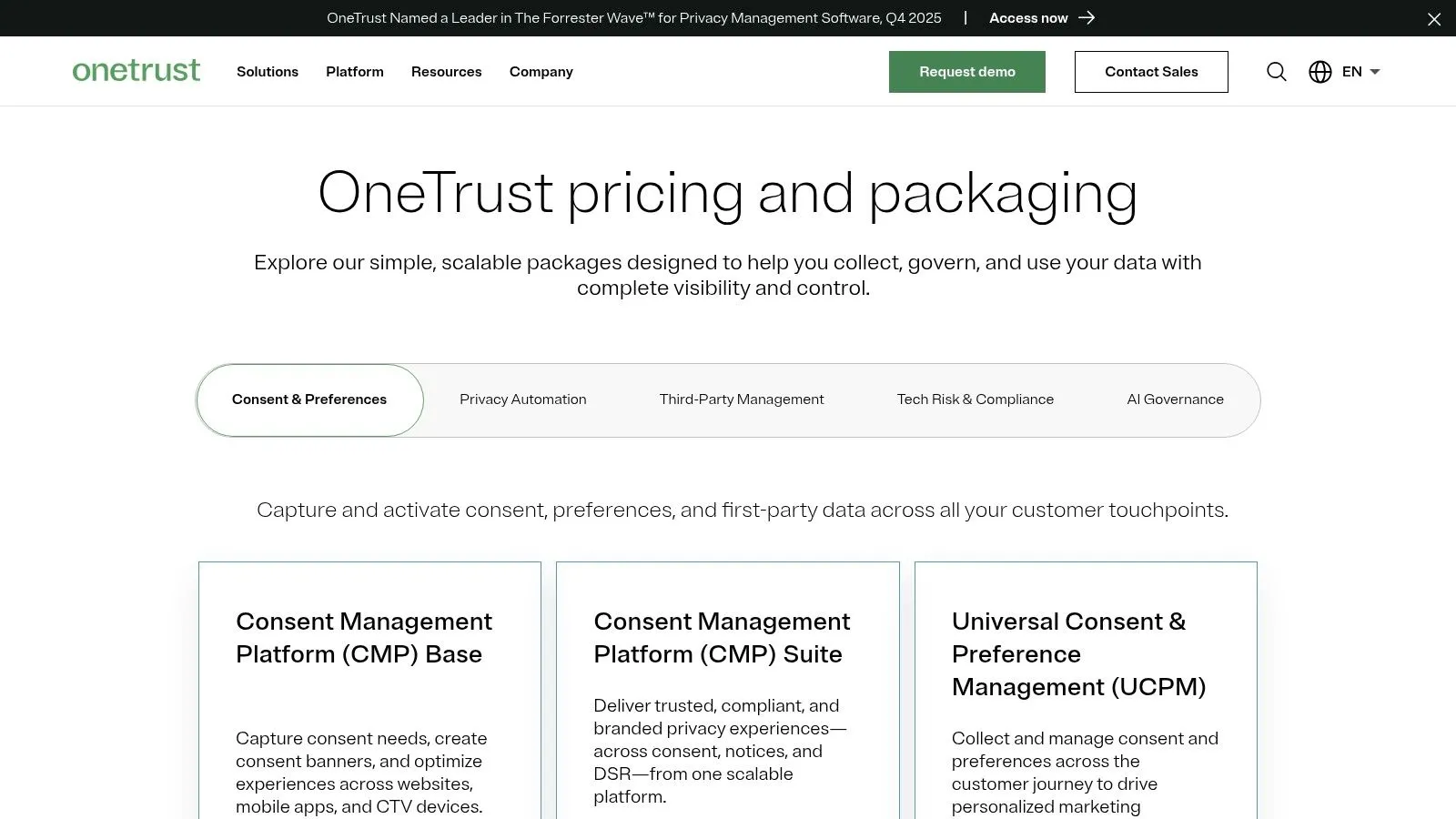
Unlike more niche tools, OneTrust offers deep module coverage and built-in risk intelligence, including watchlist and sanctions data checks, which is critical for TPRM. It’s a mature solution backed by a vast library of over 50 frameworks and policy templates, reducing the initial setup burden. While this depth is invaluable for scale, smaller teams may find the implementation process significant and the quote-based pricing model a hurdle.
Key Details & Features
- Best For: Large enterprises needing a unified platform for privacy, third-party risk, and IT compliance at a global scale.
- Pricing: Custom quote-based. Pricing is metered by factors like admin users and the size of your managed inventory. You must contact their sales team for a quote.
- Key Features:
- Workflow automation for DSRs, risk assessments, and incidents.
- Integrated risk intelligence and sanctions/adverse media checks.
- Policy and notice lifecycle management.
- Extensive library of pre-built templates for audits and assessments.
- Integrations: Connects with a wide range of enterprise systems, including cloud providers, security tools, and HR platforms.
Pros & Cons
| Pros | Cons |
|---|---|
| Broad Module Coverage | Complex Implementation |
| Deep functionality across privacy, TPRM, and IT risk management. | Can be resource-intensive for small teams to deploy and manage effectively. |
| Scalable for Global Use | Opaque Pricing |
| Designed to handle complex, multinational compliance programs. | The quote-based sales process lacks transparency for initial budgeting. |
| Mature Content Library | Potential Overkill for SMBs |
| A vast collection of templates and frameworks accelerates program setup. | The platform’s extensive capabilities may be more than what a small or mid-size business needs. |
For organizations just starting to build their compliance programs, focusing on foundational elements is key. A solid strategy for employee compliance training is often a more manageable and impactful first step before adopting an enterprise-level platform like OneTrust.
Website: https://www.onetrust.com/pricing/
3. NAVEX One (NAVEX)
NAVEX One positions itself as an integrated ethics and compliance platform, ideal for organizations seeking to manage not just regulations but the cultural aspects of compliance. Its strength lies in combining policy management, employee training, and incident reporting into a unified experience. The platform’s Compliance Hub serves as a central portal where employees can access policies, complete training, and make disclosures, which is a powerful way to embed compliance into daily workflows.
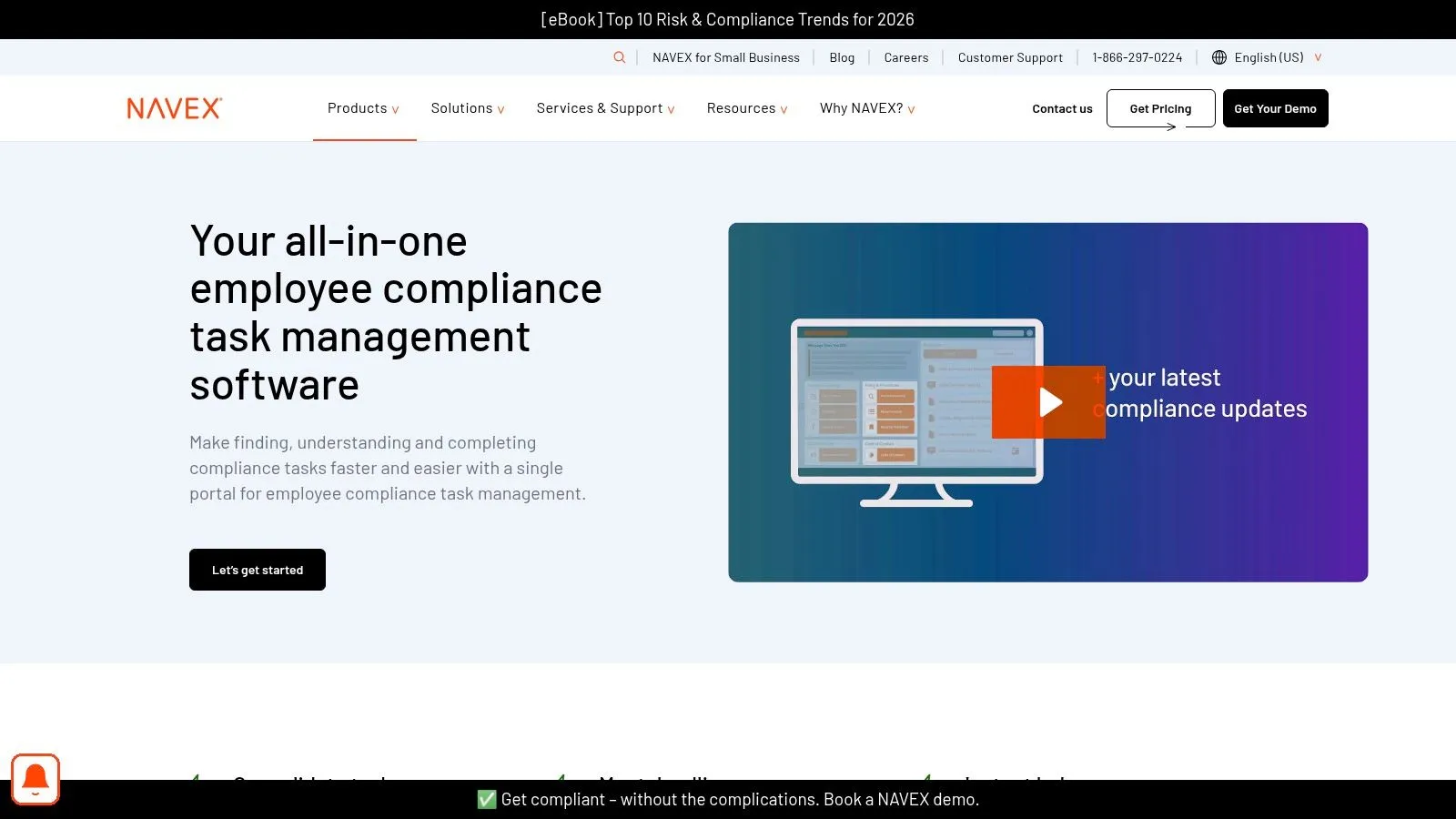
Unlike point solutions that only manage documents, NAVEX One includes the well-regarded EthicsPoint hotline and case management system, providing robust analytics for incident trends. It also incorporates modern tools like an AI-assisted policy summarizer and a multilingual Q&A assistant to improve employee comprehension. While this comprehensive approach is excellent for mature programs, the enterprise-focused sales model and breadth of features may be excessive for startups or businesses focused on a single compliance framework.
Key Details & Features
- Best For: Mid-to-large-sized organizations that need an all-in-one platform for managing ethics, policy lifecycle, and incident reporting.
- Pricing: Custom quote-based. You must contact their sales team to configure a solution and receive pricing.
- Key Features:
- Centralized Compliance Hub for employee tasks, policies, and training.
- EthicsPoint for anonymous incident reporting and case management.
- AI-powered tools for policy summaries and Q&A.
- Professional services for program implementation and support.
- Integrations: Offers integrations with HRIS and single sign-on (SSO) systems to streamline user management and access.
Pros & Cons
| Pros | Cons |
|---|---|
| Broad Ethics & Compliance Suite | Pricing Not Published |
| Covers policy, training, and incident management in a single platform. | The enterprise sales process requires direct contact for a quote, making initial budgeting difficult. |
| Unified Employee Experience | Potential Overkill for SMBs |
| The Compliance Hub and SSO simplify how employees engage with compliance tasks. | The extensive suite may be more than what a startup or small business needs. |
| Strong Support Ecosystem | Complex for Single-Framework Needs |
| Offers robust professional services for implementation and ongoing program management. | Companies focusing on just one standard like SOC 2 may find the platform too broad. |
For organizations that value a strong ethical culture alongside regulatory adherence, NAVEX One is a standout choice. It effectively bridges the gap between policy documentation and employee behavior, making it one of the best compliance management software options for a holistic approach.
Website: https://www.navex.com/en-us/products/navex-ethics-compliance/compliance-hub/
4. Hyperproof
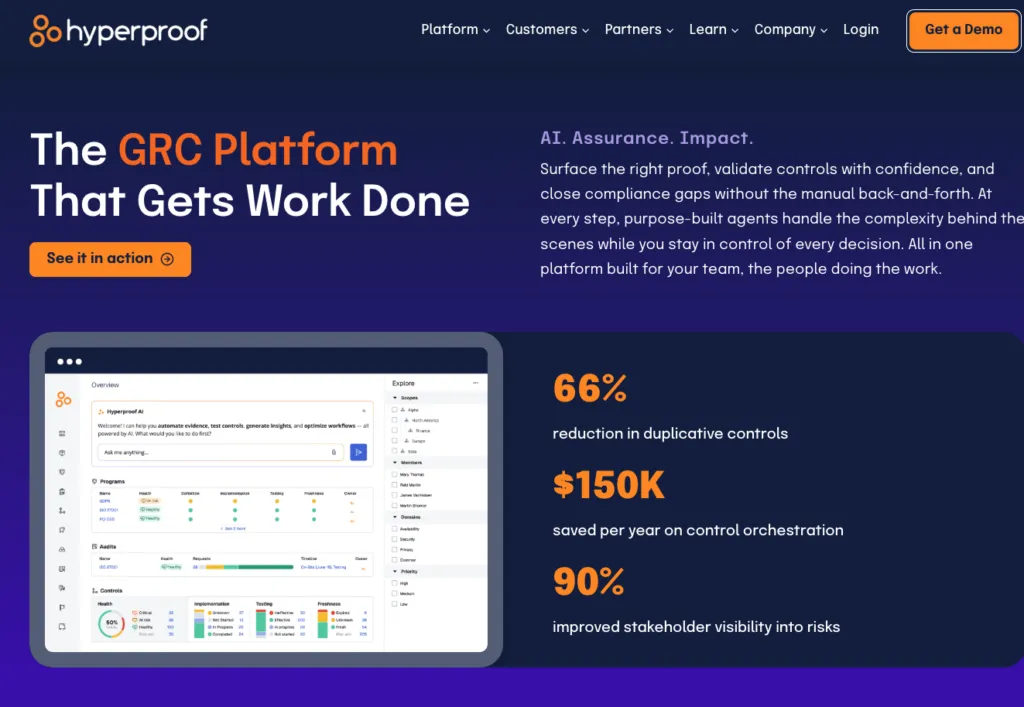
Hyperproof is an AI-powered GRC platform designed for organizations looking to streamline compliance orchestration and reduce manual effort. Its core strength is automating control operations, allowing teams to map a single control to multiple frameworks like SOC 2, ISO 27001, and NIST. This "test once, apply everywhere" approach significantly cuts down on redundant evidence collection and testing, making it an efficient choice for teams managing overlapping regulatory requirements. The platform provides a unified view of compliance, risk registers, and third-party vendor management.
Unlike tools that silo different GRC functions, Hyperproof integrates them into a single user interface with real-time reporting dashboards. It centralizes evidence management, creating a single source of truth that simplifies audit preparation. The platform’s emphasis on automation and enterprise security, including its own SOC 2 Type II compliance, makes it a trusted option for tech-focused companies. However, the lack of public pricing requires direct sales engagement, and unlocking its more advanced configurations may necessitate professional onboarding services.
Key Details & Features
- Best For: Tech-savvy, mid-market to enterprise companies managing multiple, overlapping compliance frameworks who want to automate evidence collection and control testing.
- Pricing: Custom quote-based. You must contact their sales team for a demo and pricing details.
- Key Features:
- Automated control mapping and evidence collection across multiple frameworks.
- Centralized risk registers and vendor risk management modules.
- Real-time reporting dashboards for audit readiness and compliance posture.
- Enterprise-grade security features, including SSO/MFA and SOC 2 Type II compliance.
- Integrations: Connects with cloud providers (AWS, Azure), security tools, project management software, and HRIS platforms.
Pros & Cons
| Pros | Cons |
|---|---|
| Strong Automation | Opaque Pricing |
| Reduces redundant control work and simplifies evidence gathering. | Quote-based model makes it difficult to budget without a sales call. |
| Unified GRC Platform | Onboarding May Be Needed |
| Combines compliance, risk, and vendor management in a single UI. | Advanced configurations and integrations may require professional services. |
| Enterprise-Grade Security | Can Be Complex for Simple Needs |
| Built with a strong security posture, making it ideal for regulated industries. | Might be more robust than what a company with only one or two frameworks needs. |
Effective evidence collection in a tool like Hyperproof relies on strong internal processes. Establishing clear document control procedures ensures that the information fed into the system is accurate, versioned, and audit-ready from the start.
Website: https://hyperproof.io/pricing/
5. Drata
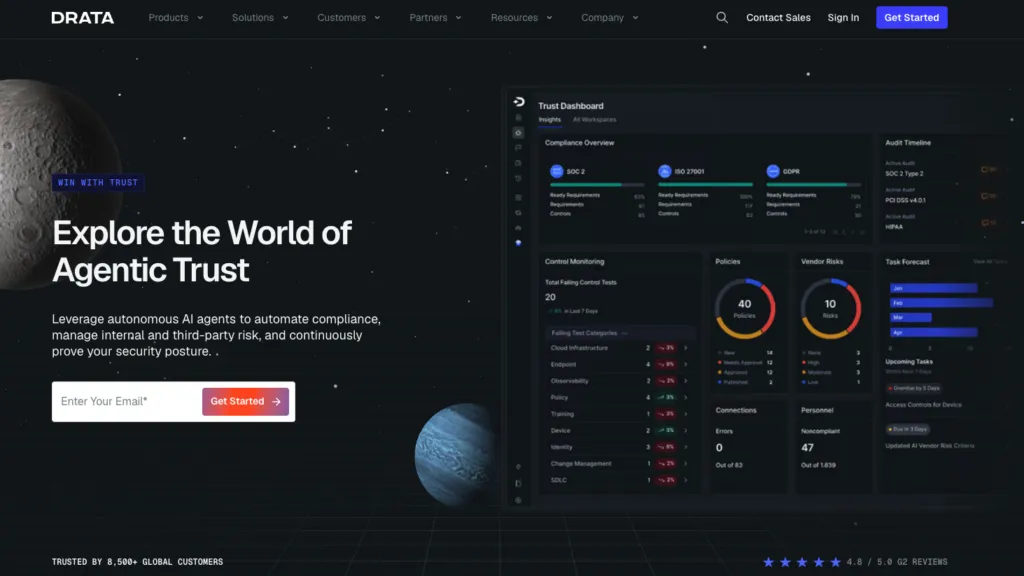
Drata is a security and compliance automation platform designed for fast-growing technology companies aiming to achieve and maintain audit readiness. It excels at streamlining evidence collection and continuous monitoring for frameworks like SOC 2, ISO 27001, HIPAA, and GDPR. The platform connects directly to a company's cloud stack, HR systems, and developer tools to automatically gather proof that controls are in place and operating effectively, drastically reducing manual audit preparation time.
Unlike broader GRC tools, Drata’s strength is its deep focus on technology-centric compliance. Its developer-friendly "compliance-as-code" approach resonates with engineering teams, embedding security into their existing workflows. The platform's automated evidence collection and pre-mapped controls provide a clear, accelerated path to certification, making it one of the best compliance management software solutions for startups and scale-ups that need to build trust with enterprise customers quickly.
Key Details & Features
- Best For: Technology companies and SaaS businesses seeking to automate evidence collection and continuous monitoring for security frameworks like SOC 2 and ISO 27001.
- Pricing: Custom quote-based. Offers structured "Foundation" and "Advanced" tiers, but you must contact their sales team for specific pricing details.
- Key Features:
- Automated evidence collection and continuous controls monitoring.
- Pre-built policy templates and pre-mapped frameworks.
- Integrated risk management and vendor management modules.
- Trust Center to publicly showcase security posture.
- Integrations: Extensive library of pre-built integrations with cloud providers (AWS, Azure, GCP), identity providers, and SaaS tools.
Pros & Cons
| Pros | Cons |
|---|---|
| Fast Audit Readiness | Quote-Based Pricing |
| Accelerates certification for common frameworks through automation. | Lacks public pricing figures, requiring a sales conversation for budgeting. |
| Broad Integration Ecosystem | Niche Security Focus |
| Connects with hundreds of applications for seamless evidence collection. | Less suited for broad ethics, corporate, or non-IT compliance needs. |
| Transparent Plan Structure | Implementation Learning Curve |
| Clearly defined Foundation and Advanced tiers help guide purchasing. | While automated, initial setup requires technical integration and configuration. |
Website: https://drata.com/plans
6. Vanta
Vanta is a compliance automation platform designed to help tech-forward companies streamline and accelerate security certifications like SOC 2, ISO 27001, and HIPAA. It stands out by continuously monitoring a company's systems to gather evidence automatically, significantly reducing the manual effort required to prepare for an audit. This makes Vanta a top choice for startups and growth-stage companies aiming to achieve compliance quickly to unlock enterprise deals or build customer trust.
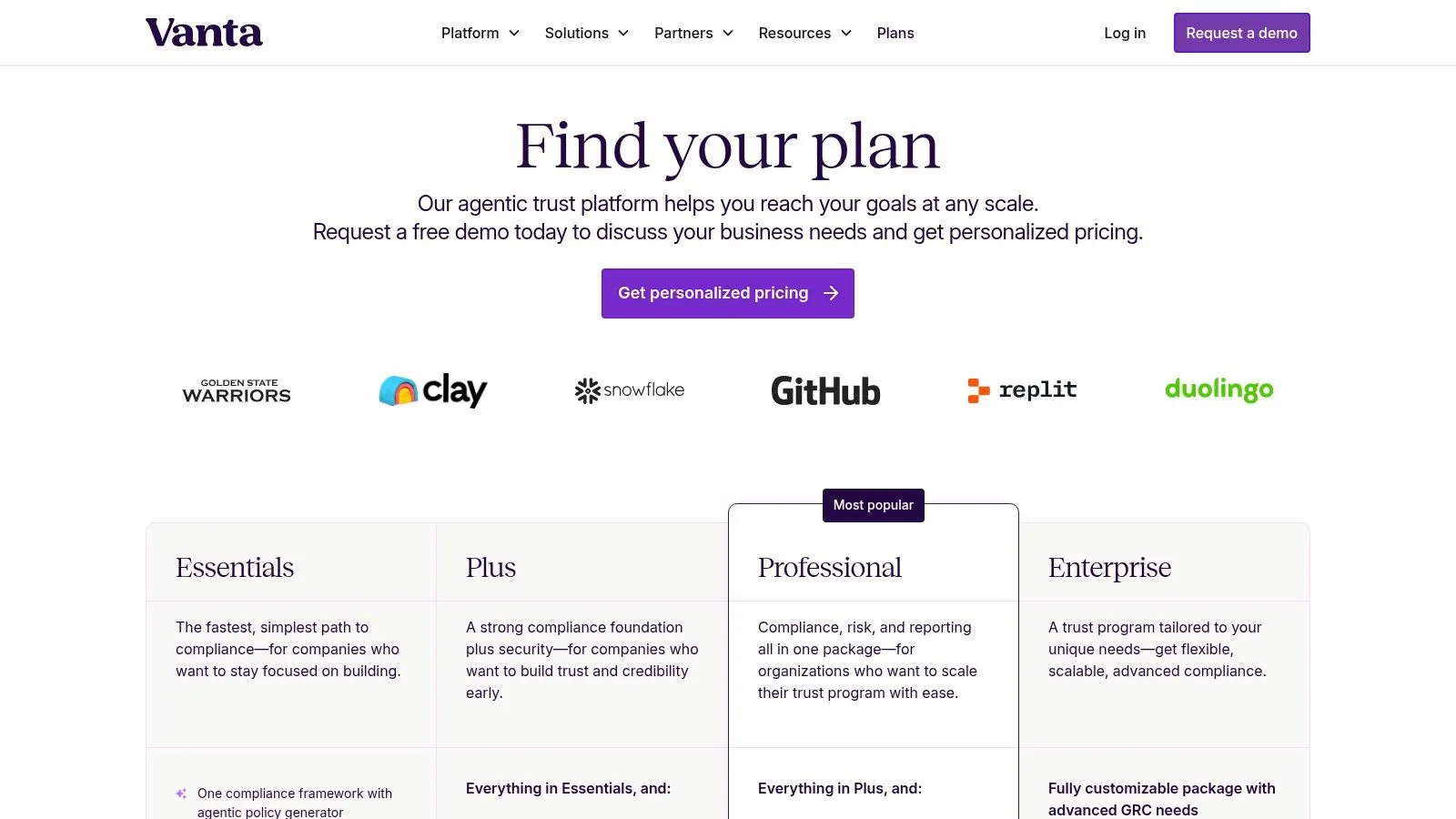
Unlike broad GRC platforms, Vanta’s strength is its deep integration with cloud services, source control, and HR systems, providing real-time visibility into security posture. The platform also offers features like Trust Centers, which help sales teams share security documentation securely, and automated security questionnaires to expedite the sales cycle. Its established ecosystem of partner auditors provides a clear and often faster path to certification, although this can add an extra layer of coordination and cost.
Key Details & Features
- Best For: Technology companies and startups needing to achieve and maintain security certifications like SOC 2 or ISO 27001 quickly.
- Pricing: Custom quote-based. You must book a demo to receive pricing information tailored to your required frameworks and company size.
- Key Features:
- Continuous, automated evidence collection via native integrations.
- Trust Center portals for secure documentation sharing with customers.
- AI-powered security questionnaire automation.
- Access to a network of vetted partner auditors.
- Integrations: Connects with over 200 popular SaaS applications, cloud providers, and developer tools.
Pros & Cons
| Pros | Cons |
|---|---|
| Accelerates First-Time Audits | Opaque Pricing |
| The automated platform and auditor network streamline the certification process. | The lack of public pricing makes initial budget planning difficult. |
| Strong Technical Integrations | Partner Reliance |
| Deep connections to cloud and developer tools provide real-time monitoring. | Some services depend on third-party auditors, which can add cost and complexity. |
| Sales Enablement Tools | Niche Focus |
| Trust Centers and questionnaire automation help prove security to prospects. | May be less suited for companies with complex, non-technical GRC needs. |
While Vanta excels at automating technical compliance checks, it's crucial to remember that compliance also relies on well-documented processes and consistent employee training. A tool focused on standard operating procedures can complement Vanta by ensuring the human side of compliance is just as robust as the technical side.
Website: https://www.vanta.com/pricing
7. Optro (formerly AuditBoard)
Optro is an enterprise-grade platform that unifies audit, risk, and compliance into a single, connected ecosystem. It is particularly well-suited for larger, regulated organizations in the US that need to manage internal audits alongside complex compliance obligations. The platform’s key differentiator is its use of AI to automate manual tasks like evidence collection, control testing, and identifying the impact of regulatory changes, making it one of the best compliance management software choices for teams focused on efficiency.
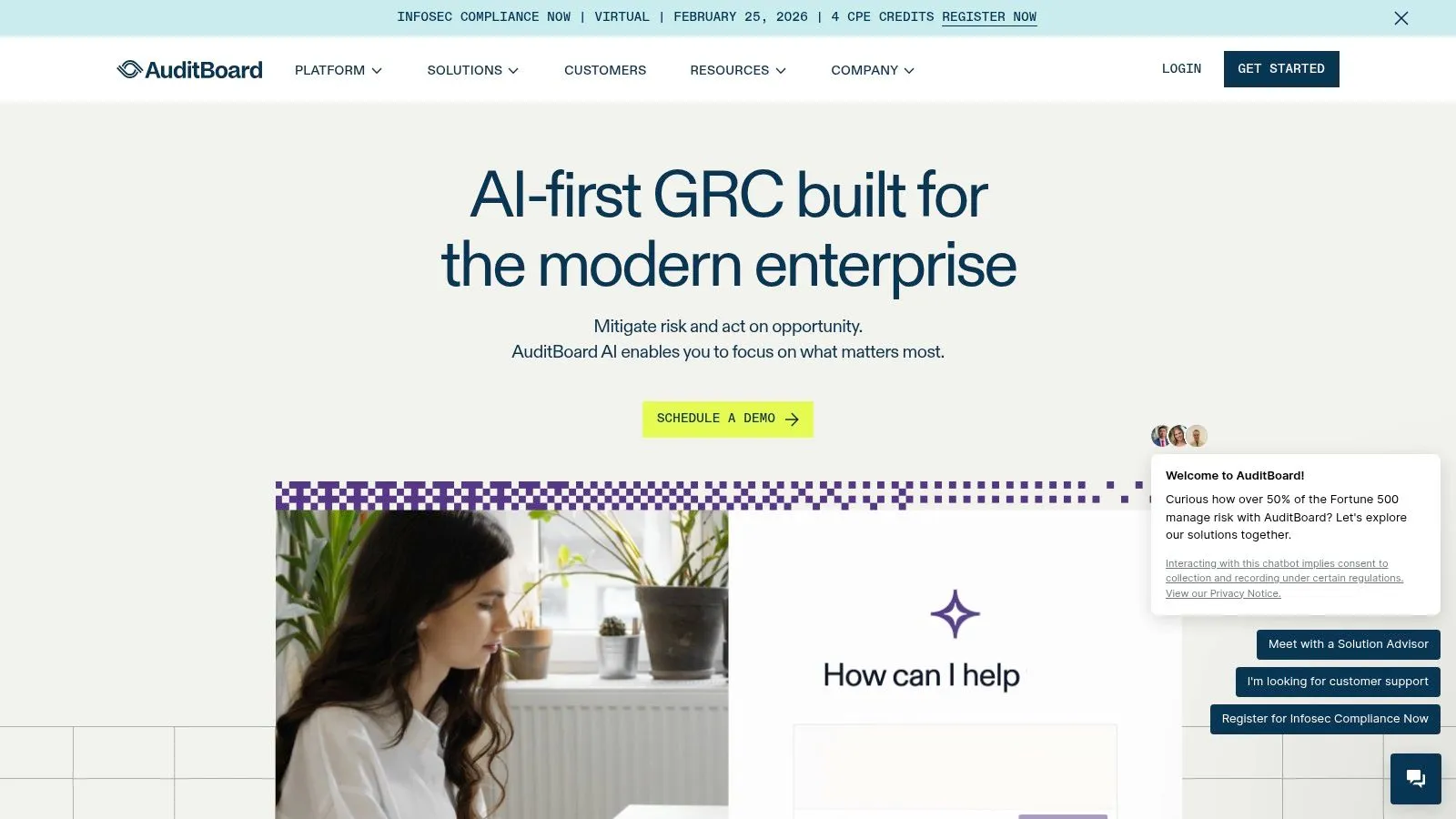
Unlike many GRC tools, Optro maps over 30 frameworks to the Secure Controls Framework (SCF), which simplifies control mapping and reduces redundant testing. Its powerful, user-friendly analytics and reporting capabilities allow teams to build custom dashboards with drag-and-drop functionality for continuous monitoring. While the platform is robust, its quote-based pricing is geared toward mid-to-large enterprise budgets, and implementation often requires significant upfront program design to maximize its value.
Key Details & Features
- Best For: Mid-to-large enterprises in regulated industries seeking an integrated platform for internal audit, risk, and compliance.
- Pricing: Custom quote-based. You must contact their sales team for a demo and pricing information. Licensing is noted to include unlimited stakeholder access.
- Key Features:
- AI-powered automation for evidence gathering and control testing.
- Unified control management with 30+ frameworks mapped to SCF.
- Drag-and-drop analytics for creating custom reports and dashboards.
- Extensive integrations with cloud services, security tools, and business applications.
- Integrations: Connects with major enterprise systems like AWS, Azure, Jira, ServiceNow, and Slack.
Pros & Cons
| Pros | Cons |
|---|---|
| Deep Enterprise Capabilities | Targets Enterprise Budgets |
| Strong functionality across audit, risk, and compliance management. | The sales-led pricing model is typically suited for larger organizations. |
| Strong Analytics & Monitoring | Requires Program Design Effort |
| Provides powerful, user-friendly tools for continuous oversight. | Implementation can be complex and requires a well-defined program strategy. |
| Favorable Stakeholder Licensing | Potential Overkill for SMBs |
| Unlimited stakeholder licenses encourage broad organizational adoption. | The platform’s breadth may be more than what a smaller business needs. |
For teams looking to strengthen their internal controls before adopting a large-scale platform, starting with a comprehensive internal audit checklist can help establish foundational processes and identify key risk areas.
Website: https://www.auditboard.com/
8. LogicGate Risk Cloud
LogicGate Risk Cloud is a highly configurable, no-code governance, risk, and compliance (GRC) platform designed for organizations that need to build custom, end-to-end compliance programs. Its primary differentiator is its flexibility; instead of forcing teams into rigid, pre-built modules, it allows users to design unique workflows for everything from policy management to automated evidence collection. This makes it an excellent choice for businesses with specific or evolving compliance needs that don't fit standard templates.
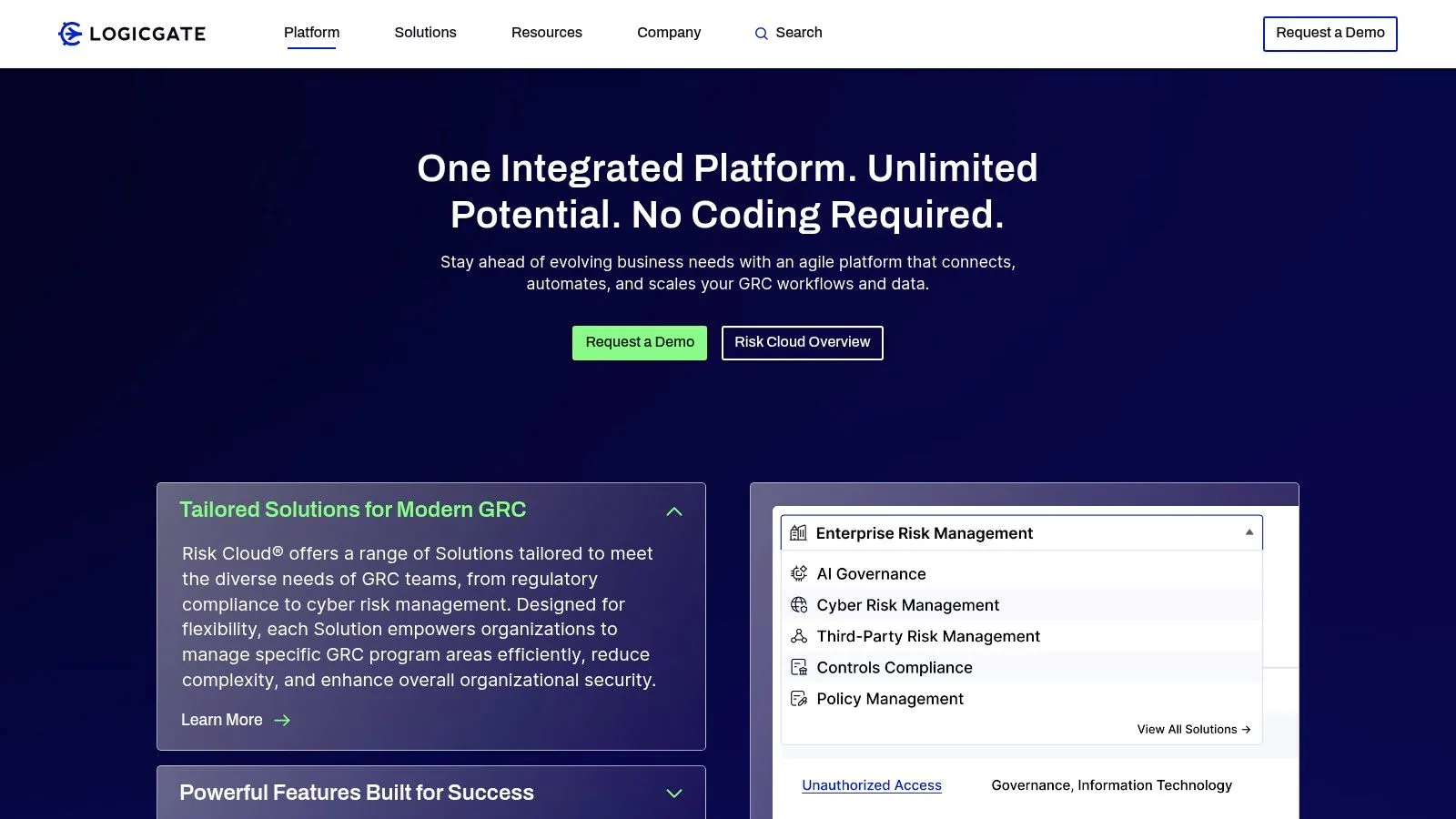
The platform's strength lies in its ability to automate manual processes and eliminate reliance on spreadsheets. Features like automated evidence collection, cross-framework mapping, and quantitative risk modeling (using Open FAIR) empower teams to build a more mature and data-driven compliance function. While its no-code nature is accessible, it does require a greater initial configuration effort compared to out-of-the-box solutions. The payoff is a system tailored precisely to your operational reality.
Key Details & Features
- Best For: Mid-size to large organizations needing a flexible, no-code platform to build custom compliance and risk management workflows.
- Pricing: Custom quote-based. Pricing is scoped based on the applications and user types required. You must contact their sales team for a quote.
- Key Features:
- No-code workflow builder with a graph database for relationship mapping.
- Automated evidence collection and continuous control monitoring.
- Risk Cloud Quantify for Monte Carlo and Open FAIR quantitative analysis.
- Pre-built 'Applications' library to accelerate program deployment.
- Integrations: Connects to key business systems like Jira, Slack, and various security and IT service management tools via its API.
Pros & Cons
| Pros | Cons |
|---|---|
| Highly Flexible & Configurable | Requires Upfront Configuration |
| The no-code builder allows for creating truly custom compliance workflows. | Greater initial setup effort is needed compared to pre-configured tools. |
| Strong Automation Capabilities | Pricing Not Publicly Listed |
| Reduces manual effort in evidence gathering, assessments, and reporting. | The custom quote process makes initial budgeting less straightforward. |
| Power-User Licensing Model | Can Be Complex for Simple Needs |
| Helps control costs by offering different access levels for viewers and participants. | The platform’s power may be excessive for teams with basic compliance requirements. |
This platform is a strong contender when you need one of the best compliance management software solutions that can adapt to your specific processes, rather than forcing your processes to adapt to the software.
Website: https://www.logicgate.com/platform/
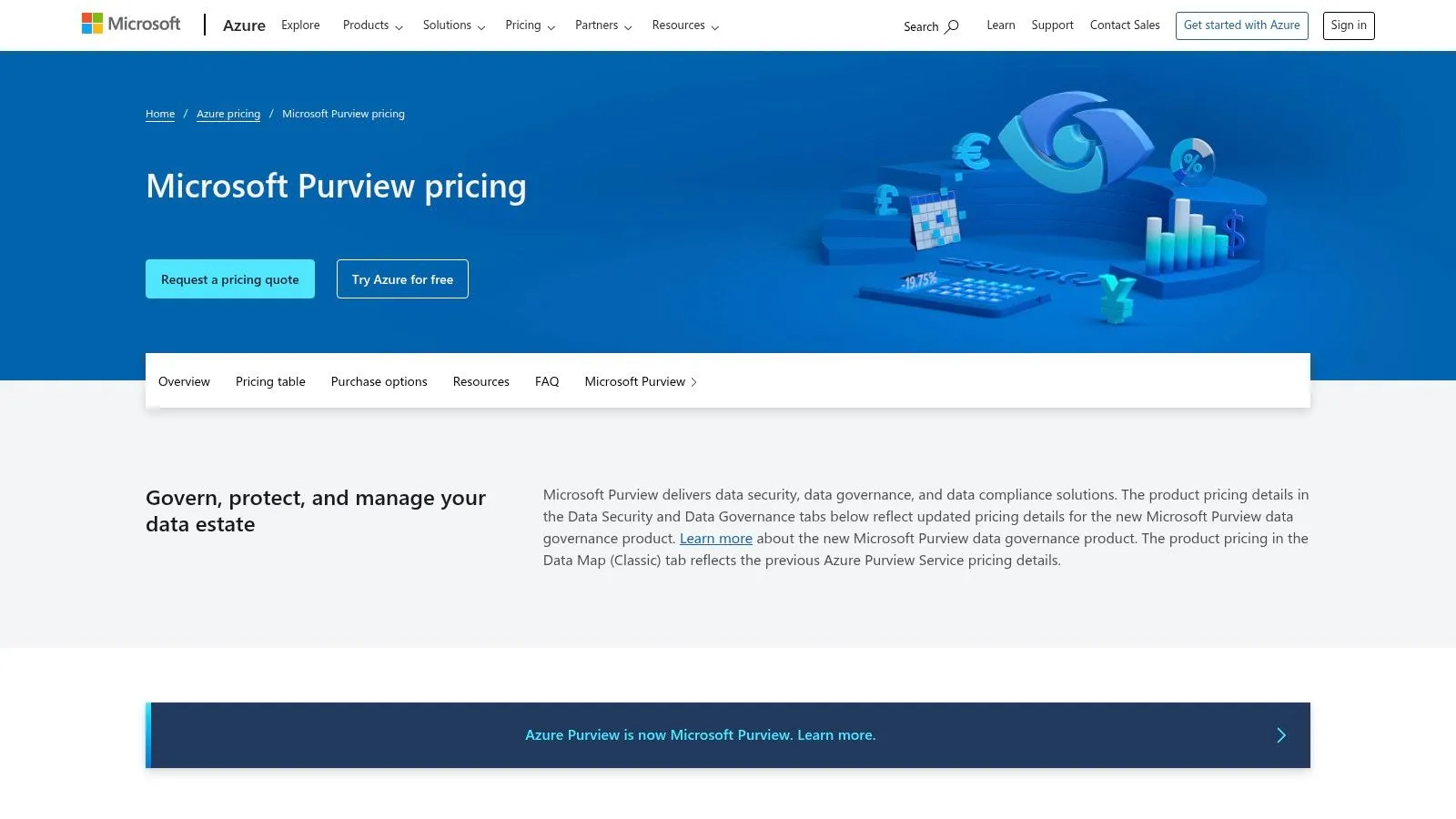
9. Microsoft Purview (Compliance Manager & Purview services)
Microsoft Purview is a collection of compliance and data governance solutions designed for organizations deeply embedded in the Microsoft 365 ecosystem. Its core strength is its native integration, providing visibility and control over data within Teams, SharePoint, OneDrive, and Exchange. Purview helps organizations manage risks through tools like Compliance Manager, which offers assessments and scoring against various regulations, making it one of the best compliance management software choices for Microsoft-centric businesses.
Unlike standalone platforms, Purview leverages existing identity and data signals to power its eDiscovery, Data Loss Prevention (DLP), and insider risk management features. This tight integration simplifies deployment for M365 users but can present a steep learning curve for teams not already proficient in the Azure and M365 admin environments. The platform is ideal for consolidating compliance tools and reducing vendor sprawl if your primary data resides within Microsoft’s cloud.
Key Details & Features
- Best For: Organizations heavily invested in Microsoft 365 seeking native tools to manage data governance, risk, and compliance.
- Pricing: A mix of licensing (included in M365 E5 Compliance) and pay-as-you-go meters for specific services. You must consult Azure pricing details.
- Key Features:
- Compliance Manager with continuous assessments and improvement actions.
- eDiscovery, Data Loss Prevention (DLP), and insider risk management.
- Communication Compliance to monitor messages for policy violations.
- Data lifecycle and records management across the M365 suite.
- Integrations: Native, deep integrations with the entire Microsoft 365 and Azure ecosystem.
Pros & Cons
| Pros | Cons |
|---|---|
| Deep Microsoft 365 Integration | Complex Pricing Model |
| Seamlessly manages compliance for data within Teams, SharePoint, and Exchange. | The mix of suite licenses and pay-as-you-go meters can be difficult to forecast. |
| Reduces Vendor Sprawl | Configuration Complexity |
| Consolidates multiple compliance functions into the existing Microsoft stack. | Can be challenging to configure and manage for teams that are not M365 experts. |
| Flexible Licensing Options | Best for Microsoft-Native Shops |
| Offers both suite-based licensing and PAYG meters for different needs. | Provides limited value for organizations whose critical data lives outside the M365 ecosystem. |
Website: https://azure.microsoft.com/en-us/pricing/details/purview
The 9 Best Compliance Management Software Solutions Compared
| Tool | Best for | Pricing | G2 rating |
|---|---|---|---|
| Whale | SOP- and training-centric compliance management | Free Forever ($0, 10 members included); Scale $249/month and Advance $499/month, both billed yearly; Enterprise on request | 4.8/5 |
| OneTrust | Enterprise privacy and GRC coverage | Custom, quote-only, metered by usage | 4.6/5 (108 reviews) |
| NAVEX One | Unified ethics and compliance programmes | Custom, quote-only | 3.7/5 (84 reviews) |
| Hyperproof | Streamlined, configurable control operations | Custom, quote-only across three tiers | 4.5/5 (221 reviews) |
| Drata | Fast audit readiness for common frameworks | Custom, quote-only across three tiers | 4.7/5 (1,337 reviews) |
| Vanta | First-audit acceleration and broad integrations | Custom, quote-only, priced by headcount | 4.6/5 (2,701 reviews) |
| Optro (formerly AuditBoard) | Deep enterprise audit and risk analytics | Custom, quote-only, enterprise-focused | 4.6/5 (1,622 reviews) |
| LogicGate Risk Cloud | Highly configurable GRC workflows | Custom, quote-only, modular licensing | 4.6/5 (191 reviews) |
| Microsoft Purview | Native Microsoft 365 compliance and data governance | Licensed through Microsoft 365 E5, as a standalone Purview Suite add-on that requires E3, or consumption-based for certain Azure services. Confirm the exact mix that applies to you with Microsoft | 4.3/5 (25 reviews for the Compliance Manager sub-product; Purview ratings are split across sub-products rather than one listing) |
Every vendor except Whale prices on request. We checked each one’s own pricing page in August 2026 and none of the eight publishes a figure, so treat any specific number you see quoted elsewhere with caution. G2 ratings reflect scores at the time of writing.
Making Your Final Decision: It's All About the Process
Navigating the landscape of compliance management software can feel overwhelming. We've explored everything from comprehensive, enterprise-grade GRC platforms like OneTrust and NAVEX One to audit-automation powerhouses like Drata and Vanta. We've also seen how a platform-native option like Microsoft Purview can fold compliance into tooling you already run. Each tool presents a powerful way to manage risk, track controls, and prepare for audits.
The sheer variety underscores a fundamental truth: there is no single "best" compliance management software for every organization. The ideal choice is deeply contextual, hinging on your industry, scale, regulatory pressures, and compliance maturity. A fintech startup preparing for its first SOC 2 audit will find immense value in Vanta's streamlined, evidence-gathering workflows. In contrast, a global manufacturing firm managing ISO standards and supply chain regulations may require the robust, all-encompassing GRC capabilities of a solution like Optro or Hyperproof.
Key Takeaways for Your Selection Journey
As you move from evaluation to decision, keep these core principles at the forefront of your strategy. They will serve as your compass in selecting a tool that not only meets today's needs but also scales with your future growth.
- Audit-Focused vs. Program-Focused: First, clarify your primary driver. Are you looking to pass a specific audit like SOC 2 or ISO 27001 as efficiently as possible? If so, tools like Drata and Vanta are built for that exact purpose. If your goal is to build a long-term, holistic governance, risk, and compliance (GRC) program, then platforms like NAVEX One or LogicGate Risk Cloud offer a more expansive and strategic foundation.
- Integration is Non-Negotiable: Your compliance tool cannot live on an island. Its ability to connect with your existing tech stack (cloud providers, HRIS, project management tools) is critical for automating evidence collection and reducing manual work. Always scrutinize the depth and reliability of a platform's integrations before committing.
- The User Experience Matters (A Lot): If your team finds the software cumbersome or confusing, they simply won't use it effectively. Widespread adoption is the bedrock of a successful compliance culture. Prioritize platforms with intuitive interfaces, clear dashboards, and straightforward workflows to ensure the tool becomes an enabler, not a bottleneck.
The Missing Link: From Policy to Practice
Ultimately, compliance is not just about having the right software; it's about what your people do every single day. A perfectly configured GRC platform is ineffective if the underlying standard operating procedures (SOPs), policies, and training guides are outdated, inaccessible, or ignored. This is the critical gap where many compliance initiatives falter. You can define hundreds of controls, but if an employee doesn't know the correct, documented process for handling sensitive data, a vulnerability remains.
This is precisely where a solution like Whale becomes a powerful, foundational layer for your entire compliance strategy. While GRC platforms manage the what (the controls, the risks, the audits), Whale manages the how (the step-by-step processes, the training, the on-the-job knowledge).
By centralizing your SOPs, work instructions, and company policies in an accessible, easy-to-update platform, Whale ensures that your team's daily actions are perfectly aligned with your compliance requirements. It transforms abstract policies into actionable, just-in-time knowledge. For organizations where operational excellence is directly tied to regulatory adherence, such as in manufacturing, finance, or logistics, this connection is not just beneficial; it's essential. Integrating a process management tool like Whale with your chosen compliance software creates a resilient, end-to-end system where your strategy is reinforced by consistent, daily execution.
As you make your final choice, look beyond the feature lists and consider the entire ecosystem of your operations. The best compliance management software is the one that fits your technical needs, but the most successful compliance program is one built on a bedrock of clear processes and empowered people.
FAQs about Compliance Management Software
What is compliance management software?
Compliance management software helps organisations track, document and prove that they are meeting regulatory or policy requirements. That covers evidence collection, audit readiness, policy management and training completion.
What is the difference between compliance management software and GRC software?
Compliance management software focuses specifically on meeting requirements. GRC software, covering governance, risk and compliance, is broader, adding enterprise risk management and governance structure on top of compliance tracking. Many GRC platforms include compliance management as one part of a wider suite, which is why several tools on this list appear in both categories.
How much does compliance management software cost?
Most enterprise-grade options in this category are quote-only. Pricing depends on company size, the number of frameworks or controls you need to manage, and how deep the feature set goes. Of the nine tools here, only Whale publishes figures. The other eight all require a sales conversation, so budget time for scoping as well as money for licences.
What should you look for when choosing compliance software?
Start with the problem you are actually solving: a specific certification such as SOC 2 or ISO 27001, broader enterprise risk management, or making sure employees follow documented procedures day to day. Then look for genuine integration with the tools you already use, honest pricing information, and evidence that the platform will not need a consultant every time your process changes.
Can compliance software integrate with HR and training systems?
Many compliance platforms integrate with common business tools, and some build training and comprehension tracking directly into the compliance workflow rather than treating training as a separate system. If ongoing employee training is central to your compliance programme, that distinction matters more than the integration list alone.
What is the best compliance software for a small business versus an enterprise?
Smaller organisations are often better served by tools with transparent, accessible pricing and a focus on day-to-day process adherence. Whale starts at Free Forever ($0, 10 members included), with Scale at $249/month and Advance at $499/month billed yearly, and Enterprise pricing on request. Larger organisations with formal audit and risk functions are the natural fit for the quote-only GRC platforms on this list, where scoping and implementation are part of the purchase.
Bram Billiet, is the Co-founder and Chief Product Officer at Whale. His obsession for building the product is matched matched only by his love for conquering levels in Mario Brothers.