SOP & Process Documentation
The 12 best wiki software tools for teams in 2026 (we compared them)


In this article
The best wiki software for teams depends on what your wiki is really for: a place to find answers, a library of procedures people must follow, or a system your IT team wants to host and control.
The best wiki software for teams (in our opinion) is
- Whale for SOPs, onboarding and process knowledge. If your wiki is mostly "how we do things here", see how Whale handles knowledge sharing and management.
- Confluence for a structured, permission-heavy company wiki, especially with Jira,
- Notion for a flexible workspace that does docs, databases and projects,
- Slite for keeping docs accurate as processes change,
- and BookStack, Wiki.js, DokuWiki and MediaWiki if you want to host it yourself.
Teams usually go looking for wiki software for three reasons:
- company knowledge lives in a dozen places (Slack threads, Google Docs, one person's head), and new hires can't find anything,
- the processes people should follow are written down somewhere, but nobody knows which version is current,
- or they want AI that answers questions from their own docs, instead of making things up.
Before we continue, we want to disclose that Whale publishes this page and is one of the tools on it. But we aim to keep fair practice. As such every price comes from the vendor's own pricing page, checked in October 2026. And every tool, Whale included, gets the same fields and real cons.
What is wiki software?
Wiki software lets a team create, link and edit pages together, so company knowledge lives in one searchable place instead of in inboxes and people's heads. An internal wiki is the private version: your handbook, policies, how-tos and team pages, visible only to your company.
Here's the quick version:
- Cloud wiki software (Confluence, Notion, Slite and friends) is hosted for you, quick to set up and usually comes with AI search.
- Self-hosted wiki software (BookStack, Wiki.js, DokuWiki, MediaWiki) is free and open source, and you run it on your own servers.
- A wiki isn't quite a knowledge base. A wiki is open and collaborative. A knowledge base is usually more curated. Our guide to wiki vs knowledge base explains the difference.
- Where most wikis stop: they store and organise pages. They won't turn a process into training, quiz people on it or show you who has read the policy.
Here's the thing I keep seeing: every company wiki starts tidy. Two years later there are three pages called "Expenses", and the one people actually use is the oldest.
Key takeaways
- Whale has the highest G2 rating of the cloud tools on this list, at 4.8/5.
- Whale turns one screen recording into an SOP, an AI-generated quiz and a training flow, then assigns it and tracks who has read it. That's the part a wiki can't do.
- Free cloud plans are common. Confluence (up to 10 users), Notion, Slab (up to 10 users), Nuclino (50 items) and Whale (1 creator, up to 10 members) all have one. Slite offers a 14-day free trial.
- Guru doesn't publish prices. It's sold as a custom package.
Quick comparison of wiki software for teams
All prices in US dollars, checked in October 2026. G2 ratings as shown on G2 in October 2026.
| Tool | Best for | Starting paid price | Free option | Hosting | G2 rating |
|---|---|---|---|---|---|
| Whale | SOPs, onboarding and process knowledge | $249/month billed yearly (3 creators) | Yes: 1 creator, up to 10 members | Cloud | 4.8 |
| Confluence | Structured company wikis and Jira teams | $5.78/user/month (Standard) | Yes, up to 10 users | Cloud | 4.1 |
| Notion | Docs, databases and projects | $10/member/month billed yearly (Plus) | Yes | Cloud | 4.6 |
| Slite | Keeping docs accurate as processes change | $10/user/month billed yearly (Basic) | No (14-day trial) | Cloud | 4.6 |
| Nuclino | A simple, lightweight wiki | $6/user/month billed yearly (Starter) | Yes (50 items) | Cloud | 4.7 |
| Guru | Verified answers inside every tool | Not published (custom package) | No | Cloud | 4.7 |
| Slab | A clean, focused internal wiki | $6.67/user/month billed yearly (Startup) | Yes, up to 10 users | Cloud | 4.6 |
| Tettra | Answering repeat questions in Slack | $8/user/month, 10-user minimum | No (30-day trial) | Cloud | 4.7 |
| BookStack | Simple, structured self-hosted docs | Free (MIT licence) | Yes | Self-hosted | 3.5 |
| Wiki.js | Markdown-first technical docs | Free (AGPL-v3 licence) | Yes | Self-hosted | 4.3 |
| DokuWiki | A lean wiki with no database to manage | Free (GPL v2 licence) | Yes | Self-hosted | 4.0 |
| MediaWiki | Large, Wikipedia-style knowledge sites | Free (GPL licence) | Yes | Self-hosted | Not rated (BlueSpice MediaWiki: 4.0) |
What a 20-person team actually pays for wiki software
Headline prices are hard to compare because every vendor counts people differently. So we priced the same team: 20 people, yearly billing where it's offered, everyone able to read the docs, and AI switched on where it's an option.
| Tool | Monthly cost for 20 people | How we got there |
|---|---|---|
| BookStack / Wiki.js / DokuWiki / MediaWiki | $0 licence | Free and open source: you pay for your own hosting and upkeep |
| Confluence Standard | $115.60 | 20 × $5.78 per user, Atlassian's listed rate |
| Tettra Scaling | $160.00 | 20 × $8, Kai AI answers included |
| Nuclino Business | $200.00 | 20 × $10 billed yearly, Sidekick AI is on Business |
| Slite Basic | $200.00 | 20 × $10 billed yearly, AI search included |
| Whale Scale | $249.00 | 3 creators included. Everyone else joins as a member, with no per-seat fee. |
| Slab Business | $250.00 | 20 × $12.50 billed yearly, AI Ask is on Business |
| Notion Business | $400.00 | 20 × $20 billed yearly, Notion AI is on Business |
| Guru | Not published | Custom package, talk to sales |
Free isn't free if someone on your team spends Fridays patching a server. And cheap isn't cheap if nobody reads the wiki. The real question is whether your wiki only stores knowledge, or actually gets it into people's heads.
1. Whale
Best wiki software for SOPs, onboarding and process knowledge
G2 rating: 4.8/5
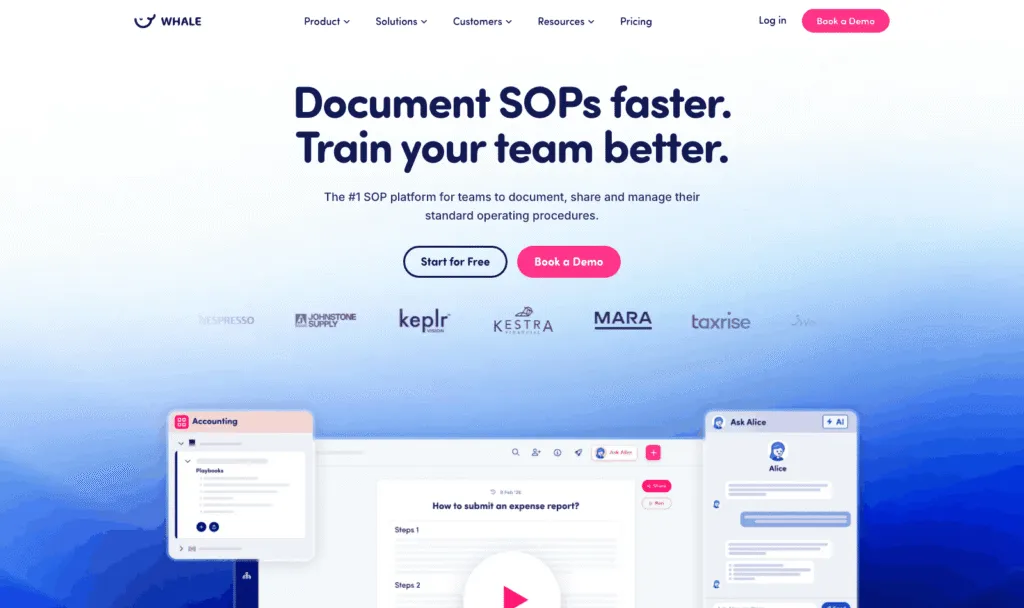
Most company wikis quietly turn into a pile of "how we do X" pages that new hires are meant to read. Whale (usewhale.io) is an AI-powered SOP software and training platform built for exactly that half of your wiki. You record a process once, and Whale turns it into a written SOP, an AI-generated quiz and a training flow you can assign. Alice, Whale's AI assistant, then answers your team's questions from your own SOPs, with sources.
Key features of Whale
- Video to SOP and a step recorder that turn screen recordings into step-by-step SOPs
- Read assignments: send a card, playbook or guide to a person, role or group with a due date, require an acknowledgement click, and export completion records as audit evidence
- Training flows, AI quizzes, checklists, analytics and reporting
- Content review cycles that remind the right expert to verify a doc on schedule, plus approval flows on Enterprise
- Alice, Whale's AI assistant, which answers questions from your documentation, plus a Chrome extension that surfaces SOPs inside the apps your team already uses
- Whale MCP: connect Claude, ChatGPT, Cursor or Gemini and work inside Whale with your own permissions (Scale and up)
- Version history, e-signatures on Advance, and iOS and Android apps
Whale pricing
- Free: $0, 1 creator, up to 10 members, 20 playbook items, 20 one-time AI credits
- Scale: $249/month billed yearly, 3 creators included, unlimited documentation, training flows, AI quizzes, PDF and Word export, Whale MCP
- Advance: $499/month billed yearly, 5 creators included, adds e-signatures, video editor and AI voiceovers, enforced SSO and granular permissions
- Enterprise: custom, adds approval flows, automatic redaction, SCIM and HRIS integrations, API access
Whale's pricing page lists SOC 2 certification, HIPAA readiness and GDPR compliance, with EU hosting in Belgium.
Whale pros
- One recording becomes an SOP, a quiz and a training flow, so writing docs stops being the bottleneck
- Read assignments and acknowledgements show who has actually read the policy, which no other tool on this list does
- Whale's MCP connects your company documentation to your AI tools, so your teams and agents work from accurate information
- Alice and the Chrome extension put answers where people work, rather than in a portal nobody opens (you can even ask Alice in Slack through the Whale app)
Whale cons
- Looking for a free-form wiki for meeting notes and specs? Whale is built for processes, not every kind of doc.
- Permissions customisation is limited below the Advance plan, and some customers find that restrictive when managing access across several teams. Granular permissions start at $499 a month.
Choose Whale if your wiki is mostly SOPs, onboarding and policies, you'd rather record a process than write it, and you need to know people have read and understood it.
Whale isn't the right fit if you want a general-purpose space for notes, brainstorms and specs: Notion, Confluence or Nuclino will suit you better.
2. Confluence
Best for a structured company wiki, especially with Jira
G2 rating: 4.1/5
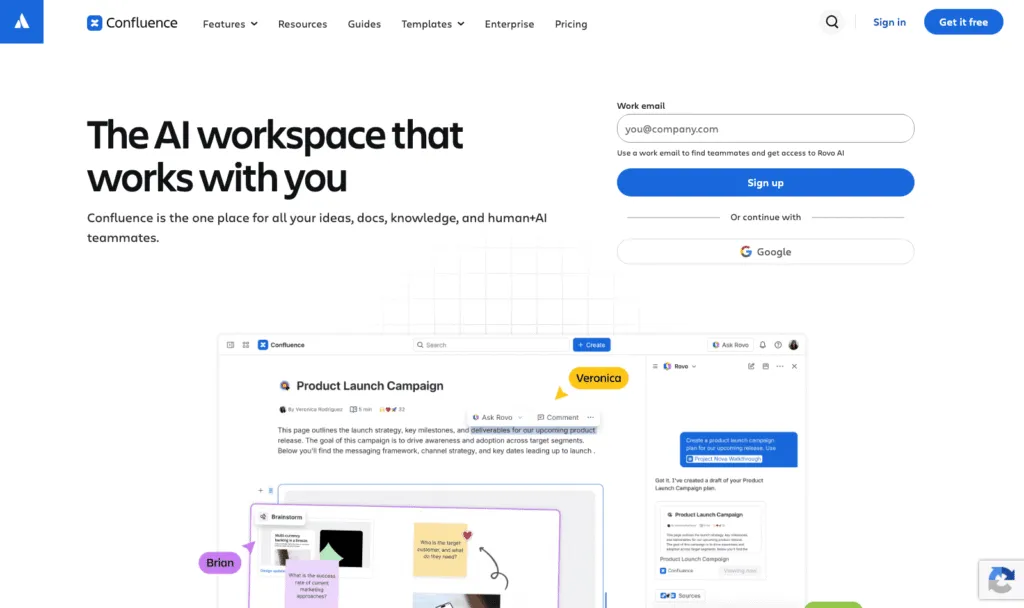
Confluence is the wiki most people picture when they hear "company wiki": spaces, page trees, granular permissions and deep Jira integration, with Atlassian's Rovo AI for search, chat and agents. It's built for scale, and it shows. A small team can find it like buying a lorry to do the school run.
Key features of Confluence
- Spaces, page trees and granular permissions
- Rovo Search, Chat and Agents
- Native Jira integration
Confluence pricing
- Free: up to 10 users with 2GB of storage
- Standard: $5.78/user/month
- Premium: $11.16/user/month
- Enterprise: custom
Atlassian raised its Cloud list prices on 13 October 2026, and its Data Center (self-managed) products reach end of life on 28 March 2029.
Confluence pros
- Strong structure, governance and permissions
- Low per-user price at Standard
Confluence cons
- Heavier to administer than most tools here
- Best value only if you already use Atlassian products
Weighing it up? See how Whale compares with Confluence.
3. Notion
Best for docs, databases and projects in one workspace
G2 rating: 4.6/5
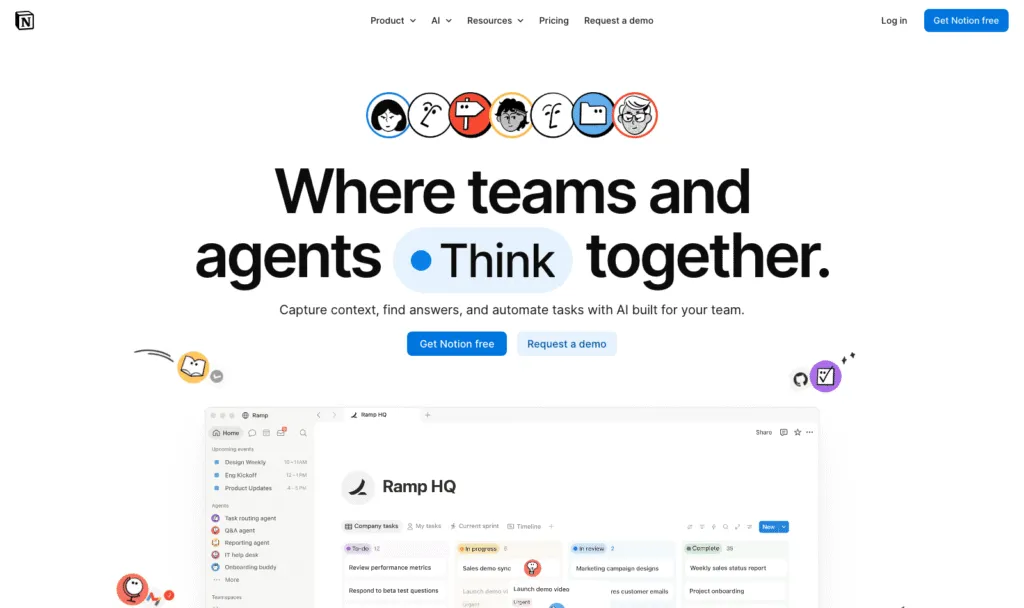
Notion is the flexible one. It does wiki pages, databases, project tracking and a huge template library, all in one friendly editor. That flexibility is its strength and its risk: without a clear structure, a Notion wiki gets messy fast.
Key features of Notion
- Pages, databases, forms and a public site
- Notion Agent, AI meeting notes and enterprise search on Business
- A large template ecosystem
Notion pricing
- Free: for individuals, with a block limit for teams of 2 or more
- Plus: $10/member/month billed yearly, $12 monthly
- Business: $20/member/month billed yearly, $24 monthly, including Notion AI
- Enterprise: custom
Notion pros
- Very flexible and familiar to most teams
- Docs and project tracking in one place
Notion cons
- No built-in training, quizzes or read tracking
- Full AI needs Business at $20 per member
Weighing it up? See how Whale compares with Notion.
4. Slite
Best for keeping docs accurate as processes change
G2 rating: 4.6/5
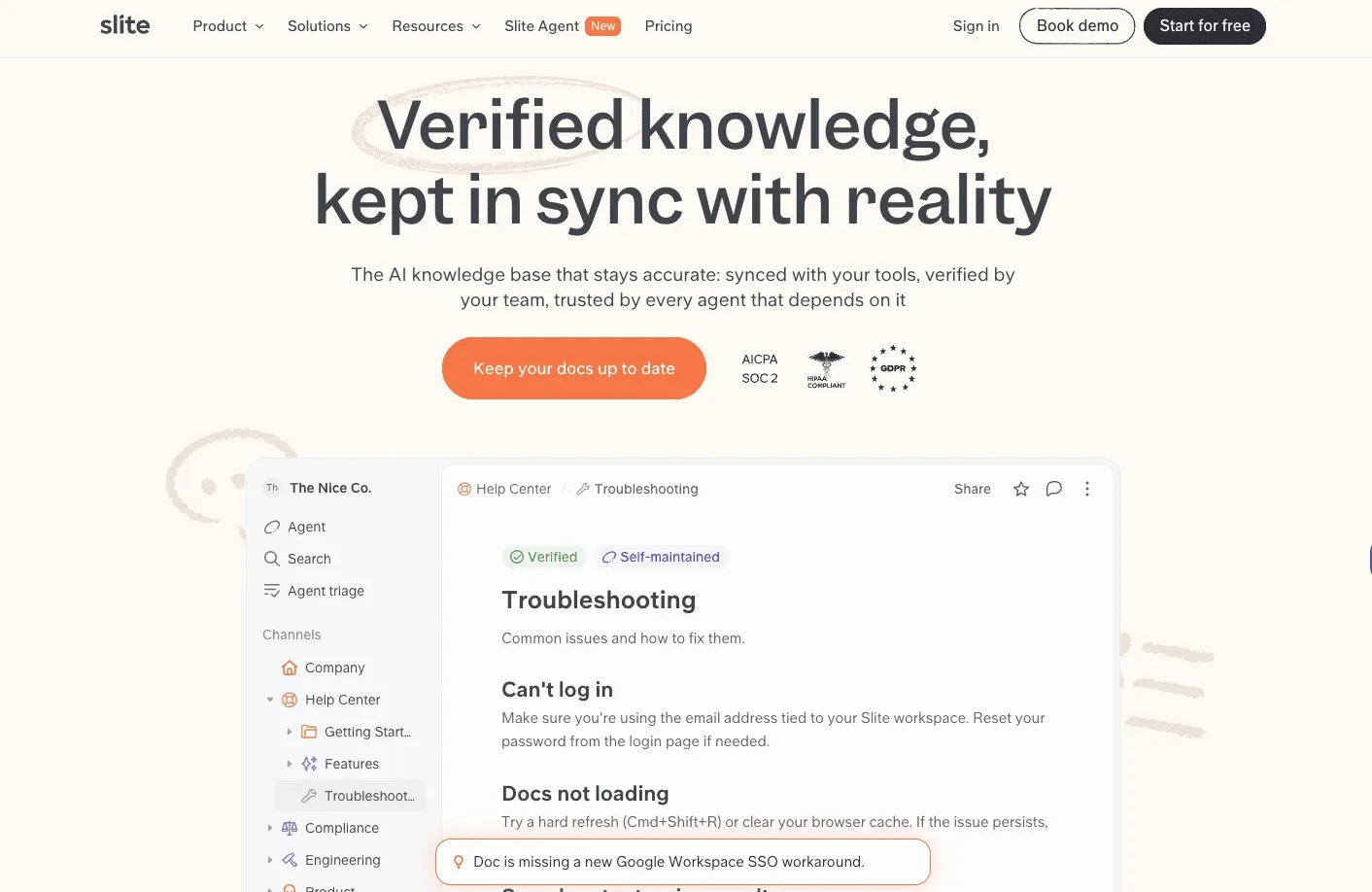
The classic way a company wiki dies is slowly: pages drift out of date and people stop trusting them. Slite is built to stop that. It's a knowledge base designed to stay current and easy to trust: its AI search cites every source, ranks verified docs first and says "no answer found" instead of guessing. Governance is built in, with doc owners, verification cycles, full version history and a Knowledge Management Panel for health checks. On Pro, the Slite Agent handles the upkeep: it compares your docs against each other and against connected tools like Slack, Linear, GitHub and Intercom, flags what's gone stale and drafts the fix, with the reasoning behind each edit, for a human to approve before anything changes.
It suits mid-sized companies where knowledge lives across several teams and nobody owns the whole picture.
Key features of Slite
- AI search that cites its sources, ranks verified docs higher and returns "no answer found" instead of guessing
- Verification on every plan: owners set a review cycle (6 months, 1 year or custom), reminders go out automatically, and readers can flag a doc as outdated
- A Knowledge Management Panel listing outdated docs, expired verifications and empty docs, with bulk filters for cleanup
- Slite Agent on Pro: detects drift and drafts the corrected text as a diff, with a reason for each edit, for the owner to approve or reject
Slite pricing
- Basic: $10 per user per month billed yearly, or $12 billed monthly
- Pro: $20 per user per month billed yearly, or $25 billed monthly, adding Slite Agent, search across 20+ connected tools and agent workflows
- Enterprise: custom, adding SCIM, audit logs, reader-only seats and a dedicated account manager
- No free plan: 14-day free trial, no credit card required
Slite pros
- Upkeep goes past flag-and-remind: the owner gets a drafted fix to approve, not a reminder to write one
- Verification on every plan, and AI search that cites sources and won't guess
Slite cons
- No training layer: no assigned readings, quizzes or completion tracking, so it can't prove someone was trained
- Slack is the only messaging integration (no Microsoft Teams), and it's cloud only, with no on-premise option
Skip Slite if your main job is training staff and proving they finished, because Slite doesn't track completion.
5. Nuclino
Best for a simple, lightweight wiki
G2 rating: 4.7/5
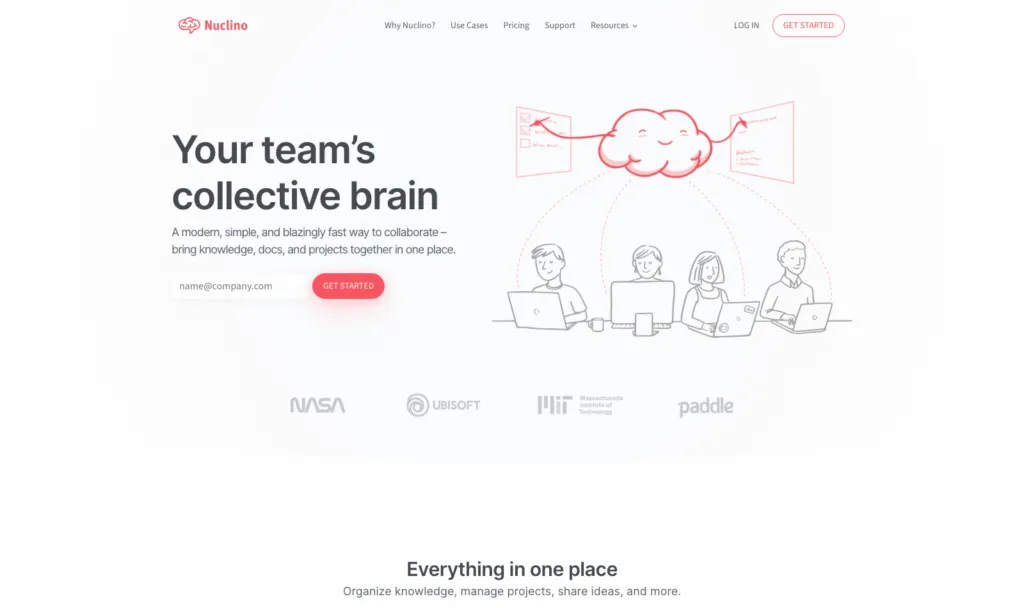
Nuclino is the opposite of Confluence's sprawl: quick to set up, quick to learn, and you can view your docs as boards, tables or a graph of how everything connects. It's one of the cheapest cloud options on this list.
Key features of Nuclino
- Real-time collaborative editing
- Board, table and graph views of your docs
- Sidekick AI on Business, which answers questions from your content and drafts text
Nuclino pricing
- Free: up to 50 items, 3 canvases and 2GB of storage
- Starter: $6/user/month billed yearly, $8 monthly
- Business: $10/user/month billed yearly, $12 monthly, including Sidekick, SAML SSO and an audit log
Nuclino pros
- Fast to adopt, with almost no learning curve
- Low price per user
Nuclino cons
- AI only on Business
- Lighter on governance and review workflows
Weighing it up? See how Whale compares with Nuclino.
6. Guru
Best for verified answers inside every tool, at enterprise scale
G2 rating: 4.7/5
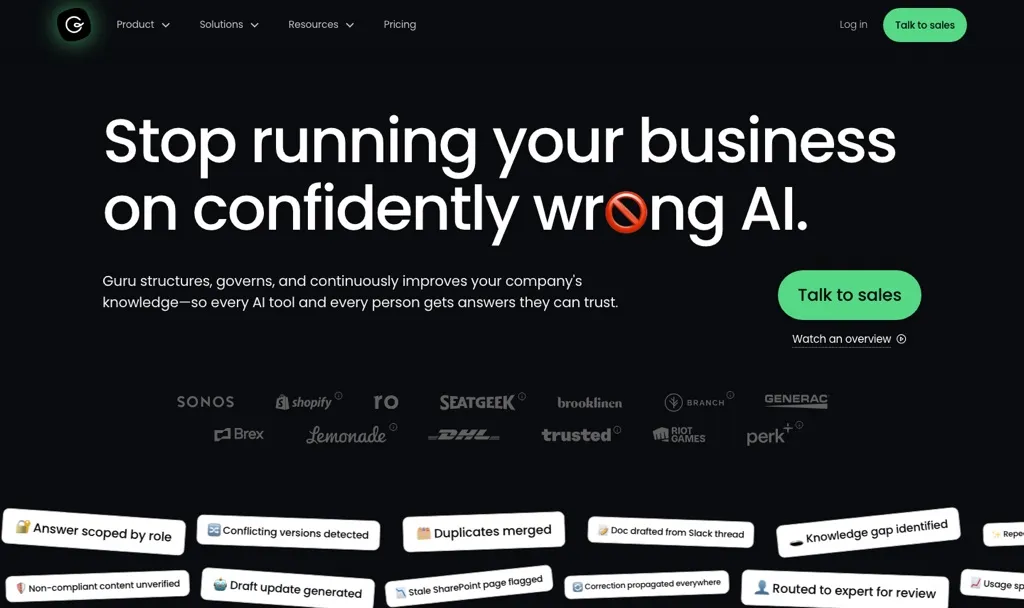
Guru is an AI knowledge platform that pushes verified answers into the tools people already use, with Knowledge Agents, AI search and MCP delivery. It's sold as a custom package with solution engineers, so it suits larger organisations with a proper knowledge-management programme.
Key features of Guru
- Knowledge Agents and AI search
- 100+ integrations and MCP delivery
- SSO, SCIM, role-based access and audit logs
Guru pricing
- Custom package only: Guru doesn't publish prices, and says pricing is "tailored to your organization's scale, knowledge complexity, and AI maturity"
- No free plan or self-serve trial listed
Guru pros
- Strong verification and governance
- Answers delivered inside other tools
Guru cons
- No published pricing
- More platform than a small team needs
Weighing it up? See our Guru alternatives guide.
7. Slab
Best for a clean, focused internal wiki
G2 rating: 4.6/5
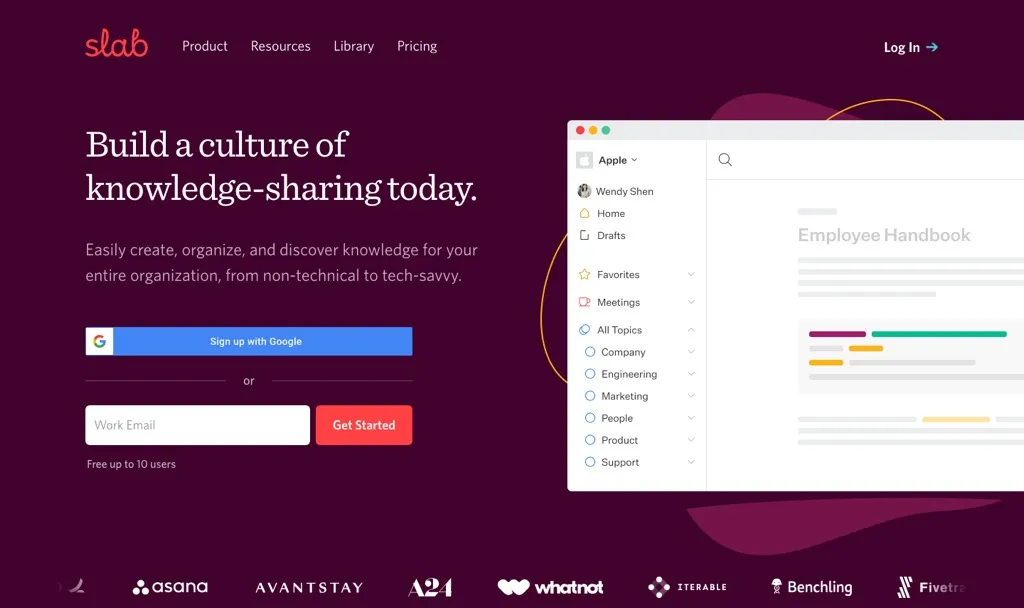
Slab is a knowledge base, full stop: a clean editor, topics for structure, and unified search across your other tools. For teams that want a wiki and nothing else, that restraint is the point.
Key features of Slab
- Topics and posts for structured internal docs
- Unified search across connected tools on every plan
- AI Autofix on Startup, AI Predict and AI Ask on Business
Slab pricing
- Free: up to 10 users, 90 days of version history
- Startup: $6.67/user/month billed yearly
- Business: $12.50/user/month billed yearly
- Enterprise: custom
Slab pros
- Generous free plan for teams of up to 10
- Focused and easy to keep tidy
Slab cons
- AI answers need the Business plan
- A wiki only: no training paths, quizzes or sign-off
8. Tettra
Best for answering repeat questions in Slack
G2 rating: 4.7/5
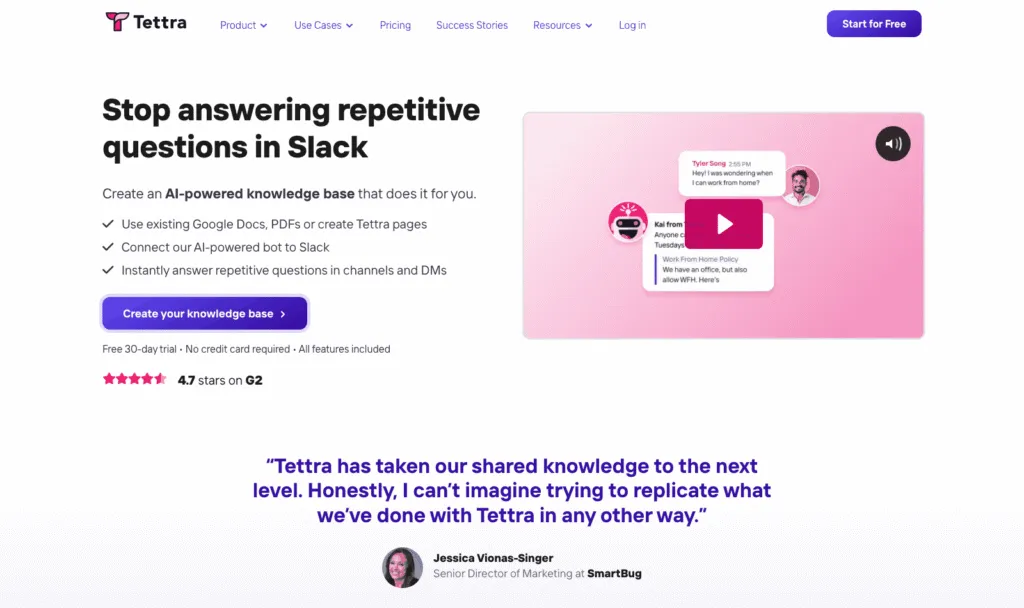
You know the five questions that land in Slack every single week? Tettra is built for those. Its AI, Kai, answers from your docs in Slack DMs and channels, and it can suggest FAQs and tag pages for you.
Key features of Tettra
- Kai AI answers, in Tettra and in Slack
- AI page tagging and AI FAQ generation
- Training from Google Docs
Tettra pricing
- Scaling: $8/user/month with a 10-user minimum, and a discount for yearly billing
- Enterprise: custom
- No free plan: 30-day free trial
Tettra pros
- AI answers in Slack included on the base plan
- Simple per-user pricing
Tettra cons
- 10-user minimum
- No training paths, quizzes or read tracking
Weighing it up? See how Whale compares with Tettra.
Open-source and self-hosted wiki software
If your IT team wants full control over where company knowledge lives, these four are free and open source. The trade-off is simple: you don't pay a licence, but someone has to run the server, apply updates and take backups. None of them lists built-in AI features.
9. BookStack
Best for simple, structured self-hosted docs
G2 rating: 3.5/5
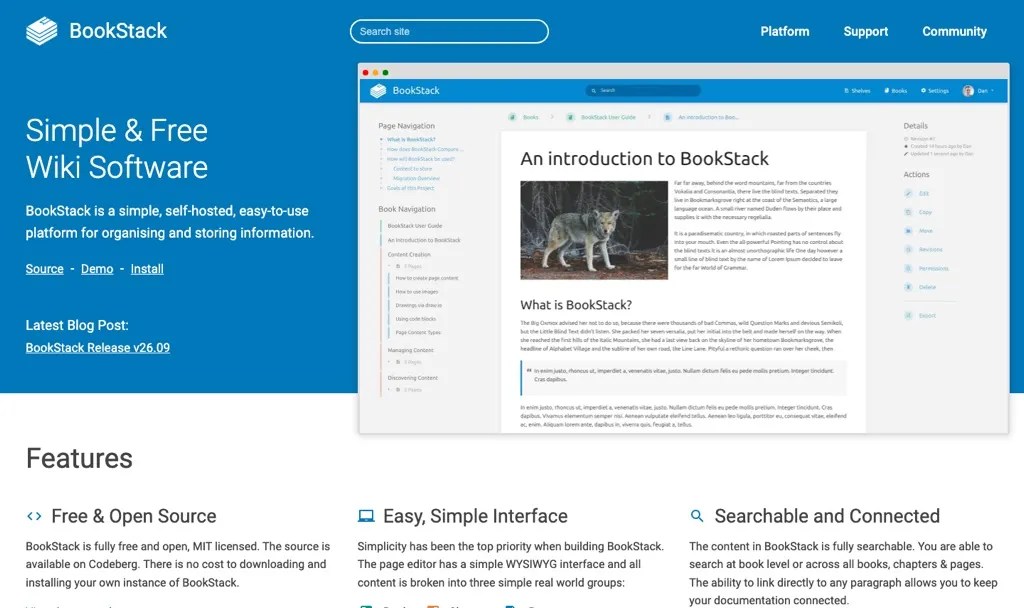
BookStack organises everything into books, chapters and pages, which makes it one of the easiest structures for a non-technical team to understand on day one.
Key features of BookStack
- Books, chapters and pages
- Free and open source (MIT licence)
- Self-hosted on your own servers
BookStack pricing
- Free: open source under the MIT licence
- Paid support plans: available. BookStack doesn't list their prices on its homepage
BookStack pros
- Free, with a very clear structure
- Full control over your data
BookStack cons
- You run and maintain the server
- No AI features listed
10. Wiki.js
Best for Markdown-first technical docs
G2 rating: 4.3/5
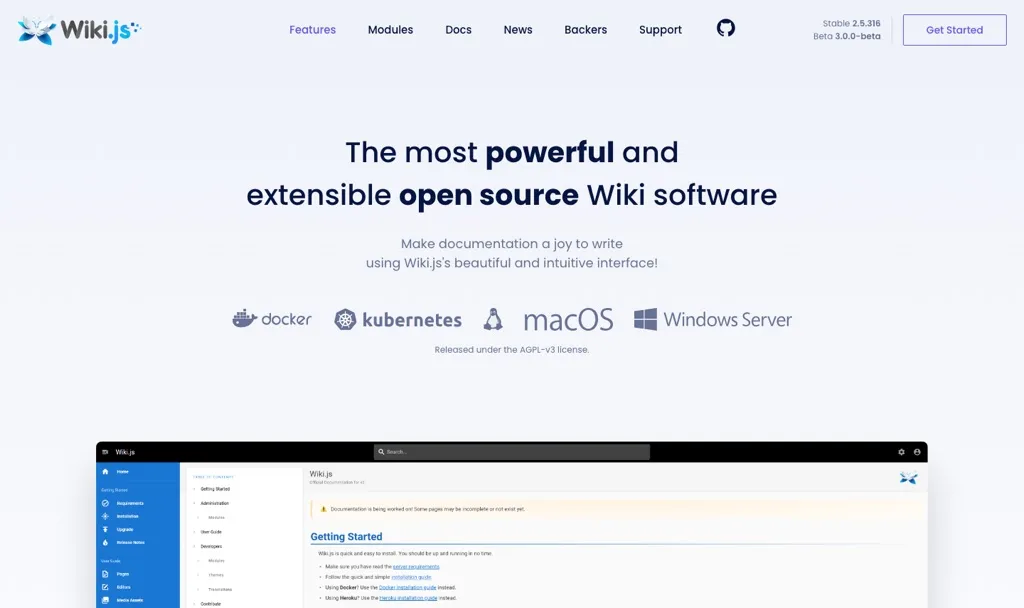
Wiki.js is a modern, open-source wiki with a Markdown editor (plus visual and HTML editors), Git sync and enterprise login options like LDAP and SAML. It's a natural fit for technical teams who think in Markdown and Git.
Key features of Wiki.js
- Markdown, visual and HTML editors
- Sync and back up content to GitHub, GitLab or Bitbucket
- Local, social, LDAP and SAML login, with 2FA
Wiki.js pricing
- Free: open source under the AGPL-v3 licence, self-hosted
- One-click install: available on the DigitalOcean Marketplace
Wiki.js pros
- Free, with Git-based backups
- Strong authentication options
Wiki.js cons
- You run and maintain the server
- No AI features listed
11. DokuWiki
Best for a lean wiki with no database to manage
G2 rating: 4.0/5
DokuWiki is a long-running open-source wiki engine that stores pages as plain text files, so there's no database to set up or maintain. That makes it a favourite for small IT teams who want something light and dependable.
Key features of DokuWiki
- Open-source wiki engine (GPL v2 licence)
- Pages stored as plain text files, with no database required
- Self-hosted on your own servers
DokuWiki pricing
- Free: open source under the GPL v2 licence
DokuWiki pros
- Free and very light to run
- Easy to back up, because pages are just files
DokuWiki cons
- You run and maintain the server
- Dated editing experience compared with modern cloud wikis
12. MediaWiki
Best for large, Wikipedia-style knowledge sites
G2 rating: Not rated on G2 (its enterprise distribution, BlueSpice MediaWiki, is rated 4.0/5)
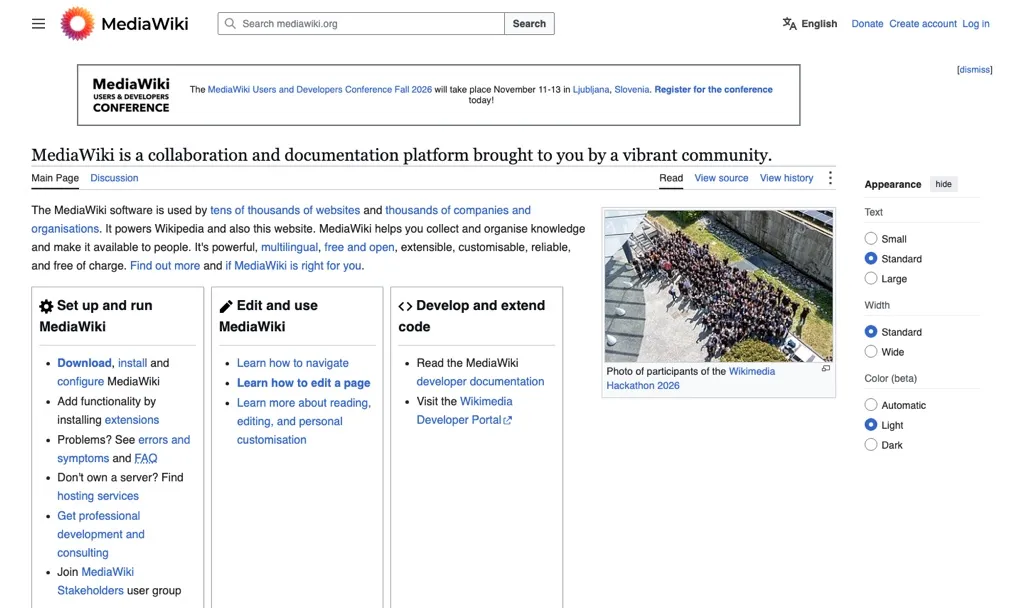
MediaWiki is the software that powers Wikipedia. It's free, licensed under the GNU General Public License, and built to handle huge sites with millions of visits a day. It runs on PHP with a database such as MySQL, and pages use MediaWiki's own wikitext format.
Key features of MediaWiki
- Proven at Wikipedia scale
- Extensions that add functionality
- Wikitext editing, so people don't need to know HTML
MediaWiki pricing
- Free: open source under the GNU General Public License
MediaWiki pros
- Extremely scalable and battle-tested
- Huge ecosystem of extensions
MediaWiki cons
- More setup and maintenance than any other tool here
- Wikitext has a learning curve for non-technical teams
How to choose wiki software
Before you look at features, check these six things:
- Search: can people find the right page in seconds, and does AI answer from your docs with sources?
- Permissions: can you control who sees and edits what, by team or role?
- Keeping pages current: are there owners, review dates or verification, so stale pages get caught?
- Proof people read it: for policies and SOPs, can you assign reading and see who completed it?
- Integrations: does it work with Slack or Teams and the tools your team already uses?
- Hosting: cloud for speed, or self-hosted for control?
Then pick by what you need most:
- Your wiki is really SOPs, onboarding and policies: Whale. Record once, then assign it, quiz it and track who has read it.
- You need structure and permissions at scale, especially with Jira: Confluence.
- You want docs, databases and projects in one place: Notion.
- Your docs keep going stale across several teams: Slite.
- You want the simplest possible wiki: Nuclino or Slab.
- The same questions keep landing in Slack: Tettra, or Guru at enterprise scale.
- You want to host it yourself: BookStack for non-technical teams, Wiki.js for Markdown and Git, DokuWiki for something light, MediaWiki for Wikipedia-scale.
If you're still deciding how to structure your wiki, our knowledge base structure webinar walks through it.
How we compared these tools
We started with the tools named in the top 10 Google results for "best wiki software" and in answers from ChatGPT and Perplexity. We also spoke to our sales team about the tools teams mention when they come to us. We kept 12 that work as a company wiki, across cloud and self-hosted options, and dropped project management suites and personal note-taking apps.
We compared each one on five things: published pricing, free plan or trial, hosting, how answers reach the team (including AI), and whether the tool helps people actually learn and follow what's written. G2 ratings are there as a sense check, not a verdict.
But what we always say to customers and prospective customers is try the tools out for yourself.
Frequently asked questions
What is the best wiki software for teams?
It depends on what your wiki holds. Whale is the best wiki software for SOPs, onboarding and process knowledge, because one recording becomes an SOP, a quiz and a training flow you can assign and track. Confluence is best for structure and Jira, Notion for flexibility, Slite for keeping docs current, and BookStack or Wiki.js for free, self-hosted wikis.
What are wiki tools?
Wiki tools are software for creating and linking pages that a team edits together, so knowledge lives in one searchable place. Company wikis hold handbooks, policies, how-tos and team pages. Some, like Confluence and Notion, are cloud services. Others, like BookStack and MediaWiki, are open source and self-hosted.
Which wiki is the most popular?
MediaWiki is the best-known wiki software, because it powers Wikipedia. For company wikis, Confluence and Notion are the names most teams shortlist first.
What is the best open source documentation system?
For a company wiki, BookStack is the easiest for non-technical teams, thanks to its books, chapters and pages structure. Wiki.js suits technical teams who like Markdown and Git, DokuWiki is the lightest to run, and MediaWiki scales the furthest.
Is there free wiki software?
Yes. BookStack, Wiki.js, DokuWiki and MediaWiki are free and open source, if you host them yourself. For cloud tools, Confluence and Slab are free for up to 10 users, Notion and Nuclino have free plans, and Whale's free plan includes 1 creator and up to 10 members, with video to SOP and Alice, Whale's AI assistant.
What's the difference between a wiki and a knowledge base?
A wiki is open and collaborative: anyone on the team can create and edit pages. A knowledge base is usually more curated, with owners and structure, and often feeds answers to customers or AI. Our wiki vs knowledge base guide goes deeper.
Ready to turn your wiki into training?
Start on Whale's free plan or see how Whale handles knowledge sharing and management. Record one process and see what Whale makes of it.
Bram Billiet, is the Co-founder and Chief Product Officer at Whale. His obsession for building the product is matched matched only by his love for conquering levels in Mario Brothers.